
New Year idioms are short phrases about fresh starts, change, and hope. Every January, people reach for the same few expressions to talk about second tries, big plans, and shaky resolutions. Some are old and well documented. Others are modern slogans that only sound like idioms. This guide keeps the two apart so you can use each phrase correctly.
“Turn over a new leaf” is the best known of them. Below you will find 17 phrases with plain meanings, documented origins, and example sentences, plus common mistakes and a short quiz.
Quick answer: Idioms for the New Year
The best known phrases are “turn over a new leaf” (change your own behaviour), “a clean slate” (a wiped past), and “ring in the new year” (celebrate at midnight). “New year, new me” is a slogan, not an idiom.
An idiom is a phrase whose meaning differs from its words. A new year idiom is one people use when they celebrate midnight,make a fresh start,or stick with goal.
Idioms for the New Year at a Glance: Quick Reference
The table lists all 17 phrases by the stage of a resolution where each one fits best.
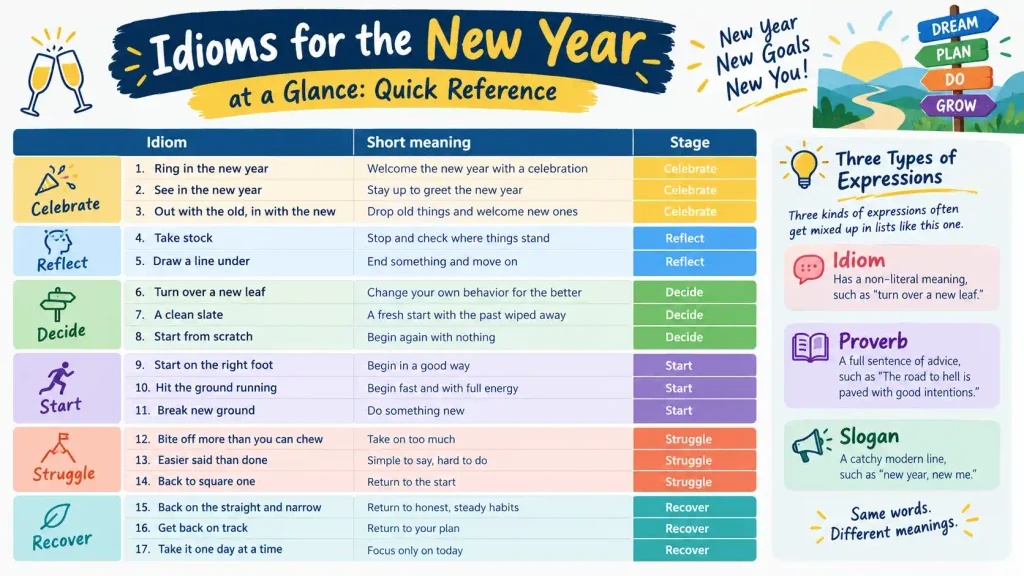
| Idiom | Short meaning | Stage |
| Ring in the new year | Welcome the new year with a celebration | Celebrate |
| See in the new year | Stay up to greet the new year | Celebrate |
| Out with the old, in with the new | Drop old things and welcome new ones | Celebrate |
| Take stock | Stop and check where things stand | Reflect |
| Draw a line under | End something and move on | Reflect |
| Turn over a new leaf | Change your own behavior for the better | Decide |
| A clean slate | A fresh start with the past wiped away | Decide |
| Start from scratch | Begin again with nothing | Decide |
| Start on the right foot | Begin in a good way | Start |
| Hit the ground running | Begin fast and with full energy | Start |
| Break new ground | Do something new | Start |
| Bite off more than you can chew | Take on too much | Struggle |
| Easier said than done | Simple to say, hard to do | Struggle |
| Back to square one | Return to the start | Struggle |
| Back on the straight and narrow | Return to honest, steady habits | Recover |
| Get back on track | Return to your plan | Recover |
| Take it one day at a time | Focus only on today | Recover |
Three kinds of expressions often get mixed up in lists like this one. An idiom has a non literal meaning, such as “turn over a new leaf.” A proverb is a full sentence of advice, such as “The road to hell is paved with good intentions.” A slogan is a catchy modern line, such as “new year, new me.”
Celebrate: Idioms for the New Year at Midnight
Three phrases cover the midnight party: “ring in the new year,” “see in the new year,” and “out with the old, in with the new.”
Ring in the new year
Meaning: to welcome the new year, usually at midnight. Use: upbeat. It fits greetings, speeches, and photo captions. Origin: Alfred, Lord Tennyson wrote “Ring out the old, ring in the new” in In Memoriam A.H.H. (1850). The poem mourns his friend Arthur Henry Hallam, who died in 1833. Ringing bells at the turn of the year is an old custom. Example: We rang in the new year with soup and board games at Grandma’s house.
See in the new year
Meaning: to stay awake until midnight so you can greet the new year. Use: neutral. It works in casual talk and in writing. Origin: no confirmed source. Example: We stayed up on the beach to see in the new year.
Out with the old, in with the new
Meaning: get rid of what is old and welcome what is fresh. Use: cheerful and playful. It fits cards, cleaning days, and business changes. Origin: the idea matches Tennyson’s line above, but no source I checked ties the short form directly to him, so treat any firm claim with care. Example: Out with the old, in with the new! I finally threw away my torn sneakers.
Reflect: Idioms for the New Year Before You Plan
Two phrases help you pause before you plan: “take stock” and “draw a line under.”
Take stock
Meaning: to stop and think about where things stand. Use: neutral. It suits work reviews, journals, and year-end talks. Origin: generally linked to shops, where owners count the goods on their shelves. Those goods are called “stock.” Example: Before you set goals, take stock of what went well this year.
Draw a line under
Meaning: to end something and stop dwelling on it. Use: neutral to a little formal. You often see it in news and work writing. Origin: often traced to drawing a line under a column of numbers to close the sum. That link is common but not confirmed. Example: Let’s draw a line under last year’s mistakes and move on.
Decide: Idioms for the New Year Resolutions
Three phrases describe the choice to begin again: “turn over a new leaf,” “a clean slate,” and “start from scratch.”
Turn over a new leaf.
Meaning: to change how you act, for the better. Use: positive. It works for resolutions, school, and work. Origin: here “leaf” means a book page, not a tree leaf. Geoffrey Chaucer’s Canterbury Tales uses “turn over the leaf” in the Miller’s Prologue to mean flipping a page. Roger Ascham’s The Scholemaster (1570) is often cited for an early figurative use of “turn a new leaf.” Sources disagree on the exact first record, so avoid any “first ever use” claim. A popular story that is wrong: the phrase does not come from autumn leaves. The book page meaning is the documented one. Example: After failing the first quiz, Ravi turned over a new leaf and studied every night.
A clean slate
Meaning: a fresh start with past mistakes wiped away. Use: positive. It fits forgiveness, new jobs, and moves. Origin: often linked to writing slates, which could be wiped blank. This story is common, but I could not confirm a dated source, so treat it as likely rather than proven. Example: The new coach gave every player a clean slate.
Start from scratch
Meaning: to begin from the very start, with nothing built yet. Use: neutral. It can sound happy (baking) or painful (losing your work). Origin: often linked to the “scratch” line in old races, though this isn’t confirmed. Example: When the file was lost, we had to rebuild the budget from scratch.
Start: Idioms for the New Year Momentum
Three phrases describe a strong first few weeks: “start on the right foot,” “hit the ground running,” and “break new ground.”
Start on the right foot.
Meaning: to begin in a careful, good way. Use: positive. Teachers and managers use it often. Origin: sometimes linked to old luck beliefs about stepping with the right foot first, though this is not confirmed. Example: A short planning meeting helped us start the year on the right foot.
Hit the ground running.
Meaning: to start a task fast, with full energy. Use: casual and positive. It fits jobs and projects. Origin: unclear. Some stories point to soldiers jumping from moving vehicles, but the history isn’t settled. Example: She read the handbook early so she could hit the ground running on Monday.
Break new ground
Meaning: to do something new that few people have done. Use: positive and a little formal. It suits science, art and business. Origin: usually explained as a farmer plowing land that was never worked before. Example: This year I’m breaking new ground by learning to swim.
Struggle: Idioms for the New Year Slump
Resolutions often slip by February, and these phrases describe the bumps: “bite off more than you can chew,” “easier said than done,” and “back to square one.”
Bite off more than you can chew
Meaning: to take on too much. Use: casual. It works as a gentle warning. Origin: no confirmed source. Example: I signed up for three classes and a marathon. I think I bit off more than I could chew.
Easier said than done
Meaning: simple to talk about, hard to carry out. Use: casual and often a bit ironic. Origin: no confirmed source. Example: “Just wake up at five,” he said. That’s easier said than done.
Back to square one
Meaning: to return to the start and lose your progress. Use: negative and casual. Origin: disputed. Board games are a common guess, but this isn’t confirmed. Example: The server crashed, so we’re back to square one.
Recover: Idioms for the New Year Comebacks
Three phrases help after a slip: “back on the straight and narrow,” “get back on track,” and “take it one day at a time.”
Back on the straight and narrow
Meaning: living honestly and following good habits again. Use: neutral and a little old-fashioned. It fits habits and behavior. Origin: commonly traced to the King James Bible (Matthew 7:14), which describes a gate that is “strait” and a narrow way. “Strait” means tight or confined. The spelling “straight” is now common too, and both forms appear in print. Example: After a rough year, he stayed on the straight and narrow.
Get back on track
Meaning: to return to your plan after a slip. Use: friendly and neutral. It works at work, at school, and in health talk. Origin: the image is usually said to be a train returning to its rails, though no source confirms this. Example: I missed the gym for two weeks, but I’m getting back on track.
Take it one day at a time.
Meaning: to focus on today only. Use: casual and comforting. People say it to friends. Origin: no confirmed source. Example: Learning a language is slow, so I take it one day at a time.
Idioms for the New Year Compared, Plus Common Mistakes
“Turn over a new leaf” is about changing your own behavior, “a clean slate” is about a wiped past, and “start from scratch” is about rebuilding from nothing.
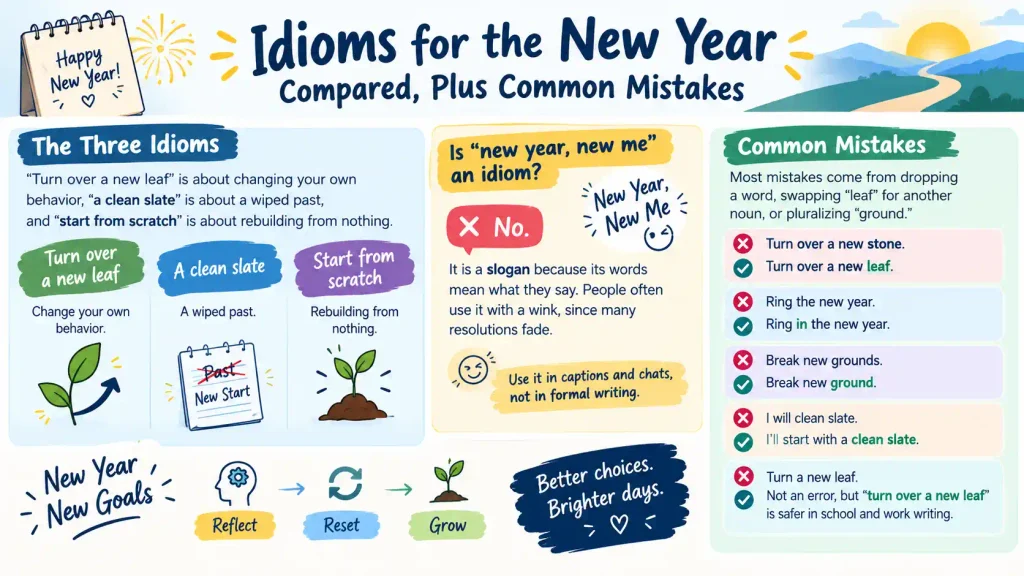
Is “new year, new me” an idiom?
No. It is a slogan because its words mean what they say. People often use it with a wink,since many resolutions fade. Use it in captions and chats,not in formal writing.
Most mistakes come from dropping a word, swapping “leaf” for another noun, or pluralizing “ground.”
- “Turn over a new stone.” Wrong. The word is “leaf.”
- “Ring the new year.” A word is missing. Say “ring in the new year.”
- “Break new grounds.” The phrase uses the singular: “break new ground.”
- “I will clean slate.” “Clean slate” is a noun phrase. Say “I’ll start with a clean slate.”
- “Turn a new leaf.” Not an error. It appears in older sources, but “turn over a new leaf” is safer in school and work writing.
Quick Practice: Idioms for the New Year Quiz
Fill each blank with a phrase from this page. Answers are below.
- We stayed up late to ______ the new year ______.
- After the crash, we had to rebuild the site ______.
- I’m trying to ______ over a new leaf this year.
- Three jobs and a degree? You may ______ off more than you can chew.
- Skipping a week put me ______ to square one.
Answers: 1. see / in (or ring / in). 2. from scratch. 3. turn. 4. bite. 5. back.
FAQs About Idioms for the New Year
What does “turn over a new leaf” mean, and where does it come from?
It means to start behaving in a better way. The “leaf” is a book page, not a tree leaf. Chaucer used a related phrase for flipping a page, and Roger Ascham’s 1570 book is often cited for an early figurative use.
Why do we say “ring in the new year”?
Most likely because bells were traditionally rung at the turn of the year. Tennyson’s poem In Memoriam A.H.H. (1850) made the image famous, though the exact start of the custom is hard to date.
Conclusion: Idioms for the New Year in Your Own Year
You now have 17 phrases that match the real path of a resolution: celebrating, reflecting, deciding, starting, wobbling and recovering. Pick two or three that fit your own year. Say them out loud, and use them in a text or a goal list this week. If you want more, try our lists of idioms for new beginnings and idioms about perseverance.
To read more: Idioms for Fire: 30 Powerful Phrases with Easy Examples