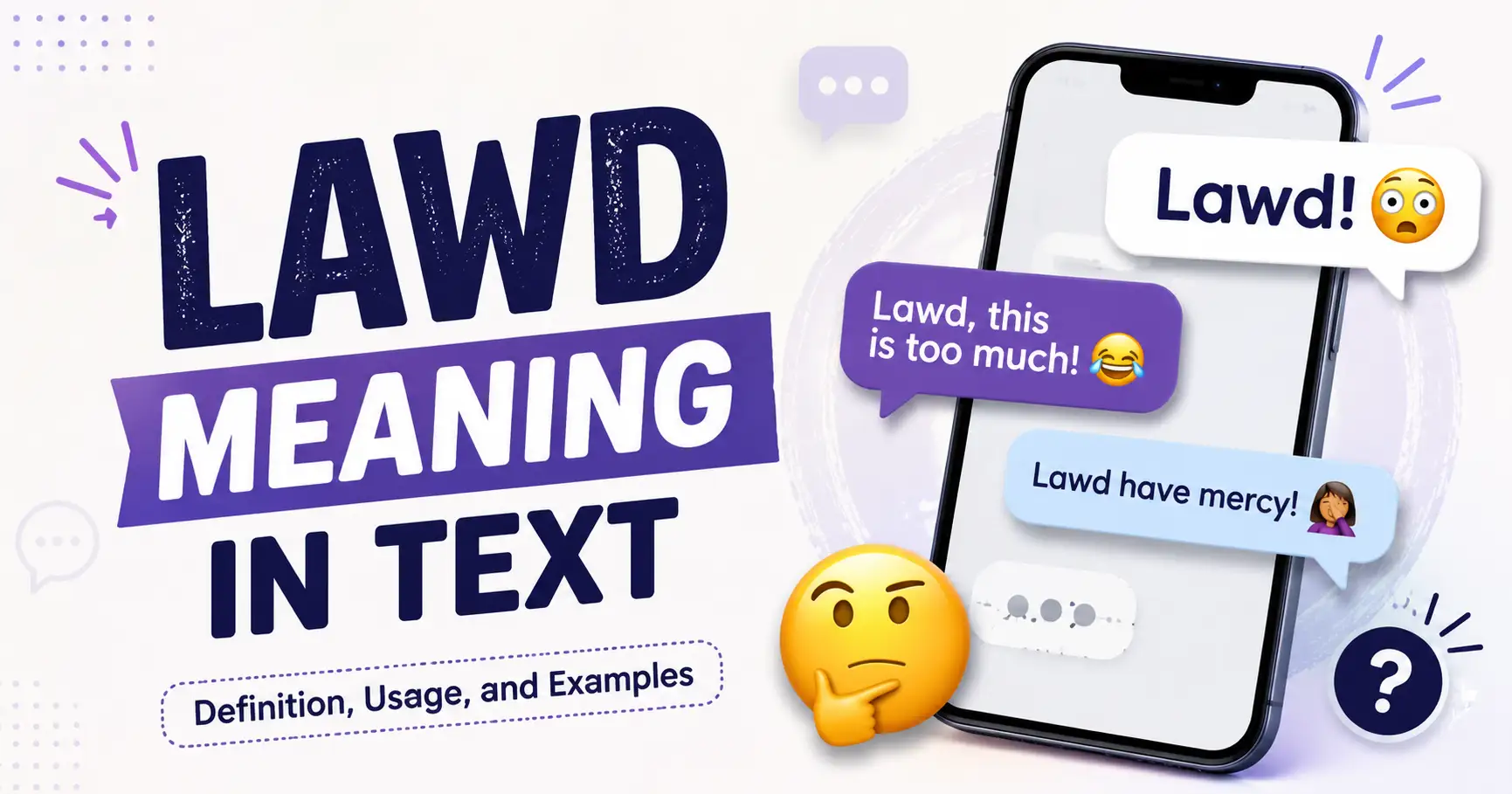
LAWD means “Lord.” It’s a non standard spelling of the word “Lord,” and people use it as an interjection in texts, comments, and captions. If you’re searching for the lawd meaning in text, here’s the short answer: it’s a dialect based way of writing “Lord” to show strong emotion, not a new word or a secret code.
This spelling is not a random internet invention. It’s a phonetic way of writing “Lord,” matching how it sounds in certain dialects. This includes African American Vernacular English (AAVE) and some Southern US accents.If you’ve seen “LAWD” in a text and wondered what it means, you’re in the right place. This guide covers the definition, the origin, how to say it out loud, and how people actually use it in real conversations.
Quick note before we go further: LAWD is also used as an unrelated acronym in a few technical fields, like “Linked Ancient World Data” in academic research. That’s not what this article covers. Here, we’re talking about LAWD, the texting slang term.
What Does LAWD Mean in a Text?
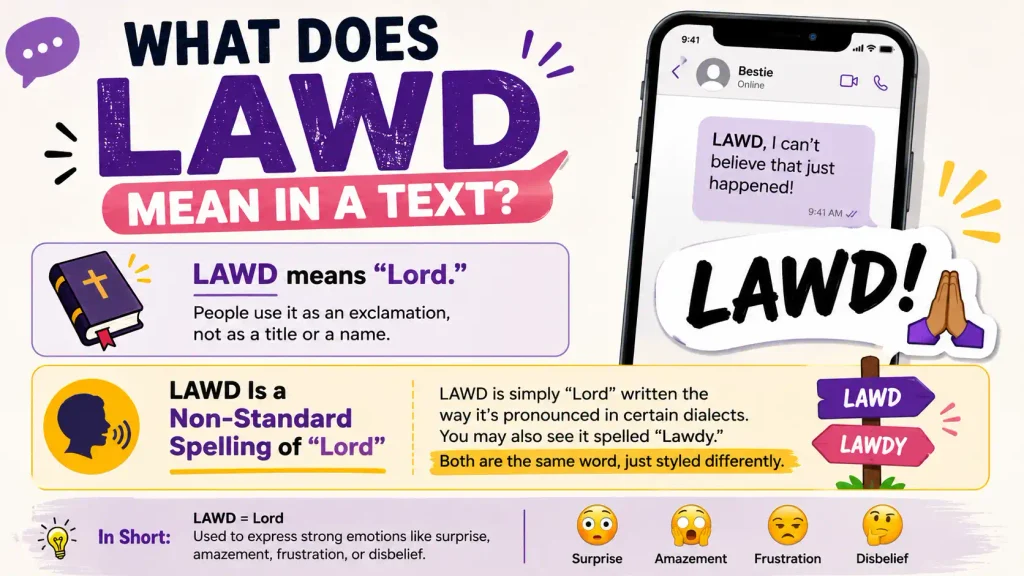
LAWD means “Lord.” People use it as an exclamation, not as a title or a name.
LAWD Is a Non-Standard Spelling of “Lord”
LAWD is simply “Lord” written the way it’s pronounced in certain dialects. You may also see it spelled “Lawdy.” Both are the same word, just styled differently.
Part of Speech: Why LAWD Is an Interjection, Not an Acronym
LAWD works as an interjection, a word that shows strong feeling, like surprise, shock, or frustration. It often stands alone, usually followed by an exclamation point.
Here are three quick examples:
- “LAWD!”
- “Oh LAWD.”
- “LAWD, that was close.”
Not to Be Confused With: Other Meanings of “LAWD”
In some technical and academic spaces, LAWD is used as an acronym. It can stand for things like “Linked Ancient World Data” or “Laser Absorption Wave Deposition.” These meanings have nothing to do with texting slang. If you saw LAWD in a text or on social media, the slang meaning of “Lord” is almost certainly what was meant.
How Do You Pronounce LAWD?
LAWD is pronounced the same as “Lord.” In IPA, a system linguists use to show sounds, it’s written as /lɔːd/.
IPA and Phonetic Breakdown (/lɔːd/)
Say the word “Lord” out loud. That’s how you say LAWD. Definitions powered by Oxford Languages confirm this pronunciation matches the standard word “Lord.”
How the Spelling Reflects the Pronunciation
The “aw” in LAWD captures how “Lord” sounds in certain accents. This spelling writes speech exactly how it’s heard.
Where Does LAWD Come From? (Origin & Etymology)
LAWD comes from two main sources. One is dialect pronunciation. The other, in some cases, is religious tradition.
The AAVE (African American Vernacular English) Connection
LAWD has strong roots in African American Vernacular English, also called AAVE. AAVE is a dialect of English with its own grammar, sounds, and vocabulary. LAWD reflects how “Lord” is often pronounced in this dialect.
The Southern US Dialect Theory
LAWD is also linked to Southern US accents. In many Southern dialects, the vowel sound in “Lord” shifts slightly, and the spelling “LAWD” tries to capture that shift.
The “Avoiding the Lord’s Name in Vain” Theory
Some people believe LAWD started as a way to avoid writing “Lord” directly. In certain Christian traditions, writing that word too casually is seen as disrespectful. This idea is widely repeated online, but it works better as a folk explanation than a proven fact.
The Deeper Etymology of “Lord”
The word “Lord” has a long history. It comes from the Old English word hlāford, which traces back to Proto-Germanic roots meaning “bread-giver” or “master.” Over hundreds of years, the spelling and sound changed until it became the modern English word “Lord.”
LAWD Before Texting: Its Pre-Digital History
LAWD is not a texting invention. People used this spelling in speech and writing long before smartphones existed, especially in Southern and African American communities. Texting didn’t create LAWD; it just gave the word a new place to live.
How Is LAWD Actually Used in Texts and Online?
LAWD is mostly used to react to something. It can show shock, humor, worry, or disbelief, depending on the moment.
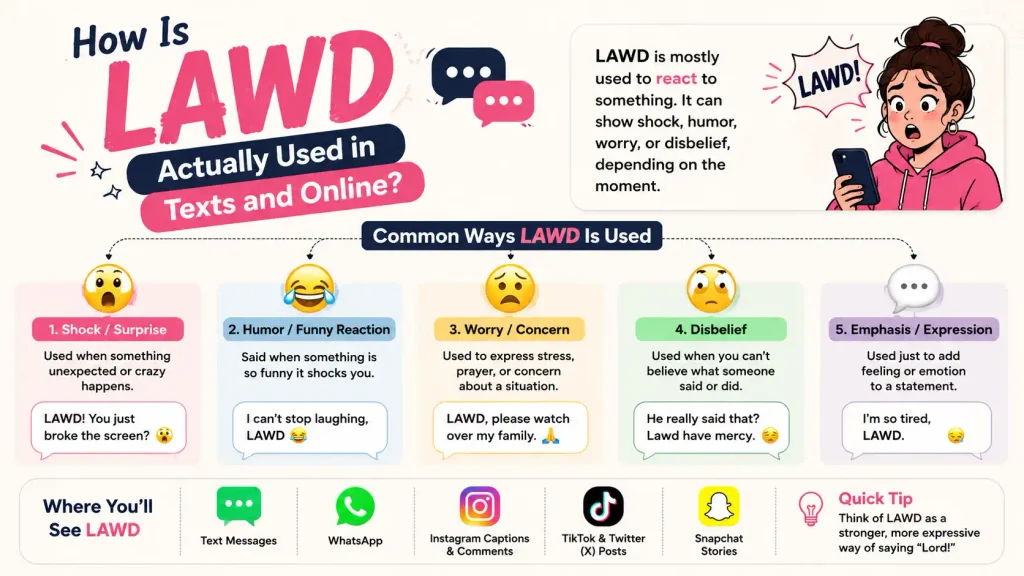
Is LAWD Sarcastic or Sincere?
This is the part most dictionaries skip. LAWD meaning in text can be completely sincere, or it can be dramatic and joking. The tone depends on the situation, not the word itself.
When I first came across “lawd” in a text, I honestly thought the person had just misspelled “Lord.” But after seeing it show up again and again in different conversations, I noticed a pattern. It almost always carried a playful, emotional tone, used to react to something surprising, funny, frustrating, or dramatic.
For example, I’ve seen “lawd” used in messages like, “Lawd, that was stressful!” or “Lawd, you look amazing!” In both cases, the word wasn’t formal or religious. It was adding emotion and making the conversation feel more casual.
From my own experience texting and scrolling through social media, lawd meaning in text depends a lot on who’s talking and what’s going on around it. A friend texting “lawd 😂” is probably just joking around. Someone typing “lawd, help me” is more likely overwhelmed or genuinely frustrated. That’s why I always read the whole conversation instead of assuming “lawd” means the same thing every time.
“Lawd” meaning in text feels more casual than writing out “Lord.” It shows up most where someone wants their reaction to sound bigger, funnier, or more dramatic. If someone sends me “lawd” on its own, I treat it as an emotional reaction first, then look at the messages around it to figure out what they mean.
A few clues that usually signal sarcasm or exaggeration:
- Extra letters, like “LAAAWD” or “LAWDDD”
- Crying-laughing emojis nearby
- All caps used for comedic effect
Clues that usually signal a sincere reaction:
- Short, simple use: “LAWD.”
- Paired with genuinely upsetting or shocking news
- No joking emojis attached.
In the end, LAWD meaning in text is less about a fixed dictionary definition and more about tone, context, and the emotion behind it.
LAWD as a Reaction to Something Dramatic or Surprising
People often type LAWD the moment something unexpected happens. It works like “Oh my gosh” or “No way”, short, quick, and easy to type mid-conversation.
LAWD on TikTok, Instagram, and Twitter/X
LAWD meaning in text, shows up often in comment sections, especially under funny videos, dramatic stories, or surprising posts. On these platforms, people often use it for comedic effect rather than as a serious reaction.
Sincere Use vs. Comedic, Exaggerated Use
LAWD carries two general uses. One is closer to its religious roots, a genuine expression tied to faith or reverence. The other is playful and exaggerated, used purely for humor or drama. Most everyday texting falls into this second category.
LAWD in a Sentence: Real Examples
Common Phrases
- Oh Lawd, expresses surprise or worry.
- Dear Lawd, often used before sharing bad or funny news.
- Lawd have mercy, a dramatic reaction to something big
- Lawd knows, means “who knows” or “nobody really knows”
- Good Lawd, shows shock, often lighthearted.
Example Text Conversations
Example 1:
- Gail: “Are you going to Jo’s party on Friday?”
- Helen: “LAWD no! I wouldn’t be caught dead there.”
Example 2:
- Reese: “Are you still seeing Terri?”
- Dee: “LAWD knows. I have no idea what’s going on in that guy’s head.”
Related Slang Terms You Should Know
LAWD belongs to a small family of “Lord”-based text abbreviations, often used in similar situations.
| Abbreviation | Meaning |
| LHM | Lord have mercy |
| OML | Oh my Lord |
| ODL | Oh dear Lord |
| PTL | Praise the Lord |
| TTL | Thank the Lord |
| TYLJ | Thank you Lord Jesus |
Frequently Asked Questions
What does LAWD meaning in a text?
LAWD is a phonetic, non-standard spelling of the word “Lord.” People use it as an interjection to express surprise, disbelief, exasperation, or strong emotion. It’s not an acronym in this context, just a dialect-based way of writing “Lord.”
Is LAWD sarcastic?
It can be either. LAWD is often used sincerely to express a genuine reaction, but people just as commonly use it ironically to exaggerate a small annoyance or dramatic moment. Emojis, extra letters, or all caps usually signal which meaning is intended.
Why do people spell it LAWD instead of LORD?
The spelling reflects how “Lord” is pronounced in African American Vernacular English (AAVE) and some Southern US dialects. It may also connect to avoiding writing “Lord” directly out of religious respect, though this origin is more folk theory than proven fact.
How do you pronounce LAWD?
LAWD meaning in text, is pronounced the same as “Lord,” written in IPA as /lɔːd/. Only the spelling changes to reflect a dialect pronunciation; the sound stays the same as the standard English word “Lord.”
What does “Oh Lawd” mean?
“Oh Lawd” is an exclamation that shows surprise, worry, or exasperation. It works much like saying “Oh my God” or “Oh no,” and people often use it as a lighthearted reaction to something unexpected.
What does LAWD stand for?
LAWD meaning in text, doesn’t stand for anything; it’s a spelling variant of “Lord,” not an acronym. A few unrelated technical fields use LAWD as an acronym, but that usage has no connection to texting or social media.
Is LAWD offensive?
No, LAWD is not inherently offensive. It’s common, widely used slang. Since it has roots in AAVE, it’s worth using thoughtfully and being aware of where it comes from, rather than treating it as generic internet speak.
The Bottom Line
The lawd meaning in text comes down to this: it’s a dialect-based spelling of “Lord,” carrying real history in AAVE and Southern speech, now living a second life in texts and comment sections.
The word hasn’t changed much over time. What’s changed is where you’re likely to run into it, and how fast people reach for it when something catches them off guard. Next time it shows up in your messages, you’ll know exactly what’s being said, and probably why.
To read more: YH Meaning in Text: The Easy Secret Explained in 2026

Digital Communication Writer
Focus: everyday texting slang, emoji meanings, casual chat abbreviations (NGL, LY, DND, etc.)
Bio angle: Grew up navigating group chats and social apps, explains slang the way it’s actually used, with real examples showing serious vs. joking vs. sarcastic tone.