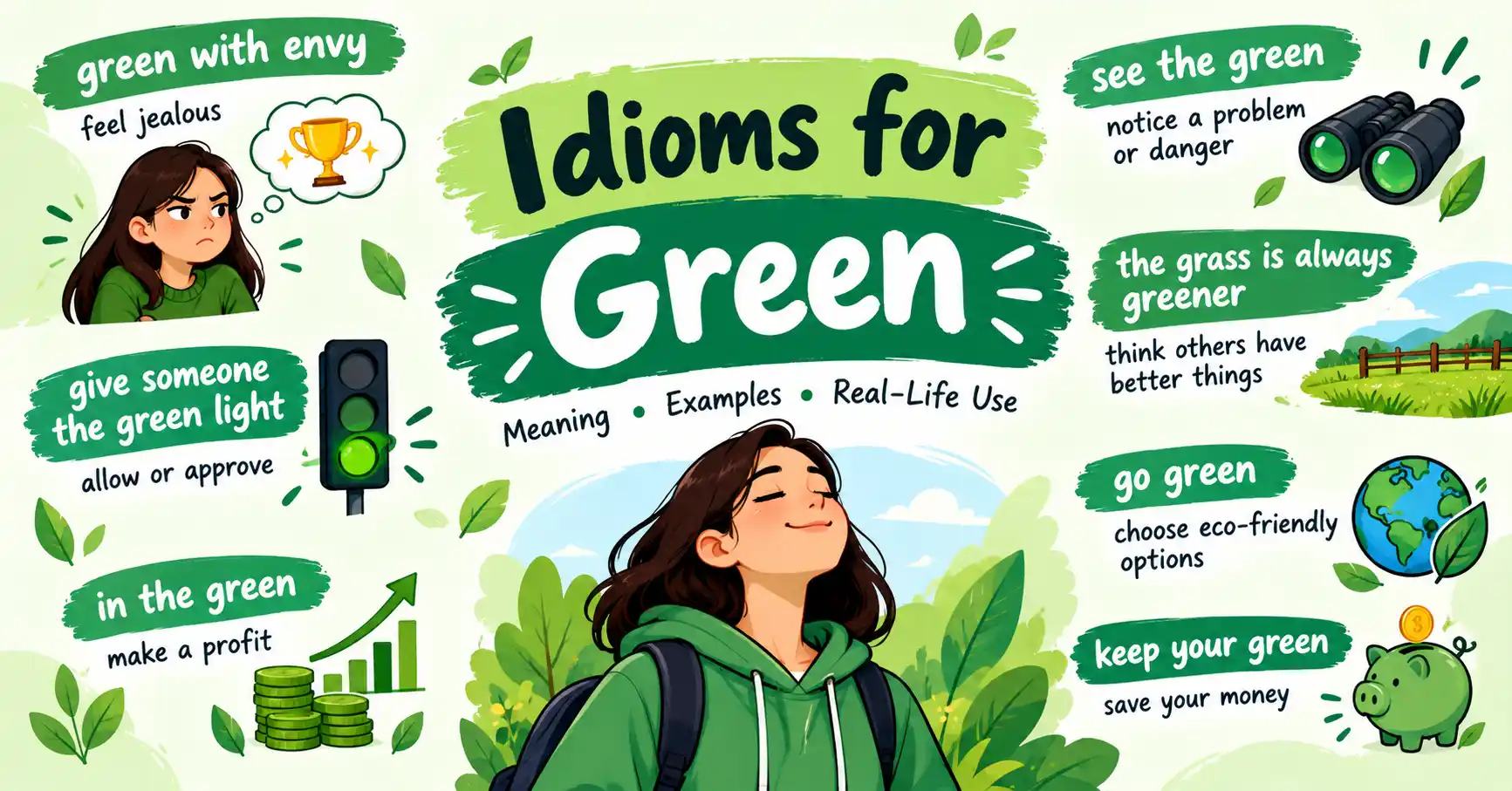
Idioms for green are fixed phrases that use one color to describe jealousy, inexperience, illness, and permission. This guide covers ten real expressions, each with its meaning, a sourced origin or date, a natural example, and a note on tone. Where no reliable origin exists, the guide says so instead of repeating a charming story.
You will also find a comparison table, a list of green phrases that only look like idioms, and the mistakes learners make most often. By the end, you will know which phrase fits which moment and which ones to leave alone.
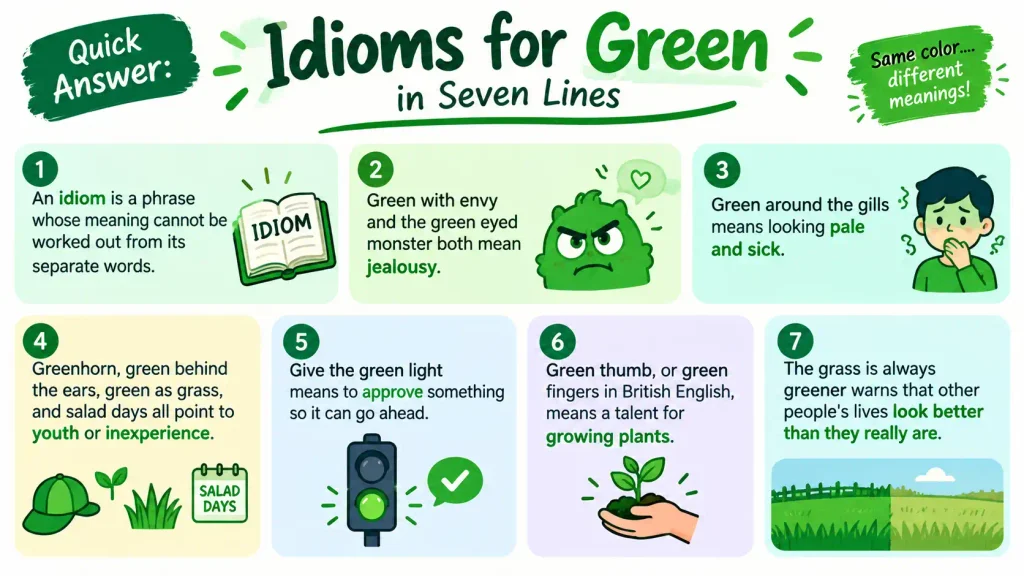
Quick Answer: Idioms for Green in Seven Lines
- An idiom is a phrase whose meaning cannot be worked out from its separate words.
- Green with envy and the green eyed monster both mean jealousy.
- Green around the gills means looking pale and sick.
- Greenhorn, green behind the ears, green as grass, and salad days all point to youth or inexperience.
- Give the green light means to approve something so it can go ahead.
- Green thumb, or green fingers in British English, means a talent for growing plants.
- The grass is always greener warns that other people’s lives look better than they really are.
Why Idioms for Green Mean So Many Things
Green covers so many meanings because the word began with living plants and then drifted in a few directions. Two main paths explain most of it.
Living plants → unripe → inexperienced → gullible
Living plants → sickly skin color → illness → envy
Chart description: green moving from plants to inexperience, and from plants to sickness and envy.
Etymonline dates the “sickly skin color” sense to the mid 1200s. The “unripe, so inexperienced” sense follows in the early 1300s. By about 1600, green could also mean easy to fool.
Envy joins the sickness path through old medical ideas. Early Greek thinkers blamed excess bile for illness and thought it tinted the skin green. That is one common explanation for the link, but no record proves it.
Two meanings sit outside both paths. The permission meaning comes from signal lights and is dated to 1937. The money meaning, as in “greenback,” is usually tied to the color of U.S. paper bills.
What Counts as Idioms for Green
An idiom is a phrase whose meaning cannot be figured out from its separate words. That rule is the filter for this list. If you can guess the meaning from the words alone, the phrase stays off. “Green space,” for example, is just a space with grass, so it does not make the cut.
Every entry below is a real, recorded expression. Where no clear origin exists, the article says so plainly. For a deeper look at the basics, read our guide on what an idiom is.
Idioms for Green About Jealousy and Sickness
The first two phrases in this group name feelings. The third describes how a person looks. Do not swap them: envy is an emotion, while the gills phrase is about the body. More phrases on this theme live in our jealousy idioms roundup.
Green with envy
- Meaning: Very jealous of someone else’s luck, looks, or success.
- Origin: The exact phrase appears in an 1853 novel by Henry William Herbert, according to Idiom Origins. That is the earliest use found so far. Shakespeare used related words much earlier, but not this exact phrase.
- Example: Half the class was green with envy when Omar won the school trip.
- Use it: Casual and a little teasing. The tone is negative, but light.
The green eyed monster
- Meaning: Jealousy, pictured as a creature that takes over a person.
- Origin: Portia speaks of “green-eyed jealousy” in The Merchant of Venice (about 1596). Then, in Othello (about 1604), Iago warns that jealousy is “the green eyed monster which doth mock the meat it feeds on.” You can compare other lines from the playwright in our Shakespeare idioms guide.
- Example: Dad joked that the green eyed monster showed up when my sister got the bigger bedroom.
- Use it: Literary and playful. It suits stories, speeches, and jokes.
Green around (or about) the gills
- Meaning: Looking pale and sick, often from nausea or fear.
- Origin: Not confirmed. It is often linked to the pale, greenish look of a sick face. No source settles it, so treat any single story as a guess.
- Example: After the boat ride, Tom looked green around the gills.
- Use it: Casual. It points to the body, not to a feeling like envy. Both “around” and “about” work.
Idioms for Green About Inexperience
This group follows the “unripe” branch from the opening section. Four expressions belong here, and all of them treat a person like fruit that needs more time.
Greenhorn
- Meaning: A person who is new to a job or place and still learning.
- Origin: In the mid-1400s, the word named a young horned animal. By about 1650, people used it for new soldiers. By the 1680s, it could mean any beginner, according to Etymonline.
- Example: The manager paired the new hire, a true greenhorn, with a patient mentor.
- Use it: Informal and a bit old fashioned. It can sting if you aim it at someone, so pick your audience.
Green behind the ears
- Meaning: Young, new, and not yet wise to how things work.
- Origin: Not confirmed. It looks like a cousin of “wet behind the ears,” which is often explained by newborn animals still damp after birth.
- Example: At twenty-two, she was still green behind the ears about office politics.
- Use it: Casual and mildly critical. It sounds gentler than calling someone clueless.
Green as grass
- Meaning: Naive and easy to fool.
- Origin: No clear origin found. The comparison is plain: fresh grass is young and new.
- Example: He was green as grass when he bought his first used car, and the seller knew it.
- Use it: Informal. “Greenhorn” is a noun for a newcomer, while “green as grass” is a description you add to a person.
Salad days
- Meaning: The carefree, youthful years of someone’s life.
- Origin: Documented. In Antony and Cleopatra (about 1606, Act 1, Scene 5), Cleopatra says, “My salad days, when I was green in judgment, cold in blood.” She is mocking her own foolish youth. Today the phrase usually sounds fond.
- Example: Grandpa loves telling stories about his salad days on the football team.
- Use it: Warm and slightly old-fashioned. The tone is positive.
Idioms for Green About Permission and Gardening
The last group covers approval, plant skill, and a warning about envy.
Give the green light.
- Meaning: To approve something so it can go ahead.
- Origin: Green and red railway signals are recorded in 1883. The “permission” meaning is dated to 1937, according to Etymonline.
- Example: Our boss gave the green light to the new work schedule.
- Use it: It works well in business writing. In a legal or formal document, a plainer word often fits better. Write “The board granted approval” instead of “The board gave the green light.”
Green thumb / green fingers
- Meaning: A natural skill with plants and gardening.
- Origin: Green thumb is recorded by 1938, according to Etymonline. A popular story ties it to the mythical Green Man, but the true source is unclear, so do not repeat that story as fact.
- Example: My aunt has a green thumb, and her tomatoes win at the county fair.
- Use it: Friendly and positive. Green thumb is mostly American, while green fingers is more common in British English. For related phrases, see our plant idioms guide.
The grass is always greener on the other side.
- Meaning: Other people’s lives look better than they really are.
- Origin: No firm date confirmed. The picture is easy to follow: a field across the fence looks fuller than your own.
- Example: Before you quit, remember that the grass is always greener on the other side.
- Use it: A gentle warning. Do not mix it up with “greener pastures.” That phrase names a truly better place or job, as in “She left for greener pastures in Toronto.”
Idioms for Green at a Glance
This table sets the ten expressions side by side, with meaning, tone, region, and earliest recorded date.
| Expression | Meaning | Typical tone | Region | Earliest date |
| Green with envy | Very jealous | Negative, light | General | 1853 (earliest found) |
| The green-eyed monster | Jealousy | Playful, literary | General | About 1604 (Othello) |
| Green around the gills | Pale and sick | Casual | General | Not confirmed |
| Greenhorn | A beginner | Informal, can sting | General | Mid 1400s (animal); 1680s (any beginner) |
| Green behind the ears | Young and inexperienced | Mildly critical | General | Not confirmed |
| Green as grass | Naive | Informal | General | Not confirmed |
| Salad days | Youthful years | Warm, positive | General | About 1606 |
| Give the green light | Approve | Neutral to positive | General | 1937 |
| Green thumb / green fingers | Skill with plants | Positive | Thumb: US. Fingers: UK | By 1938 |
| The grass is always greener | Envy of others’ lives | Mild warning | General | Not confirmed |
Tone labels show typical usage, not strict rules.
Phrases That Look Like Idioms for Green but Are Not
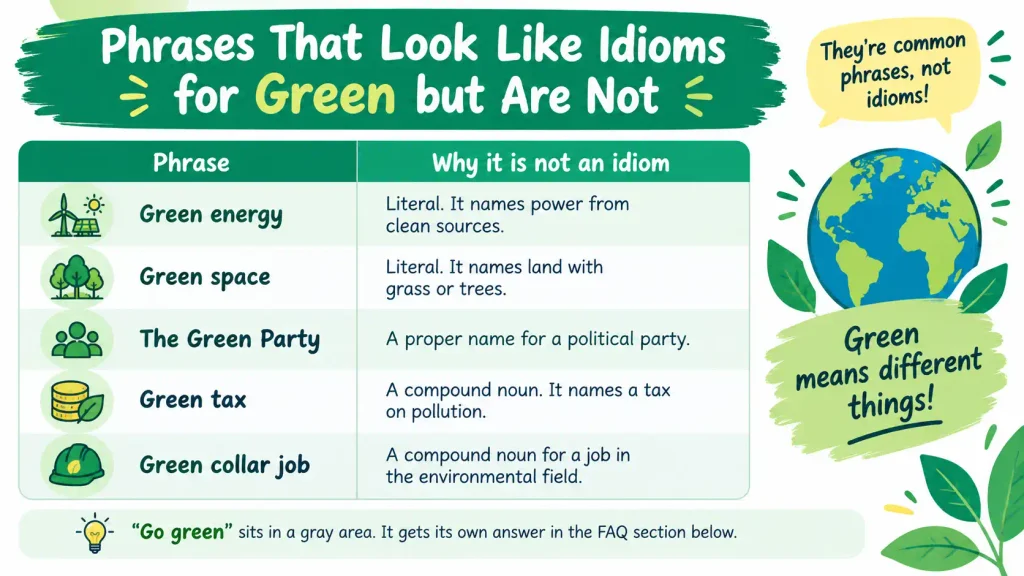
Green energy, green space, the Green Party, green tax, and green collar job are ordinary phrases, not idioms. Each one means just what its words say.
| Phrase | Why it is not an idiom |
| Green energy | Literal. It names power from clean sources. |
| Green space | Literal. It names land with grass or trees. |
| The Green Party | A proper name for a political party. |
| Green tax | A compound noun. It names a tax on pollution. |
| Green collar job | A compound noun for a job in the environmental field. |
“Go green” sits in a gray area. It gets its own answer in the FAQ section below.
Common Mistakes and Myths About Idioms for Green
The most common mistakes are mixing up envy and illness, changing fixed wording, and mistaking look-alike phrases.
| Mistake | Better version | Why |
| “I was so jealous I turned green around the gills.” | “I was so jealous I turned green with envy.” | Gills points to illness, not jealousy. |
| “After the ride, I felt green with envy” (meaning sick) | “After the ride, I felt green around the gills.” | Green with envy always means jealous. |
| “She has a green finger for roses.” | “She has green fingers” or “a green thumb.” | Both phrases are fixed. Use one thumb (US) or plural fingers (UK). |
| “He left for the grass is greener.” | “He left for greener pastures.” | Greener pastures names a better place. The grass saying is a full sentence. |
| “Shakespeare wrote ‘green with envy.'” | “Shakespeare wrote ‘green-eyed monster.'” | The exact phrase green with envy is first found in 1853. |
These are common confusion patterns, not survey results.
Three popular claims also fail to hold up or cannot be confirmed.
Myth 1: Shakespeare coined “green with envy.” He wrote “green eyed jealousy” and “green eyed monster.” The exact phrase “green with envy” is first found in an 1853 novel. The Shakespeare claim is repeated often, but it does not fit the record.
Myth 2: “Green light” dates to the early 1900s. Some sites say so. Railway signals date to 1883, and the “permission” meaning is dated to 1937.
Myth 3: “Green thumb” comes from the Green Man. It is a popular story. No source confirms it.
FAQs About Idioms for Green
Here are short answers to four common questions.
Why is green associated with jealousy? Shakespeare helped lock in the link when he wrote “green-eyed jealousy” (about 1596) and “green eyed monster” (about 1604). Old ideas about bile and sickly skin likely feel natural, though no record proves that path.
Why does “green light” mean permission? Green signals mean “go,” so the idiom borrows that message. Railway signals used green and red by 1883. The “approval” meaning is dated to 1937, per Etymonline.
What is the difference between green thumb and green fingers? There is no difference in meaning. Both name skill at growing plants. Green thumb is mostly American, and green fingers is more common in British English.
Is “go green” an idiom? Go green is a gray area. It is figurative, but most learners can guess its meaning: act in eco friendly ways. It works better as a common phrase than as a classic idiom.
Final Thoughts on Idioms for Green
Green carries many meanings, but most trace back to one idea: something young, unripe, or unwell. Check the tone before you use them, and watch for look alike phrases. For more color expressions, try our guide to red idioms or browse the full color idioms hub.
To read more: 25 Best Idioms About Art: Powerful Meanings & Examples

Digital Communication Writer
Focus: everyday texting slang, emoji meanings, casual chat abbreviations (NGL, LY, DND, etc.)
Bio angle: Grew up navigating group chats and social apps, explains slang the way it’s actually used, with real examples showing serious vs. joking vs. sarcastic tone.