Idioms for reading use words like book, page, and line to describe things that have nothing to do with reading. A phrase like “by the book” doesn’t involve holding a book at all. It means following rules exactly. That’s the pattern behind every idiom on this page.
Below, you’ll find clear meanings, honest origins, and example sentences you can reuse right away. You’ll also learn which idioms sound friendly, which sound harsh, and which ones get mixed up most often.
Quick Answer: Idioms for Reading and Loving Books
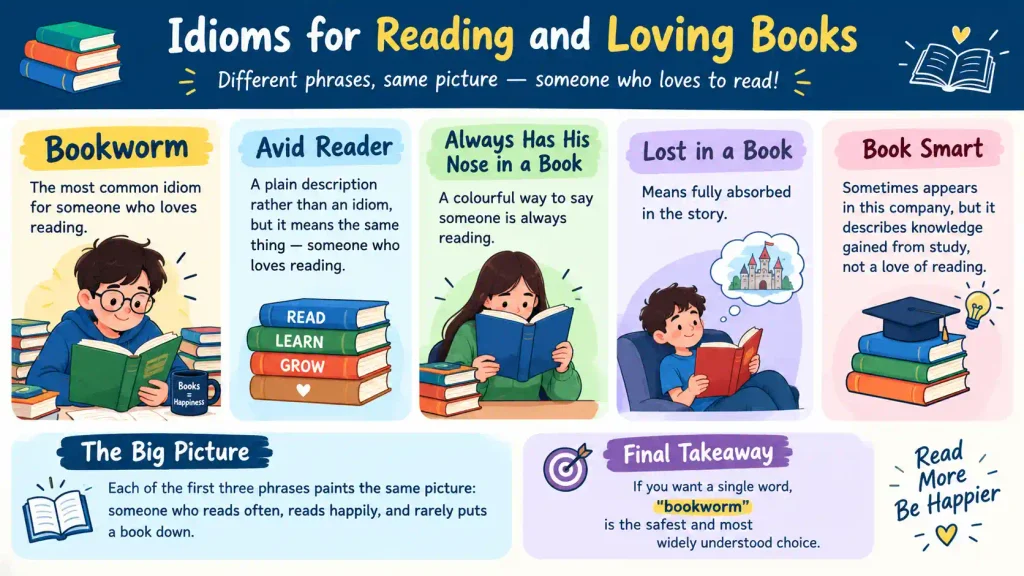
“Bookworm” is the most common idiom for someone who loves reading. People also say “avid reader,” which is a plain description rather than an idiom, or they say a person always has his nose in a book. Some say a reader is lost in a book, meaning fully absorbed in the story. The phrase “book smart” sometimes appears in this company, but it describes knowledge gained from study, not a love of reading. Each of the first three phrases paints the same picture: someone who reads often, reads happily, and rarely puts a book down. If you want a single word, “bookworm” is the safest and most widely understood choice.
What Are Idioms for Reading and Why Do They Matter?
Idioms for reading are phrases built from book and page images that stand for everyday actions, feelings, or judgments. A book has a cover, pages, and lines of text. English speakers borrowed those parts to describe real life, the same way they borrowed weather or sports imagery for other idioms. Once you spot the pattern, idioms for reading become easy to recognize and use correctly.
Grouping Idioms for Reading by Tone
Reading idioms fall into three tones: warm, harsh, and plain. Knowing which one you’re using matters. Some sound kind, others sound like a scolding, and a few are simply neutral and factual. Mixing up the tone can make a sentence land the wrong way, so here’s how to tell them apart.
Positive and Affectionate Idioms for Reading
Bookworm describes someone who loves to read.
- My daughter is a real bookworm. She finishes a new book every week.
- He’s such a bookworm that he brings a novel to every party.
An open book points to a person whose feelings are easy to read.
- My mom is an open book. I always know when something’s bothering her.
- Our new manager is an open book about her plans for the team.
Take a leaf out of someone’s book means to copy what another person does because it works well for them.
- You should take a leaf out of Sara’s book and start arriving earlier.
- I took a leaf out of my brother’s book and started saving more money.
A page-turner refers to a story so exciting you can’t put it down.
- The mystery novel was such a page turner that I finished it in one night.
- Ask her about that thriller. She says it’s a total page turner.
Hit the books means to study hard.
- I need to hit the books tonight before my math test.
- The new hire spent the weekend hitting the books to learn the software.
Lose yourself in a book means to become fully absorbed in a story.
- On rainy days, I love to lose myself in a book and forget my chores.
- My son loses himself in a book every night before bed.
Negative and Critical Idioms for Reading
A closed book refers to someone or something hard to understand.
- My new coworker is a closed book. Nobody knows much about him.
- His past is a closed book to me.
Cook the books means to falsify financial records.
- The manager was fired for cooking the books to hide the losses.
- Investigators found that the company had cooked the books for years.
Throw the book at someone means to punish someone as harshly as possible.
- The judge threw the book at the repeat offender.
- My boss threatened to throw the book at anyone late again.
In someone’s bad books describes being out of favor with someone.
- I forgot her birthday, so I’m in her bad books now.
- He’s in the boss’s bad books after missing the deadline.
To read someone the riot act means to scold someone sternly and warn them to stop. This one has real history behind it, which is covered below.
- Dad read us the riot act after we broke curfew.
- The coach read the team the riot act after they lost focus.
Neutral and Functional Idioms for Reading
By the book means following rules exactly.
- She always does things by the book, even when it slows her down.
- The teacher grades by the book, so read the instructions carefully.
Read the fine print means to check all the small details in a document.
- Always read the fine print before signing a loan.
- I read the fine print on the coupon and found extra fees.
Read between the lines means to notice a meaning that isn’t stated directly.
- She said she was fine, but I read between the lines and knew she wasn’t.
- Read between the lines of his email. He’s asking for help.
On the same page means agreeing or understanding something the same way.
- Let’s make sure we’re on the same page before the meeting starts.
- My husband and I are finally on the same page about the budget.
Read up on something means to study or research a topic.
- I read up on car insurance before buying a policy.
- Read up on the topic before class tomorrow.
Where These Idioms for Reading Come From
Most reading idioms come from everyday objects such as books, pages, and lines, shaped by centuries of English speech. A few trace back to real laws and old stories.
“Read the riot act” comes from a real law, not a story someone invented. In 1714, the British Parliament passed the Riot Act. It let officials read a formal warning to a large crowd, ordering people to disperse or face arrest. Anyone who stayed together for an hour after the warning could be punished, and officers could use force to break up the group. The law was repealed long ago, but the phrase stuck around. Word historians think it began as a figure of speech in the 1800s, though no one can confirm the exact date.
“Read my lips” became a household phrase in 1988, when George H. W. Bush said, “Read my lips: no new taxes” in his speech accepting the Republican presidential nomination. The idiom already meant “listen closely” before that speech, but the moment gave it new life in everyday conversation.
Not every reading idiom involves a book. “The writing on the wall,” a clear sign that something bad is coming, comes from a story in the Book of Daniel. Mysterious writing appears on a wall during a king’s feast and warns of his downfall. The phrase isn’t about books, but it shares the same reading theme as the rest of this list.
Books shaped English for centuries before smartphones and screens existed. As printed books became common in homes, pages, covers, and lines gave people an easy, shared image to build phrases from. That is likely why so many idioms borrow from reading.
Commonly Confused Idioms for Reading
These reading idioms sound alike but mean different things, and mixing them up is a common mistake for English learners.
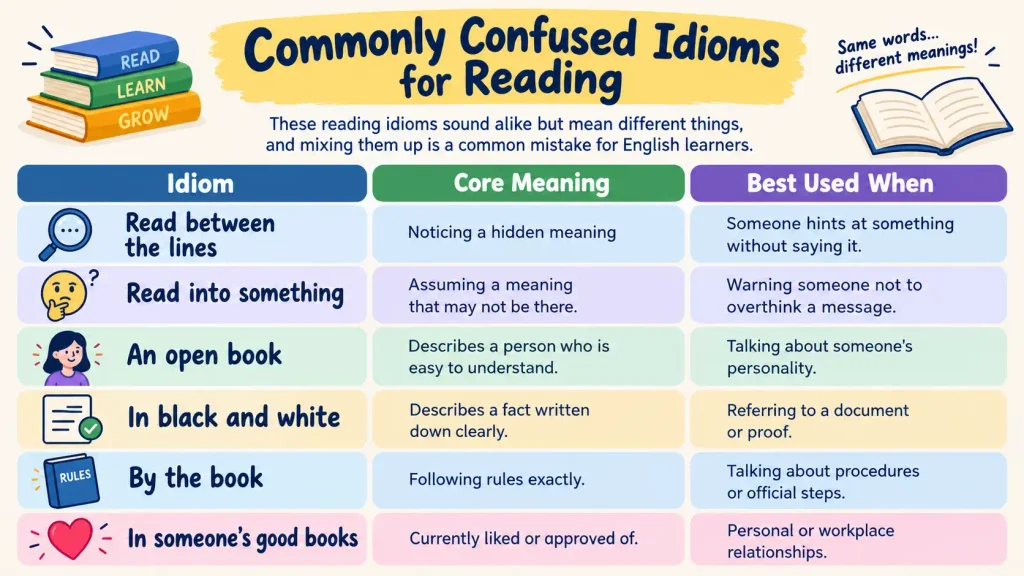
| Idiom | Core Meaning | Best Used When |
| Read between the lines | Noticing a hidden meaning | Someone hints at something without saying it |
| Read into something | Assuming a meaning that may not be there | Warning someone not to overthink a message |
| An open book | Describes a person who is easy to understand | Talking about someone’s personality |
| In black and white | Describes a fact written down clearly | Referring to a document or proof |
| By the book | Following rules exactly | Talking about procedures or official steps |
| In someone’s good books | Currently liked or approved of | Personal or workplace relationships |
Good books vs. bad books. These two phrases look almost identical but mean opposite things. “Good books” means someone approves of you. “Bad books” means you’ve upset them. One small word changes the whole meaning, so it’s easy to pick the wrong one by accident.
Read between the lines vs. read into something. Both involve guessing a hidden meaning, but they’re not twins. Reading between the lines usually means you caught something true that wasn’t said out loud. Reading into something often means you assumed too much, and your guess might be wrong. If a friend says, “Don’t read into it,” they’re telling you your guess is probably off.
An open book vs. in black and white. The first describes a person. The second describes a fact or a signed document. Learners sometimes swap these because both suggest something clear. But you wouldn’t call a contract “an open book,” and you wouldn’t call a chatty friend “black and white.”
Mistake to avoid: taking idioms literally. New learners sometimes picture the actual words. Nobody physically hits a book when they study, and nobody bakes anything when they “cook the books.” If a phrase sounds strange in a normal sentence, it’s probably an idiom, not an instruction.
Full List of Idioms for Reading: 30 Phrases at a Glance
Here’s every idiom from this guide, plus a few extras, in one quick-scan table.
| Idiom | Meaning | Example |
| Bookworm | Someone who loves reading | She’s been a bookworm since childhood. |
| An open book | Easy to understand emotionally | He’s an open book about his feelings. |
| Take a leaf out of someone’s book | To copy a good example | Take a leaf out of her book and plan ahead. |
| A page-turner | A gripping book that is hard to put down | This thriller is a real page-turner. |
| Hit the books | To study | I need to hit the books before finals. |
| Lose yourself in a book | To become fully absorbed | I lose myself in a book every weekend. |
| A closed book | Hard to understand | His past is a closed book to us. |
| Cook the books | To falsify financial records | They cooked the books to hide the debt. |
| Throw the book at someone | To punish severely | The judge threw the book at him. |
| In someone’s bad books | Out of favor | She’s in her boss’s bad books now. |
| In someone’s good books | In favor | He’s back in his mom’s good books. |
| Read the riot act | To scold sternly | Mom read us the riot act. |
| By the book | Following rules exactly | He always does his job by the book. |
| Read the fine print | To check small details | Read the fine print before you sign. |
| Read between the lines | To notice a hidden meaning | Read between the lines of her email. |
| On the same page | To agree or understand alike | We’re finally on the same page. |
| Read up on something | To research a topic | I read up on the new tax rules. |
| Read into something | To over-interpret | Don’t read into that comment. |
| In black and white | Clearly written down | It’s in black and white in the contract. |
| Turn over a new leaf | To start fresh | She turned over a new leaf this year. |
| A heavy read | A dense or difficult book | That history book was a heavy read. |
| A light read | An easy, relaxing book | I wanted a light read for the beach. |
| Read the room | To sense the mood of a group | He failed to read the room at the party. |
| Read someone’s mind | To know their thoughts | It’s like you read my mind! |
| Read someone like a book | To easily tell what they are thinking | I can read you like a book. |
| Crack a book | To start studying | I haven’t cracked a book all week. |
| Book smart | Knowledgeable from study but lacking practical skills | He’s book smart but bad with tools. |
| Don’t judge a book by its cover | Don’t judge by appearance | Don’t judge a book by its cover. She’s brilliant. |
| Off the books | Unofficial or undocumented | He paid the workers off the books. |
| In my book | In my opinion | In my book, honesty always wins. |
FAQs About Idioms for Reading
What does “read someone like a book” mean? It means you can easily tell what a person is thinking or feeling. It’s often used when someone’s expressions or habits give away their true mood. For example: “I could read him like a book. He was clearly nervous about the interview.”
What is the origin of “read the riot act”? The phrase comes from a real law passed by the British Parliament in 1714, called the Riot Act. Officials used it to read a formal warning to unruly crowds, ordering them to disperse. Over time, the phrase moved from law into daily speech and now describes any stern warning.
What is an idiom for someone who loves reading? “Bookworm” is the most common one. “Avid reader” and “always has their nose in a book” describe the same kind of person in slightly different words.
What’s the difference between being “in someone’s good books” and “in someone’s bad books”? Being “in someone’s good books” means they approve of you or are pleased with you. Being “in someone’s bad books” means the opposite: you’ve upset or disappointed them. The phrases sound alike but describe opposite situations, so double check which one fits before you use it.
Conclusion: Using Idioms for Reading Every Day
Reading idioms turns ordinary objects such as books, pages, and lines into shortcuts for real feelings and situations. Once you learn a few, patterns like “by the book” or “read between the lines” stop sounding strange and start feeling natural. Pay attention to tone, since a warm idiom like “bookworm” and a harsh one like “throw the book at someone” can’t be swapped without changing your meaning. Start with the idioms for reading that fit your daily conversations at school, work, or home, and the rest will come with practice.
To read more: Idioms for Sweet: 18 Essential Phrases, Meanings & Origins