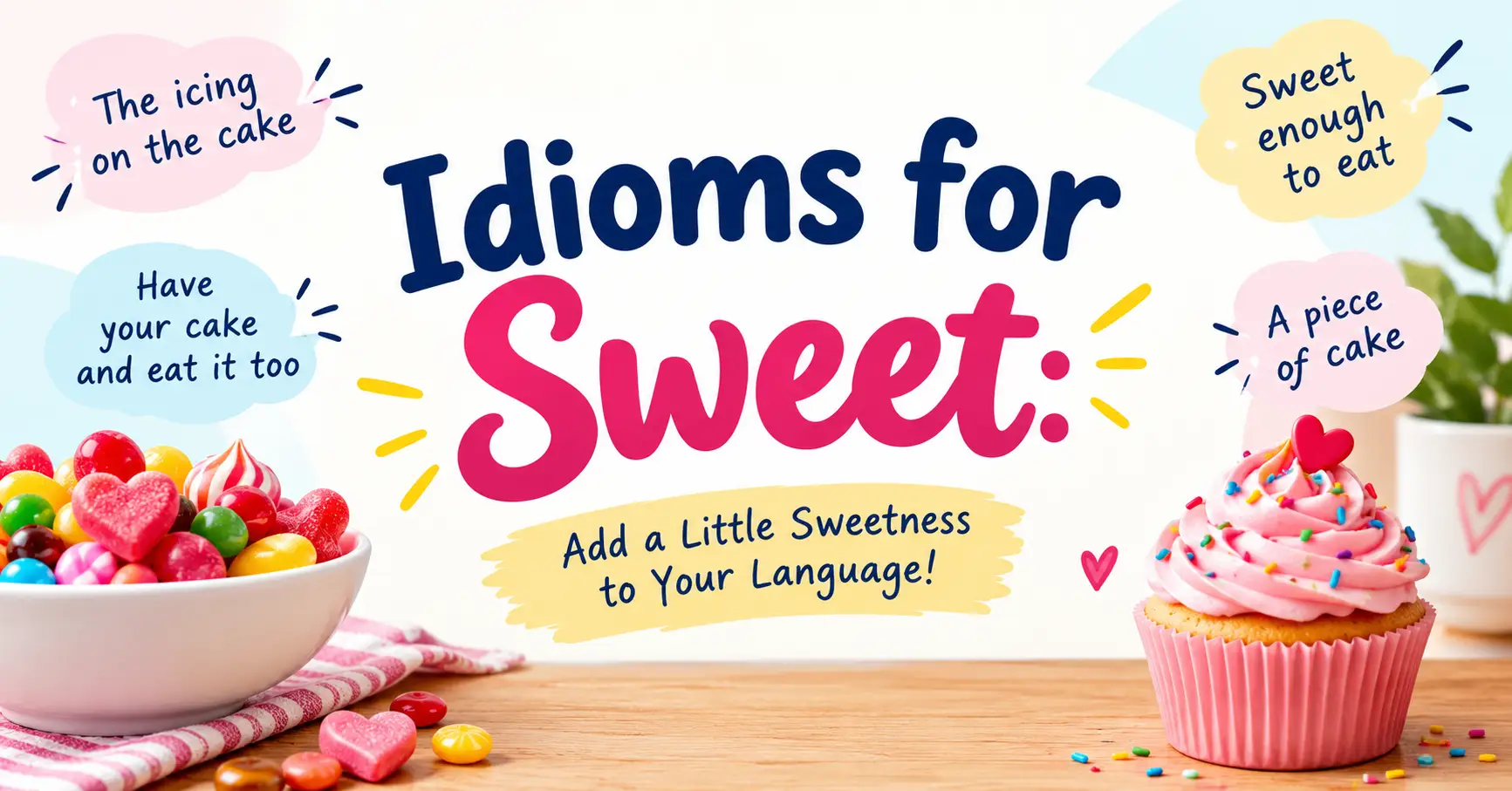
Idioms for sweet don’t always describe sugar or taste. Many describe a kind person, a good deal, or a satisfying moment, so the word stretches far beyond the kitchen. English speakers use it to praise someone’s personality, soften bad news, or celebrate a win, often without any food involved at all.
This guide sorts the most common sweet idioms by meaning, so you know exactly which one fits your situation. You’ll also get real origin stories where they exist, natural example sentences from work, school, and everyday life, and a list of mistakes learners make most often with this group of expressions.
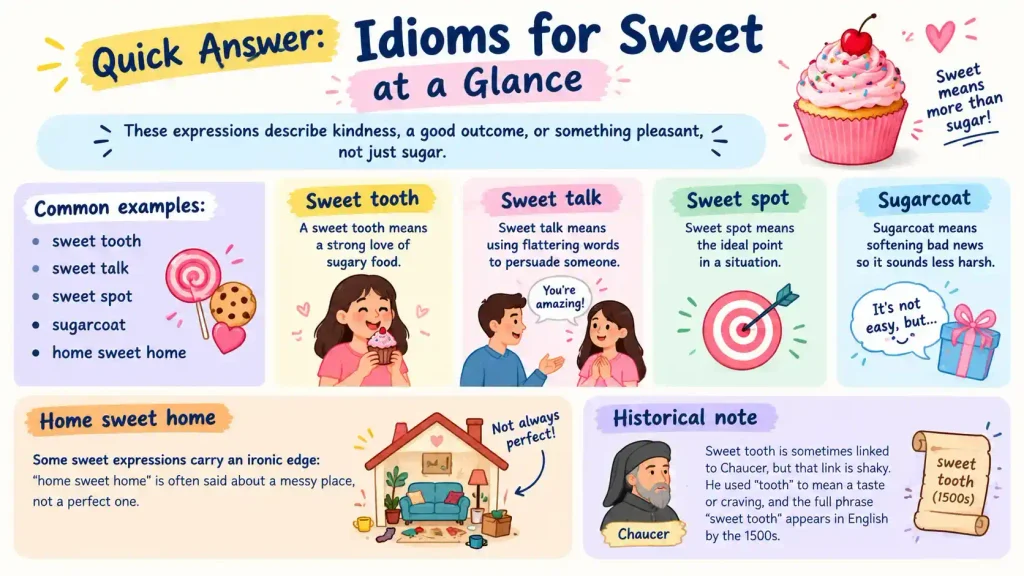
Quick Answer: Idioms for Sweet at a Glance
These expressions describe kindness, a good outcome, or something pleasant, not just sugar.
- Common examples: sweet tooth, sweet talk, sweet spot, sugarcoat, home sweet home.
- A sweet tooth means a strong love of sugary food.
- Sweet talk means using flattering words to persuade someone.
- Sweet spot means the ideal point in a situation.
- Sugarcoat means softening bad news so it sounds less harsh.
- Some sweet expressions carry an ironic edge: “home sweet home” is often said about a messy place, not a perfect one.
- Sweet tooth is sometimes linked to Chaucer, but that link is shaky. He used “tooth” to mean a taste or craving, and the full phrase “sweet tooth” appears in English by the 1500s.
What Do Idioms for Sweet Really Mean in English?
In idioms, sweet can describe a taste, a kind person, or an easy success, not just sugar. English speakers stretched this one word in two directions. One path stayed close to food: sugar, honey, candy, dessert. The other path moved toward feelings: kindness, comfort, and ease.
Almost every expression on this page falls into one of those two lanes. Once you notice the split, the whole list becomes much easier to remember. You’ll start to guess the meaning of a new sweet phrase just by asking which lane it fits.
Idioms for Sweet People and Personality
These expressions describe someone kind, gentle, or easy to like.
- As sweet as honey / as sweet as sugar: very kind or pleasant. My neighbor is as sweet as honey; she always waters my plants when I travel. A coworker might say it too: The new hire is as sweet as sugar, and she already knows everyone’s name.
- Sweet tempered: calm and gentle by nature. Their new puppy is sweet-tempered and never barks at strangers. Teachers use it about students as well: He’s a sweet-tempered kid who shares his snacks without being asked.
- Sweetheart: a term for someone you love or care about. He called his grandmother his sweetheart from the day he could talk. It also works outside family: The bus driver is a real sweetheart; he waits an extra minute if he sees you running.
- Be sweet on somebody: to have romantic feelings for someone. This one sounds old-fashioned now, so save it for casual or playful speech. Everyone at work can tell Marco is sweet on the new intern.
- All sweetness and light: pleasant and friendly, at least on the surface. She was all sweetness and light during the meeting, but her email afterward was harsh.
- Sweet-natured (or a sweet nature): a gentle, kind character that shows in everyday behavior. Despite the long shift, she kept her sweet nature and thanked every customer by name.
Idioms for Sweet Deals, Situations, and Outcomes
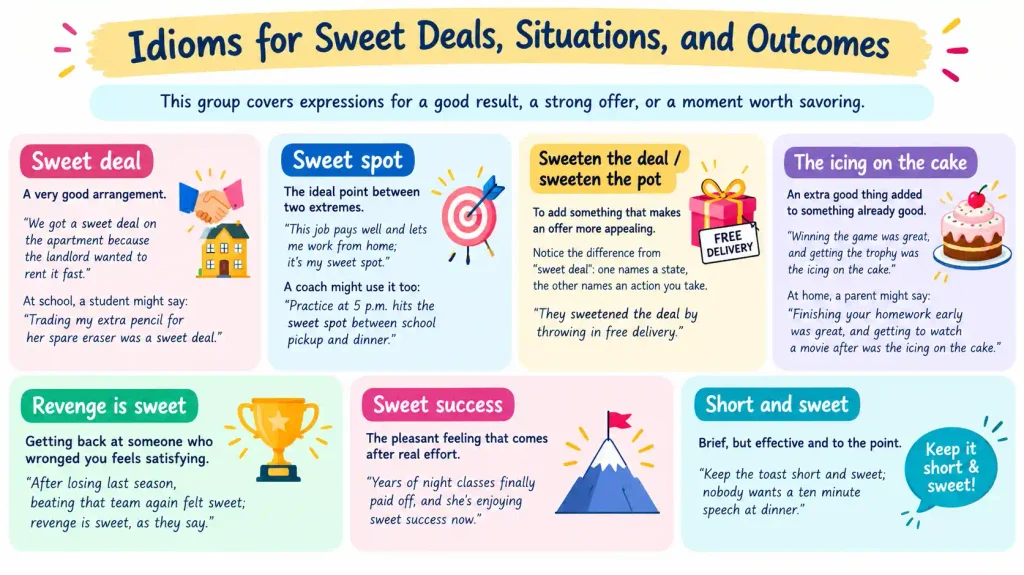
This group covers expressions for a good result, a strong offer, or a moment worth savoring.
- Sweet deal: a very good arrangement. We got a sweet deal on the apartment because the landlord wanted to rent it fast. At school, a student might say: Trading my extra pencil for her spare eraser was a sweet deal.
- Sweet spot: the ideal point between two extremes. This job pays well and lets me work from home; it’s my sweet spot. A coach might use it too: Practice at 5 p.m. hits the sweet spot between school pickup and dinner.
- Sweeten the deal / sweeten the pot: to add something that makes an offer more appealing. Notice the difference from “sweet deal”: one names a state, the other names an action you take. They sweetened the deal by throwing in free delivery.
- The icing on the cake: an extra good thing added to something already good. Winning the game was great, and getting the trophy was the icing on the cake. At home, a parent might say: Finishing your homework early was great, and getting to watch a movie after was the icing on the cake.
- Revenge is sweet: getting back at someone who wronged you feels satisfying. After losing last season, beating that team again felt sweet; revenge is sweet, as they say.
- Sweet success: the pleasant feeling that comes after real effort. Years of night classes finally paid off, and she’s enjoying sweet success now.
- Short and sweet: brief, but effective and to the point. Keep the toast short and sweet; nobody wants a ten minute speech at dinner.
Idioms for Sweet Talk and Flattery
This set covers ways of using kind or charming words to influence someone.
- Sweet talk: to persuade someone using flattering language. He tried to sweet-talk his way out of the parking ticket. At home, a child might try it too: She sweet-talked her dad into one more bedtime story.
- Sugarcoat: to make bad news sound gentler than it really is. Don’t sugarcoat it; just tell me if the project failed. A doctor’s office is another common setting: The nurse didn’t sugarcoat the wait time; she said it would be at least an hour.
- Honeyed words: flattering speech that often can’t be trusted. His honeyed words impressed the investors, but the numbers told a different story.
- Honey trap: a scheme that uses attraction to lure someone into a trap. The film’s plot centers on a spy caught in a honey trap.
- Sweeten someone up: to be extra nice to someone before asking for a favor. He brought coffee for the whole office before asking his boss for a day off, a classic way to sweeten someone up.
Sweet Talk vs. Sugarcoat vs. Honeyed Words: Idioms for Sweet Talk
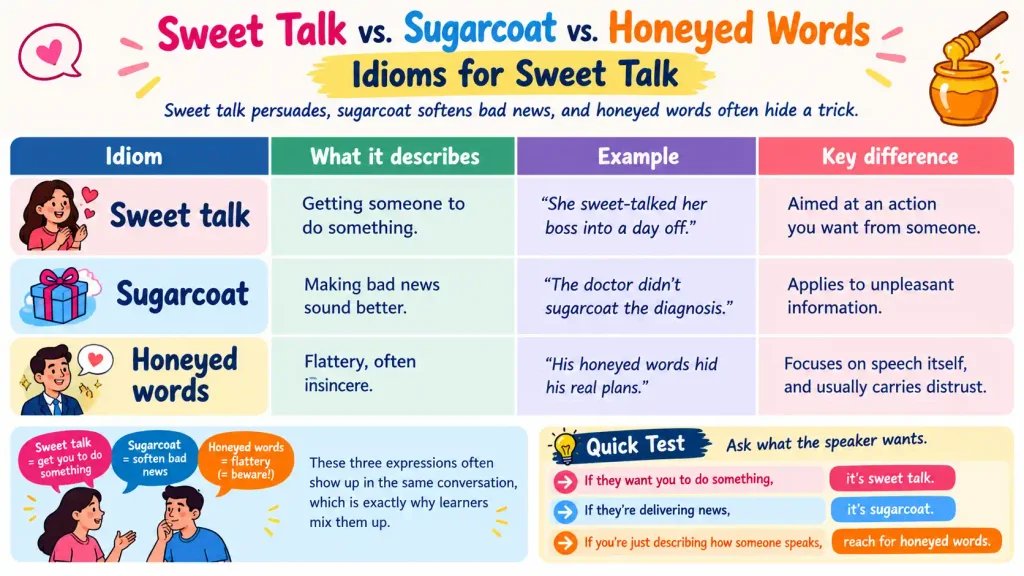
Sweet talk persuades, sugarcoat softens bad news, and honeyed words often hide a trick.
| Idiom | What it describes | Example | Key difference |
| Sweet talk | Getting someone to do something | She sweet-talked her boss into a day off. | Aimed at an action you want from someone |
| Sugarcoat | Making bad news sound better | The doctor didn’t sugarcoat the diagnosis. | Applies to unpleasant information |
| Honeyed words | Flattery, often insincere | His honeyed words hid his real plans. | Focuses on speech itself, and usually carries distrust |
These three expressions often show up in the same conversation, which is exactly why learners mix them up. A useful test is to ask what the speaker wants. If they want you to do something, it’s sweet talk. If they’re delivering news, it’s sugarcoat. If you’re just describing how someone speaks, reach for honeyed words.
When Idioms for Sweet Aren’t Actually Sweet (Tone and Connotation)
Some sweet expressions carry a sharp or ironic edge instead of real warmth.
- Home sweet home: often used sincerely, but also said with irony about a messy or chaotic place. We walked into the flooded kitchen and just sighed, “Home sweet home.”
- Sugarcoat: by definition, this points to something unpleasant underneath. If nothing bad happened, there’s no reason to use it.
- In your own sweet time: sounds gentle, but it’s usually a complaint about someone being slow. You finally called me back, in your own sweet time.
- Sweet on someone: playful when used between friends, but it can sound teasing or a little mocking if said in front of the person it describes.
Tone matters more than the dictionary definition here. A learner who only memorizes the literal meaning might use “home sweet home” at exactly the wrong moment, or miss the mild complaint hiding inside “in your own sweet time.” Reading the room before using these four phrases will save you from sounding confused, or worse, rude by accident.
Where Idioms for Sweet Come From (Real Origins, With Sources)
A few sweet expressions have real, documented histories, while others carry only guesses.
- Sweet tooth is often traced back to Geoffrey Chaucer in the 14th century, but that link isn’t solid. Chaucer used “tooth” to mean a taste or craving in general, not sugar specifically, and the full phrase “sweet tooth” shows up in English by the 1500s. The narrower, sugary meaning became dominant as sugar grew cheaper and more common in everyday cooking.
- A rose by any other name would smell as sweet comes from Shakespeare’s Romeo and Juliet. Juliet says this line to argue that a name doesn’t change what something truly is underneath. The full idea, not just the word “sweet,” has outlived the play and now shows up in arguments about labels and branding.
- Home sweet home began as a song lyric written by John Howard Payne in 1823 for the opera Clari, or the Maid of Milan. Most people today have never heard the opera, yet the line lived on long after it faded, eventually becoming a phrase stitched onto pillows and welcome mats.
- The sweet science is an old nickname for boxing, popularized in the early 1800s by the English sportswriter Pierce Egan. It praises the skill and control good boxers show rather than anything actually sweet about the sport.
- Keep someone sweet has no reliable documented origin. A few sites guess it started in the early 1900s, but that claim isn’t backed by any real source, so treat it as a guess, not a fact, until better evidence turns up.
Knowing these backstories does more than satisfy curiosity. It also helps you remember which phrases are old-fashioned and literary (like the Shakespeare line) and which ones stay casual and modern (like sweet spot), so you pick the right tone for the right moment.
Phrases That Look Like Idioms for Sweet but Aren’t (Quick Watch List)
A few phrases use the word sweet but have nothing to do with sweetness at all.
- Sweet on: describes romantic interest, not taste.
- The sweet science: a nickname for boxing, with no sugar involved.
- Sweet sixteen: marks a birthday, not a personality trait.
- You bet your sweet bippy: a playful, old-fashioned way to say “absolutely.” Here “sweet” is just a joking filler word.
- Sweet nothings: loving words whispered between partners, which are not actually “nothing.” Always use the plural.
Learners often assume every phrase with “sweet” points to kindness or taste, and that assumption trips them up here. Keep this short list nearby whenever a new sweet expression shows up in something you’re reading, and check it before guessing at the meaning.
Common Mistakes With Idioms for Sweet
The most common mistake is using one of these expressions in the wrong tone or grammar pattern.
- Saying someone “has a sweet tooth” to mean they’re kind. It only means they love sugary food. Try “sweet-tempered” for personality instead.
- Dropping “the” from “sweeten the deal.” Say “sweeten the deal,” not “sweeten deal.”
- Using “sugarcoat” for good news. This word only works when something negative is being softened.
- Writing “sweet for someone” instead of “sweet on someone” when talking about romantic interest.
- Using “sweet nothing” in the singular. The idiom is “sweet nothings,” so the singular will sound off to a native speaker.
- Using “the sweet science” outside of boxing. It doesn’t transfer to other sports, even ones that also require skill and timing.
FAQs About Idioms for Sweet
Is it “sweet tooth” or “sweet teeth”? The standard form is “sweet tooth,” even when you talk about several people: “They both have a sweet tooth.” You may occasionally see “sweet teeth,” but it sounds unusual to most native speakers, so stick with the singular.
What is the origin of “sweet tooth”? It is often tied to Chaucer, who used “tooth” for a general craving, but the exact origin of the full phrase isn’t proven. See the origins section above for the full story.
What does “keep someone sweet” mean? It means doing or saying nice things to keep someone happy with you, often so they’ll help you later. Its true origin isn’t documented, as explained in the origins section above.
What’s the difference between “sweet talk” and “sugarcoat”? Sweet talk aims to persuade someone toward an action, while sugarcoat softens the delivery of bad news. You sweet-talk a person into doing something; you sugarcoat a fact to make it easier to hear.
Can sweet expressions sound sarcastic? Yes, several of them do. “Home sweet home” and “in your own sweet time” often carry an ironic tone, said about a messy place or a slow response rather than something genuinely pleasant.
Related Idioms to Explore After Idioms for Sweet
If this list interested you, idioms for kind and idioms for bitter cover the emotional range on either side of it. For more food-based expressions, look for guides on idioms about bread, salt, and cooking. Each one follows the same pattern of everyday words stretching into feelings and situations.
Conclusion: Idioms for Sweet in Everyday English
Sweet expressions cover far more ground than sugar and candy. They describe kind people, good deals, flattering words, and even moments of quiet irony, all with one small word doing a lot of work. Once you know which group a phrase belongs to, picking the right one for your sentence gets much easier.
Pay close attention to tone before you use these phrases, since a few of them carry a hidden edge that the dictionary definition alone won’t show you. Try one of these expressions the next time you want to describe a kind friend, a good deal, or a piece of news you’d rather soften, and check back here whenever a new sweet phrase leaves you guessing.
To read more: Idioms for Music: 30 Powerful Phrases with Meanings

Digital Communication Writer
Focus: everyday texting slang, emoji meanings, casual chat abbreviations (NGL, LY, DND, etc.)
Bio angle: Grew up navigating group chats and social apps, explains slang the way it’s actually used, with real examples showing serious vs. joking vs. sarcastic tone.