
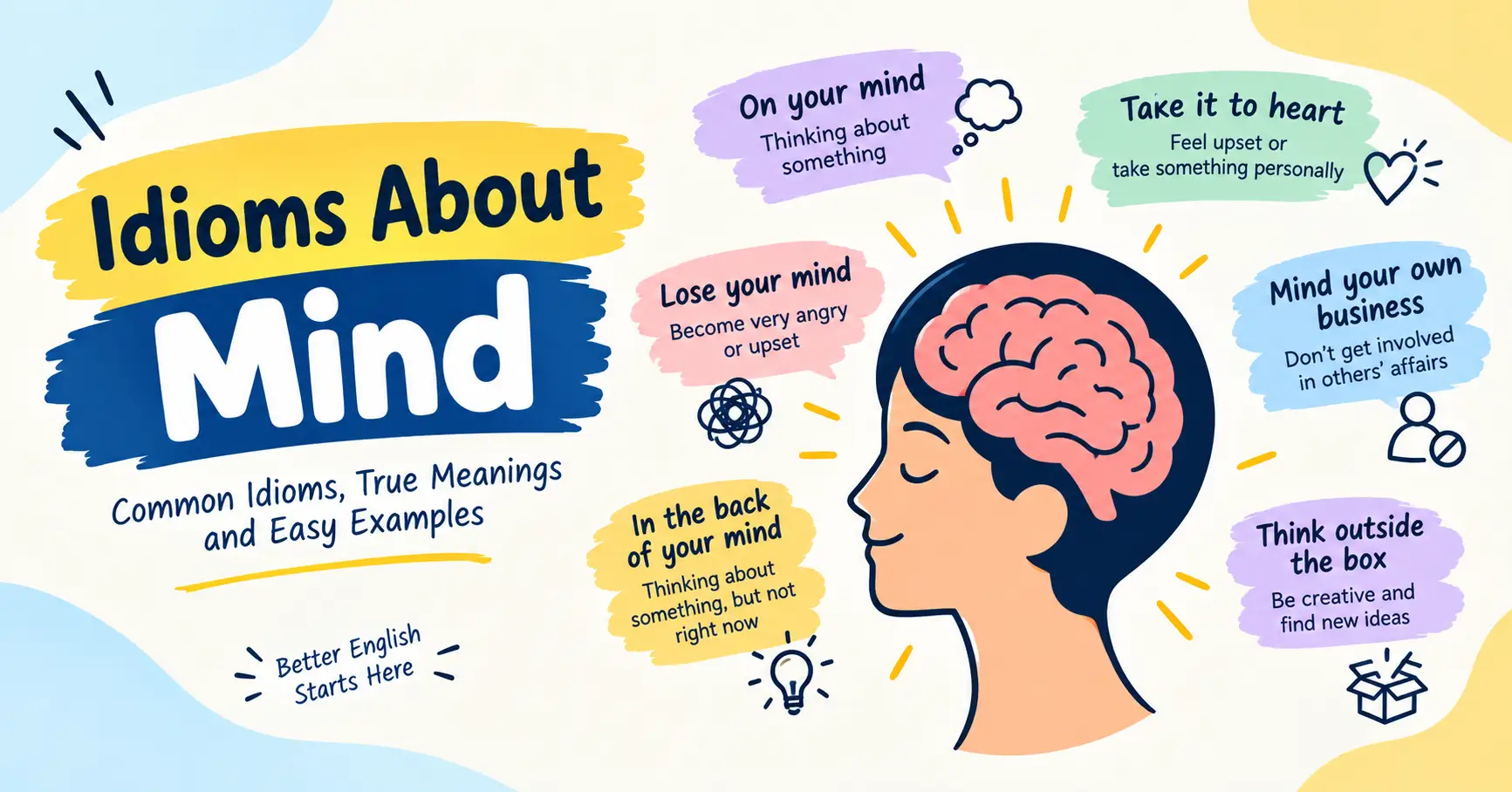
Idioms about mind are phrases that use the word “mind” to talk about thinking, deciding, remembering, or feeling shocked. English speakers use them every day, in casual chats and in formal writing. You’ll hear them at work when someone “speaks their mind,” and at home when a chore “slips your mind.”
This guide explains what these phrases mean, where some come from, and how to use them correctly. You’ll find real examples for work, school, and everyday conversation. You’ll also see common mistakes learners make and simple fixes for each one.
Quick answer: (Idioms About Mind)
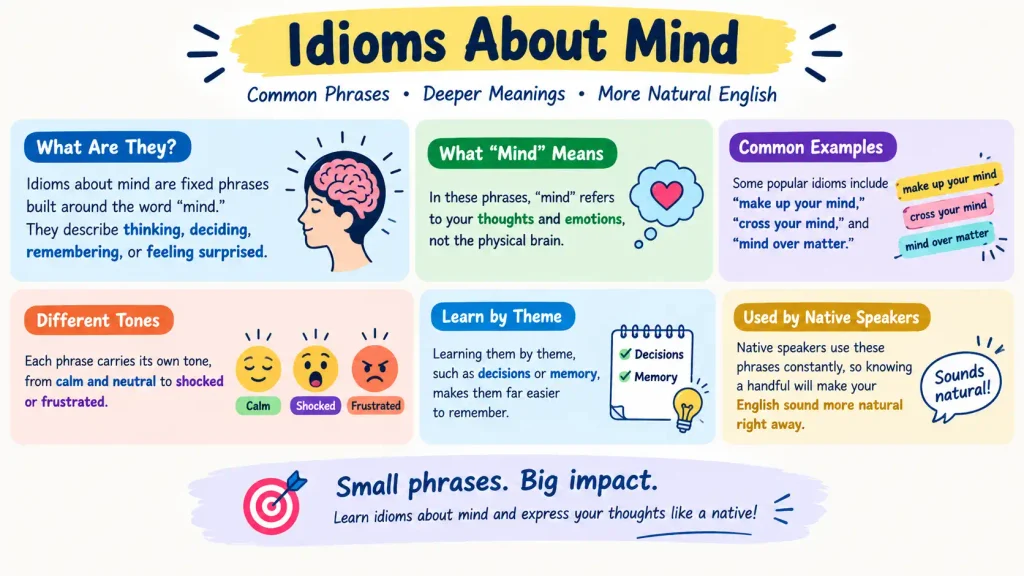
Idioms about mind are fixed phrases built around the word “mind.” They describe thinking, deciding, remembering, or feeling surprised. In these phrases, “mind” refers to your thoughts and emotions, not the physical brain. Common examples include “make up your mind,” “cross your mind,” and “mind over matter.” Each phrase carries its own tone, from calm and neutral to shocked or frustrated. Learning them by theme, such as decisions or memory, makes them far easier to remember. Native speakers use these phrases constantly, so knowing a handful will make your English sound more natural right away.
What Do Idioms About Mind Really Mean in English?
These phrases use “mind” to describe your thoughts, memory, and feelings, not the physical organ in your head.
English treats “mind” and “brain” as two separate ideas. The brain is a body part. You can scan it, study it, and see it in a diagram. The mind is the part of you that thinks, worries, decides, and remembers. That’s why we say “change your mind,” never “change your brain.”
Old English had a word close to “mind” that meant memory or thought. Over the centuries, speakers built dozens of idioms around this small word. Each one adds a slightly different shade of meaning. Some describe decisions. Others describe forgetting, shock, or willpower. Once you group them by theme, they get much easier to learn.
These phrases are also figurative, so you cannot read them word for word. When someone says a surprise “blew my mind,” nothing exploded. The speaker simply means the news was astonishing. Reading the phrase as a whole unit is the first step to using it well. It also helps to notice the grammar around the phrase, because most of these expressions need a possessive word such as “my,” “your,” or “her” that matches the person being discussed.
Idioms About Mind vs. Brain vs. Head: Which Family Do You Need?
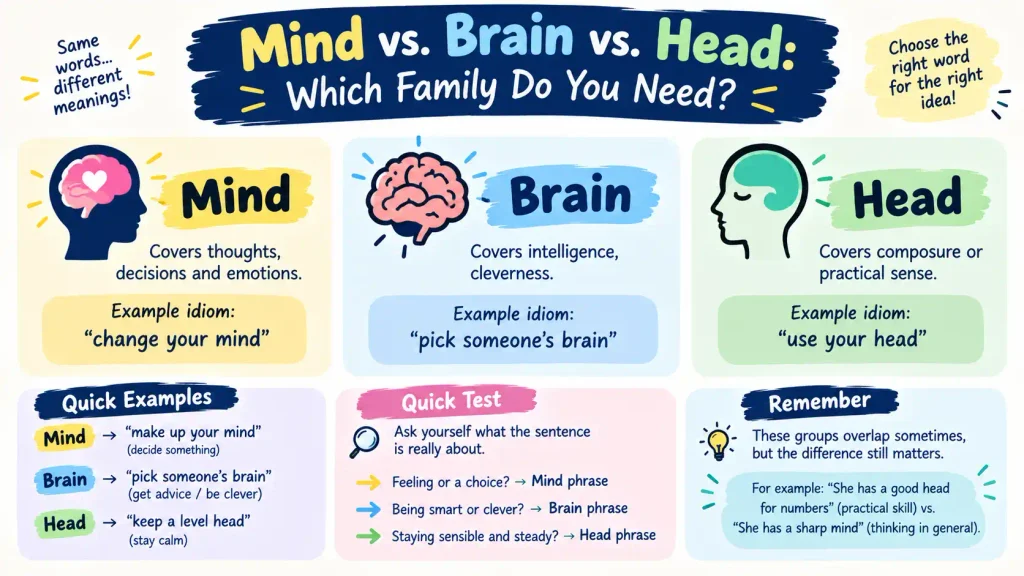
Mind idioms cover thoughts and decisions, brain idioms cover intelligence, and head idioms cover composure or practical sense.
English learners often mix up these three word families. They sound related, but each one does a different job in a sentence.
| Family | What it covers | Example idiom |
| Mind | thoughts, decisions, emotions | “change your mind” |
| Brain | intelligence, cleverness | “pick someone’s brain” |
| Head | composure, practical sense | “use your head” |
These groups overlap sometimes, but the difference still matters. If you want advice, you “pick someone’s brain.” If you stay calm in a crisis, you “keep a level head.” If you decide something, you “make up your mind.”
A quick test can help you choose. Ask yourself what the sentence is really about. If it’s about a feeling or a choice, reach for a mind phrase. If it’s about being smart or clever, use a brain phrase. If it’s about staying sensible and steady, use a head phrase. For example, “She has a good head for numbers” praises practical skill, while “She has a sharp mind” praises thinking in general.
Core Idioms About Mind With Real Examples
The phrases below fall into four simple groups: decisions, memory, shock, and willpower (including speaking up).
Tone matters as much as meaning. Some of these phrases are friendly and light, while others sound angry or stressed. “Great minds think alike” fits a joke with a friend, but “give someone a piece of your mind” would sound harsh in a polite email. Each example below includes a short label for work, school, family, or casual use, so you can see where the phrase sounds most natural.
Decision Making Idioms About Mind
Make up your mind means choosing something for the first time.
- Work: “She made up her mind to ask for a raise.”
Change your mind means switching a choice you already made.
- School: “He changed his mind about which college to attend.”
Have a mind to means feeling inclined to do something.
- Casual: “I have a mind to skip the gym today.”
Be of two minds means feeling unsure between two options.
- Work: “I’m of two minds about taking the new job. The pay is better, but the commute is longer.”
Make up your mind vs. change your mind: Use the first phrase when you’re deciding for the first time. Use the second when you’re switching a decision you already made. Example: “First I made up my mind to stay home. Then I changed my mind and went out.”
“Make up your mind” is also used as an impatient command. Example: “Just make up your mind, the waiter is waiting!”
Memory Idioms About Mind
Slip your mind means forgetting something by accident.
- Family: “Sorry, I forgot to call you back. It slipped my mind.”
Cross your mind describes a thought that passes through briefly.
- Work: “It crossed my mind that we might miss the deadline.”
Bear in mind or keep in mind asks someone to remember something important for later.
- School: “Keep in mind that the test covers chapter five.”
On your mind describes something you keep thinking about.
- Casual: “You’ve been on my mind all week.”
Bring to mind means to remind you of something.
- Casual: “That song brings to mind our trip to the coast.”
At the back of your mind describes a thought you hold quietly without focusing on it.
- Family: “I kept the deadline at the back of my mind all week.”
These phrases sound similar, but the feeling behind each one is different. “Slip your mind” is neutral and often apologetic. “Cross your mind” is quick and passing. “On your mind” is a thought that stays and keeps coming back.
Shock, Sanity & Intensity Idioms About Mind
Blow your mind describes something that shocks or amazes you. The tone is usually positive and excited.
- Casual: “The concert blew my mind.”
Out of your mind describes acting crazy or feeling extremely worried. With a word like “joy,” it can also mean overjoyed. The tone is negative or intense.
- Work: “He was out of his mind with stress before the presentation.”
Lose your mind describes becoming extremely frustrated or overwhelmed. The tone is negative.
- Family: “I nearly lost my mind trying to assemble that crib.”
Boggle the mind describes something hard to understand or believe. The tone is neutral, often mixed with surprise.
- School: “The size of the universe boggles the mind.”
You can also use the adjective “mind-blowing.” Example: “The view from the summit was mind-blowing.”
Willpower, Resolve & Speaking Up: Idioms About Mind
Mind over matter describes using willpower to overcome a physical problem.
- Casual: “She finished the marathon on mind over matter alone.”
This phrase has a documented origin. It appeared in an 1863 book by geologist Sir Charles Lyell, The Geological Evidence of the Antiquity of Man, where it described the growing role of intelligence over long stretches of time, not personal willpower. Over time, the meaning shifted. Today it means personal grit and determination. A similar line appears much earlier in Virgil’s Aeneid, often translated as “mind moves matter.” Whether this Latin line directly shaped the English phrase isn’t fully confirmed, but the connection is worth knowing.
Presence of mind describes staying calm and thinking clearly during an emergency.
- Work: “He had the presence of mind to call for help right away.”
Speak your mind describes saying exactly what you think.
- Work: “She always speaks her mind in meetings.”
Give someone a piece of your mind describes telling someone you’re angry with them, directly and firmly.
- Family: “I gave my neighbor a piece of my mind about the noise.”
Great minds think alike is said when two people land on the same idea. The tone is playful and positive.
- Casual: “You ordered pizza too? Great minds think alike!”
Common Mistakes With Idioms About Mind
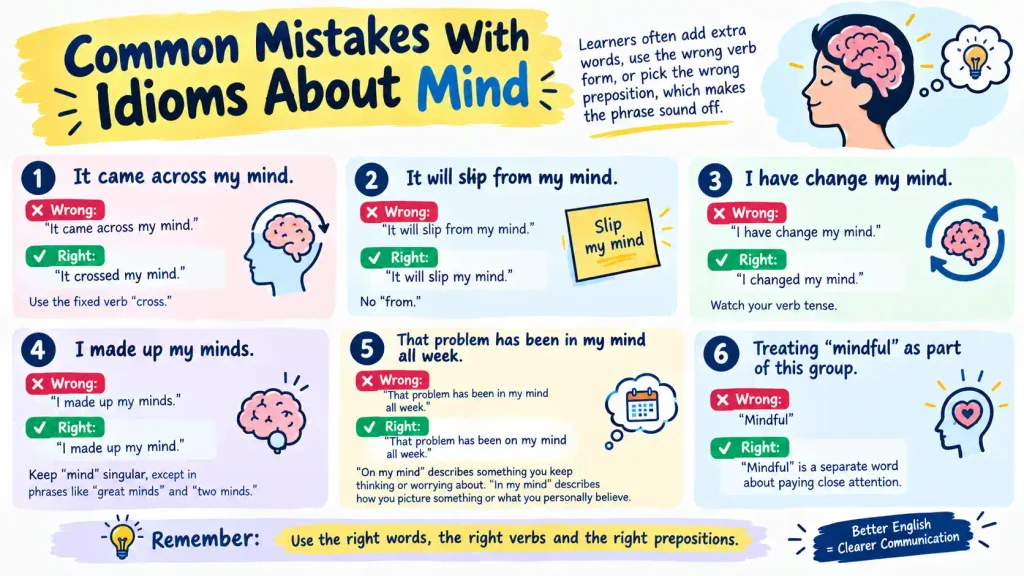
Learners often add extra words, use the wrong verb form, or pick the wrong preposition, which makes the phrase sound off.
- Wrong: “It came across my mind.” Right: “It crossed my mind.” Use the fixed verb “cross.”
- Wrong: “It will slip from my mind.” Right: “It will slip my mind.” No “from.”
- Wrong: “I have change my mind.” Right: “I changed my mind.” Watch your verb tense.
- Wrong: “I made up my minds.” Right: “I made up my mind.” Keep “mind” singular, except in phrases like “great minds” and “two minds.”
- Wrong: “That problem has been in my mind all week.” Right: “That problem has been on my mind all week.” “On my mind” describes something you keep thinking or worrying about. “In my mind” describes how you picture something or what you personally believe.
- Wrong: treating “mindful” as part of this group. “Mindful” is a separate word about paying close attention.
A simple habit can prevent most of these errors. When you learn a new phrase, copy the whole sentence into a notebook, not just the phrase itself. That way you also save the verb, the possessive, and the preposition that go with it.
Idioms About Mind: Frequently Asked Questions
What’s the difference between “make up your mind” and “change your mind”?
“Make up your mind” means deciding something for the first time. “Change your mind” means switching a decision you already made. You make up your mind once, then you might change it later.
What is the origin of “mind over matter”?
The phrase appeared in an 1863 book by geologist Sir Charles Lyell, who used it to describe the growing role of intelligence over time. The meaning later shifted toward personal willpower, which is how we use it today. A similar idea appears much earlier in Latin, in Virgil’s Aeneid, though a direct link between the two isn’t fully confirmed.
What are the differences between brain and mind idioms?
Brain idioms describe intelligence, like “pick someone’s brain” or “rack your brain.” Mind idioms describe thoughts, decisions, and feelings, like “change your mind” or “cross your mind.” The brain is a body part; the mind covers your thinking and emotions.
What does “give someone a piece of your mind” mean?
It means telling someone exactly what you think, usually because they upset you. It’s a direct, sometimes blunt way to complain. Example: “She gave the driver a piece of her mind after he cut her off.”
How can I learn these phrases faster?
Group them by theme, such as decisions, memory, and shock. Learn two or three at a time, write one sentence for each, and use them in real conversations during the week.
Final Thoughts on Idioms About Mind
Idioms about mind show up everywhere in spoken English, from casual talk with friends to serious moments at work. Learning them by theme makes them stick faster than memorizing a random list. Start with a few from each group above, then use them in your own sentences this week. The more you practice, the more natural they’ll feel.
Once these phrases feel familiar, head idioms and brain idioms are the natural next step. Try “use your head” and “keep a level head,” then “pick someone’s brain” and “rack your brain.” Reading short stories, watching sitcoms, and listening to podcasts are easy ways to hear these expressions in context, and every new example you notice will strengthen your memory of the phrase. You can also explore memory idioms in English, common English idiom mistakes, and how tone and connotation help you match the right phrase to the right mood.
To read more: 24 Idioms About Storms Explained: Powerful Meanings & Origins

Digital Communication Writer
Focus: everyday texting slang, emoji meanings, casual chat abbreviations (NGL, LY, DND, etc.)
Bio angle: Grew up navigating group chats and social apps, explains slang the way it’s actually used, with real examples showing serious vs. joking vs. sarcastic tone.