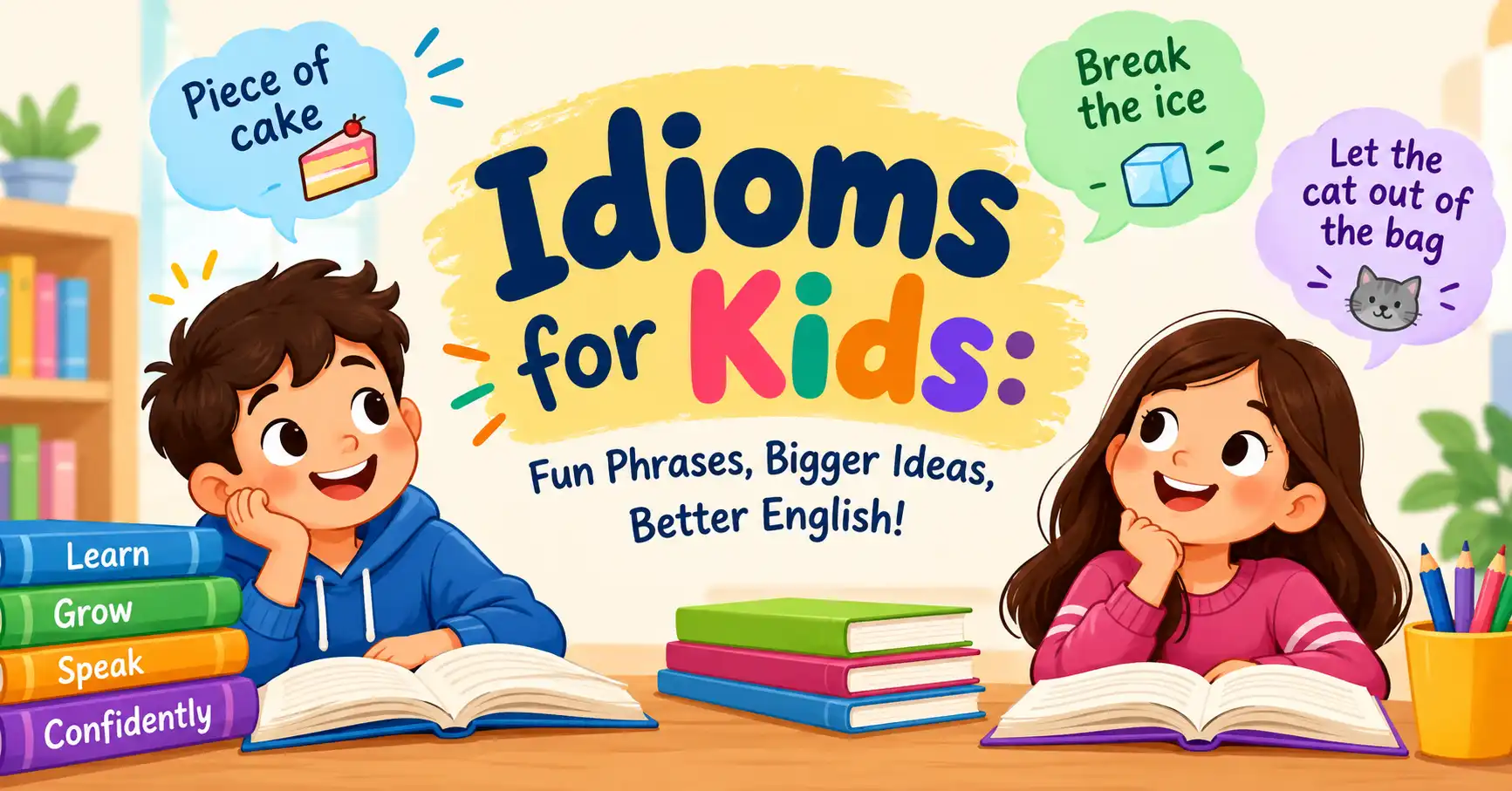
Idioms for kids are phrases that mean something different from what their words say on the surface. When someone tells a child to “break the ice,” they aren’t talking about actual ice. They mean it’s time to start a conversation and ease the awkwardness in the room.
Kids often take these phrases literally at first, which is exactly what makes them tricky and fun to learn. This guide walks through idiom meanings, real word origins, easy to hard examples, common mix ups, and simple ways to teach them at home or in class.
Quick Answer:(Idioms for Kids)
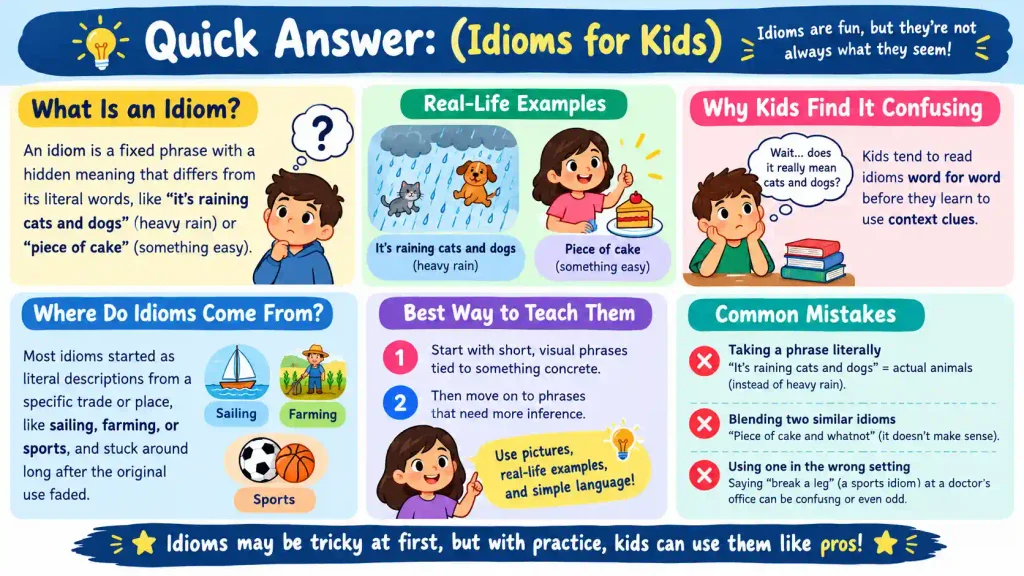
An idiom is a fixed phrase with a hidden meaning that differs from its literal words, like “it’s raining cats and dogs” (heavy rain) or “piece of cake” (something easy). Kids find idioms confusing at first because they tend to read word for word before they learn to use context clues. Most idioms started as literal descriptions from a specific trade or place, like sailing, farming, or sports, and stuck around long after the original use faded.
The easiest way to teach them is to start with short, visual phrases tied to something concrete, then move on to phrases that need more inference. Common mistakes include taking a phrase literally, blending two similar idioms, or using one in the wrong setting.
What Are Idioms for Kids, and Why Are They Tricky?
A phrase counts as an idiom when its overall meaning has nothing to do with the literal words inside it. When someone says “it’s raining cats and dogs,” no animals are falling from the sky. It just means the rain is heavy.
Young children tend to read language literally. If you tell a six year old to “hold your horses,” they might actually look around for horses. That isn’t confusion on their part. It’s simply how language skills develop. Kids usually get better at spotting figurative meaning as they get older, once they start picking up on context clues instead of relying only on word-for-word meaning.
That’s why idioms make a great classroom or bedtime topic. They show kids that words can carry a hidden meaning, and that context, not just vocabulary, decides what a sentence really says.
Idioms for Kids vs. Proverbs, Metaphors & Similes: What’s the Difference?
Each type of expression works differently. An idiom is a fixed phrase with a non literal meaning, a proverb gives advice, a metaphor compares two things directly, and a simile compares two things using “like” or “as.”
| Type | Definition | Example | Purpose |
| Idiom | A fixed phrase whose meaning can’t be guessed from the words | “Break a leg” (good luck) | Adds color and personality to speech |
| Proverb | A short saying that gives life advice or a general truth | “The early bird catches the worm” | Teaches a lesson or piece of wisdom |
| Metaphor | A direct comparison stating one thing is another | “Time is money” | Describes something by equating it with something else |
| Simile | A comparison using “like” or “as” | “Busy as a bee” | Describes something by comparing it, not equating it |
Here’s a simple way to remember it: a proverb teaches a lesson, a metaphor says one thing is another, and a simile says one thing is like another. An idiom has to be learned as a whole, because its meaning doesn’t come from the grammar or the individual words.
Where Idioms for Kids Come From: Real Origins, Not Guesses
Most idioms started as literal descriptions tied to a specific trade, place, or time period, then stuck around as figures of speech after the original activity faded. Below are documented or well supported origin stories, grouped by the world they came from. Where an origin is only a popular theory, it’s labeled that way.
From the sea
- Batten down the hatches means get ready for trouble. Sailors used wooden strips, called battens, to seal a ship’s hatches before a storm. The phrase moved into everyday speech to mean “prepare for something rough.”
- Know the ropes means understand how to do something well. On old sailing ships, dozens of ropes controlled the sails, and a skilled sailor had to know exactly which rope did what.
- In the same boat means facing the same problem as someone else. The picture is easy to see: people in one small boat share the same risks. The exact first use of the phrase isn’t well documented.
From the farm
- Don’t count your chickens before they hatch means don’t assume something will happen before it actually does. The saying points back to farm life, where an egg could still fail to hatch.
- Make hay while the sun shines means take advantage of good conditions while they last. Farmers had to cut and dry hay in dry weather, since rain would ruin it. The phrase grew into general advice about acting at the right moment.
- Chip off the old block means a child who resembles a parent. It’s often traced to woodworking, where a small chip shares the same grain as the larger block, though the exact source is hard to confirm.
From sports
- Three strikes and you’re out means someone gets a limited number of chances before facing consequences. It comes from baseball, where a batter is out after three strikes.
- Hit it out of the park means to do something extremely well. It’s also from baseball, describing a home run that clears the outfield fence.
- The ball is in your court means it’s someone else’s turn to act or decide. It comes from tennis, where the next move belongs to the player the ball lands near.
From the stage and stories
- Break a leg means good luck, usually said to performers. Its exact origin is debated. One common theory says wishing someone “good luck” directly was thought to jinx a show, so people said the opposite. The story is widely repeated, but no single source confirms it.
- Catch-22 means a no-win situation caused by contradictory rules. It has a clear, confirmed source: Joseph Heller’s 1961 novel Catch-22, where a pilot can only be excused from flying if he’s declared insane, but asking to be excused proves he’s sane enough to fly.
Easy Idioms for Kids to Teach First
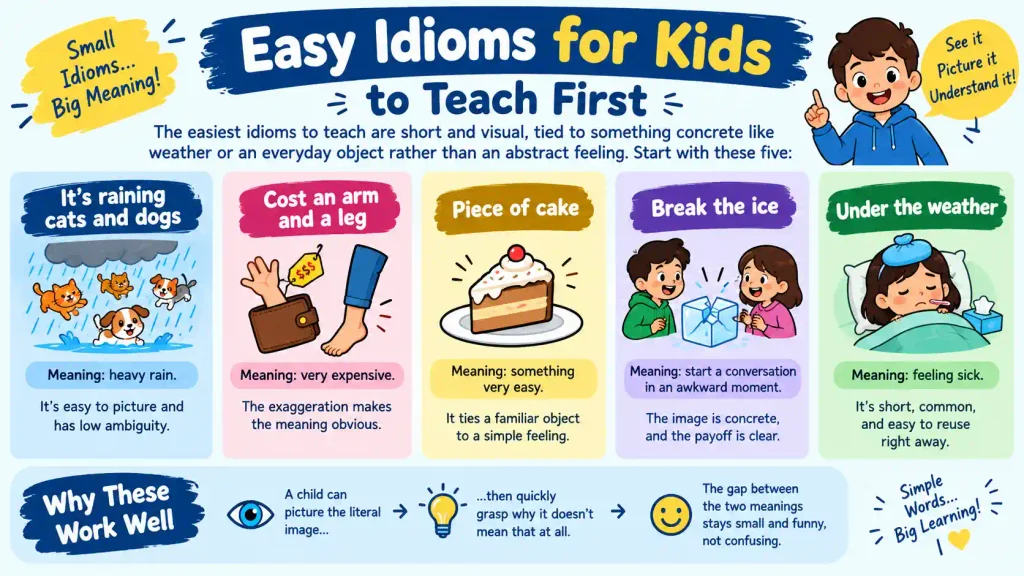
The easiest idioms to teach are short and visual, tied to something concrete like weather or an everyday object rather than an abstract feeling. Start with these five:
- It’s raining cats and dogs: heavy rain. It’s easy to picture and has low ambiguity.
- Cost an arm and a leg: very expensive. The exaggeration makes the meaning obvious.
- Piece of cake: something very easy. It ties a familiar object to a simple feeling.
- Break the ice: start a conversation in an awkward moment. The image is concrete, and the payoff is clear.
- Under the weather: feeling sick. It’s short, common, and easy to reuse right away.
These work well as a first step because a child can picture the literal image, then quickly grasp why it doesn’t mean that at all. The gap between the two meanings stays small and funny, not confusing.
Harder Idioms for Kids: Inference and Themed Lists
The next step is idioms that ask a child to read a situation instead of just picturing an image. Try these five once the starter list feels easy:
- Bite the bullet: face something difficult with courage.
- Let the cat out of the bag: accidentally reveal a secret.
- Hit the nail on the head: describe or guess something exactly right.
- Kill two birds with one stone: solve two problems with one action.
- On the fence: undecided about something
These take more thought because the words don’t point as directly to the meaning. A child has to connect the phrase to a feeling or a situation, not just a picture.
Idioms also cluster around everyday topics, which makes them easier to remember in groups.
Animal idioms
- Let sleeping dogs lie: don’t bring up a problem that’s already settled.
- The elephant in the room: an obvious problem nobody wants to mention
- A fish out of water: someone who feels out of place
Food idioms
- Spill the beans: reveal a secret.
- That’s the way the cookie crumbles: that’s just how things turned out.
- Bring home the bacon: earn money for the family.
Feelings idioms
- Butterflies in your stomach: feeling nervous
- On cloud nine: feeling extremely happy
- Down in the dumps: feeling sad
Common Mistakes With Idioms for Kids (and Easy Fixes)
The most common mistake is taking an idiom literally, but blending two similar idioms and using a phrase in the wrong setting are close behind. Here are three patterns worth watching for.
Taking it literally. A child hearing “it’s raining cats and dogs” might genuinely ask where the animals are falling from. This is normal at younger ages and usually fades as reading comprehension grows. A quick drawing of the literal picture and the real meaning side by side helps.
Blending two idioms. Kids sometimes merge “spill the beans” and “let the cat out of the bag” into something like “spill the cat.” Both phrases mean nearly the same thing, so the mix-up is understandable. Practice each phrase in its own sentence to keep them separate.
Using an idiom in the wrong setting. A child might tell a friend who is struggling with homework, “It’s a piece of cake!” The phrase is correct, but the tone doesn’t fit, and it can sound unkind. Gently pointing out the mismatch, without turning it into a correction, helps the idiom stick properly next time.
Why Teaching Idioms for Kids Matters
Teaching idioms helps kids move past literal reading and start picking up meaning from context, which is a core reading comprehension skill. A child who can decode figurative language is better prepared to understand books, conversations, and instructions that rely on tone rather than exact wording.
Idioms also build vocabulary in a way plain word lists don’t. Each phrase comes packaged with a small image or story that makes it memorable. Teachers and parents often find that kids remember an idiom faster than a vocabulary word, simply because the phrase is stranger and more fun to picture.
Beyond comprehension, idioms give kids a social boost. Everyday conversation, TV shows, and classroom instructions are full of figurative phrases, and a child who recognizes them joins in with more confidence instead of getting stuck on a phrase that sounds odd out of context.
Frequently Asked Questions About Idioms for Kids
What is the difference between an idiom and a proverb?
An idiom is a fixed phrase with a non literal meaning, while a proverb is a short saying that offers advice or a general truth. “Break a leg” is an idiom because its meaning has nothing to do with legs, while “the early bird catches the worm” is a proverb because it directly teaches a lesson about acting early.
What is the easiest idiom to teach a child?
Short, visual idioms tied to something concrete work best as a starting point, such as “it’s raining cats and dogs” or “piece of cake.” The literal image is easy to picture, which makes the gap between the literal and figurative meaning obvious and fun rather than confusing.
How do idioms help kids with reading comprehension?
Idioms train kids to look past literal word meaning and read for context, one of the core skills behind strong reading comprehension. A child who’s comfortable with figurative language is less likely to get stuck when a book, article, or conversation uses a phrase that doesn’t mean exactly what it says.
What does “it’s raining cats and dogs” mean, and where did it come from?
It means it’s raining very hard. Its origin isn’t confirmed. A popular story links it to 17th-century England, where heavy storms supposedly washed dead animals into the streets, but language historians generally treat that as a myth rather than a proven source.
Final Thoughts on Idioms for Kids
Idioms give kids a fun, low stakes way to practice something they’ll need for the rest of their lives: reading between the lines. Start with short, visual phrases like “piece of cake” or “under the weather,“ then work up to trickier ones like “bite the bullet” once the basics feel easy. Pair each phrase with its real backstory where one exists, and be honest when an origin is just a popular guess rather than a proven fact. A child who learns this way won’t just memorize a list. They’ll understand how English actually works.
To read more: 15 Powerful Idioms About Mind With Easy Examples