
Idioms for friendship are short phrases that describe how friends meet, stay close, help each other, and make up after a fight. This guide covers 22 of them. Each one gets a plain meaning, real examples, and a tip on when to use it. Seven also come with a documented origin, and one is marked as unknown. You will also find a tone chart, common mistakes, a quiz, and four FAQ answers.
Friendship idiom: a fixed phrase that talks about friends in a way the words alone don’t show. “Thick as thieves” describes two very close friends, not criminals.
Quick Answer: The Most Common Idioms for Friendship
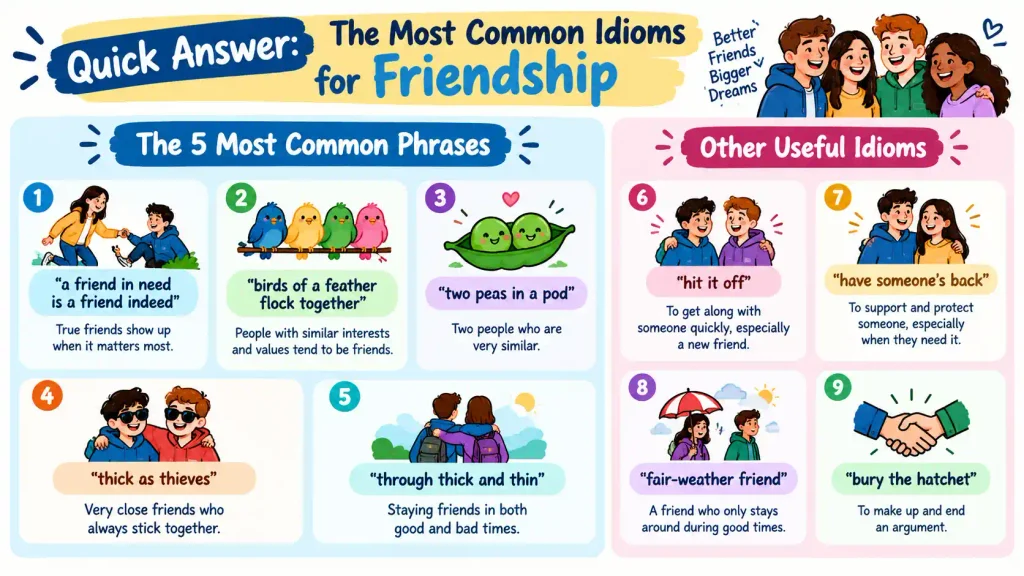
The five most common phrases are “a friend in need is a friend indeed,” “birds of a feather flock together,” “two peas in a pod,” “thick as thieves,” and “through thick and thin.”
Use “hit it off” for a new friend. Use “have someone’s back” for a loyal one. Pick “fair weather friend” for a fake one, and “bury the hatchet” for making up after a fight.
All 22 Idioms for Friendship at a Glance
The 22 phrases fall into four groups: making friends, staying close, standing by each other, and mending a broken friendship.
| Idiom | Short meaning |
|---|---|
| Hit it off | Like each other right away |
| Get on like a house on fire | Become close very fast |
| Click with someone | Connect without effort |
| Strike up a friendship | Start a friendship |
| Birds of a feather flock together | Similar people end up together |
| Two peas in a pod | Very alike |
| Thick as thieves | Very close, often secretive |
| Joined at the hip | Always together |
| Go back a long way | Have known each other for years |
| Close-knit | Tightly bonded |
| Kindred spirits | Share the same outlook |
| A friend in need is a friend indeed | Real friends help in hard times |
| Through thick and thin | In good times and bad |
| Fair-weather friend | Around only when life is easy |
| A shoulder to cry on | Someone who comforts you |
| Have someone’s back | Protect and support them |
| In someone’s corner | On their side |
| Stand by someone | Stay loyal under pressure |
| Bury the hatchet | End a quarrel |
| Build bridges | Repair a relationship |
| Clear the air | Talk out the tension |
| Patch things up | Make up after a fight |
Idioms for Friendship About Making Friends
Hit it off, get on like a house on fire, click with someone, and strike up a friendship all describe how a bond begins.
Hit it off
Meaning: Two people like each other from the first meeting.
Watch out: This phrase covers the start only.
Example: I hit it off with my new teammate during the first coffee break.
Get on like a house on fire
Meaning: Two people become warm friends very quickly.
Watch out: Fire sounds scary, but this phrase is cheerful. It is common in British English and suits casual talk.
Example: My brother expected an awkward dinner, but he and my fiancée got on like a house on fire.
Also useful
Click with someone: We clicked at the first study group.
Strike up a friendship: She struck up a friendship with the man next to her on the train.
Idioms for Friendship Between Close Friends
Birds of a feather, two peas in a pod, thick as thieves, and joined at the hip all point to close friends, but each one stresses something different.
Birds of a feather flock together
Meaning: People with the same tastes or habits end up in the same group.
Origin: The earliest known English use comes from William Turner in 1545, in a satire against Catholic clergy. Some websites credit Plato’s Republic, but that claim rests on an 1856 translation by Benjamin Jowett, and the link is doubted.
Watch out: The tone changes with the speaker. It can sound warm, or it can sound like a dig at a group.
Example: The three of them sit together at lunch every day. Birds of a feather, I guess.
Two peas in a pod
Meaning: Two people are very much alike in looks or in character.
Origin: John Lyly wrote in Euphues and His England (1580) that two things were “as lyke as one pease is to an other.” In Tudor times, “pease” was the singular word. Nobody can say whether Lyly invented the comparison.
Example: My sister and my cousin laugh at the same jokes. They’re two peas in a pod.
Thick as thieves
Meaning: Two people are extremely close, and they often share secrets.
Origin: Nobody has confirmed where it began. One of the earliest records is in Theodore Hook’s novel The Parson’s Daughter (1833), which already calls it a proverb, so it is older. Here, “thick” means close and trusting. A similar saying, “as thick as three in a bed,” appears in Walter Scott in 1820.
Watch out: The word “thieves” adds a touch of mischief. It is friendly, but it is not formal.
Example: Since the merger, the two managers have been thick as thieves.
Joined at the hip
Meaning: Two people are almost never apart.
Origin: Nobody knows.
Watch out: It can sound like teasing. Said the wrong way, it can sound like criticism.
Example: You never see one without the other. Those two are joined at the hip.
Also useful
Go back a long way: Hamza and I go back a long way. We met in primary school.
Close-knit: It’s a close knit team that eats lunch together every day.
Kindred spirits: We found out we were kindred spirits when we both loved the same odd author.
Idioms for Friendship That Show Loyalty
Phrases like “a friend in need is a friend indeed,” “through thick and thin,” and “fair weather friend” show how friends act when life gets hard.
A friend in need is a friend indeed
Meaning: A person who helps you in trouble is a true friend.
Origin: The idea goes back to the Roman poet Quintus Ennius (239–169 BC), who wrote in Latin that a sure friend is known in an unsure time. Some websites wrongly call him a Greek philosopher. His line carries the same idea, but it is not the source of the English words.
Watch out: Is it “indeed” or “in deed”? The standard spelling is “indeed.” A second reading, “in deed,” says a real friend proves it through actions.
Example: When our car broke down at night, my uncle drove two hours to get us. A friend in need is a friend indeed.
Through thick and thin
Meaning: Two people stay together in good times and bad.
Origin: The earliest known use appears in Geoffrey Chaucer’s The Reeve’s Tale, written around 1386, where a runaway horse goes “through thick and thin.” The phrase first described riding through dense thickets and open ground. Edmund Spenser used it in 1590, and the friendship sense grew from there.
Watch out: The order is fixed. Say “thick and thin,” never “thin and thick.”
Example: We failed one exam and passed the next together. We’ve been friends through thick and thin.
Fair-weather friend
Meaning: A person is around only when things go well.
Origin: The phrase appears in print from the late 1600s. A well known early example is a letter from Alexander Pope to John Gay, dated October 1, 1730.
Watch out: Keep the hyphen. Also remember that this one is an insult.
Example: Half my colleagues stopped talking to me after the layoffs. I learned who the fair-weather friends were.
Also useful
A shoulder to cry on: After the breakup, she needed a shoulder to cry on.
Have someone’s back: Don’t worry about the meeting. I have your back.
In someone’s corner: Whatever you decide, I’m in your corner.
Stand by someone: He stood by her during the whole trial.
Idioms for Friendship After a Quarrel
Bury the hatchet, build bridges, clear the air, and patch things up all refer to ending a quarrel and becoming close again.
Bury the hatchet
Meaning: Two people end a quarrel and make peace.
Origin: The phrase comes from a North American peace custom in which people buried weapons. It is linked to the Haudenosaunee (Iroquois) Confederacy. French missionary records from the 1640s, the Jesuit Relations, describe Native envoys who wanted to throw the hatchet deep into the earth. Sources disagree on the year of the first English use, so treat any single date with care.
Watch out: The surviving records were written by Europeans, so the full story is not known. The phrase also borrows from Native American culture, so use it with respect.
Example: After a year of silence, the cousins buried the hatchet at the wedding.
Also useful
Build bridges: She called him to build bridges after the argument.
Clear the air: Let’s clear the air before the project starts.
Patch things up: They patched things up over tea.
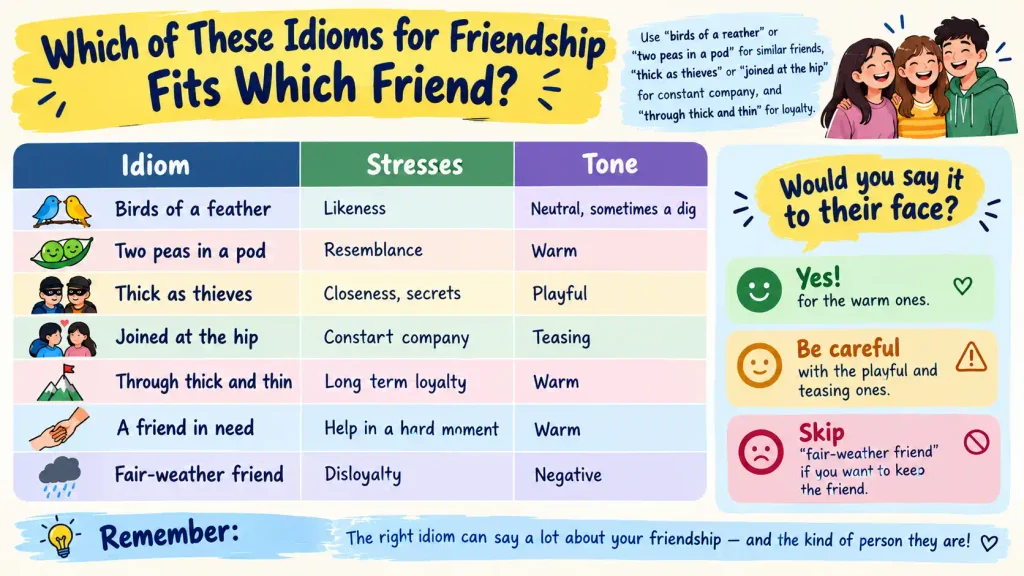
Which of These Idioms for Friendship Fits Which Friend?
Use “birds of a feather” or “two peas in a pod” for similar friends, “thick as thieves” or “joined at the hip” for constant company, and “through thick and thin” for loyalty.
Side-by-side tone chart
| Idiom | Stresses | Tone |
|---|---|---|
| Birds of a feather | Likeness | Neutral, sometimes a dig |
| Two peas in a pod | Resemblance | Warm |
| Thick as thieves | Closeness, secrets | Playful |
| Joined at the hip | Constant company | Teasing |
| Through thick and thin | Long term loyalty | Warm |
| A friend in need | Help in a hard moment | Warm |
| Fair-weather friend | Disloyalty | Negative |
Would you say it to their face? Yes for the warm ones. Be careful with the playful and teasing ones. Skip “fair weather friend” if you want to keep the friend.
Common Mistakes With Idioms for Friendship and US vs UK Usage
Most mistakes come from changing a word, flipping the word order, or using a phrase for the wrong stage of a friendship.
- Writing “a friend in deed” by accident when you mean “indeed.”
- Flipping the order to “thin and thick.”
- Dropping the hyphen in “fair weather friend.”
- Using “hit it off” for a friendship that is ten years old.
- Using “bury the hatchet” for a one sided apology. The phrase needs both sides to make peace.
- Putting “thick as thieves” in a formal report.
| Situation | UK | US |
|---|---|---|
| Being on good terms | get on with someone | get along with someone |
| Casual word for a friend | mate | buddy |
Quick Quiz on Idioms for Friendship
- Which idiom describes two people who look and act alike?
- What does “fair-weather friend” describe?
- Which phrase means “to end a quarrel”?
- Which Roman poet wrote the Latin line behind “a friend in need is a friend indeed”?
- What did “through thick and thin” first describe?
Answers: 1. Two peas in a pod. 2. A person who is around only in good times. 3. Bury the hatchet. 4. Quintus Ennius. 5. Riding through dense thickets and open ground.
FAQ About Idioms for Friendship
Is it “a friend in need is a friend indeed” or “a friend in deed”?
The standard form is “a friend in need is a friend indeed.” The spelling “in deed” is a second reading that says a true friend shows it through actions. The first one is more common, so choose it unless you want a pun.
Where does “through thick and thin” come from?
It comes from Geoffrey Chaucer’s The Reeve’s Tale, written around 1386. The phrase first described travel through thickets and open land. Later writers used it for a friend who stays loyal in easy and hard times.
Can friendship idioms be used in formal writing?
Yes, but pick them with care. “Through thick and thin” and “a friend in need is a friend indeed” work in most writing. “Thick as thieves” and “joined at the hip” are informal. Keep those for speech, stories, and friendly emails.
Are friendship idioms used in other cultures?
Yes, many languages have close matches. Spanish uses ser uña y carne, which translates as “to be nail and flesh,” to say two friends are inseparable. The pictures differ, but the idea of closeness and loyalty stays the same.
Conclusion: Using Idioms for Friendship Well
Friendship phrases give you short, ready made ways to talk about every stage of a friendship, from the first hello to making peace after a fight. Match the phrase to the stage, and check the tone before you say it to a friend’s face. Some origins above are confirmed, while others are only guesses.
Pick one idiom from each group and use it this week. Practice is the fastest way to make them sound natural.
To read more: 22 Idioms for Eyes: Powerful Meanings You’ll Love