Idioms for Music are everyday phrases that borrow tunes, notes, and instruments to describe real life. “Face the music” is a good example. It means to accept the blame for what you did, and it has nothing to do with a song.
This page covers 30 of these phrases. Each one comes with a plain meaning, a natural example, and a usage tip. You will also see which origin stories are proven, which are guesses, and which phrases can sound rude at work.
Quick Answer: What Are Idioms for Music?
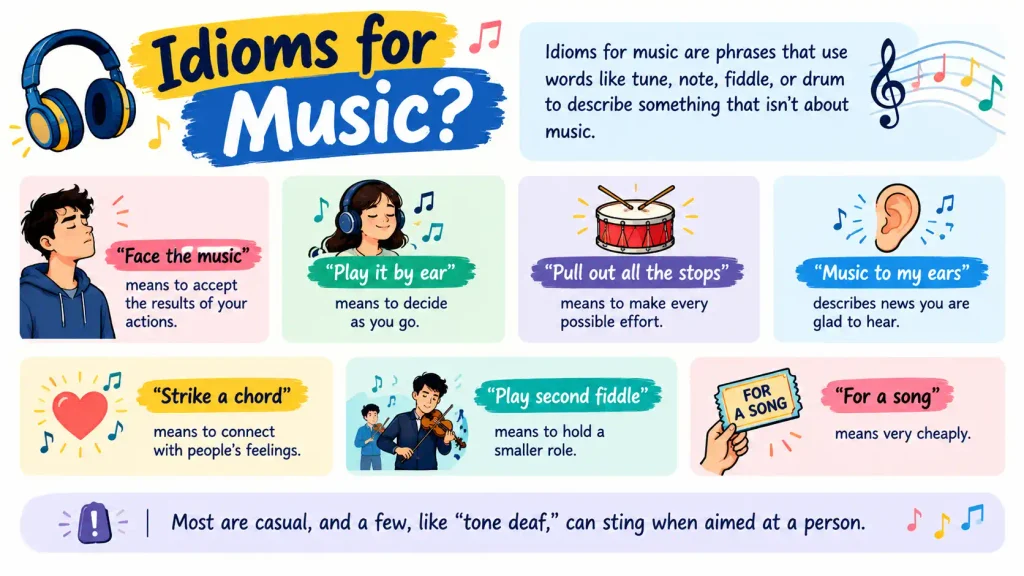
Idioms for music are phrases that use words like tune, note, fiddle, or drum to describe something that isn’t about music.
- “Face the music” means to accept the results of your actions.
- “Play it by ear” means to decide as you go.
- “Pull out all the stops” means to make every possible effort.
- “Music to my ears” describes news you are glad to hear.
- “Strike a chord” means to connect with people’s feelings.
- “Play second fiddle” means to hold a smaller role.
- “For a song” means very cheaply.
Most are casual, and a few, like “tone deaf,” can sting when aimed at a person.
What Counts Among Idioms for Music?
A music idiom is a phrase whose image comes from music, instruments, or sound, and whose meaning goes beyond them.
That is the only rule used here. Phrases that just use a word like “play” or “blow” don’t count. “Blow a gasket” is about engines, not music. A few entries sit close to the edge, such as “clear as a bell,” “swan song,” “fine tune,” and “it takes two to tango.” They stay because learners often meet them beside the others.
The 10 Essential Idioms for Music
The ten essential idioms for music are face the music, play second fiddle, pull out all the stops, for a song, play it by ear, music to my ears, strike a chord, march to the beat of your own drum, like a broken record, and ring a bell.
1. Face the Music
- Meaning: To accept the unpleasant results of your own actions.
- Example: “I forgot to send the report, so now I have to face the music with my boss.”
- Tone: Serious but everyday. It works in speech and in writing.
What we actually know:
- Documented: The earliest use found so far is in a New Hampshire newspaper from August 1834. In that line, an editor is told to stop dodging and answer. The phrase seems to be American in origin.
- Possible theory: One popular story traces it to disgraced officers being “drummed out” of their regiment. Another says actors literally faced the orchestra pit.
- Popular story, weak evidence: A third story links it to West Gallery church singing. The same source calls this one less likely.
The records show no clear source for the meaning, so every story is a guess. The longer form, “face the music and dance,” is the title of a 1936 Irving Berlin song written for the film Follow the Fleet.
2. Play Second Fiddle
- Meaning: To hold a smaller role while someone else leads.
- Example: “After the merger, she played second fiddle to the new director.”
- Tone: Mildly negative. Neutral in casual talk.
- Usage note: People usually add “to” and the name of the leader: “play second fiddle to Dana.”
3. Pull Out All the Stops
- Meaning: To make every possible effort.
- Example: “Grandma pulled out all the stops for my birthday dinner.”
- Tone: Positive. It suits both speech and writing.
- Origin note: The pipe organ story checks out. Stops are knobs that control air flow to the pipes, and pulling them all out makes the organ as loud as it can be.
4. For a Song
- Meaning: To buy something very cheaply.
- Example: “We got this old couch for a song at a garage sale.”
- Tone: Casual and friendly.
- Origin note: The phrase dates to the late 1500s, and an early use appears in a Shakespeare play. Why a “song” became the price is a guess. One idea is the small coins given to street singers, or the low cost of sheet music.
5. Play It by Ear
- Meaning: To decide what to do as things happen, with no fixed plan.
- Example: “Let’s play it by ear and see how the weather looks on Saturday.”
- Tone: Relaxed and neutral.
- Origin note: Musicians play by ear when they perform without sheet music. The phrase itself needs no piano.
6. Music to My Ears
- Meaning: News that makes you glad to hear it.
- Example: “You finished the project early? That’s music to my ears.”
- Tone: Warm and positive.
- Usage note: People say it as a reply to good news. Said in a dry voice about bad news, it turns sarcastic.
7. Strike a Chord
- Meaning: To make people feel a connection, or to ring true for them.
- Example: “Her speech about starting at a new school struck a chord with the whole class.”
- Tone: Positive. It fits formal writing as well as speech.
- Spelling note: The word is chord, a group of notes played together. It is not cord, a piece of rope.
8. March to the Beat of Your Own Drum
- Meaning: To live in your own way, whatever others do.
- Example: “My cousin marches to the beat of her own drum. She wears rain boots every day, sun or not.”
- Tone: Usually admiring, though it can sound critical.
- Related form: People also say “march to a different drummer.” A line in Henry David Thoreau’s Walden (1854) about hearing a different drummer is a close cousin.
9. Like a Broken Record
- Meaning: Saying the same thing over and over.
- Example: “Sorry to sound like a broken record, but please clean your room.”
- Tone: Mildly negative. Speakers often use it about themselves to soften a request.
- Origin note: The image comes from a scratched vinyl record that keeps skipping back to the same spot.
10. Ring a Bell
- Meaning: To sound familiar, even if you can’t say why.
- Example: “The name Carter rings a bell. Did we meet at the conference?”
- Tone: Neutral.
- Usage note: It often appears in questions and denials: “Does that ring a bell?” or “It doesn’t ring a bell.”
More Idioms for Music, Grouped by Theme
Beyond the essentials, idioms for music fall into four groups: instruments and sound, singing and voice, rhythm and beat, and performance and stage.
The 18 below, plus the 10 essentials and two more in the next section (“blow your own trumpet” and “change your tune”), make 30.
Instruments and Sound
- Fit as a fiddle: in very good health. “Grandpa is 85 and still fit as a fiddle.”
- Clear as a bell: very easy to hear or understand. “The teacher’s directions were clear as a bell.”
- With bells on: eager and happy to show up. “Invite me, and I’ll be there with bells on.”
- Fiddle while Rome burns: to waste time on small things during a crisis. “Arguing about font colors while the website is down is fiddling while Rome burns.” The Nero story behind it is a myth. See the origins section.
- Whistle in the dark: to act brave when you feel afraid. “He said the test was easy, but he was whistling in the dark.”
- Fine tune: to make small changes until something works well. “We fine tuned the schedule before the trip.”
Singing and Voice
- Carry a tune: to sing the right notes. “I can’t carry a tune, so I’ll skip karaoke.”
- Sing for your supper: to earn a reward by doing something in return. “The guests sang for their supper by washing the dishes.”
- Swan song: a final act before something ends. “The farewell match was her swan song.”
- Tone-deaf: unable to hear pitch, or unaware of how others feel. “The ad was tone-deaf. It joked about people losing their jobs.”
Rhythm and Beat
- Get into the rhythm: to settle into a routine. “After two weeks, I got into the rhythm of the new job.”
- Without skipping a beat: continuing right away, with no pause. “She answered the hard question without skipping a beat.”
- Drum up support: to work at gaining interest or backing. “The club drummed up support with posters.”
- On a good note: with a happy or positive ending. “The meeting ended on a good note.”
Performance and Stage
- All that jazz: and other things like that. “He brought snacks, drinks, games, and all that jazz.”
- It takes two to tango: both sides share the blame. “Don’t blame only Sam. It takes two to tango.”
- One hit wonder: someone with one big success and nothing after it. “The bakery was a one-hit wonder. Only the lemon cake sold.”
- Call the tune: to be the one in charge. “The person who pays usually calls the tune.”
Easily Confused Idioms for Music, Side by Side
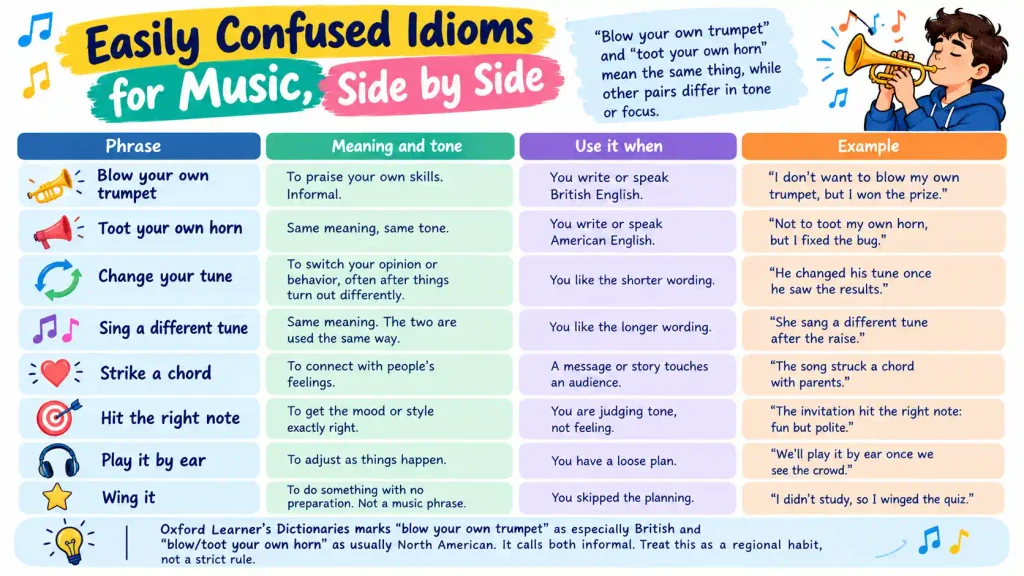
“Blow your own trumpet” and “toot your own horn” mean the same thing, while other pairs differ in tone or focus.
| Phrase | Meaning and tone | Use it when | Example |
| Blow your own trumpet | To praise your own skills. Informal. | You write or speak British English. | “I don’t want to blow my own trumpet, but I won the prize.” |
| Toot your own horn | Same meaning, same tone. | You write or speak American English. | “Not to toot my own horn, but I fixed the bug.” |
| Change your tune | To switch your opinion or behavior, often after things turn out differently. | You like the shorter wording. | “He changed his tune once he saw the results.” |
| Sing a different tune | Same meaning. The two are used the same way. | You like the longer wording. | “She sang a different tune after the raise.” |
| Strike a chord | To connect with people’s feelings. | A message or story touches an audience. | “The song struck a chord with parents.” |
| Hit the right note | To get the mood or style exactly right. | You are judging tone, not feeling. | “The invitation hit the right note: fun but polite.” |
| Play it by ear | To adjust as things happen. | You have a loose plan. | “We’ll play it by ear once we see the crowd.” |
| Wing it | To do something with no preparation. Not a music phrase. | You skipped the planning. | “I didn’t study, so I winged the quiz.” |
Oxford Learner’s Dictionaries marks “blow your own trumpet” as especially British and “blow/toot your own horn” as usually North American. It calls both informal. Treat this as a regional habit, not a strict rule.
Tone at Work: Which Idioms for Music Are Safe to Use?
Most music idioms are fine in friendly work talk, but a few can sound rude when aimed at a person.
| Tone | Idioms |
| Positive | music to my ears, strike a chord, hit the right note, without skipping a beat, on a good note |
| Neutral or practical | play it by ear, fine-tune, call the tune, ring a bell, get into the rhythm |
| Negative or critical | blow your own trumpet, like a broken record, tone-deaf, play second fiddle |
This grid is usage advice, not a dictionary label. For a report or cover letter, “fine tune,” “strike a chord,” and “pull out all the stops” read well. Save “music to my ears,” “all that jazz,” and “with bells on” for casual chat.
A few need care:
- Tone-deaf can sting. Call an ad or a message tone deaf, not a coworker.
- Like a broken record works about yourself. Aimed at someone else, it says they nag.
- Play second fiddle suggests a lower rank. Avoid it when describing a colleague’s role.
- Blow your own trumpet can sound like a put down when said about another person.
Where Idioms for Music Come From: What’s Documented and What’s Myth
Only a few idioms for music have a documented origin, which means there is written proof. Most of the rest have an obvious image or an unproven story.
| Idiom | Origin claim | Grade |
| Face the music | First known use: New Hampshire paper, August 1834. Cause unknown. | First use documented. Cause: possible theories only. |
| Pull out all the stops | Pipe organ stops. | Documented |
| For a song | In print by the late 1500s. Reason for “song” is unclear. | Date documented. Reason: possible. |
| Play second fiddle | The second violin supports the first. | Obvious from the image |
| Play it by ear | Playing without sheet music. | Obvious from the image |
| Like a broken record | A scratched record repeats. | Obvious from the image |
| Fiddle while Rome burns | Emperor Nero, 64 CE. | Myth |
Don’t repeat this myth: Nero did not fiddle while Rome burned. The fiddle did not exist in ancient Rome. The Roman historian Tacitus wrote that Nero was rumored to have sung about the fall of Troy, but he said no eyewitness confirmed it. Nero was also at his villa about 35 miles away when the fire began. The phrase survives as a vivid image, but the history behind it does not hold up.
Common Mistakes with Idioms for Music
The most common mistakes are misspelling “chord,” reading a phrase too literally, and changing its fixed wording.
- Writing “strike a cord.” The word is chord. A cord is a rope.
- Taking “face the music” literally. It has nothing to do with listening to a song. It is about facing the results of your actions.
- Treating “for a song” as “free.” It means very cheap. Something free costs no money at all.
- Using “play it by ear” only about hearing. It also covers plans, trips, and meetings.
- Changing the fixed wording. People say “fit as a fiddle,” not “fit like a fiddle,” and “clear as a bell,” not “clear like a bell.”
FAQs About Idioms for Music
Short answers to four common questions about music idioms follow.
What does “face the music” mean, and where does it come from? Face the music means to accept the unpleasant results of what you did. Its origin is not settled. The earliest use found so far is from an August 1834 New Hampshire newspaper. Popular theories, such as drummed-out soldiers and actors before the orchestra pit, are unproven.
What is the difference between “blow your own trumpet” and “toot your own horn”? They mean the same thing: to brag about your own skills. Oxford Learner’s Dictionaries marks the trumpet version as especially British and the horn version as usually North American. Both are informal, so keep them for casual talk and light humor.
Does “play it by ear” only refer to music? No. Musicians play by ear when they perform without sheet music. Everyone else uses the phrase for deciding as they go, like plans for a trip or a meeting. It suggests a loose plan and a willingness to adjust.
Is “music to my ears” formal or informal? It is an everyday, friendly phrase. It fits casual talk and relaxed work chats better than formal reports. In writing for a stricter audience, say “welcome news” or “good news” instead.
Conclusion: Idioms for Music in Everyday English
Idioms for music make English warmer and more colorful, but they work best when you know their tone and their real history. “Pull out all the stops” is a good place to start, since its pipe organ story is documented. “Face the music” is another, though only its first use is documented, not its cause. Pick three from this list and try them this week.
For more themed lists, see idioms about storms, idioms for reading, idioms for trees, and idioms for weird.
To read more: 15+ Easy Idioms for Kids: Amazing Meanings & Origins