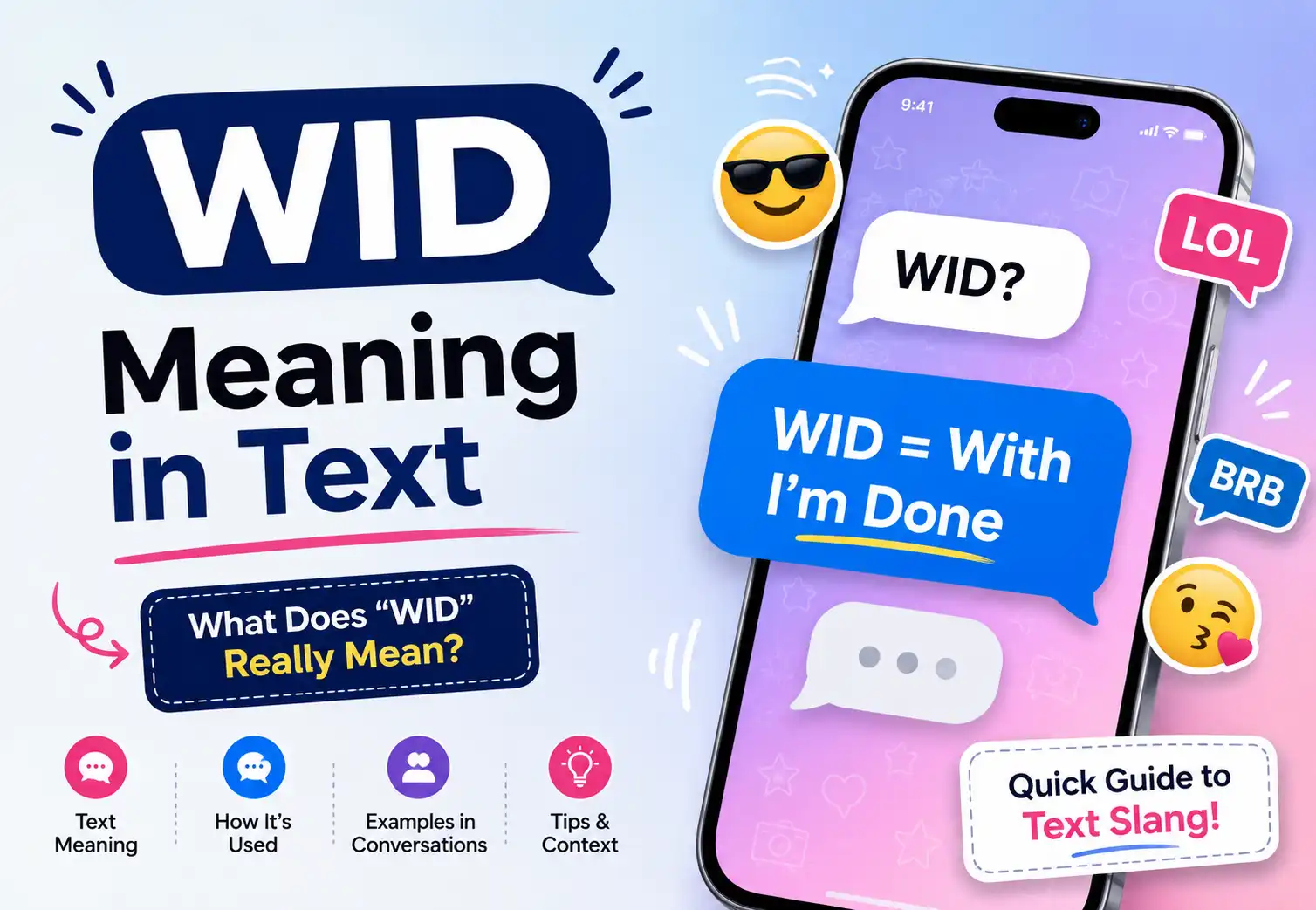
If you’re searching for the meaning of “wid” in text, here’s the short answer. “Wid” is an informal spelling of the word “with.” People use it the same way they use “with” in any sentence. There’s one thing to watch for, though. When “WID” is written in all capital letters, it usually means something different. This guide clearly breaks down both meanings. You never have to guess the wid meaning in text again.
What Does “Wid” Mean in a Text? (Quick Answer)
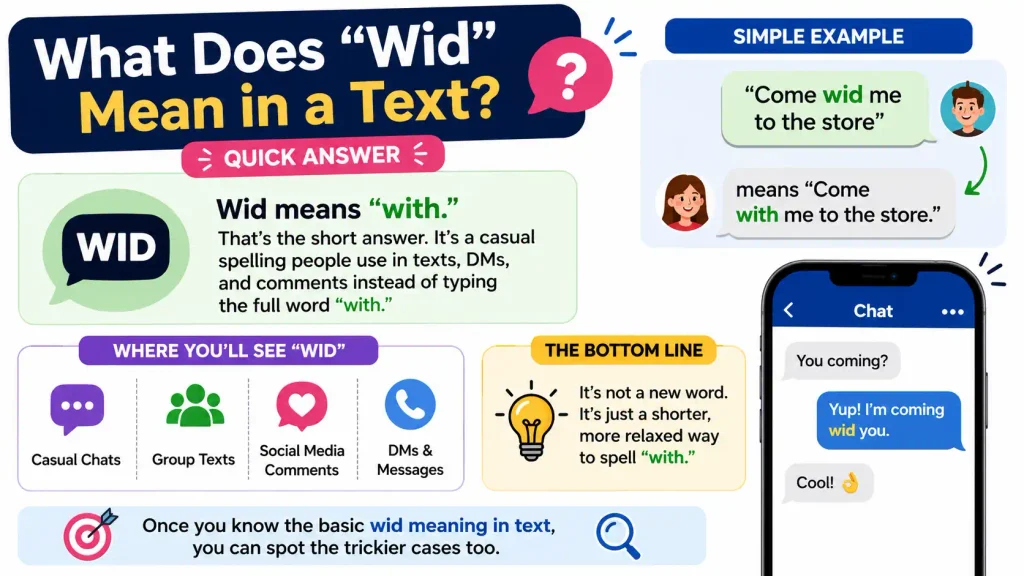
Wid means “with.” That’s the short answer. It’s a casual spelling people use in texts, DMs, and comments instead of typing the full word “with.”
Here’s a simple example:
“Come wid me to the store” means “Come with me to the store.”
You’ll see this spelling often in casual chats, group texts, and social media comments. It’s not a new word. It’s just a shorter, more relaxed way to spell “with.” Once you know the basic wid meaning in text, you can spot the trickier cases too.
Wid vs. WID: Why Capitalization Changes the Meaning
Here’s the most important thing to know. Lowercase “wid” and uppercase “WID” usually mean two different things.
Lowercase “wid” means “with”
When “wid” appears in lowercase in the middle of a normal sentence, it almost always means “with.” For example: “I’m wid my sister right now.”
Uppercase “WID” is an acronym.
When “WID” appears in all capital letters, it’s usually an acronym. It’s not a spelling of “with.” The most common meaning is “When I Drink.” People use this to describe things they only do after having a drink. A common example is smoking a cigarette or texting an ex.
How to tell which one someone means
Look at two clues:
- Capitalization. Lowercase usually means “with.” All caps usually means an acronym.
- Sentence context. Does “with” fit naturally in the sentence? If yes, that’s likely the meaning. If not, the acronym is more likely.
Keeping these two clues in mind is the fastest way to nail down the correct wid meaning in text. You won’t have to ask the sender what they meant.
Where “Wid” Comes From (Origin & Dialect Roots)
“Wid” is a phonetic spelling of “with.” That means it’s spelled the way the word sounds. People say it this way when talking quickly or casually.
A softened “th” sound
In fast, casual speech, the “th” sound in “with” often softens. It turns into a “d” sound. So “with” starts to sound like “wid.” Texting simply writes down that sound.
Roots in dialect speech
This spelling isn’t random. It has real roots in dialects. These include African American Vernacular English (AAVE), Caribbean English, and older Scots speech. Dictionary.com even lists a real example. It’s from the novel Their Eyes Were Watching God by Zora Neale Hurston. A character in the book says, “he know what to do wid.”
Why texting adopted it
Texting favors short, fast, sound based spelling. “Wid” already existed as a spoken version of “with.” That made it a natural fit for quick typing on a phone. This is also why the casual wid meaning in text spread so quickly. Texting and social media simply became everyday habits.
How to Use “Wid” in a Sentence
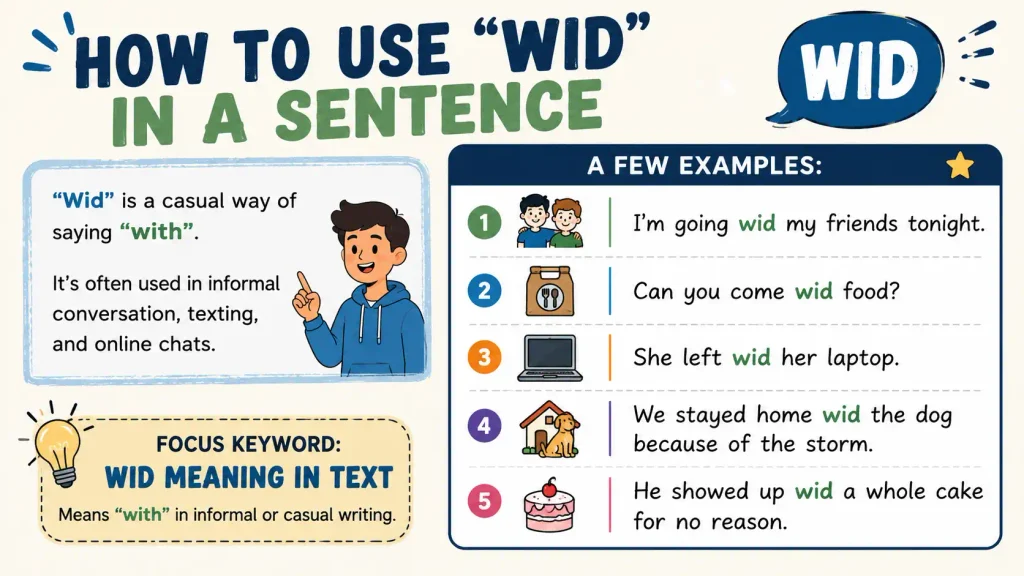
“Wid” works exactly like “with” in a sentence. Just swap it in wherever “with” would normally go.
A few examples:
- “I’m going wid my friends tonight.”
- “Can you come wid food?”
- “She left wid her laptop.”
- “We stayed home wid the dog because of the storm.”
- “He showed up wid a whole cake for no reason.”
I first noticed this spelling a few years ago. I was moderating comments on a community Discord server. Someone wrote “im wid it” under a poll. I paused for a second, wondering if they meant “widow” or were making some kind of joke. A second comment used the same spelling. That’s when it clicked. “Wid” was just their normal way of texting “with.” That small mix up taught me something useful. Always check the words around a slang term before guessing its meaning. This habit has helped me sort out dozens of confusing texts since then, including other cases where the meaning of ” wid ” in text wasn’t obvious at first glance.
When “wid” is appropriate, and when it isn’t
“Wid” works fine in texts, DMs, and casual social media comments. It doesn’t belong in formal writing. Skip it in work emails, school essays, or job messages. Use the full word “with” instead. A casual spelling can look careless in a formal setting, even when the meaning is clear.
Other Meanings of WID (All Caps Acronym)
“WID” is an acronym. It can stand for more than one thing. It depends on the group of people using it.
“When I Drink”
This is the most common meaning. People use it to describe habits or behaviors that only show up after drinking. Example: “He’s a WID smoker” means he only smokes cigarettes when he’s been drinking.
Less common slang meanings
Slang dictionaries like Urban Dictionary list a few rarer meanings. These include “Woman in Disguise” and short versions of phrases like “What it do.” These meanings are far less common. They usually only make sense within a specific friend group or online community.
How to spot which meaning fits
If a sentence is about drinking, it’s likely the “When I Drink” meaning. If the sentence is about a person’s personality or style, it might be one of the rarer slang meanings instead. As with the lowercase version, context does most of the work here.
Wid Across Platforms and Age Groups
The casual spelling shows up a little differently depending on where you see it.
- Texting and DMs: This is where “wid” is most common. It’s swapped in for “with” in quick, informal messages between friends or family.
- Social media comments: On Instagram, TikTok, and X, “wid” often shows up in comments and captions. It’s common in casual or funny posts.
- Gaming chats: In multiplayer games, “wid” shows up in fast-typed messages like “come wid me.” Speed matters more than spelling here.
- Generational patterns: Younger texters use the lowercase spelling more freely. The all caps version shows up more in meme culture and specific online groups, not everyday chat.
Recognizing where the term appears makes it easier to guess the intended meaning. You can often do this before you even read the full sentence.
Common Mistakes People Make With “Wid”
A few small mix-ups come up again and again when people run into this spelling for the first time.
- Assuming it’s always a typo. “Wid” looks close to other words. Some readers assume the sender made a mistake. In most casual chats, it’s intentional shorthand, not an error.
- Confusing it with “widow.” The missing period is the giveaway. Casual “wid” has no punctuation attached. The formal abbreviation almost always does.
- Missing the acronym version. Skimming past all caps “WID” as lowercase “with” can lead to a confusing sentence. If “with” doesn’t make sense, stop and consider the acronym instead.
- Using it in the wrong setting. “Wid” in a work email or a formal message can look unpolished. It’s completely normal in a group chat, though.
Watching for these patterns makes it much easier to catch the right reading the first time. You won’t need to reread the message two or three times.
Is “Wid” the Same as the Dictionary Word “Wid.”?
No, “wid.” with a period is a completely different, formal word. It has nothing to do with texting slang.
A formal abbreviation for “widow” or “widower”
Merriam Webster and Dictionary.com confirm this. “Wid.” is a standard dictionary abbreviation for “widow” or “widower.” You might see it in official documents, obituaries, or formal records.
Why this is different from texting “wid”
The texting spelling “wid” has no period. It means “with.” The formal abbreviation “wid” has a period. It means “widow” or “widower.” The two look almost the same. But they come from different sources and appear in different settings. Confusing the two is an easy mistake. The period is the simplest visual clue that separates them.
Related Texting Abbreviations You Should Know
“Wid” isn’t the only word that gets this phonetic spelling treatment. A few related terms follow the same pattern.
- Widout, short for “without.” Example: “I can’t go widout my phone.”
- W/, a symbol shortcut also used to mean “with,” often in notes or quick messages.
- W/o, a symbol shortcut for “without.”
Each of these follows the same idea. They shorten or reshape a common word for faster typing . Learning these related terms alongside the core wid meaning in text makes casual messages much easier to read.
Frequently Asked Questions
What does wid mean in a text message?
In a text message, the wid meaning in text is an informal spelling of “with.” It’s typically used the same way as “with” in a normal sentence, like “I’m wid my friends right now.”
What does WID mean in all caps?
When written in all capital letters, WID is usually an acronym. It’s most commonly short for “When I Drink.” It can also appear as slang for other phrases, depending on context.
Is wid a real word?
“Wid” isn’t a standard English word on its own. It’s an informal spelling of “with.” It’s commonly used in casual texting and in some regional dialects.
Does wid mean widow?
“Wid.” with a period is a formal dictionary abbreviation for “widow” or “widower.” This is different from the casual texting use of “wid” to mean “with.”
Why do people spell “with” as “wid” in texts?
The spelling reflects how “with” is often pronounced in casual speech and certain dialects. The “th” sound softens to a “d” sound. Texting has simply adopted this phonetic shorthand.
What’s the difference between wid and widout?
“Wid” means “with.” “Widout” means “without.” Both are informal texting spellings. They follow the same phonetic pattern.
Can wid mean something other than “with” in texting?
Yes. If it’s capitalized as “WID,” it can be an acronym like “When I Drink.” Context and capitalization both help you figure out the intended meaning.
Bottom Line
So the next time “wid” shows up in your messages, you won’t need to guess about the wid meaning in text. Check the capitalization first. Then read the sentence around it. Nine times out of ten, someone’s just telling you they’re with a friend, with food, or with their laptop. No mystery required.
To read more: Ord Meaning in Text: Stop Guessing, Get Instant Clarity in 2026