
Introduction
👁👄👁 meaning in text is the first thing people search for the moment this odd little combo lands in their inbox. You just got a text with 👁👄👁 in it, and now you’re not sure what it means. You are not alone. This emoji combo shows up everywhere, from group chats to TikTok comments, but it never came with a clear definition.
The truth is, it is not just one thing. 👁👄👁 can mean calm acceptance, wide eyed shock, or sometimes nothing more than a playful reaction. The real meaning depends on the conversation around it.
In this guide, we’ll explain exactly what 👁👄👁 means, where it came from, and how to use it the right way. By the end, you’ll know exactly what someone means the next time they send it to you.
Quick Answer: 👁👄👁 Meaning in Text
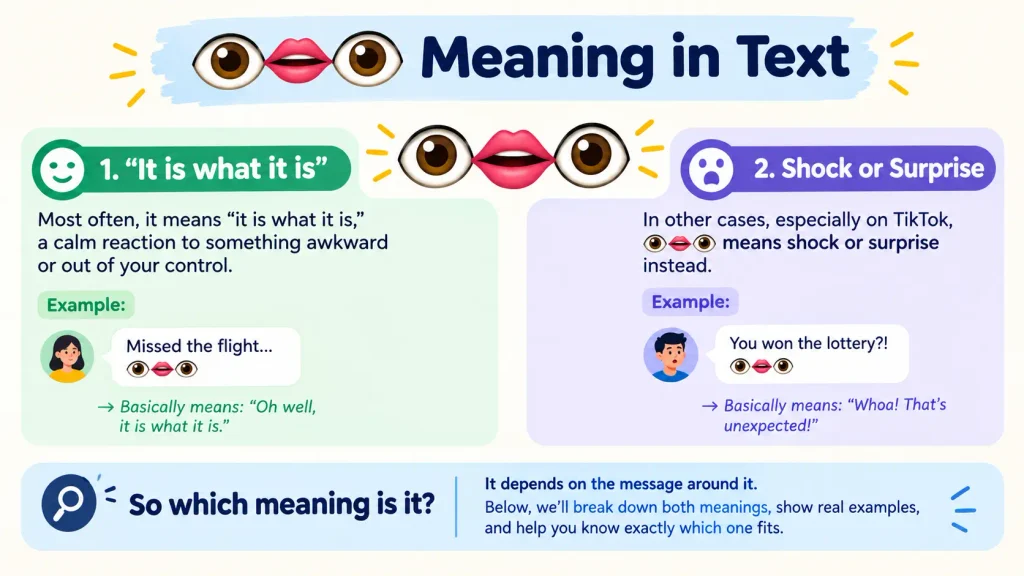
It usually comes down to one of two things. Most often, it means “it is what it is,” a calm reaction to something awkward or out of your control. In other cases, especially on TikTok, 👁👄👁 means shock or surprise instead.
So which meaning is it? It depends on the message around it. Below, we’ll break down both meanings, show real examples, and help you know exactly which one fits.
The Real 👁👄👁 Meaning in Text: Two (or Three) Definitions
There is no single dictionary definition for 👁👄👁, which is exactly why so many people search before replying. The combo is made up of an eye emoji, a mouth emoji, and a second eye emoji. It is internet slang, so its meaning shifts based on context, just like a meme or a popular phrase would. Here are the three most common ways people use it.
👁👄👁 as “It Is What It Is”,Resigned Acceptance
This is the original sense. 👁👄👁 started as an emoji version of the phrase “it is what it is.” People use it when something bad or strange happens, and there is nothing they can do about it.
For example, someone might text 👁👄👁 after their flight gets delayed. They are not shocked. They are simply accepting the situation with a calm, quiet stare.
👁👄👁 as Shock or Disbelief, The TikTok Reaction Sense
The second sense is shock or surprise. This reading grew popular on TikTok. People use 👁👄👁 to react to something bizarre, funny, or hard to believe.
Picture someone watching a strange video. Their eyes go wide. Their mouth drops open a little. That is the feeling 👁👄👁 is meant to show.
👁👄👁 as a Reaction That Doesn’t Mean Anything Specific
Some people say 👁👄👁 has no fixed meaning at all. This is also true, in a way. Many native English speakers say they use the emoji just to react, without one exact message in mind.
That does not mean 👁👄👁 is meaningless. It means it is flexible. The tone comes from the words around it, not from the emoji alone.
How to Tell Which 👁👄👁 Meaning in Text Applies (Context Clues)
I first noticed 👁👄👁 in a text conversation after I’d shared something unexpected, and honestly, I wasn’t sure what it meant at first, since it doesn’t have one fixed dictionary definition. From context, it felt like the sender was silently reacting: “I’m watching this,” “I have no words,” or “What did I just see?”
Since then, I’ve noticed it really does depend on the conversation. If a friend sends it right after surprising news, it usually reads as disbelief or shock. If it shows up after a funny or awkward comment, it more often means “I’m speechless.”
My rule of thumb now is simple. I look at the message right before and after the emoji. I never assume it only has one meaning. The words around it matter. The relationship between the people texting matters too. So does the overall tone of the chat.
Quick checklist to read 👁👄👁 correctly:
- Look at the message sent right before it.
- Check the relationship between you and the sender.
- Notice the overall tone of the conversation.
- Ask yourself: Is this reacting to bad news, or something funny?
Where Did 👁👄👁 Meaning in Text Come From? (Origin Story)
Knowing the history behind this emoji combo helps explain why it carries more than one meaning today. This meme has been around longer than most people think.
The First Known Use (2015 Tweet)
The earliest known use of 👁👄👁 traces back to a 2015 tweet. A Twitter user paired the emoji combo with Backstreet Boys song lyrics as a playful reaction. At that point, it was just a small joke between a few users.
How It Went Viral on Twitter/X (2018–2020)
The emoji combo did not become widely known until a few years later. Between 2018 and 2020, several viral tweets used 👁👄👁 to react to strange or funny situations. One tweet compared American history to European history and used the emoji as a punchline. It gained thousands of likes and retweets.
By 2020, 👁👄👁 had spread across Twitter, Instagram, Discord, and eventually TikTok. It became one of the most recognized emoji combos of that era, sitting alongside older reaction symbols like the shrug kaomoji ¯_(ツ)_/¯.
The Mysterious “It Is What It Is” App (2020)
In June 2020, a mysterious Twitter account named “It Is What It Is” appeared using 👁👄👁 as its symbol. At first, no one knew what the account was promoting. Reporters at the time, including tech journalist Josh Constine, wrote about the confusion it caused online.
Later that month, the account revealed itself as a fundraising platform for racial justice causes. This moment tied the emoji to something more meaningful than a joke, and it helped push it even further into mainstream use.
How to Use 👁👄👁 Meaning in Text in Texts, DMs, and Comments
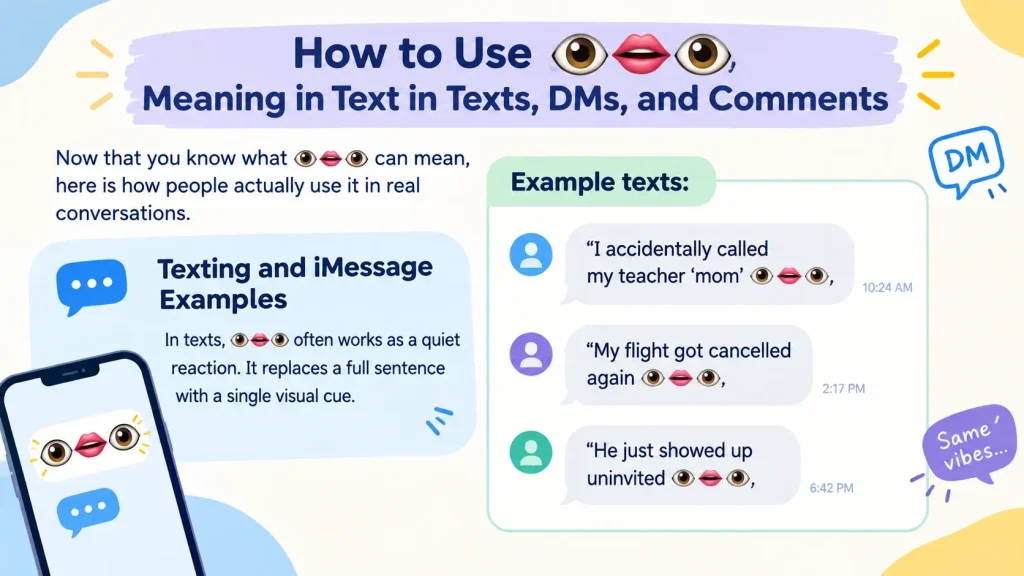
Now that you know what 👁👄👁 can mean, here is how people actually use it in real conversations.
Texting and iMessage Examples
In texts, 👁👄👁 often works as a quiet reaction. It replaces a full sentence with a single visual cue.
Example texts:
- “I accidentally called my teacher ‘mom’ 👁👄👁”
- “My flight got cancelled again 👁👄👁”
- “He just showed up uninvited 👁👄👁”
In each case, the emoji says more than words could.
Twitter/X and Comment Sections
On Twitter/X, people often use 👁👄👁 in replies to react to unexpected news or strange posts. It works well as a short, wordless comment under someone else’s tweet.
TikTok Specific Usage
On TikTok, 👁👄👁 is a very common comment on odd or funny videos. Viewers use it to show they are watching in disbelief, almost like a silent “what am I watching right now?”
When NOT to Use 👁👄👁 Meaning in Text (Tone Mistakes to Avoid)
Because 👁👄👁 can mean different things, it can also be misread. Avoid using it in serious or emotional conversations. It may come across as dismissive instead of thoughtful.
For example, sending 👁👄👁 after someone shares bad personal news may seem cold. That is true even if you did not mean it that way. In casual, funny, or lighthearted moments, though, it fits naturally.
👁👄👁 vs. Similar Reaction Emoji
👁👄👁 is not the only emoji people use to react without words. Here is how it compares to a few similar options.
👁👄👁 vs. 💀 (Skull/“I’m Dead”)
💀 usually means something is extremely funny, almost to the point of “dying laughing.” 👁👄👁 is calmer. It leans more toward shock or quiet acceptance than pure humor.
👁👄👁 vs. 😐 (Neutral Face)
😐 shows a flat, unimpressed reaction. 👁👄👁 carries more emotion. It often shows surprise or disbelief, while 😐 shows a lack of interest.
👁👄👁 vs. 🫠 (Melting Face)
🫠 shows embarrassment or feeling overwhelmed, almost like melting from awkwardness. 👁👄👁 is more of a frozen, silent stare than a meltdown.
👁👄👁 vs. 👁️👅👁️ (The Commonly Confused Variant)
👁️👅👁️ swaps the mouth emoji for a tongue emoji. This variant is often used in a joking or flirty way, and it is not the same combo. If you see it, know that it carries a different, more playful tone.
Is 👁👄👁 Meaning in Text Still Relevant in 2026?
Yes, people still use 👁👄👁 in 2026. It has stayed popular since its big spread between 2018 and 2020. Gen Z and younger millennials use it most, though its popularity can look different depending on the platform.
Like most internet slang, its popularity may rise and fall with trends. Right now, though, 👁👄👁 is still widely understood and commonly used across texting apps and social media.
Frequently Asked Questions About 👁👄👁 Meaning in Text.
What does 👁👄👁 mean in text?
👁👄👁 usually means “it is what it is,” a reaction expressing calm, resigned acceptance of something awkward, absurd, or out of your control. In some contexts, especially on TikTok, it can also mean shock or wide eyed disbelief. The words around it usually reveal which meaning fits.
What does 👁👄👁 mean on TikTok?
On TikTok, 👁👄👁 is most often used to react to something bizarre, funny, or cringeworthy. It represents the blank, wide eyed stare of someone who just witnessed something shocking or hard to believe. Commenters often use it instead of writing a full reply.
Does 👁👄👁 mean embarrassing?
Not exactly. It doesn’t mean “embarrassing” on its own, but people often use it to react to an embarrassing or awkward moment. It expresses a speechless “well, that happened” feeling rather than labeling the moment itself as embarrassing.
What’s the difference between 👁👄👁 and “it is what it is”?
👁👄👁 is essentially the emoji version of the phrase “it is what it is.” Both express calm acceptance of an undesirable outcome, but the emoji can also carry a shock or surprise meaning that the written phrase alone does not.
Where did the 👁👄👁 emoji come from?
The earliest documented use dates to a 2015 tweet, but it did not go viral until 2018 to 2020 on Twitter. From there, it spread to TikTok, Instagram, and other platforms, becoming a widely recognized reaction emoji.
Is 👁👄👁 still used in 2026?
Yes. It has remained in casual use as a reaction emoji since its 2018–2020 viral spread. How often it’s used can vary by platform and age group, but it is still a common and recognizable part of texting slang today.
What does 👁️👅👁️ mean, and is it the same as 👁👄👁?
👁️👅👁️ is a different, less common variant that swaps the mouth for a tongue emoji. It’s typically used with a more suggestive or joking tone and is often confused with the original combo, but the two are not the same.
The Bottom Line on 👁👄👁 Meaning in Text
It is not just one emoji with one fixed meaning. It carries the calm resignation of “it is what it is,” the wide eyed shock of a jaw dropping moment, and sometimes, nothing more than a playful “no comment.”
The real trick to reading it correctly is not memorizing a single definition. It’s noticing the message it’s sitting next to. Once you start paying attention to the words right before and after 👁👄👁, the meaning becomes obvious almost every time, and soon, you’ll be using it with just as much confidence as everyone else.
To read more: LF Meaning in Text : 8 Costly Mistakes to Avoid

One Comment