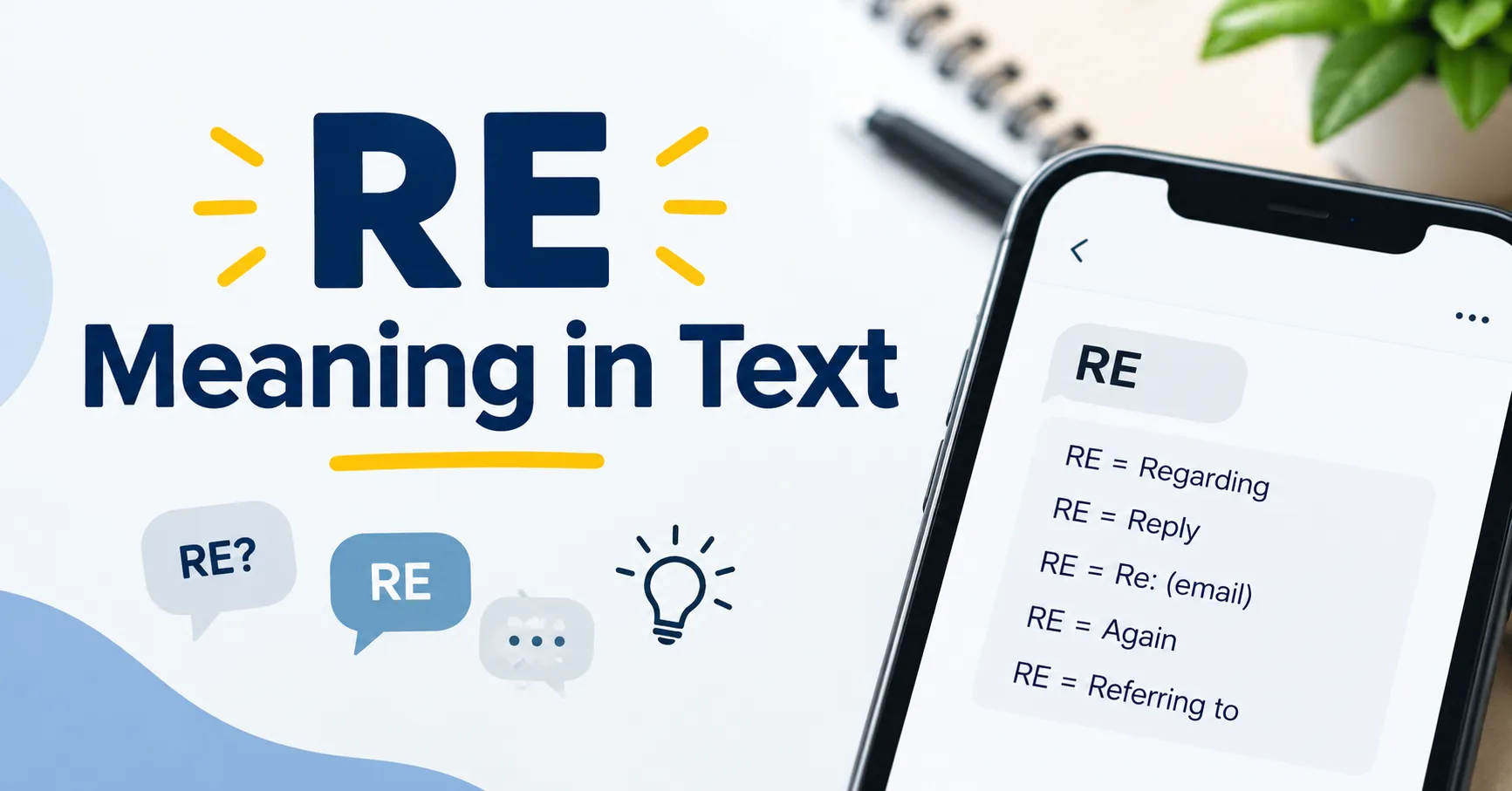
The RE meaning in text is simple: “RE” means “regarding” or “about.” People use it in texts, emails, and letters to point back to a topic that already came up. It saves them from having to repeat the whole subject line all over again.
This guide covers that meaning only, not the musical note “re” from do re mi. If you’ve ever gotten a text that just says “RE” and wondered what it meant, keep reading.
Quick Answer: RE Meaning in Text
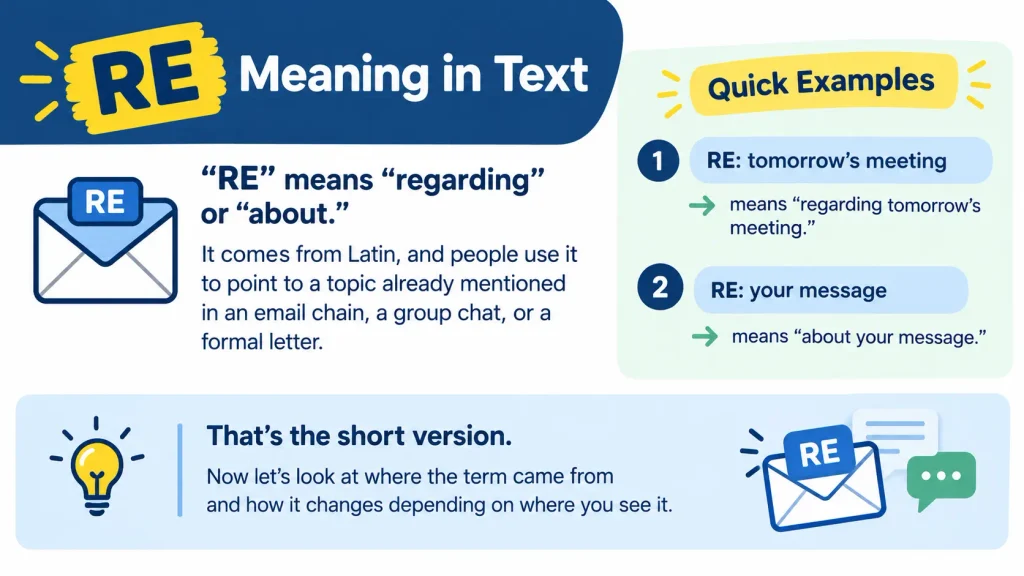
“RE” means “regarding” or “about.” It comes from Latin, and people use it to point to a topic already mentioned in an email chain, a group chat, or a formal letter.
Here are two quick examples:
- “RE: tomorrow’s meeting” means “regarding tomorrow’s meeting.”
- “RE your message” means “about your message.”
That’s the short version. Now let’s look at where the term came from and how it changes depending on where you see it.
Where “RE” Comes From (Origin & Etymology)
“RE” comes from a Latin phrase called in re, meaning “in the matter of.” Over hundreds of years, people shortened it down to just two letters: re.
Lawyers used “in re” first, as a fast way to say “this document is about this case.” Business letters picked up the habit next, and email later made “Re:” a normal part of everyday writing.
Most dictionaries, including Merriam Webster, list “re” as a short word meaning “with reference to” or “regarding.” The two letter word you see in your inbox is much older than email itself.
How Context Changes the RE Meaning in Text (My First Time Seeing It)
The first time someone texted me just two letters, RE, meaning in text I had no clue what it meant. So I scrolled up and read the messages around it. In that chat, RE turned out to be short for “regarding”; my friend was replying about something we’d talked about earlier that day.
Since then, I’ve seen “RE” show up everywhere: texts, emails, group chats. Every time, the real meaning depends on what came before it.
That one confusing text taught me something simple: never guess what “RE” means all by itself. Look at the topic. Look at who sent it. Look at the messages around it. That’s exactly why this guide breaks down the RE meaning in text by place: texting, email, letters, and even gaming chat, instead of giving you just one flat answer.
Does “RE” Mean “Reply” or “Regarding”? (The #1 Misconception)
“RE” means “regarding,” not “reply.” This is the biggest mix up people make when they look up the RE meaning in text for the first time.
Here’s why the confusion happens: when you hit “reply” on an email, your inbox adds “Re:” to the subject line automatically, so people start to think the two words are connected.
But “re” was already a word long before email existed, and it has always meant “regarding.” The reply button just borrowed it because a reply is, by definition, still about the same topic. So the next time you see “Re:” in your inbox, remember: it points to the topic; it doesn’t announce that a reply happened.
RE Meaning in Text: Email Subject Lines
In an email subject line, “Re:” shows that the message is part of an ongoing conversation about a specific topic.
Your email app adds it for you. You don’t have to type it yourself, and most clients won’t let you remove it without editing the subject line manually.
How Gmail, Outlook, and Other Email Clients Handle “Re:”
Gmail and Outlook both add “Re:” automatically when you click reply, but they don’t always show it the same way. Gmail often hides the prefix and groups all the replies into one thread under the sender’s name. Outlook usually shows every “Re:” message as its own line, unless you turn on “Show as Conversations.”
This matters because your very first subject line, the one before any replies, is the one people notice most.
The Technical Side: In Reply To and References Headers
Email doesn’t only use the word “Re:”; it also uses hidden headers. When you reply, your app quietly adds an In Reply To header storing the original message’s ID, plus a References header listing the full thread.
This follows an official standard, RFC 5322, so your app groups messages correctly even if “Re:” gets deleted from the subject line.
“RE” in Text Messages, DMs, and Social Media
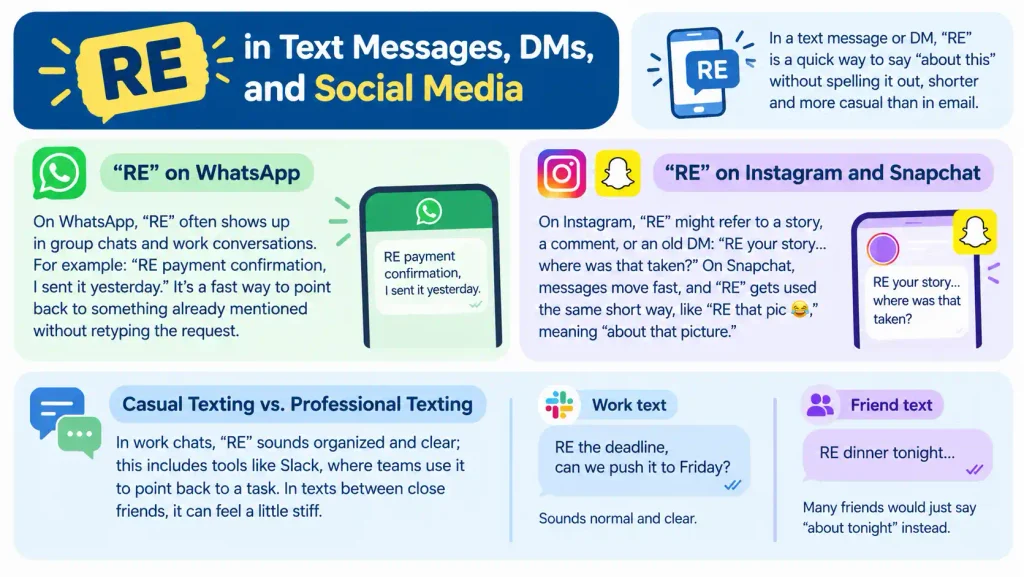
In a text message or DM, “RE” is a quick way to say “about this” without spelling it out, shorter and more casual than in email.
“RE” on WhatsApp
On WhatsApp, “RE” often shows up in group chats and work conversations. For example: “RE payment confirmation, I sent it yesterday.” It’s a fast way to point back to something already mentioned without retyping the request.
“RE” on Instagram and Snapchat
On Instagram, “RE” might refer to a story, a comment, or an old DM: “RE your story… where was that taken?” On Snapchat, messages move fast, and “RE” gets used the same short way, like “RE that pic 😂,” meaning “about that picture.”
Casual Texting vs. Professional Texting
In work chats, “RE” sounds organized and clear; this includes tools like Slack, where teams use it to point back to a task. In texts between close friends, it can feel a little stiff.
- Work text: “RE the deadline, can we push it to Friday?” sounds normal and clear.
- Friend text: “RE dinner tonight…” many friends would just say “about tonight” instead.
“RE” in Letters and Cover Letters
In a formal letter, “Re:” introduces the topic of the letter right at the top, usually placed above the greeting. For example: “Re: Invoice #5542.” This tells the reader exactly what the letter is about before they read a single sentence of the body.
In a cover letter, “Re:” can point to the job you’re applying for, as in “Re: Application for Marketing Coordinator.” It’s a small detail, but it helps a hiring manager sort your letter right away.
What Does “RE” Mean When Someone Comes Back Online? (The “Hi Again” Sense)
“RE” can also mean “hi again,” used when someone returns to a chat after being away. This meaning is very different from “regarding.” It’s common in French speaking chat rooms and online games.
“RE” as Short for “Rebonjour”
In French, “rebonjour” means “hello again.” Many French speakers shorten it to just “re” when they come back to a conversation. Gamers use it the same way after going AFK (“away from keyboard”), stepping away, then typing “re” as a quick hello to the lobby.
Why This Sense Confuses English Speakers
Most English speakers only know “RE” as short for “regarding,” so seeing someone type “re” as a greeting in a gaming chat can seem strange. But it’s not a mistake; it’s a real meaning of the same two letters, just from a different language and setting.
Is “RE” Rude, Cold, or Passive,Aggressive? (Reading the Tone)
“RE” is not rude by itself, but it can feel cold if there’s no warmth around it. The word is neutral; the feeling comes from everything else: punctuation, emojis, and how short the reply is.
| Tone | Example | How It Feels |
| Friendly | “RE your vacation pics, they looked amazing 😄” | Warm and casual |
| Neutral | “RE your question, the answer is yes.” | Clear and professional |
| Cold | “RE your complaint.” | Distant, maybe tense |
A bare message with no warmth can feel harsh, especially mid argument, but the same word wrapped in a friendly sentence feels completely normal.
RE vs. Other Abbreviations (FYI, BTW, FWD, Cc, Bcc)
“RE” is one of many short text and email terms.
| Term | Meaning | Common Use |
| RE | Regarding / about | Texts, emails, letters |
| FWD | Forward | Passing a message to someone new |
| FYI | For your information | Sharing a fact, no reply needed |
| BTW | By the way | Adding a side note |
| Cc | Carbon copy | Copying someone on an email |
| Bcc | Blind carbon copy | Copying someone secretly |
The easiest way to remember it: “RE” points back to a topic, “FWD” sends a message forward, and “Cc”/”Bcc” just add people to the conversation.
How to Use the RE Meaning in Text Correctly (Etiquette Best Practices)
Use “RE” to keep conversations clear, but don’t let it pile up or lose its meaning.
Avoid Stacking “Re: Re: Re:”
Long email threads sometimes turn into “Re: Re: Re: Meeting Update.” This looks messy. Most apps trim it automatically, but it’s still better to keep just one “Re:” when you can.
When to Start a New Thread Instead
If the topic changes completely, don’t keep the old “Re:” line. Say the thread started as “Re: Project Alpha” but now you’re planning a holiday party, start a brand new email instead of hijacking the old one.
- Keep “Re:” when you’re still talking about the same topic.
- Start fresh when the subject has completely changed.
How to Respond to a Message That Just Says “RE”
If someone texts you just “RE,” check the messages before it, then reply based on the topic. A few natural ways to respond, depending on the tone:
- Friendly: “Ohhh got you 😄”
- Neutral: “Understood, thanks for clarifying.”
- Playful: “Now THAT’S interesting 👀”
The key is simple: don’t panic if “RE” shows up alone. Scroll up, find the topic, and reply naturally.
Frequently Asked Questions About RE Meaning in Text
What does RE mean in a text? “RE” means “regarding” or “about.” It’s used to reference the topic of a message, especially when continuing a conversation, and shows up in texts, group chats, and DMs.
Does RE mean regarding or reply? “Re” technically means “regarding,” from the Latin in re (“in the matter of”). It’s often assumed to mean “reply” since it shows up when replying to emails, but that’s a common misconception.
What does RE mean in an email? In an email subject line, “Re:” shows the message is part of an existing thread about a topic. Most clients, including Gmail and Outlook, add it automatically as soon as you click reply.
What does RE mean in a letter? In a formal letter, “Re:” introduces the subject, for example, “Re: Invoice #5542,” usually placed above the greeting so the reader understands the topic right away.
Is it rude to text someone just “RE”? Not usually. “Re” itself is neutral, not rude. But a bare “re” with no greeting can feel cold or abrupt, especially in casual or emotional chats. Tone depends a lot on the relationship and whatever comes right after it.
What does RE mean when someone comes back online? In French influenced chat and gaming spaces, “re” is short for “rebonjour,” meaning “hello again”, a quick greeting when someone returns after stepping away. It’s a totally different meaning from the “regarding” sense used in emails.
What’s the difference between RE and FWD? “Re” shows a message is a reply referencing the original subject. “Fwd” shows a message is being passed along to a brand new recipient instead. In short, “re” continues a conversation, while “fwd” starts one with someone new.
Bottom Line
“RE“ is just two letters, but they carry real meaning. Now you know the full RE meaning in text: “regarding” in most cases, and “hi again” in French chat and gaming spaces. The next time it shows up in your inbox or mid game, you’ll know exactly where to look for the answer, right there in the conversation around it.
To read more: The 7 Best GM Meaning in Text: Essential Guide

Digital Communication Writer
Focus: everyday texting slang, emoji meanings, casual chat abbreviations (NGL, LY, DND, etc.)
Bio angle: Grew up navigating group chats and social apps, explains slang the way it’s actually used, with real examples showing serious vs. joking vs. sarcastic tone.