You open your phone, see a text that just says “nun,” and pause. Is it a typo? A word you don’t know? A word you do know, spelled wrong? If you’ve landed here, you’re probably trying to figure out the nun meaning in text, and the good news is that it’s simpler than it looks. This short reply shows up constantly on SMS, Snapchat, TikTok, and Instagram, and once you know the pattern behind it, you’ll never have to guess again.
Nun Meaning in Text (Quick Answer)
In texting, “nun” means “nothing.” It’s a fast, informal reply people send when someone asks “What’s up?” “What are you doing?”, or “Anything new?” It is not a misspelling of “none,” even though the two words sound identical out loud. Context is the key: if the question is about activity, the answer is “nun.” If the question is about quantity, the answer is “none.“
Nun Meaning in Text vs. “None”: What’s the Difference?
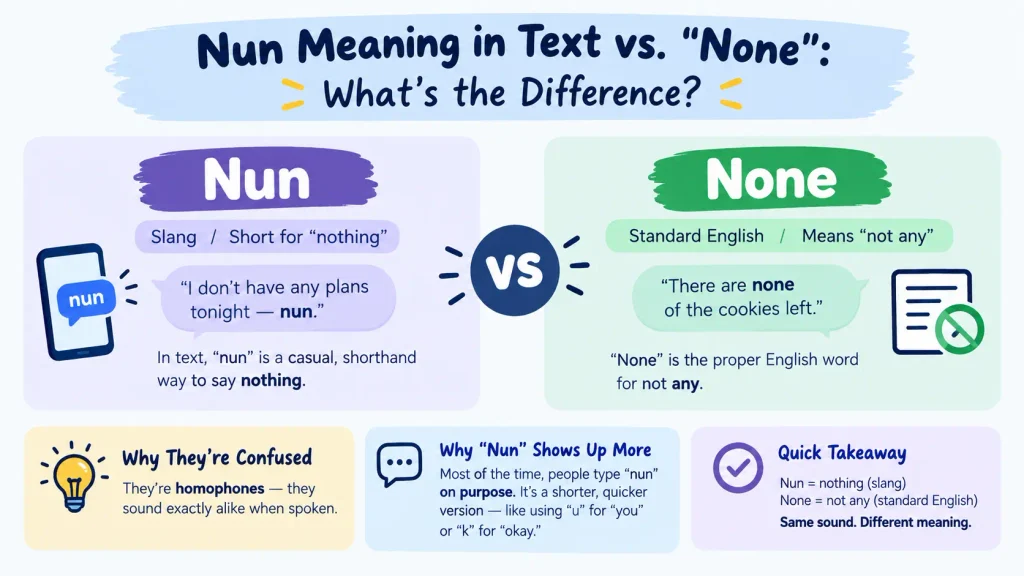
“Nun” and “none” are not the same word, even though they get mixed up constantly. One is slang; the other is standard English. “Nun” is short for “nothing.” “None” means “not any.” Understanding the nun meaning in text starts with keeping these two apart, since almost every mix-up traces back to this one point of confusion.
These two words are easy to mix up because they’re homophones; they sound exactly alike when spoken. That shared sound is the entire reason people confuse them in writing. Most of the time, though, someone typing “nun” isn’t making a mistake. They’re choosing the shorter version on purpose, the same way they’d choose “u” over “you” or “k” over “okay.”
How to Tell “Nun” and “None” Apart
Look at the question being answered:
- “Nun” usually answers something like “what are you doing?” or “what’s up?”
- “None” usually answers a question about amount, like “how many do you have?”
A simple swap test works almost every time: try inserting the full word into the sentence. If “nothing” fits, the word is “nun.” If “not any” fits better, the word is “none.” This one trick resolves nearly every case where the two words could plausibly go either way, and it’s worth remembering the next time a message leaves you second guessing which one was meant.
Where “Nun” Comes From
“Nun” comes from clipping the word “nothing” down to something faster to type. Texting has always rewarded speed over spelling. “U” became “you.” “K” became “okay.” “Thx” became “thanks.” “Nun” follows the same shortcut logic, and once you see the pattern, the nun meaning in text stops feeling random and starts feeling like just another entry in a long list of typing shortcuts.
Texting Shorthand and Clipped Words
Clipped words spread because they save time in fast moving conversations. Once one person in a group chat starts using “nun” instead of “nothing,” friends pick it up, and it becomes part of the shared vocabulary of that group. Multiply that across millions of group chats, comment sections, and DMs, and you get a widely recognized piece of slang that barely needs an explanation anymore among people who text often.
How It Spread Through Everyday Chats
Slang rarely spreads through dictionaries; it spreads through repetition. Someone types a short reply, their friends see it, and within a few exchanges it becomes the default way that whole circle answers a certain kind of question. That’s exactly how a clipped word like this one turns into something almost everyone recognizes on sight, long before they ever look it up.
How People Actually Use the Nun Meaning in Text in Real Conversations
Across group chats, DMs, and comment sections, this reply shows up almost exclusively between friends, rarely in anything formal. Here’s a typical exchange:
Friend: wyd rn? You: nun, just chillin. u?
“Wyd” means “what are you doing,” and the one word reply answers it cleanly: nothing much going on. Some people type it out of habit because it matches how “none” sounds when spoken aloud, which is exactly why the two get tangled together. But in real conversations, the original question almost always makes the intended sense obvious, so nobody actually stops to wonder which spelling was intended.
Another common exchange looks like this:
Friend: anything new with you? You: nun tbh, same old same old
Here again, the reply is answering a question about activity, not quantity, which is the fastest way to confirm the intended meaning without overthinking it.
You’ll see this word most often on:
- Text messages (SMS)
- Snapchat and Instagram DMs
- TikTok comments
- Discord chats
- Group texts between friends
It shows up far less on platforms built for work, since professional writing calls for the full word instead of a clipped one.
How to Reply When Someone Texts You “Nun”
If a friend sends this one word reply, there’s no need to overthink it. It simply means they’re free and not doing much right now. A few natural ways to keep the conversation going:
- Ask a follow up: “Nun? Want to hang out?”
- Share your own plans: “Same, just relaxing. You want to grab food?”
- Keep it light: “Lol same, bored too.”
- Turn it into an invite: “Nun sounds boring, come hang out with us.”
Most of the time, a short reply like this just signals availability, not annoyance or disinterest. Reading it as an opening rather than a dead end usually keeps the conversation moving in the right direction.
Is the Nun Meaning in Text Rude or Just Relaxed Texting?
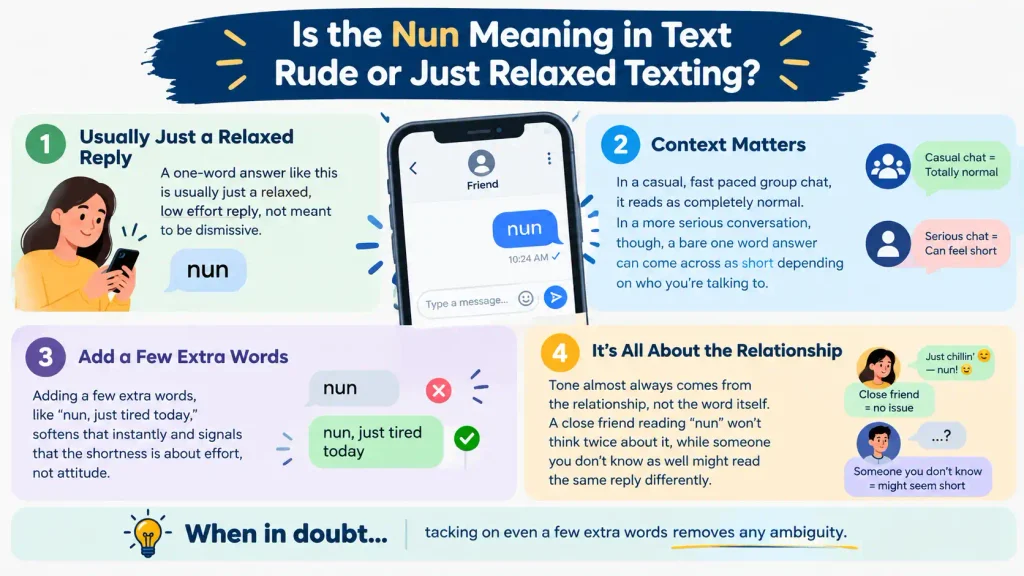
A one word answer like this is usually just a relaxed, low effort reply, not meant to be dismissive. In a casual, fast paced group chat, it reads as completely normal. In a more serious conversation, though, a bare one word answer can come across as short depending on who you’re talking to. Adding a few extra words, like “nun, just tired today,” softens that instantly and signals that the shortness is about effort, not attitude.
Tone almost always comes from the relationship, not the word itself. A close friend reading “nun” won’t think twice about it, while someone you don’t know as well might read the same reply differently. When in doubt, tacking on even a few extra words removes any ambiguity.
Who Uses This Word When Texting?
Teens and young adults use this reply the most, though anyone comfortable with casual digital conversation might use it too. It’s part of everyday chat culture rather than a term tied to one specific app or generation, even if it’s most visible among younger users on social platforms.
Slang trackers and online glossaries that document texting trends classify this word the same way most casual users do: a quick, informal stand in for “nothing,” used almost exclusively in relaxed, low stakes exchanges. It rarely, if ever, shows up in a resume, a cover letter, or a message to a manager, which is a useful line to remember when deciding whether a reply fits the situation.
Related Texting Slang
This reply belongs to a bigger family of short, everyday texting responses. A few common ones worth knowing:
- nm, nothing much
- nmu, nothing much, you?
- wbu, what about you?
- hbu, how about you?
- idk, I don’t know
- k, okay
- fr, for real
- rn, right now
These abbreviations all serve the same purpose: they keep fast moving chats efficient. Learning a handful of them makes it much easier to follow group chats without feeling lost.
Common Mistakes to Avoid With the Nun Meaning in Text
A few small mix-ups come up repeatedly:
- Don’t confuse it with “none”; one replaces “nothing,” the other replaces “not any.”
- Don’t assume the sender is upset; a short reply is usually just quick, not cold.
- Don’t use it in formal writing; save it for casual chats with friends, not work messages or emails.
- Don’t take a bare reply personally; most of the time it says more about how busy someone is than how they feel about you.
Keeping these points in mind clears up nearly every confusing moment involving this term, whether you’re the one sending it or the one trying to decode it.
Other Meanings Outside of Texting
This word carries a few unrelated meanings outside of chat slang, in case you’re searching for one of these instead:
- Nun (religious woman): A woman who has joined a religious order, often taking vows of poverty, chastity, and obedience.
- Nun (Hebrew letter): The 14th letter of the Hebrew alphabet.
- Nun (Arabic letter): Known as “nūn,” the 25th letter of the Arabic alphabet.
- Nun buoy: A cone shaped floating marker used in sailing to guide boats safely through water.
Context always makes clear which sense is intended in a given sentence.
FAQ
What is the nun meaning in text? It means “nothing.” People use it as a short, casual reply to a question like “what are you doing?” to keep fast moving conversations simple.
Is “nun” the same as “none”? No. They sound identical when spoken, but “nun” is slang for “nothing,” while “none” is a standard word meaning “not any.” The shared sound is the main source of confusion.
What does it mean on Snapchat, TikTok, or Instagram? It works the same way it does in a regular text message: shorthand for “nothing,” usually given as a quick answer about what someone is currently doing.
Why do people say it instead of spelling out “nothing”? It’s a clipped, faster way to type “nothing.” Shorter replies are quicker to send and easier to read at a glance, especially during rapid back and forth chats.
Is it rude or dismissive? Not usually. It’s typically just low effort and casual, not meant to dismiss anyone. In relaxed friend groups, it reads as completely normal.
What’s the difference between “nun” and “nm” in texting? “Nun” implies nothing at all is happening, while “nm” (“nothing much”) suggests something small is going on. Both are quick, informal replies.
What does it mean when someone texts you this word? It usually means they aren’t doing anything in particular right now. It’s an informal way to answer a question about their current activity, most common between friends rather than in formal messages.
Bottom Line
The nun meaning in text comes down to one simple idea: it’s a fast, casual way to say “nothing,” not a misspelling of “none.” Once you remember that this reply answers questions about activity while “none” answers questions about amount, the confusion disappears for good.
You’ll see it most often in group chats, DMs, and casual conversations between friends, rarely in formal writing. It belongs to a much bigger family of short texting replies, like “nm,” “wbu,” and “idk”, all built to keep fast conversations moving. Next time it shows up on your screen, you’ll know exactly what your friend means: nothing much, nothing new, just a normal, relaxed reply.
To read more: Oh Meaning in Text: Instant Clarity, No Confusion in 2026