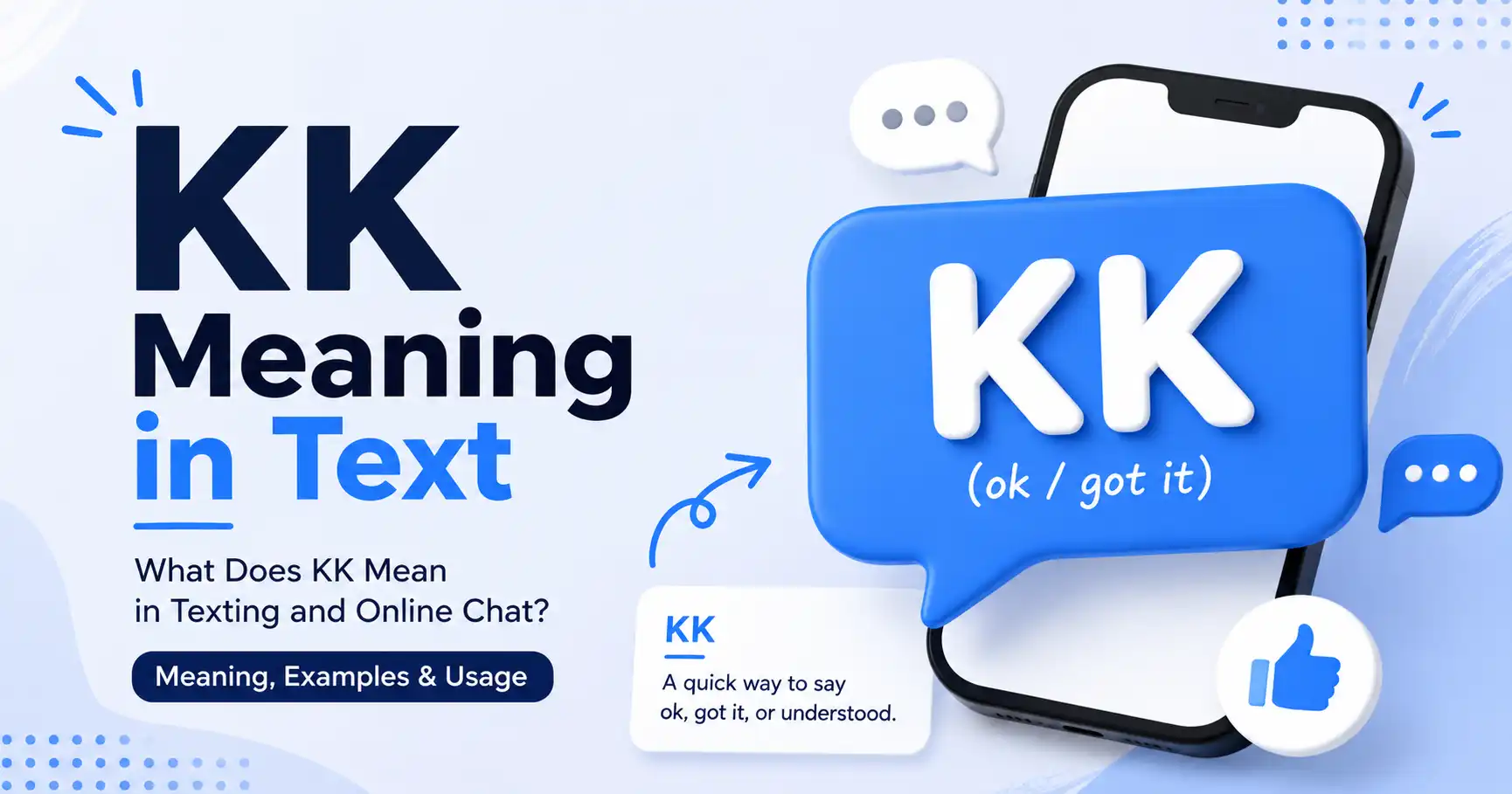
KK means “okay.” That’s the short answer to “kk meaning in text.” It’s a quick way to agree, confirm, or show you understood a message. People type it in texts, group chats, social apps, and games all the time.One quick note before we go further: KK is not related to KKK (the hate group). They share two letters. We’ll explain that mix-up in detail below.
If you’ve ever gotten a text that says “kk” and wondered if the person was mad at you, you’re not alone. This guide covers exactly what kk means, where it came from, and how to read its tone next to other short replies like “k” or “ok.”
What Does KK Mean in Text?(Quick Answer)
KK is a texting abbreviation that means “okay.” People use it to show agreement, confirm plans, or let someone know a message was received.
Here’s a simple example:
Friend: “Meet me at 6.”
You: “kk”
In this case, “kk” means “okay, I’ll be there.”
People often use kk to:
- Agree with something
- Confirm they understood
- Let someone know their message got through
One thing trips people up: the difference between “k” and “kk.” A single “k” can feel short or cold. Doubling the letter softens it. Most texters read “kk” as more relaxed and friendly than a bare “k.”Kk is one small piece of a much bigger world of internet slang and text abbreviations, alongside terms like LOL, BRB, and IDK.
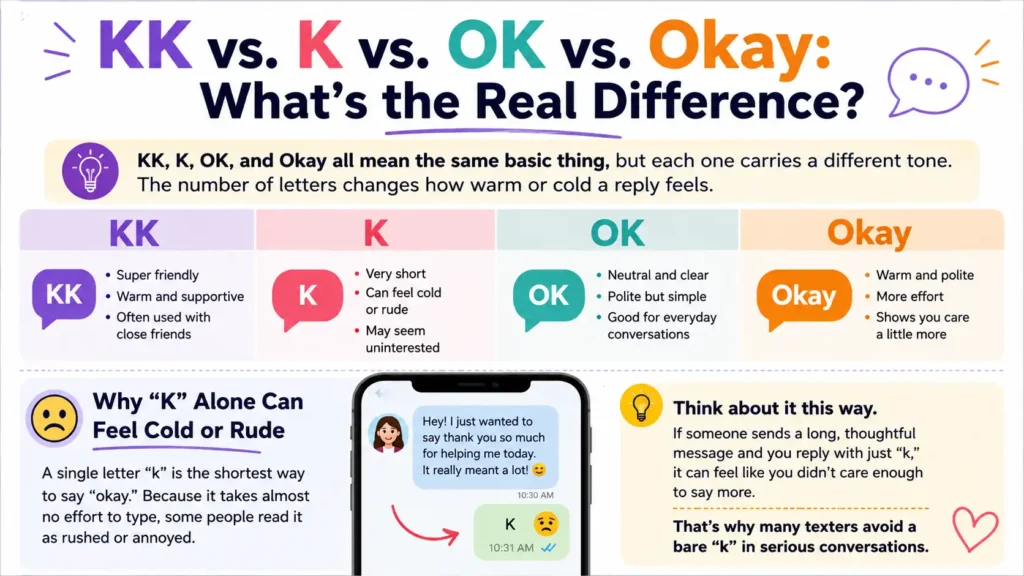
KK vs. K vs. OK vs. Okay: What’s the Real Difference?
KK, K, OK, and Okay all mean the same basic thing, but each one carries a different tone. The number of letters changes how warm or cold a reply feels.
Why “K” Alone Can Feel Cold or Rude
A single letter “k” is the shortest way to say “okay.” Because it takes almost no effort to type, some people read it as rushed or annoyed.Think about it this way. If someone sends a long, thoughtful message and you reply with just “k,” it can feel like you didn’t care enough to say more. That’s why many texters avoid a bare “k” in serious conversations.
Comparison Table: KK vs. K vs. OK vs. Okay
| Term | Tone | Best Used For | Risk of Being Misread |
| K | Blunt, sometimes cold | Very casual, low-stakes replies | High, can seem angry or dismissive |
| KK | Friendly, casual | Everyday texting, quick confirmations | Low |
| OK | Neutral | General use, work chats | Low to medium |
| Okay | Clear, polite | Formal or important messages | Very low |
If you’re unsure which to use, “kk” is usually a safe, friendly choice for casual texts. Save “okay” or “Okay” for anything more serious.
A Quick Note on “KK” vs. “KKK”
KK and KKK are two completely different things. KK is texting slang for “okay.”
KKK refers to the Ku Klux Klan, a hate group. The two are not connected in any way.
The mix-up usually happens for one simple reason: a typo. Someone means to type “kk” but hits the same key one extra time, turning it into “kkk.” Fast typing and autocorrect can both cause this.So if you see “kkk” in an otherwise normal, friendly text, about plans, homework, or a game, it’s almost certainly just an accidental extra letter. The surrounding conversation, not the letters themselves, tells you which meaning is intended.
Where Does KK Come From?
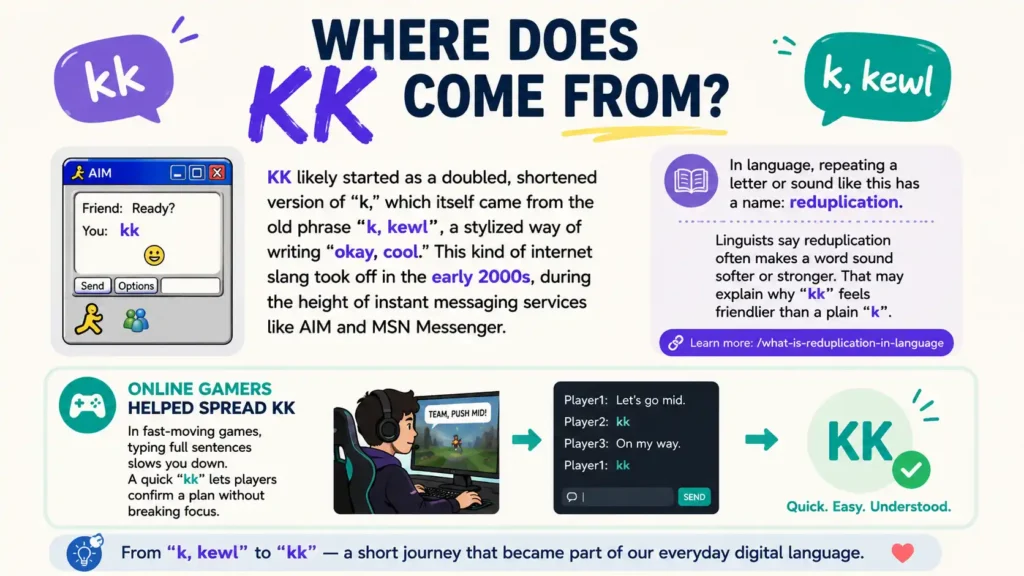
KK likely started as a doubled, shortened version of “k,” which itself came from the old phrase “k, kewl”, a stylized way of writing “okay, cool.” This kind of internet slang took off in the early 2000s, during the height of instant messaging services like AIM and MSN Messenger.
In language, repeating a letter or sound like this has a name: reduplication. Linguists say reduplication often makes a word sound softer or stronger. That may explain why “kk” feels friendlier than a plain “k”.
Online gamers also helped spread kk. In fast-moving games, typing full sentences slows you down. A quick “kk” lets players confirm a plan without breaking focus.
A Real Example of How Tone Gets Lost in “KK”
I text a lot: group chats with friends, quick check-ins with coworkers, the usual mix most people deal with every day. A while back, I sent a friend a fairly long message explaining why I couldn’t make it to her birthday dinner. She replied with just “kk.”
I remember staring at my phone, sure she was annoyed with me. It turned out she wasn’t upset at all. She was driving at the time and typed the fastest reply she could manage. When I asked her about it later, she laughed and said “kk” was just her go-to quick reply, with no hidden meaning behind it.
That moment taught me something useful: the word itself doesn’t carry the tone. The relationship and the situation do. A “kk” from a close friend usually means nothing more than “got it.” The same “kk” from someone you barely know can feel harder to read.
How and Where People Use KK
People use kk across almost every kind of digital chat, texting, gaming, social media, and sometimes casual workplace messages. Where you see it often shapes what it means.
In Texting and Group Chats
This is the most common home for kk. It keeps group conversations moving without everyone writing full sentences over SMS or messaging apps like WhatsApp.
- “Dinner’s at 7.”, “kk”
- “Don’t forget your homework.” “kk got it”
In Gaming and Discord
Gamers use kk to confirm plans fast, often in the middle of a match. Speed matters more than politeness here.
- “Cover the left side.” “kk”
- “Ready to start?” “kk go”
On Snapchat, TikTok, and Instagram
On social apps, kk usually shows agreement or wraps up a short exchange.
- “See you tomorrow!”, “kk 😊”
- “I’ll send the link.”, “kk thanks”
At Work or in Professional Messages
This is where kk gets risky. Between close coworkers in a casual chat, it might be fine. In emails, with clients, or with your boss, it can look too casual.
It’s safer to use “Okay,” “Understood,” or “Got it” in professional settings.
Does Punctuation Change What KK Means?
Yes, punctuation and emojis can change how kk feels, even though the word stays the same. Small details like a period or an exclamation point shift the tone a lot.
| Style | Feels Like |
| kk | Neutral, casual |
| kk! | Upbeat, enthusiastic |
| kk. | More final or serious |
| kk… | Uncertain, hesitant |
| kk 🙂 | Warm and friendly |
If you want to sound extra friendly, add an emoji or a few extra words, like “kk, see you soon!”
Is KK Rude? (And Other Common Misconceptions)
No, kk is not rude on its own. Most of the time, it’s a normal, friendly way to say “okay.” Here are a few myths worth clearing up.
Myth: KK always means someone is annoyed.
Not true. Tone comes from the whole conversation, not from this one word alone.
Myth: KK and K mean the same thing.
Not quite. Many readers see “k” as colder and “kk” as warmer, even though both technically mean “okay.”
Myth: KK always ends a conversation.
Not always. It simply confirms understanding. The chat can continue right after.
Myth: Only teens use KK.
Not anymore. Both Gen Z and Millennials use it, along with plenty of parents and coworkers, in casual chats.
What to Say Instead of KK (Alternatives Table)
If kk feels too casual for the moment, plenty of other options say “okay” without the slang. The right pick depends on who you’re talking to.
| Alternative | Tone | Best Context |
| Sure | Friendly | Casual chats |
| Got it | Clear, professional | Work messages |
| Understood | Formal | Emails, instructions |
| Will do | Helpful | Tasks or requests |
| Sounds good | Warm, casual | Plans with friends |
| Noted | Professional | Workplace confirmations |
For anything formal, skip the slang entirely and use a full sentence, like “Okay, I’ll take care of it.”
Does KK Mean Something Different in Other Languages?
Yes, outside of English texting, “kk” or similar letters can point to a completely different idea. The same letters can attach to different meanings depending on the language.
Korean “ㅋㅋ” (Laughter, Not “Okay”)
In Korean, the letter “ㅋ” makes a “k” sound and is used to show laughter, similar to “haha” in English. When people type “ㅋㅋ,” or write it out as “kk,” it means laughing, not “okay.” This is a different symbol tied to a different meaning than the English texting term.
Japanese “K.K.” (A Company Suffix)
In Japan, “K.K.” is short for “Kabushiki Kaisha,” a term added after a company’s name, similar to “Inc.” or “Corp.” in English. It has nothing to do with texting slang.
Finnish and Dutch Meanings
In Finnish, “kk” can be short for “month.” In Dutch, “kk” is sometimes linked to “kanker,” the word for cancer, though this use is rare and very different from the English texting term.
These examples show why context and language both matter when figuring out what “kk” means in any given message.
Other Meanings of KK (Kiss Kiss, and More)
In some close relationships, “KK” can also stand for “kiss kiss,” used as a sweet way to end a message. This meaning shows up far less often than the “okay” meaning, usually only between couples or close friends.
If “KK” appears at the very end of a warm, affectionate message, instead of as a quick reply to a question, it might carry this second, softer meaning rather than a simple acknowledgment.
Frequently Asked Questions
Is kk the same as ok?
Yes, “kk” and “ok” both mean “okay.” The main difference is tone: the doubled letter in “kk” usually reads as slightly warmer and more casual, while “ok” feels a bit more neutral and standard across texting and messaging apps.
Is kk rude in texting?
No, “kk” is not inherently rude. Most texters read it as a friendly, quick way to say “got it” or “sounds good.” It can feel colder only in a tense or emotional conversation, where any short reply might come across as dismissive.
What’s the difference between k and kk?
“K” alone often feels blunt, rushed, or even annoyed, since it takes almost no effort to type. “Kk” is generally seen as warmer and more conversational, even though both technically mean the same thing: “okay.”
Why do people say kk instead of ok?
“Kk” feels faster and friendlier to type than “ok” for many texters. It started in gaming and instant-messaging chats, where quick replies mattered, and stuck around because the doubled letter softens the tone compared to a shorter reply.
What does kkk mean in a text, and is it related to kk?
“Kkk” is unrelated to “kk.” It’s almost always a simple typo, where an extra letter was added by accident. “Kk” means “okay,” while “KKK” refers to the Ku Klux Klan and has no real connection to everyday texting slang.
What does kk mean from a girl or guy?
“Kk” means the same thing no matter who sends it: “okay” or “got it.” The tone you read into it depends far more on your relationship with that person, and the conversation itself, than on whether a girl or guy typed it.
Can I use kk in a work email or professional message?
It’s best to avoid “kk” in formal settings like emails or client messages. Words like “Okay,” “Understood,” or “Noted” sound more polished and professional, while still confirming that you received and agreed with the message.
The Bottom Line on KK
So, what’s the real “kk meaning in text”? It’s simply “okay”, a small, fast, friendly way to agree or confirm something. It carries almost no hidden meaning on its own, and it’s definitely not connected to KKK.
The next time someone sends you a bare “kk,” don’t overthink it. Most of the time, it just means “got it, sounds good.” Whether it’s a friend, a coworker, or a gamer on the other end, you’ll now know exactly what they mean.
to read more: RCS Meaning in Text Message: The Essential, Easy Guide in 2026

Digital Communication Writer
Focus: everyday texting slang, emoji meanings, casual chat abbreviations (NGL, LY, DND, etc.)
Bio angle: Grew up navigating group chats and social apps, explains slang the way it’s actually used, with real examples showing serious vs. joking vs. sarcastic tone.