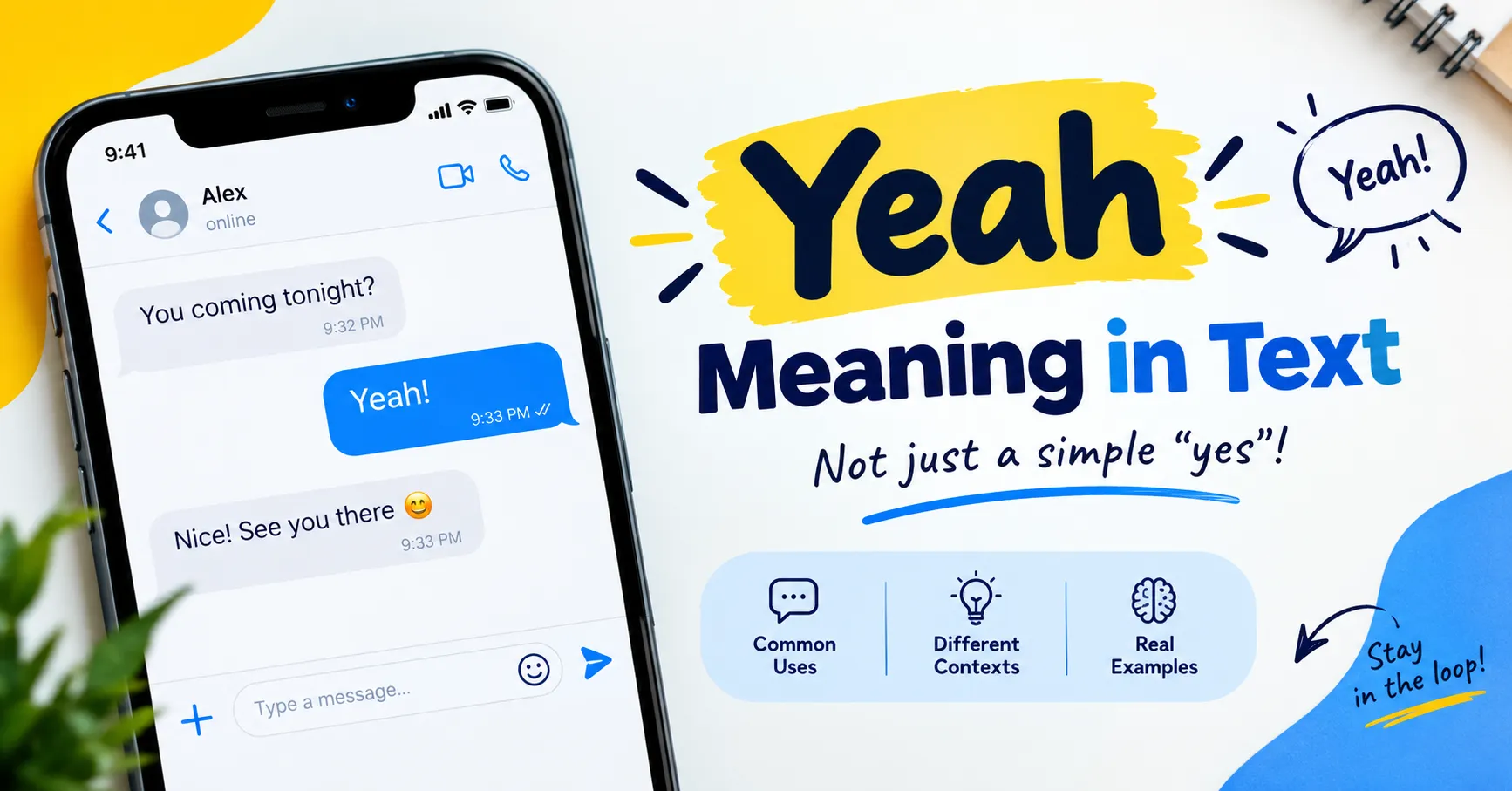
Yeah meaning in text starts with a simple idea: “yeah” means “yes.” In a text message, it is a casual and informal way to agree with someone or answer a question. But the exact tone of “yeah” can change based on punctuation, timing, and the words around it.
This guide breaks down what “yeah” really means in texting, how tone changes its meaning, and how it compares to similar words like “yea,” “yay,” and “ya.” You will also learn the five tones that most people misread.
Quick Answer: Yeah Meaning in Text at a Glance
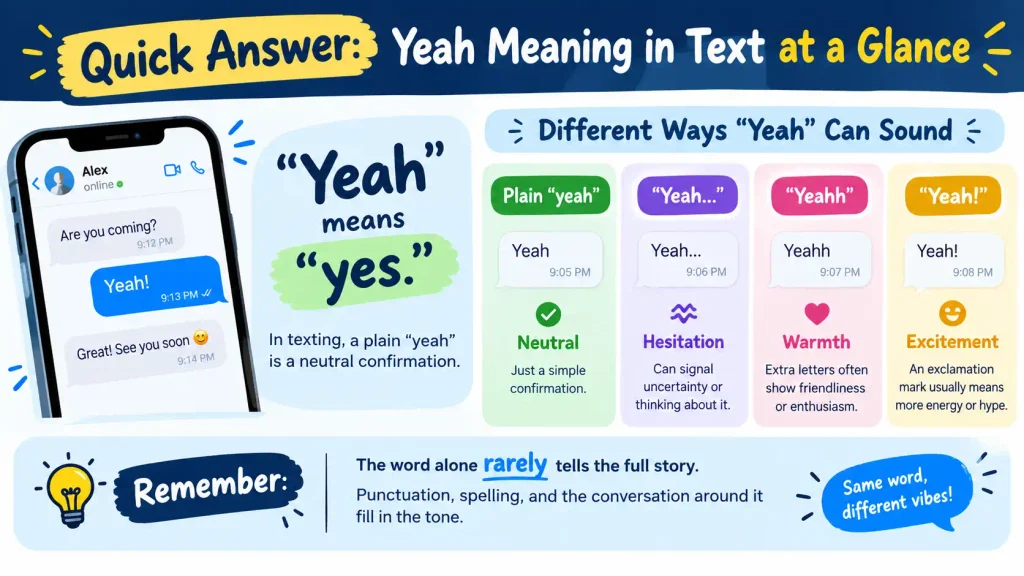
“Yeah” means “yes.” In texting, a plain “yeah” is a neutral confirmation. Adding dots (“yeah…”) can signal hesitation, while extra letters or an exclamation mark (“yeahh,” “yeah!”) usually signal warmth or excitement. The word alone rarely tells the full story. Punctuation, spelling, and the conversation around it fill in the tone.
Yeah Meaning in Text: Definition and Why Context Changes Everything
“Yeah” is an informal way of saying “yes.” People use it in casual speech and in texting more than in formal writing. It is an interjection, a short word used to show agreement or a reaction. According to Merriam-Webster, “yeah” is simply an informal way of saying yes. It comes from spoken English, so it feels more relaxed and friendly than the word “yes.”
Here is the simple part. “Yeah” and “yes” mean the same thing. The difference is tone, not meaning. “Yes” sounds more formal. “Yeah” sounds more relaxed and everyday.
But there is more to it. When you talk out loud, your voice shows how you feel. A flat “yeah” sounds different from an excited “yeah!” In a text message, there is no voice. So people show tone through punctuation, spelling, how fast they reply, and the words around the “yeah.” These small clues help the reader guess the sender’s mood.
Tone 1: A plain “yeah.” A bare “yeah” with no punctuation is usually a simple, neutral confirmation. It answers a question without adding extra feeling. For example, if someone asks, “Are you coming today?” and you reply, “Yeah,” that is a clear, calm yes. Nothing more, nothing less.
Tone 2: “Yeah…” with dots. Adding dots after “yeah” often signals hesitation. It can mean the person agrees, but something feels off or unsaid. If a friend asks a question and gets “yeah…” in reply, it may hint that the sender is not fully sure, or that there is more they have not said yet.
Tone 3: “Yeah!” or “yeahh.” Adding an exclamation mark or extra letters usually makes “yeah” sound more excited or friendly. “Yeahh” or “yeahhh” can feel warmer or more playful than a plain “yeah.”
Is a one-word “yeah” text rude or dry? A one word “yeah” text is not automatically rude. It often just means the person is confirming something quickly and casually. It can feel dry only in certain cases, like when it replies to a long or emotional message with no follow up at all. In most everyday chats, a plain “yeah” is simply efficient, not unfriendly.
Yeah Meaning in Text: What I Learned From Real Chats
I started noticing the word “yeah” a lot when chatting with friends and family through text messages. At first, I thought it was simply an informal way of saying “yes.” But after seeing it used in different conversations, I realized “yeah” can carry slightly different meanings depending on the situation and tone.
One example stuck with me. Someone asked me, “Are you coming today?” and I replied, “Yeah.” I was just confirming that I would come. Nothing complicated about it.
But in another conversation, a friend asked me a question, and I replied with “yeah…” The extra dots made my reply feel less enthusiastic, even though the basic meaning was still agreement. I had not meant to sound unsure. Looking back, I could see how that short reply read that way.
I also noticed that people use “yeah,” “yeahh,” “yeahhh,” and “yea” in different ways in casual texting. A simple “yeah” often works as a quick confirmation. “Yeahh,” on the other hand, can sound more friendly or playful.
Because of these small moments, I learned that understanding the meaning of ” yeah ” in text means looking at the whole conversation, not just the single word. Today, when I see “yeah” in a message, I think about the question being answered, my relationship with that person, and the words around it before deciding what they really mean. This habit has helped me avoid misreading short text replies more than once.
Yeah Meaning in Text in Different Texting Situations
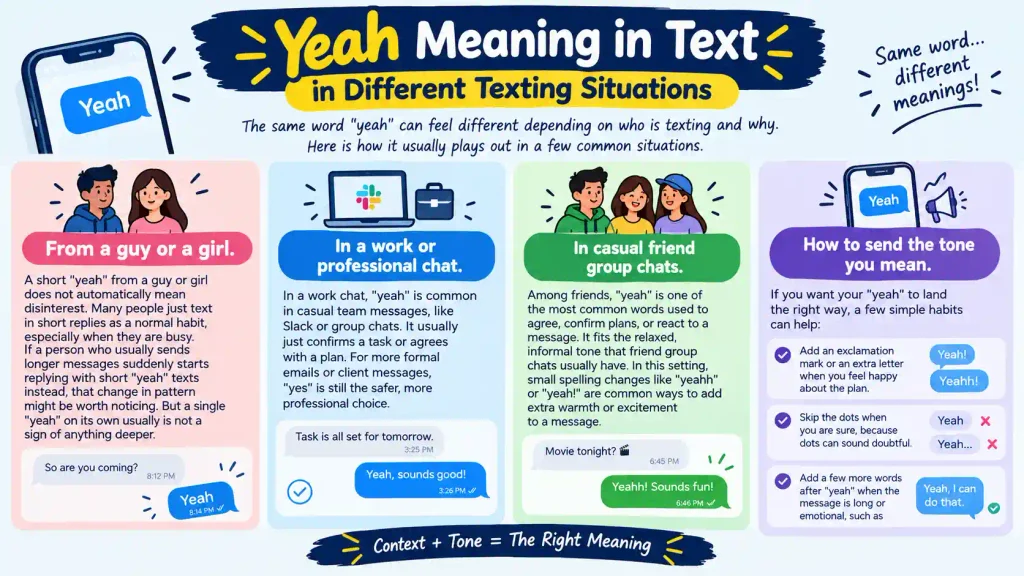
The same word “yeah” can feel different depending on who is texting and why. Here is how it usually plays out in a few common situations.
From a guy or a girl. A short “yeah” from a guy or girl does not automatically mean disinterest. Many people just text in short replies as a normal habit, especially when they are busy. If a person who usually sends longer messages suddenly starts replying with short “yeah” texts instead, that change in pattern might be worth noticing. But a single “yeah” on its own usually is not a sign of anything deeper.
In a work or professional chat. In a work chat, “yeah” is common in casual team messages, like Slack or group chats. It usually just confirms a task or agrees with a plan. For more formal emails or client messages, “yes” is still the safer, more professional choice.
In casual friend group chats. Among friends, “yeah” is one of the most common words used to agree, confirm plans, or react to a message. It fits the relaxed, informal tone that friend group chats usually have. In this setting, small spelling changes like “yeahh” or “yeah!” are common ways to add extra warmth or excitement to a message.
How to send the tone you mean. If you want your “yeah” to land the right way, a few simple habits can help:
- Add an exclamation mark or an extra letter when you feel happy about the plan.
- Skip the dots when you are sure, because dots can sound doubtful.
- Add a few more words after “yeah” when the message is long or emotional, such as “Yeah, I can do that.”
Yeah Meaning in Text vs. Ya, Yea, Yay, Yep, and Yup
Texting has created several spelling forms of “yeah.” Here is how they compare.
Yeah vs. ya vs. yh. “Ya” and “yh” are shorter, faster ways to type “yeah,” often used when someone is typing quickly on a phone. They mean the same thing as “yeah,” just with a more rushed or casual feel.
Yeah vs. yea vs. yay. These three words look similar but mean very different things. “Yeah” meaning in text is a casual way to say “yes.” “Yea” is a formal way to agree, often used in voting, as in “all in favor say yea.” “Yay” is an exclamation of excitement or celebration, like “Yay, we won!”
Yeah vs. yep vs. yup. “Yep” and “yup” are also casual ways to say “yes,” similar to “yeah.” They tend to sound a bit more playful or blunt, and they are common in both speech and texting.
| Word | Meaning | Typical Tone |
| Yeah | Casual yes | Neutral, everyday |
| Yeahh / Yeahhh | Casual yes, extra emphasis | Warm, playful |
| Ya / Yh | Casual yes, quick typing | Rushed, informal |
| Yea | Formal agreement (voting) | Formal |
| Yay | Excitement or celebration | Excited, happy |
| Yep / Yup | Casual yes | Blunt, playful |
Yeah Meaning in Text in Common Phrases, Origin, and Synonyms
Some phrases built around “yeah” do not mean plain agreement. Here are the most common ones.
Tone 4: What does “yeah, right” mean? “Yeah, right” is a sarcastic phrase. It means the speaker doubts what was just said, not that they agree with it. For example, if someone says, “I finished my homework in five minutes,” and you reply, “Yeah, right,” you are showing disbelief, not confirming the claim.
Tone 5: What does “yeah, yeah” mean? “Yeah, yeah” can mean two different things, depending on context. It can be a relaxed way of agreeing, or it can signal mild annoyance, like “I already know, you can stop explaining.” Without more context, it is hard to know which meaning is meant. Reading the surrounding messages usually makes it clear.
What does “oh yeah” mean? “Oh yeah” often shows sudden excitement, agreement, or remembering something. For example, “Oh yeah, I forgot to tell you!” shows a small burst of memory or realization.
Where does “yeah” come from? “Yeah” comes from American English and became common in the early 1900s. It developed as a relaxed, spoken version of “yes.” The Online Etymology Dictionary traces “yeah” back to a casual, drawled pronunciation of “yes.” Over time, “yeah” spread into both American and British English as a normal, informal word.
Synonyms and antonyms of “yeah.” The synonyms of “yeah” are yes, yep, yup, sure, and okay. The antonyms are no, nope, and nah.
Yeah Meaning in Text: Frequently Asked Questions
Q: What does “yeah” mean in a text? A: In a text message, “yeah” is an informal way of saying “yes,” but its exact tone depends on punctuation, timing, and the conversation around it. A plain “yeah” usually reads as a neutral confirmation, while “yeah…” or a delayed reply can suggest hesitation.
Q: Is yeah the same as yes? A: “Yeah” means the same thing as “yes.” It is simply the casual, informal version used in speech and texting. “Yes” is more appropriate for formal writing and professional emails, while “yeah” fits everyday conversation with friends, family, and close coworkers.
Q: What does it mean when someone just texts “yeah”? A: A one word “yeah” text is most often a simple, neutral confirmation rather than a sign of disinterest. Context matters. The same “yeah” can feel warm in an ongoing casual chat, or it can feel short in response to a longer message.
Q: What is the difference between yeah, yea, and yay? A: “Yeah” is a casual way of saying yes. “Yea” is a formal yes, mainly used in voting or historical writing. “Yay” is an exclamation of excitement or celebration. They sound alike, but each one serves a completely different purpose in a message.
Q: Why do people spell it “yeahh” or “yeahhh” in texts? A: Repeating the final letter, as in “yeahh” or “yeahhh,” is a texting habit that signals extra enthusiasm, playfulness, or friendliness compared to a plain “yeah.” It copies the effect of vocal emphasis that written text cannot otherwise show.
Bottom Line: Yeah Meaning in Text Depends on Tone
“Yeah“ is a small word, but in texting, it carries more weight than it seems. A single extra letter, an added dot, or an exclamation mark can shift a simple “yes” into something warmer, more hesitant, or more sarcastic. The real meaning lives in the tone and context around the word, not just the word itself. The next time you see “yeah” in a message, check the punctuation, the spelling, the reply time, and the conversation around it. That is where the real meaning lives.
To read more: RBF Meaning in Text: 5 Proven Ways to Avoid Awful Mistakes