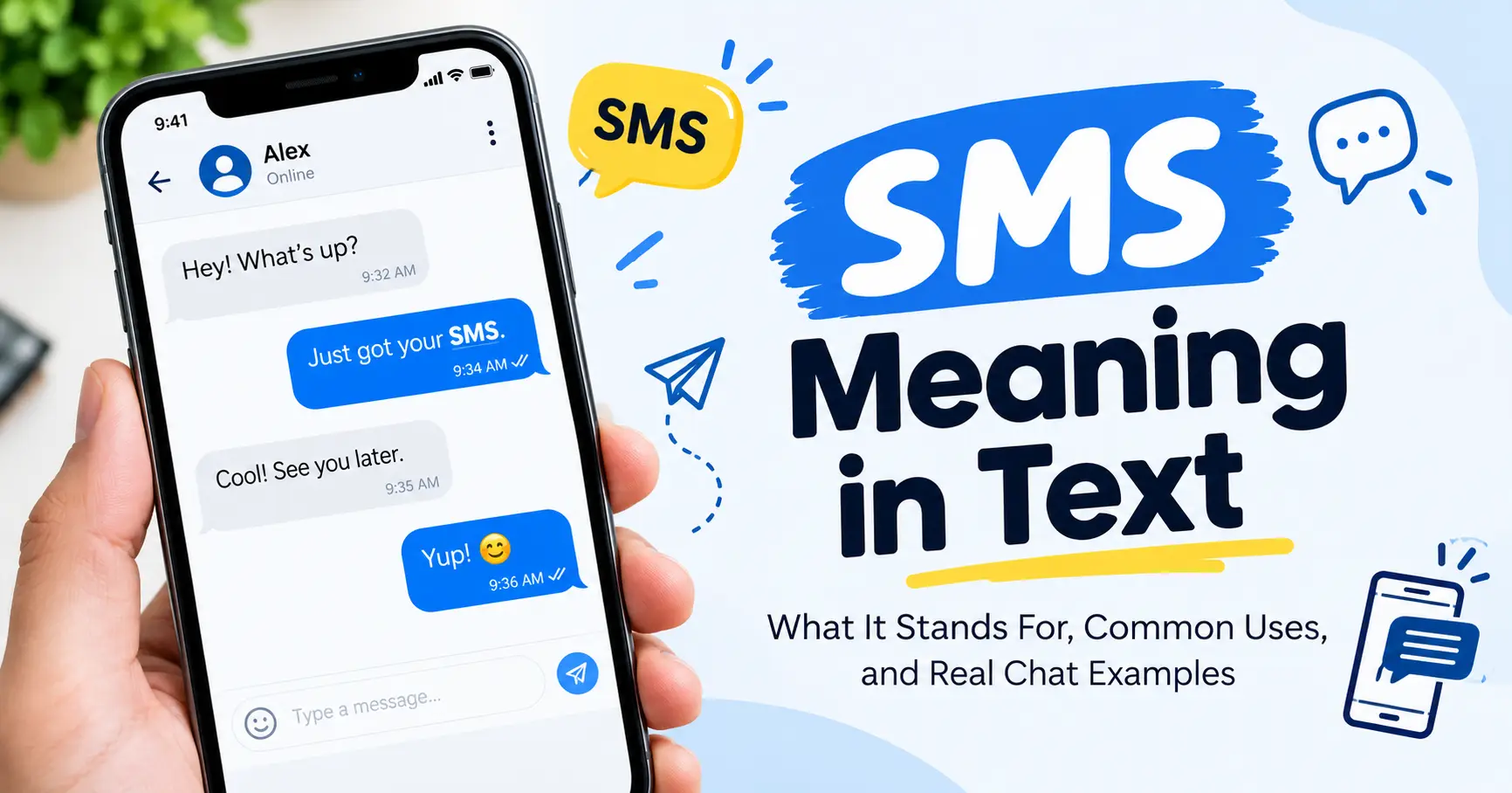
It comes down to one simple idea: Short Message Service, the plain text standard built into nearly every mobile phone. It sends text between phones over a cellular network, not the internet, so you don’t need Wi-Fi or a data plan to send one. This guide explains it in plain language, including why your text sometimes turns green instead of blue, and whether that means you’ve been blocked. No jargon is left unexplained.
Quick Answer: SMS Meaning in Text Messages Explained
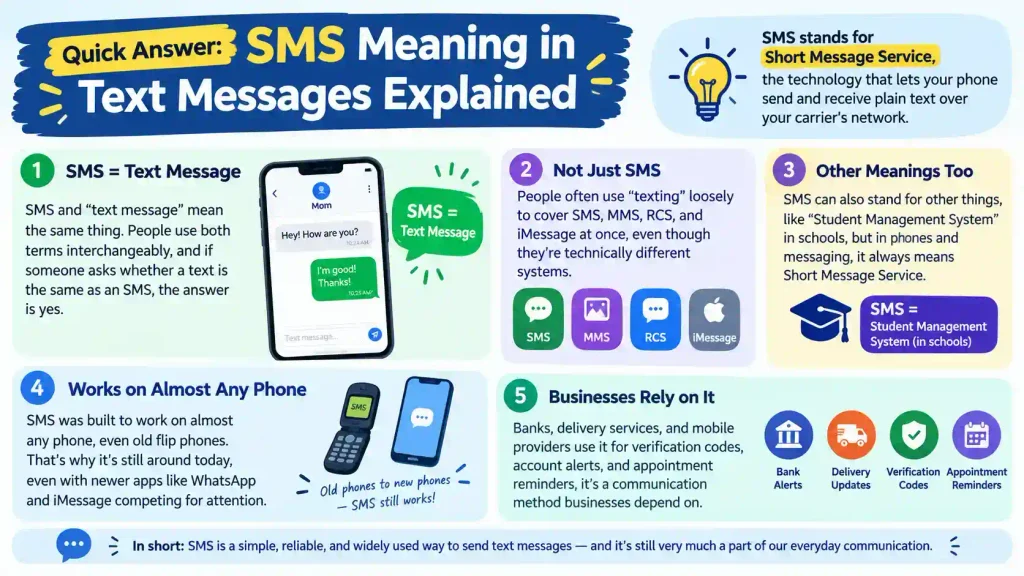
SMS stands for Short Message Service, the technology that lets your phone send and receive plain text over your carrier’s network. SMS and “text message” mean the same thing; people use both terms interchangeably, and if someone asks whether a text is the same as an SMS, the answer is yes.
One note on wording: people often use “texting” loosely to cover SMS, MMS, RCS, and iMessage at once, even though those are technically different systems. SMS can also stand for other things, like “Student Management System” in schools, but in phones and messaging, it always means Short Message Service.
SMS was built to work on almost any phone, even old flip phones. That’s why it’s still around today, even with newer apps like WhatsApp and iMessage competing for attention. Banks, delivery services, and mobile providers use it for verification codes, account alerts, and appointment reminders; it’s a communication method businesses depend on.
SMS Meaning in Text Messages and the “Blocked” Myth
Seeing “SMS” instead of “iMessage” or “RCS” does not mean you’ve been blocked. It just means your phone sent the message using the standard cellular protocol instead of an internet-based one. This confusion is one of the most common questions people ask about texting.
Your phone tries the “smarter” system first, iMessage on an iPhone, or RCS on Android, and falls back to plain SMS when the recipient doesn’t have that feature turned on, uses a different type of phone, has no internet connection, or their carrier doesn’t support RCS yet. None of these reasons have anything to do with being blocked.
People often lump three different things into one word, “blocked.” If a contact has blocked you, the message often still shows as “sent,” with no error at all. If your carrier flagged it as spam, you might see “message failed”, a network issue, not a personal block. A general delivery failure might show “network problem,” usually from a weak signal. The safest way to know if someone blocked you is to call them or ask a mutual friend; an unusual text is not solid proof either way.
SMS Meaning in Text Messages: Why Bubbles Turn Green
On an iPhone, a blue bubble means the message was sent using iMessage over the internet. A green bubble means it was sent as SMS or MMS over the cellular network instead. A green bubble is not a warning sign; it usually just means the other person has an Android phone, or their internet connection dropped for a moment.
SMS Meaning in Text Messages: How the Message Actually Travels
Your phone doesn’t send a text straight to your friend’s phone; it takes a short trip first. Your phone forwards it to your carrier’s Short Message Service Center (SMSC), think of it as a mail-sorting station, which figures out the recipient’s network and routes the message there. If the recipient’s phone is on and in range, it arrives almost instantly; if it’s off or out of range, the SMSC holds the message and delivers it once the phone reconnects. The whole trip usually takes just a few seconds.
SMS travels over your carrier’s cellular signal, not the internet, which is different from apps like WhatsApp or iMessage that need Wi-Fi or mobile data. That’s exactly why it still matters: it works in places with weak internet, during emergencies, and on phones with no messaging apps installed at all. That reliability shows up in the numbers, too: industry research from CTIA and Mobile Marketing Watch puts the average SMS open rate at around 98%, far higher than email.
SMS Meaning in Text Messages: Character Limits Explained
A standard SMS message can hold up to 160 characters, a limit rooted in the older telecom signaling system SMS was originally built for. SMS uses a coding system called GSM-7 for basic English letters, numbers, and symbols, packing each character into just 7 bits of data; that’s what makes room for exactly 160 characters in a single message.
If your message runs longer, your phone doesn’t cut it off. It splits the message into segments and sends them one after another, each part after the first usually 153 characters long, since a little extra data is needed to stitch the parts back together. Your phone reassembles them on the other end, so you never notice the split.
Emojis and characters from languages like Chinese, Arabic, or Russian don’t fit into GSM-7, so they use a different system called UCS-2, which needs more data per character. That drops the limit from 160 down to just 70 characters per segment, which is why a text with even one emoji can suddenly split into multiple parts.
| Message Type | Encoding | Max Characters (single message) |
| Plain English text | GSM-7 | 160 |
| Text with emoji or special characters | UCS-2 | 70 |
| Multi-part (long) message | Segmented | Up to 1,600 total |
SMS Meaning in Text Messages vs. MMS, RCS, iMessage, and WhatsApp
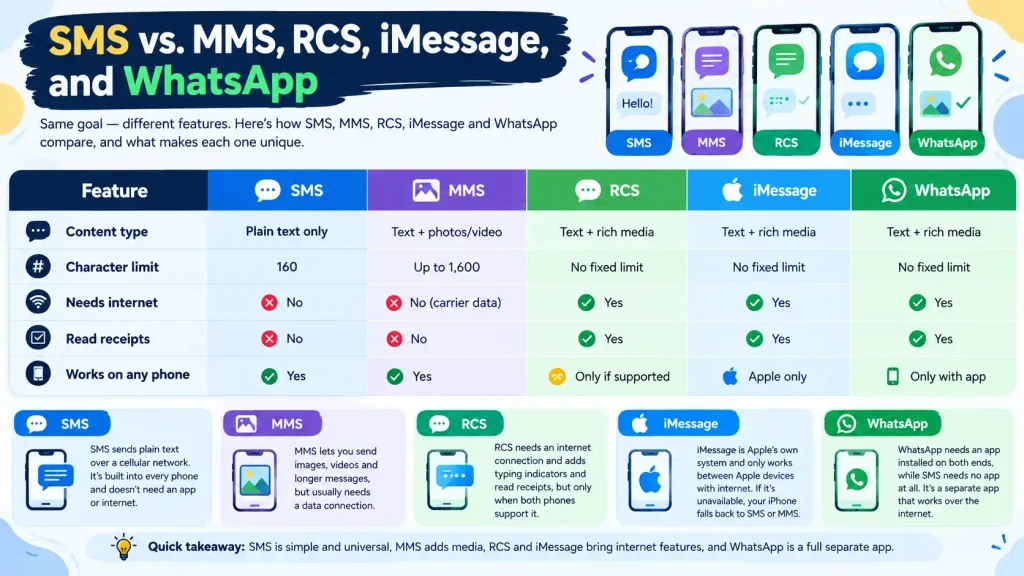
SMS sends plain text over a cellular network. MMS adds photos and video. RCS and iMessage add internet-based features like read receipts. WhatsApp is a separate app that needs internet on both ends.
| Feature | SMS | MMS | RCS | iMessage | |
| Content type | Plain text only | Text + photos/video | Text + rich media | Text + rich media | Text + rich media |
| Character limit | 160 | Up to 1,600 | No fixed limit | No fixed limit | No fixed limit |
| Needs internet | No | No (carrier data) | Yes | Yes | Yes |
| Read receipts | No | No | Yes | Yes | Yes |
| Works on any phone | Yes | Yes | Only if supported | Apple only | Only with app |
MMS, or Multimedia Messaging Service, lets you send images, videos, and longer messages, but usually needs a data connection. RCS, or Rich Communication Services, needs an internet connection and adds typing indicators and read receipts, but only when both phones support it. iMessage is Apple’s own system and only works between Apple devices with internet; when it’s unavailable, an iPhone automatically falls back to SMS or MMS. WhatsApp needs an app installed on both ends, while SMS needs no app at all; it’s built directly into every phone’s basic texting function.
SMS Meaning in Text Messages and Security Risks
SMS is not encrypted, which makes it less private than apps like WhatsApp or Signal, though it’s still widely trusted for everyday use because of how reliable and universal it is. When you send an SMS, the message travels through your carrier’s network without end to end encryption, so avoid sending sensitive details like passwords or bank information through plain text.
Smishing is phishing done through text messages instead of email; scammers send fake texts pretending to be your bank or a delivery company, hoping you’ll click a bad link. SMS spoofing is when a scammer disguises the sender’s number, making a text look like it came from someone you trust, which is why you can’t always trust the number shown on a message. A few habits keep you safer: don’t click links in unexpected texts, call the company directly if you’re unsure a message is real, and never share passwords or codes over text.
Many apps also send a one-time password by SMS as part of two factor authentication, adding a helpful layer of login security beyond just a password. One risk worth knowing about is a “SIM swap” scam, where someone tricks your carrier into moving your number to their SIM card and could receive your codes instead of you. Even with that risk, SMS based two factor authentication is still far safer than a password alone.
SMS Meaning in Text Messages: Cost and History
Most phone plans today include unlimited texting, so most people never pay per message. Standard SMS is usually included free; MMS can sometimes cost extra depending on your carrier; pay-per-text plans still exist and typically charge a small fee per message; and international texting often costs more than sending within your home country. If you’re unsure what your plan includes, check with your carrier directly, since rates change often.
SMS was standardized as part of GSM (Global System for Mobile Communications) in the mid-1980s, though it took a few more years before anyone actually used it. The first SMS text message was sent on December 3, 1992, when engineer Neil Papworth sent “Merry Christmas” over Vodafone’s network in the UK. For years afterward, it was mostly used for short, personal messages between friends and family, and over time it grew into a tool businesses now use for reminders, alerts, and customer updates, alongside newer options like RCS and messaging apps.
FAQs About SMS Meaning in Text Messages
What does SMS mean? SMS stands for Short Message Service, a text-messaging standard built into nearly every mobile phone. It sends plain text between phones over a cellular network, not the internet, which is why it works even without Wi-Fi or a data plan.
Does SMS mean I’m blocked? No. Seeing “SMS” instead of “iMessage” or “RCS” simply means your message was sent over the standard cellular protocol instead of an internet-based one, usually because the recipient’s device or connection doesn’t support the other format.
Is SMS the same as a text message? Yes. SMS and text message refer to the same thing: a plain-text message sent over a cellular network instead of the internet. People use both words interchangeably in everyday conversation.
What’s the difference between SMS and MMS? SMS is limited to plain text and capped at 160 characters. MMS adds support for photos, videos, and audio, along with longer messages, but usually needs a data connection.
What’s the difference between SMS and RCS? SMS works on any phone over a cellular signal with no internet required. RCS needs an internet connection and adds read receipts and typing indicators, but only when both phones support it.
Why did my text send as SMS instead of iMessage? Your iPhone falls back to SMS when the recipient doesn’t have iMessage available, for example, if they use an Android phone or have no internet connection.
Is SMS safe to use? SMS isn’t end-to-end encrypted, so it’s technically less private than apps like WhatsApp or Signal. Even so, it remains one of the most trusted and widely used messaging methods, partly because it’s commonly used for two factor authentication codes.
The Bottom Line on SMS Meaning in Text Messages
SMS has been quietly running in the background of billions of conversations since 1992, and it’s still doing its job today, no Wi-Fi required, no app to download, no green bubble to feel bad about. Now that you know the full meaning behind it, the next time your phone shows “SMS” instead of “iMessage,” you’ll know exactly what’s happening behind the scenes, and you can stop wondering if it means something it doesn’t.
To read more: Yeah Meaning in Text: 5 Secret Tones Most Get Wrong