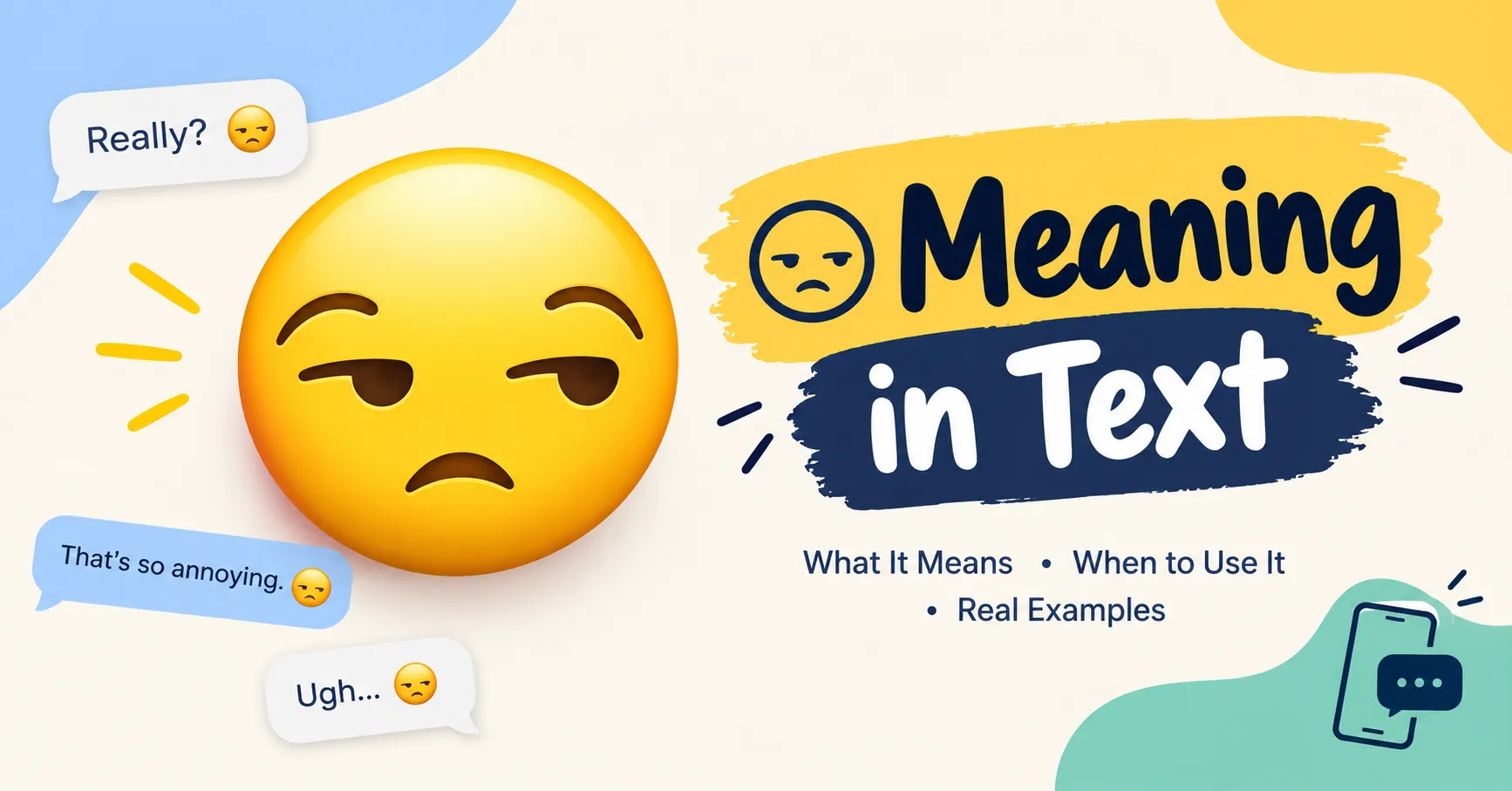
😒 Meaning in text usually points to one thing: the sender feels annoyed, unimpressed, or a little unsure about something. This is not the same as simply saying something “wasn’t funny.” The unamused face can also show boredom, doubt, or light sarcasm.
What it truly means often depends on who sent it and what came right before it. This guide will help you figure that out, step by step.
😒 Meaning in Text: Quick Definition
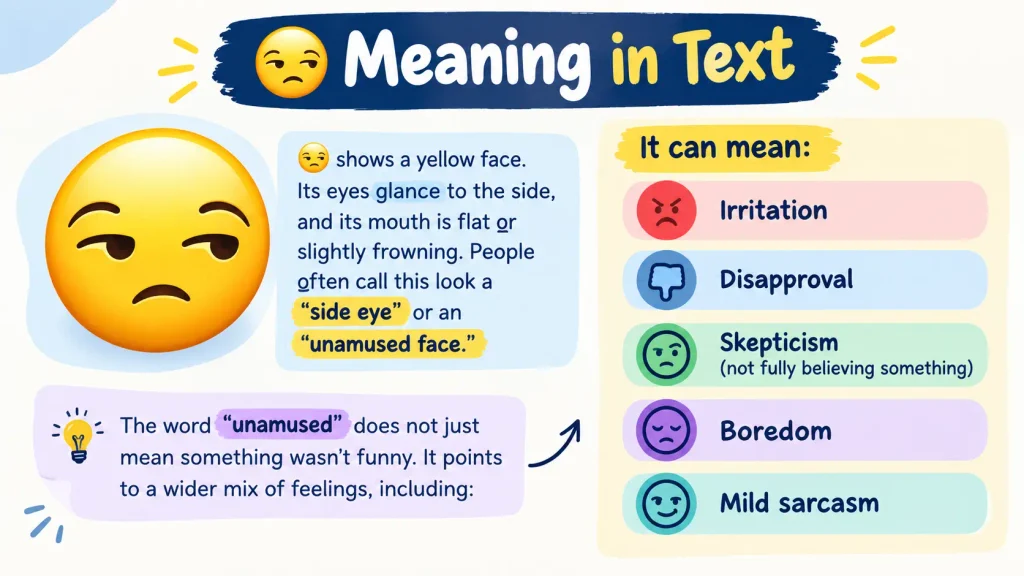
😒 shows a yellow face. Its eyes glance to the side, and its mouth is flat or slightly frowning. People often call this look a “side eye” or an “unamused face.”
The word “unamused” does not just mean something wasn’t funny. It points to a wider mix of feelings, including:
- Irritation
- Disapproval
- Skepticism (not fully believing something)
- Boredom
- Mild sarcasm
It can be mild, like simple boredom or a shrug. It can also be sharper, like real annoyance. The words around it usually show how strong the feeling is.
Think of 😒 as a silent way to say, “Really?” or “I’m not buying that.” It’s a small picture that carries a big attitude. That is why the same face can feel harmless to one person and harsh to another.
😒 Meaning in Text: How It Works in Texting and Group Chats
In texting, 😒 usually shows up as a quick reaction, not a full sentence. You’ll see it a lot in DMs (direct messages) and group chats, where one small symbol can say more than a long reply. Many people, especially younger texters, use it as internet shorthand for doubt or side-eye.
Genuine annoyance vs. joking use. The same emoji can mean two very different things, and tone is the key.
- Genuine annoyance: Sent after bad news, a broken promise, or something upsetting. It often stands alone, with no other words or emoji.
- Joking use: Sent after a funny comment or an inside joke. It’s often paired with a laughing emoji or a playful reply.
The words and emoji next to 😒 usually show which one is meant.
When it’s the only reply. Sending only 😒, with no words, is often on purpose. The person may not want to explain more right now, or they may think the message speaks for itself.
When it’s paired with other emojis or punctuation. The symbols next to 😒 change its tone a lot.
- “😒…” often feels more serious, since the trailing dots add tension.
- “😒👀” often means playful curiosity or gossip, not real anger.
- “😒😂” almost always signals teasing, since laughter softens the message.
😒 Meaning in Text From Different People: 5 Easy Ways to Read It
The same emoji can mean different things depending on who sends it. Reading the emoji in a chat means paying attention to the relationship, not just the symbol. Here are five common senders and what the unamused face usually says from each one.
From a crush. From a crush, 😒 is usually playful teasing, not real anger. This is especially true if it follows a joke, a flirty comment, or something lighthearted you said. Look at the rest of the message before assuming they’re upset.
From a friend. From a friend, 😒 often means “seriously?” in a fun, joking way. It’s a shortcut for gentle teasing, especially about something silly or repeated, like a joke you’ve told one too many times.
From a boyfriend or girlfriend. From a partner, 😒 can mean mild annoyance about something small, or it can point to a real concern. If it follows a lighthearted comment, it’s likely playful. If it follows a disagreement, it may be worth checking in directly instead of guessing.
From your boss or a coworker. From a boss or coworker, 😒 is less common and usually more serious. Work chats tend to use fewer joking emojis, so this often points to real frustration. If your boss sends it, it’s worth following up in person or with a calm, clear message.
From someone you just met. From someone you don’t know well, 😒 is harder to read, since you don’t share a history of jokes yet. It’s safest to take the message at face value and ask a direct question if you’re unsure.
I first noticed 😒 show up in casual conversations as a way for someone to signal they were annoyed without saying it outright. In my experience, what it means shifts with the conversation. A friend sending 😒 after I repeat the same joke usually reads as “seriously?” or playful annoyance. But the same emoji from someone who’s already upset can feel more genuinely negative.
The words around 😒 matter just as much as the emoji itself. “Okay 😒” tends to read as irritated or disappointed. But “You again 😒😂” from a close friend is almost always teasing. Because of this pattern, I never read 😒 on its own. I look at the messages before it, the relationship between the people, and the overall tone of the conversation.
Most of the time, the unamused face signals annoyance, boredom, skepticism, or mild frustration rather than real anger. Understanding the context around it is the best way to know what it means in any single text.
😒 Meaning in Text: Is It a Rude or Mean Emoji?
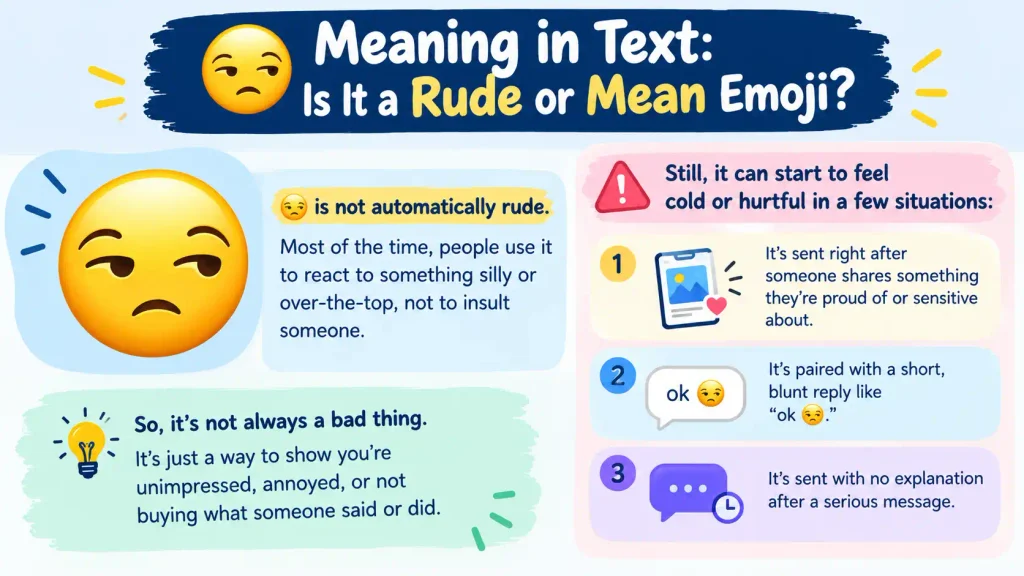
😒 is not automatically rude. Most of the time, people use it to react to something silly or over-the-top, not to insult someone.
Still, it can start to feel cold or hurtful in a few situations:
- It’s sent right after someone shares something they’re proud of or sensitive about.
- It’s paired with a short, blunt reply like “ok 😒.”
- It’s sent with no explanation after a serious message.
In casual chats between friends, the unamused face is usually harmless. In more serious conversations, it can feel dismissive, so it helps to think about the moment before hitting send.
😒 Meaning in Text vs. Similar Emoji: How to Tell Them Apart
Several emojis look or feel like 😒. Here’s how they’re different.
| Emoji | Name | What It Shows | Vibe | Example |
| 😒 | Unamused face | Irritation, disapproval, side-eye | Flat, judging | “You forgot again? 😒” |
| 🙄 | Face with rolling eyes | Big frustration, “here we go again” | Big, dramatic | “😒 my brother left dishes in the sink again 🙄” |
| 😏 | Smirking face | Mischief, flirting, feeling smug | Playful, sly | “I saw that 😏” |
| 😑 | Expressionless face | Numb, blank, “I have nothing to say” | Flat, tired-feeling | “That meeting could’ve been an email 😑” |
Unlike 😏, which has a raised, one-sided smile, 😒 has a flat or downturned mouth. That single difference changes the whole feeling: 😏 signals playful mischief, while 😒 signals irritation or doubt.
Unlike 🙄, which shows a bigger, more dramatic eye-roll, 😒 feels flatter and more judging. 🙄 often reacts to a whole situation, while 😒 reacts to one specific thing someone said.
😒 Meaning in Text: How to Respond and What to Avoid
The best reply depends on what came before it.
If it’s playful or sarcastic:
- Match the tone with a laughing emoji or a light joke back.
- Keep the conversation easy instead of over-explaining.
If it seems genuinely upset:
- Ask a simple, direct question, like “Did I do something wrong?”
- A short, honest check-in works better than guessing.
Reading the full conversation, not just the emoji, is the fastest way to pick the right reply.
Common mistakes people make. Even with context, it’s easy to misread 😒. The most common mistake is assuming it always means anger, when most of the time it’s closer to “seriously?” The second is reading it alone, without the messages before it. 😒 is a reaction, not a standalone statement, and the text right before it usually explains why it was sent.
😒 Meaning in Text: Look, Design, and Unicode Facts
Does it look different on iPhone and Android? Yes, a bit. On Apple devices (iOS), the face is bright yellow with soft shading and a clear side glance. On Android and Samsung devices, the shape and mouth curve can look slightly different, though the meaning stays the same.
These design differences rarely change how a message is understood. The words around it shape the tone far more than its art style does.
Here are the key technical facts about this emoji:
| Detail | Info |
| Official name | Unamused Face |
| Codepoint | U+1F612 |
| Category | Smileys & Emotion |
| Unicode version | 6.0 (2010) |
| Emoji version | 1.0 (2015) |
| Shortcode | :unamused: |
😒 became an official Unicode character in 2010, as part of Unicode 6.0. It did not become a true emoji until 2015, when Emoji 1.0 was released. That’s why it has two key dates in its history. These facts come from the official Unicode Character Database.
Frequently Asked Questions About 😒 Meaning in Text.
What does 😒 mean in a text? In a text, 😒 usually points to irritation, disapproval, or a skeptical side-eye look. People send it to react to something annoying, obvious, or unimpressive. It rarely means deep sadness or real anger on its own. The words around it usually show how strong the feeling is.
What does 😒 mean from a girl or guy? From either a girl or a guy, 😒 usually means the sender feels mildly annoyed, unimpressed, or playfully skeptical. The sender’s gender doesn’t change what it means. The relationship between the two people and the context of the conversation is what actually shapes the meaning.
Is 😒 a rude or mean emoji? It is not automatically rude. Most people send it to react to something silly or annoying, not to insult anyone. It can feel cold when paired with a curt reply, or sent right after someone shares good news. Context, more than the emoji itself, decides the tone.
What’s the difference between 😒 and 🙄? 😒 shows doubt or side eye through a flat, downturned mouth. 🙄 shows bigger frustration, like saying “here we go again” without words. 🙄 feels more active and dramatic, while 😒 feels flatter and more judging. Both react to annoying moments, but at different energy levels.
What’s the difference between 😒 and 😏? 😒 has a flat or frowning mouth and signals irritation or disapproval. 😏 has a raised, one sided smile and signals mischief, flirting, or feeling smug. The eyes on both look similar, but the mouth tells two very different emotional stories.
How should I respond to 😒? If it follows a joke or a light tease, a playful reply usually keeps the mood easy and fun. If it follows a serious message, or seems to come with no clear reason, it is worth asking directly what is wrong. A short, honest question works better than guessing at someone’s feelings.
What does 😒 mean from a crush? From a crush, 😒 is usually playful teasing, not real anger, especially after a joke or flirty comment. Before assuming they’re upset, look at the rest of the conversation for its overall tone. Context almost always explains what a single emoji cannot.
😒 Meaning in Text: The Bottom Line
In the end, the unamused face comes down to context, not the emoji alone. It can carry irritation, doubt, boredom, or a playful “seriously?” all in one small face.
The real meaning comes from who sent it and what they said around it. Next time 😒 lands in your messages, look at the full picture instead of guessing.
To read more: https://gtsmeaningintext.com/%f0%9f%91%81%f0%9f%91%84%f0%9f%91%81-meaning-in-text/

Digital Communication Writer
Focus: everyday texting slang, emoji meanings, casual chat abbreviations (NGL, LY, DND, etc.)
Bio angle: Grew up navigating group chats and social apps, explains slang the way it’s actually used, with real examples showing serious vs. joking vs. sarcastic tone.