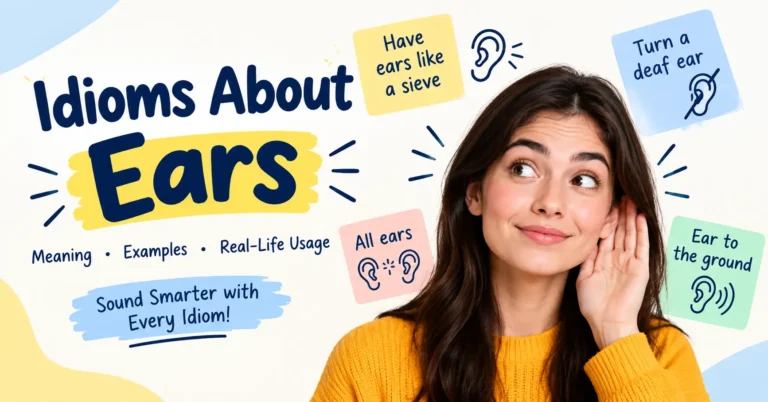
Idioms for eyes help English speakers talk about attention, honesty, love, and time. These phrases rarely mean what the words say, so they confuse learners and delight writers. Knowing them makes your speech warmer and your writing sharper. Many of them are centuries old, which gives them a texture that newer slang rarely has.
This guide explains 22 popular examples in plain English. Each entry gives a clear meaning, a real-life example, and a short tone note where it matters. The five best known phrases also get an origin check, so you can separate proof from legend.
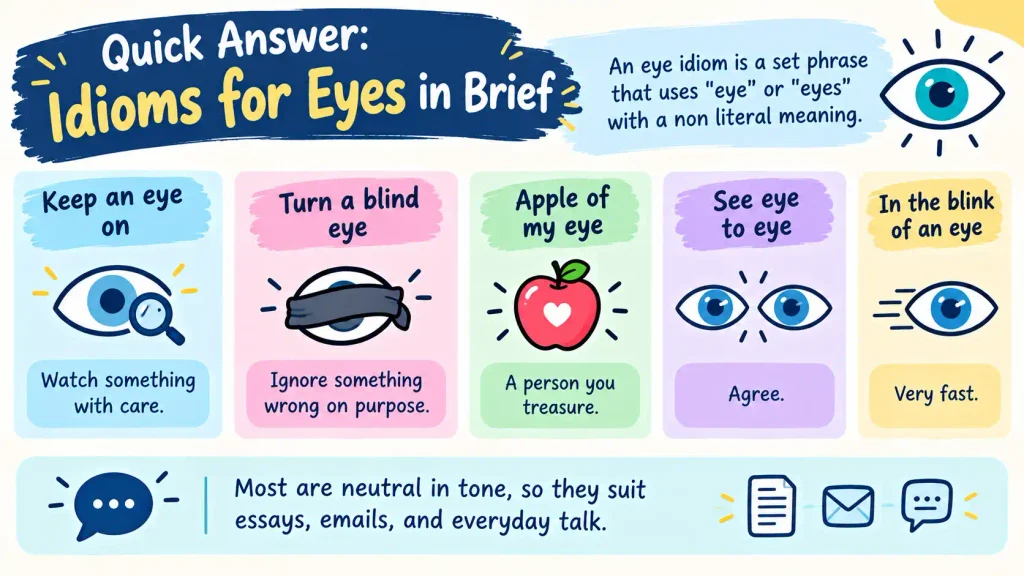
Quick Answer: Idioms for Eyes in Brief
An eye idiom is a set phrase that uses “eye” or “eyes” with a non literal meaning.
Keep an eye on: watch something with care.
Turn a blind eye: ignore something wrong on purpose.
Apple of my eye: a person you treasure.
See eye to eye: agree.
In the blink of an eye: very fast.
Most are neutral in tone, so they suit essays, emails, and everyday talk.
Famous Idioms for Eyes and Their Origins
Five phrases have origin stories you can trace. Each label shows how solid the evidence is: documented, disputed, or popular lore.
1. Turn a blind eye means to choose not to see something wrong. You know about it, but you act as if you don’t. Origin: popular lore. The famous story says Admiral Nelson raised a telescope to his blind eye at the Battle of Copenhagen in 1801 to avoid seeing an order to retreat. The battle was real, but the link to the phrase is not supported. Word Histories traces a form of the expression to 1698 and a pun on it to 1800, both before the battle. Example: “The coach turned a blind eye when the team broke curfew.” Another: “I can’t turn a blind eye to what’s happening in our department.”
2. An eye for an eye means a wrong should be repaid with an equal wrong. Origin: documented in the Bible; the Hammurabi link is disputed. The wording appears in Exodus 21, Leviticus 24, and Deuteronomy 19. Babylon’s far older Code of Hammurabi has similar payback rules, and scholars still debate whether it shaped the biblical laws. Most readers see the phrase as a cap on punishment, since you may take no more than you lost. In Matthew 5, Jesus goes further and urges people not to hit back at all. Example: “The senator warned that an eye for an eye policy would only deepen the fight.” Another: “Some people want an eye for an eye after a betrayal, but most of us settle for an apology.”
3. Apple of my eye names a person you treasure above all others. Origin: documented. A ninth-century Old English text linked to King Alfred uses “apple” for the pupil, the dark center of the eye. People guard their eyes closely, so the pupil became a symbol of something precious. Bible translators used the image next, and Wycliffe’s 1382 Bible is dated as the first “precious person” use. The 1611 King James Bible made the phrase famous. Example: “Her youngest grandson is the apple of her eye.” Another: “The new lab is the apple of the director’s eye.”
4. Beauty is in the eye of the beholder says that people judge beauty in different ways. Origin: documented wording, older idea. According to Phrases.org.uk, the modern wording first appears in Margaret Wolfe Hungerford’s 1878 novel Molly Bawn. John Lyly voiced a similar thought in 1588, and Shakespeare wrote something close in Love’s Labour’s Lost. So Hungerford earns credit for the wording, not the idea. Example: “Our team hated the logo, and the client adored it. Beauty is in the eye of the beholder.” Another: “I love that crooked old chair, but beauty is in the eye of the beholder.”
5. See eye to eye describes two people who fully agree. Origin: documented. It began as a literal picture of people standing face to face, and Isaiah 52:8 uses the wording. A Bible translation reference traces the English phrase to the Geneva Bible of 1560. Over time, it shifted from “face to face” to “of one mind.” Example: “My brother and I rarely see eye to eye about money.” Another: “The two schools finally saw eye to eye on the new schedule.”
Idioms for Eyes About Attention and Awareness
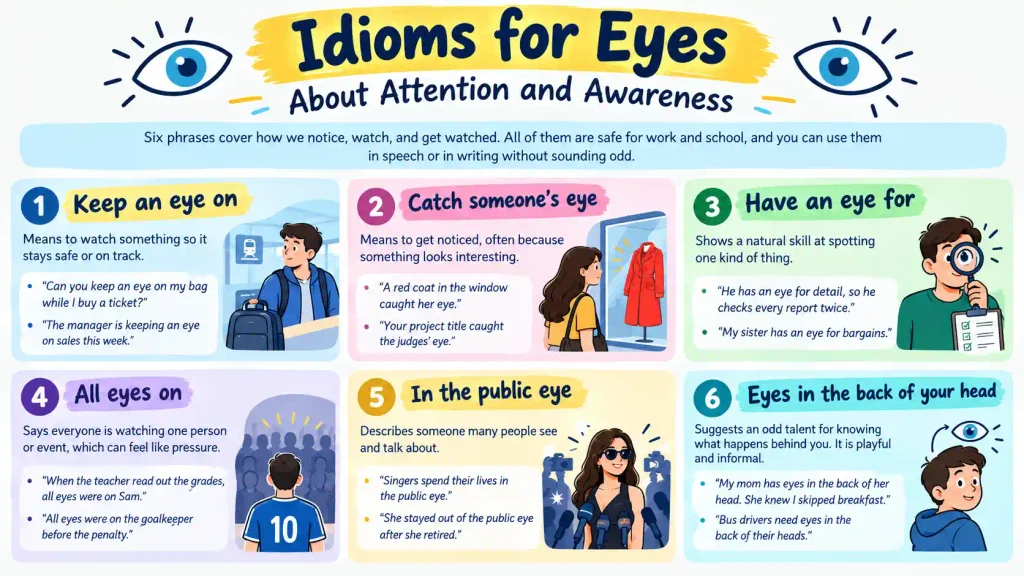
Six phrases cover how we notice, watch, and get watched. All of them are safe for work and school, and you can use them in speech or in writing without sounding odd.
Keep an eye on means to watch something so it stays safe or on track. “Can you keep an eye on my bag while I buy a ticket?” “The manager is keeping an eye on sales this week.”
Catch someone’s eye means to get noticed, often because something looks interesting. “A red coat in the window caught her eye.” “Your project title caught the judges’ eye.”
Have an eye for shows a natural skill at spotting one kind of thing. “He has an eye for detail, so he checks every report twice.” “My sister has an eye for bargains.”
All eyes on says everyone is watching one person or event, which can feel like pressure. “When the teacher read out the grades, all eyes were on Sam.” “All eyes were on the goalkeeper before the penalty.”
In the public eye describes someone many people see and talk about. “Singers spend their lives in the public eye.” “She stayed out of the public eye after she retired.”
Eyes in the back of your head suggests an odd talent for knowing what happens behind you. It is playful and informal. “My mom has eyes in the back of her head. She knew I skipped breakfast.” “Bus drivers need eyes in the back of their heads.”
Idioms for Eyes About Truth and Feelings
Eight phrases deal with tricks, clear sight, and strong emotion. Notice that a few of them are informal, so match them to your reader.
Pull the wool over someone’s eyes means to trick a person so they miss the truth. One popular story links it to wool wigs pulled down over a victim’s face, but that tale is unconfirmed. The phrase accuses someone of lying, so use it with care. “The seller tried to pull the wool over our eyes with a fake receipt.” “Don’t try to pull the wool over my eyes. I read the email.”
Open someone’s eyes means to show a person a truth they had missed. “The village trip opened my eyes to how hard it is to find clean water.” “Her speech opened the board’s eyes to the risks.”
The scales fell from someone’s eyes stands for a sudden, clear understanding. It comes from Acts 9:18, where Saul regains his sight as scales fall from his eyes. The tone is dramatic and literary. “After the third broken promise, the scales fell from his eyes.” “When I saw the real numbers, the scales fell from my eyes.”
More than meets the eye says something is deeper or more complex than it looks. “That quiet little town has more than meets the eye.” “There’s more to this story than meets the eye.”
A sight for sore eyes refers to someone or something you are very glad to see. It sounds warm and informal. “After twelve hours on the road, the hotel was a sight for sore eyes.” “You’re a sight for sore eyes, Grandpa!”
Only have eyes for someone describes loving or wanting just one person or thing. “He only has eyes for his wife.” “Ever since the new game came out, Leo has eyes only for it.”
Cry your eyes out means to cry hard for a long time. “I cried my eyes out at the end of that film.” “She cried her eyes out when the old dog passed away.”
Eyes bigger than your stomach means taking more food than you can finish. The tone is teasing. “My eyes were bigger than my stomach, so I took half the pizza home.” “Three desserts? Your eyes are bigger than your stomach.”
Idioms for Eyes About Time, Distance, and Imagination
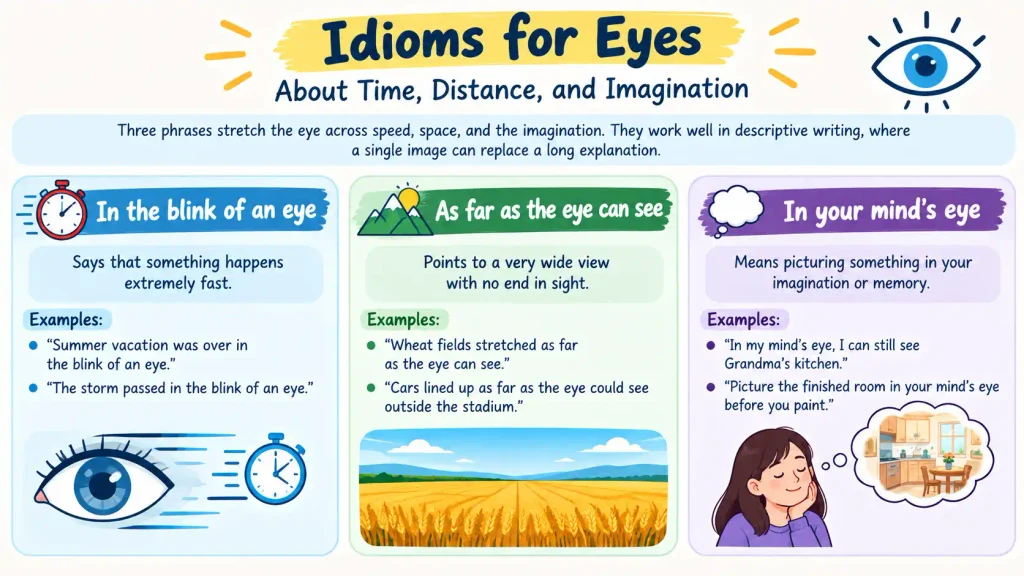
Three phrases stretch the eye across speed, space, and the imagination. They work well in descriptive writing, where a single image can replace a long explanation.
In the blink of an eye says that something happens extremely fast. “Summer vacation was over in the blink of an eye.” “The storm passed in the blink of an eye.”
As far as the eye can see points to a very wide view with no end in sight. “Wheat fields stretched as far as the eye can see.” “Cars lined up as far as the eye could see outside the stadium.”
In your mind’s eye means picturing something in your imagination or memory. Shakespeare used it in Hamlet. “In my mind’s eye, I can still see Grandma’s kitchen.” “Picture the finished room in your mind’s eye before you paint.”
Common Mistakes and Myths Around Idioms for Eyes
The easiest slips involve one small word, such as a wrong preposition or an extra “s.”
Wrong: turn a blind eye on the problem. Right: turn a blind eye to the problem.
Wrong: apple of my eyes. Right: apple of my eye, because it names one pupil.
Wrong: an eye to an eye. Right: an eye for an eye.
Wrong: see eye by eye. Right: see eye to eye.
Wrong: “Keep an eye on a new job” when you are searching. Right: “Keep an eye out for a new job.”
Tone can trip you up too. “Pull the wool over someone’s eyes” accuses a person of lying, so don’t aim it at your boss unless you mean it. Likewise, “an eye for an eye” carries moral weight, which makes it heavy for a casual email.
Tidy origin stories also trip people up. The Nelson telescope tale is lore, because the phrase appears before 1801. The line “An eye for an eye will leave the whole world blind” is often credited to Gandhi, yet no solid source for that attribution has turned up. The wool-wig story behind “pull the wool over someone’s eyes” is commonly repeated but lacks a firm source. When you meet a neat origin, ask for a date and a document. If neither exists, treat the tale as a good story.
For essays, work, and email, stick with neutral choices such as keep an eye on, see eye to eye, and more than meets the eye. Save cry your eyes out and a sight for sore eyes for friendly talk. These labels are a practical guide, not dictionary ratings, so check a learner’s dictionary if a phrase matters for a test.
FAQ on Idioms for Eyes
Idioms for Eyes: Who Coined “Beauty Is in the Eye of the Beholder”?
Margaret Wolfe Hungerford wrote the modern wording in her 1878 novel Molly Bawn. It is the earliest print citation Phrases.org.uk found. Earlier writers, including John Lyly and Shakespeare, voiced the same idea in different words. She is credited with the phrasing, not with inventing the thought.
Idioms for Eyes in the Bible: What Does “Apple of My Eye” Mean?
In the Bible, it describes a person or group that God guards with great care. Examples appear in Deuteronomy 32:10, Psalm 17:8, Proverbs 7:2, and Zechariah 2:8. The King James Bible used “apple,” but the Hebrew word points to the pupil of the eye. Since people protect their eyes closely, the image stands for something precious.
Idioms for Eyes and Revenge: Is “An Eye for an Eye” About Payback?
Not exactly. It is usually read as a limit on punishment, so payback should match the harm and go no further. In everyday English, though, speakers often use the phrase for plain revenge.
Final Thoughts on Idioms for Eyes
Eye idioms give you quick, vivid ways to talk about watching, ignoring, loving, and imagining. Learn the five famous ones first, and check any origin story for a date and a source. Then pick the tone that fits your reader. Practice makes them stick, so try using one new phrase each day in a message or journal entry, and soon these expressions will feel natural.
To read more: Idioms for Green: 10 Proven Phrases & Mistakes to Avoid