
Idioms for working hard are fixed phrases that describe strong effort, long hours, or steady focus. English has dozens of them, and each one carries a different tone. Some praise a person, some complain about a workload, and some warn about burnout. Picking the wrong one can make a friendly email sound rude.
This guide explains 20 expressions in four groups, with meanings, examples and tone notes. Where the record is solid, you will also find the origin. A table, a mistakes section and four short answers close the article.
Quick definition: An idiom is a fixed phrase whose meaning differs from its separate words. A work hard idiom describes strong effort, steady focus, a heavy workload, or overwork.
Quick Answer: Which Idioms for Work Hard Are Safe at Work?

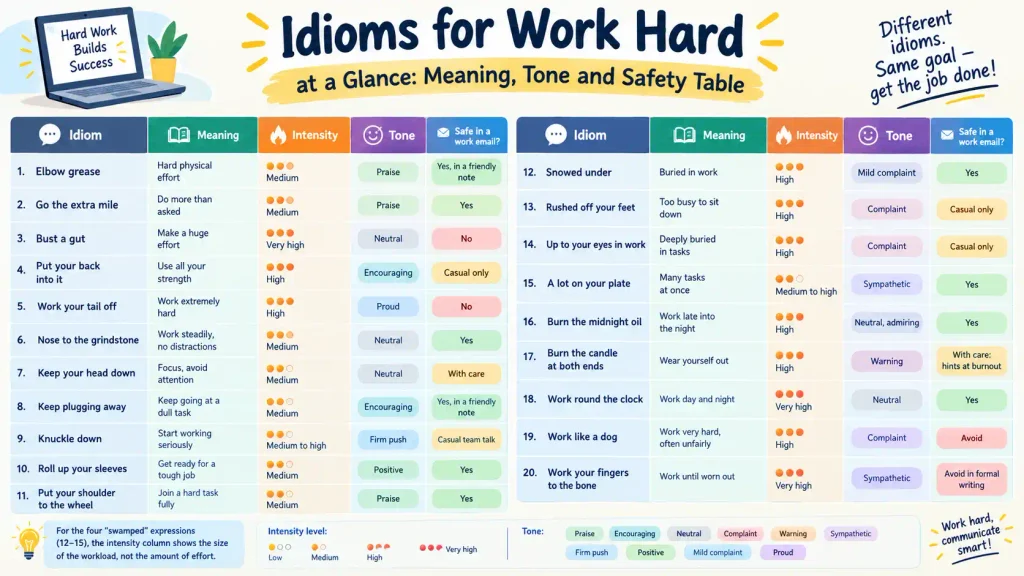
Go the extra mile, nose to the grindstone, roll up your sleeves, and burn the midnight oil are the safest picks for a work email. Bust a gut, work like a dog, and work your fingers to the bone belong in casual talk. Elbow grease and keep plugging away also suit a friendly note. Keep your head down and burn the candle at both ends need care, because they hint at hiding or burnout. Snowed under and a lot on your plate describe the size of a workload, not the amount of effort. When you are unsure about tone, choose the more neutral phrase. The table below shows the meaning, tone, and safety of all 20 expressions.
Idioms for Work Hard at a Glance: Meaning, Tone and Safety Table
| Idiom | Meaning | Intensity | Tone | Safe in a work email? |
| Elbow grease | Hard physical effort | Medium | Praise | Yes, in a friendly note |
| Go the extra mile | Do more than asked | Medium | Praise | Yes |
| Bust a gut | Make a huge effort | Very high | Neutral | No |
| Put your back into it | Use all your strength | High | Encouraging | Casual only |
| Work your tail off | Work extremely hard | High | Proud | No |
| Nose to the grindstone | Work steadily, no distractions | Medium | Neutral | Yes |
| Keep your head down | Focus, avoid attention | Medium | Neutral | With care |
| Keep plugging away | Keep going at a dull task | Medium | Encouraging | Yes, in a friendly note |
| Knuckle down | Start working seriously | Medium to high | Firm push | Casual team talk |
| Roll up your sleeves | Get ready for a tough job | Medium | Positive | Yes |
| Put your shoulder to the wheel | Join a hard task fully | Medium | Praise | Yes |
| Snowed under | Buried in work | High | Mild complaint | Yes |
| Rushed off your feet | Too busy to sit down | High | Complaint | Casual only |
| Up to your eyes in work | Deeply buried in tasks | High | Complaint | Casual only |
| A lot on your plate | Many tasks at once | Medium to high | Sympathetic | Yes |
| Burn the midnight oil | Work late into the night | High | Neutral, admiring | Yes |
| Burn the candle at both ends | Wear yourself out | High | Warning | With care: hints at burnout |
| Work round the clock | Work day and night | Very high | Neutral | Yes |
| Work like a dog | Work very hard, often unfairly | High | Complaint | Avoid |
| Work your fingers to the bone | Work until worn out | Very high | Sympathetic | Avoid in formal writing |
For the four “swamped” expressions, the intensity column shows the size of the workload, not the amount of effort.
Idioms for Work Hard That Show Extra Effort
These five expressions describe giving extra energy to a task, from scrubbing a floor to finishing a project.
Elbow grease
Meaning: Hard physical effort, especially scrubbing or polishing. People now use it for any tough job.
Example: “The pan looks ruined, but a bit of elbow grease should bring it back.”
Tone: Light and a little playful.
Origin: The poet Andrew Marvell used it in print in 1672, which is the earliest example usually cited.
Go the extra mile
Meaning: Doing more than anyone asked of you.
Example: “Our nurse went the extra mile and phoned me at home to check on my son.”
Tone: Praise. It fits almost any setting.
Origin: The idea echoes a Bible verse (Matthew 5:41) about walking a second mile with someone who forced you to walk the first.
Bust a gut
Meaning: Making a huge effort. It can also mean laughing very hard, so context matters.
Example: “I busted a gut to finish the slides before my flight.”
Tone: Informal and a little dramatic. Save it for chats with coworkers.
Put your back into it.
Meaning: Using your full strength and energy.
Example: “Come on, everyone, put your back into it. The bake sale starts in an hour!”
Tone: Encouraging, like a coach’s shout.
Work your tail off
Meaning: Working extremely hard.
Example: “He worked his tail off all summer to pay for college.”
Tone: Informal and often proud. “Work your butt off” is a ruder version, so skip it at the office.
Idioms for Work Hard That Show Focus and Persistence
These six expressions describe steady effort, a clear head, and a refusal to quit.
Nose to the grindstone
Meaning: Working steadily without letting anything distract you.
Example: “I’m keeping my nose to the grindstone until exams are over.”
Tone: Neutral and slightly serious.
Origin: Disputed. The popular story about millers sniffing their stones lacks early support, because the first examples describe holding someone’s nose to the stone as a punishment. The earliest print example is usually dated to 1532, and the modern “work hard” sense appears by 1828.
Keep your head down
Meaning: Focusing on your own work. It can also suggest staying out of trouble.
Example: “Let’s keep our heads down this week and finish the audit.”
Tone: Neutral and informal. In some offices, it hints that you are dodging attention, so check your audience.
Keep plugging away
Meaning: Continuing at a slow or dull task without quitting.
Example: “My sister kept plugging away at her driving practice until she passed.”
Tone: Encouraging.
Knuckle down
Meaning: Starting serious work after a lazy stretch.
Example: “It’s April, so it’s time to knuckle down and study for finals.”
Tone: A firm push, the kind a teacher or parent might give.
Origin: Often linked to the game of marbles, where players rest a knuckle on the ground to shoot. That link is commonly repeated but unconfirmed.
Roll up your sleeves.
Meaning: Getting ready for a tough job.
Example: “The kitchen flooded, so we rolled up our sleeves and started mopping.”
Tone: Positive and full of team spirit.
Put your shoulder to the wheel.
Meaning: Joining a hard task with full effort, usually as part of a group.
Example: “If the club wants a new roof, everyone must put a shoulder to the wheel.”
Tone: Praise, with a slightly old-fashioned feel.
Origin: Tied to Aesop’s fable of Hercules and the wagoner, in which Hercules tells a stuck driver to push the wheel himself.
Idioms for Work Hard When You Are Swamped with Tasks
These four expressions describe having more to do than you can handle, which is not the same as working hard.
Busy describes how much sits on your list, while working hard describes how much effort you give. The expressions below talk about volume, not effort.
Snowed under
Meaning: Buried in more work than you can handle.
Example: “We’ve been snowed under with orders since the holiday sale began.”
Tone: A mild complaint. It works in most emails.
Rushed off your feet
Meaning: So busy that you never get to sit down.
Example: “The café was packed, and the waiters were rushed off their feet.”
Tone: Informal. You will hear it more often in British English.
Up to your eyes in work
Meaning: Deeply buried in tasks.
Example: “Sorry I missed your call. I’m up to my eyes in homework.”
Tone: Informal and chatty.
A lot on your plate
Meaning: Many tasks or worries at once.
Example: “With a new baby and a new job, she has a lot on her plate.”
Tone: Neutral and sympathetic. It also works at the office: “I have a lot on my plate this week.”
Idioms for Work Hard That Signal Overwork
These five expressions describe very long hours or effort that costs you sleep, health, or free time.
Burn the midnight oil.
Meaning: Working or studying late into the night.
Example: “I burned the midnight oil to finish my college essay.”
Tone: Neutral, and sometimes admiring.
Origin: It goes back to oil lamps. The earliest known print use of “midnight oil” comes from the poet Francis Quarles in 1635.
Burn the candle at both ends.
Meaning: Wearing yourself out by doing too much, often by working late and starting early.
Example: “Between her night shifts and her classes, she was burning the candle at both ends.”
Tone: Warning. It signals burnout, not just long hours. Midnight oil is about late hours, while this phrase is about the price you pay.
Origin: It came from a French phrase recorded in 1611 that first pointed to wasteful spending. The sense of exhaustion appeared later, in the 1700s.
Work round the clock
Meaning: Working all day and all night, or without any real break.
Example: “Repair crews worked round the clock after the storm.”
Tone: Neutral, so it suits reports and emails. Americans usually say “around the clock.”
Work like a dog
Meaning: Working very hard, often more than seems fair.
Example: “Dad worked like a dog for twenty years, and nobody ever thanked him.”
Tone: A complaint. Leave it out of a performance review.
Work your fingers to the bone.
Meaning: Working until you are worn out.
Example: “Grandma worked her fingers to the bone to raise five kids.”
Tone: Sympathetic and dramatic.
Origin: The phrase appears in print by the 1800s, but its exact source is unclear.
Common Mistakes with Idioms for Work Hard
Most errors with idioms for work hard come from swapping one word, blending two phrases, or using a casual one in a formal setting.
- Grindstone mix-up. Say: “I’m keeping my nose to the grindstone this month.” Do not say “I’m going back to the grindstone” for nonstop work. “Back to the grindstone” means returning after a break, as in “Holidays are over, so it’s back to the grindstone on Monday.”
- Wrong object. Say: “Put your shoulder to the wheel.” Do not say “put your shoulder to the wall,” which is not a standard idiom. “Pedal to the metal” is real, but it describes speed, not effort.
- Blended phrases. Say: “I burned the midnight oil last night” for one late evening. Save “burn the candle at both ends” for a long pattern of exhaustion. Blends such as “burn the midnight candle” are not standard.
- Knuckle or buckle. Say “knuckle down” or “buckle down.” Both are standard, and both describe starting serious work. Neither is a typo of the other.
Frequently Asked Questions About Idioms for Work Hard
These four answers cover the questions learners ask most.
What is an idiom for working day and night?
“Work round the clock” is the clearest idiom for working day and night. It describes nonstop work with no real break. “Burn the midnight oil” covers late nights only. “Burn the candle at both ends” adds the idea of exhaustion. “Pull an all-nighter” describes staying up through one whole night.
What is the difference between being busy and working hard?
Being busy describes how much you have to do, while working hard describes how much effort you give. Expressions like “snowed under” and “a lot on your plate” describe busyness.
What is a formal word for hard-working?
“Diligent,” “industrious,” and “conscientious” are the most common formal words for hard-working. “Conscientious” stresses care, while “diligent” and “industrious” suit references and reviews.
Where does “burn the midnight oil” come from?
The phrase comes from the days of oil lamps, which people lit to work after dark. The poet Francis Quarles used “midnight oil” in print in 1635.
Conclusion: Idioms for Work Hard Made Simple
Idioms for work hard help you describe effort, focus, and workload in a clear, natural way.
- Go the extra mile, nose to the grindstone, roll up your sleeves, and burn the midnight oil are the safest picks for work emails.
- Bust a gut, work like a dog, and work your fingers to the bone belong in casual talk.
- Remember that “snowed under” and “a lot on your plate” show a heavy workload, not hard effort.
- Use “burn the candle at both ends” to flag burnout, and “burn the midnight oil” for a late night or two.
To read more: Idioms for Truth: 20 Powerful Phrases With Real Origins