
Idioms for sleepy give English speakers colorful ways to say they are tired, drowsy, or ready for bed. Instead of repeating the word tired all day, you can say you are dead on your feet or out like a light. This guide collects 35 phrases with plain meanings, honest origins, natural examples, and tone notes. Each group also warns you about the most common mistakes learners make.
Some phrases are strict idioms, while a few are plain phrases clearly labeled as such. The groups follow the night itself: feeling sleepy, falling asleep, sleeping deeply, napping, and staying up late. Use them at work, at school, at home, or in casual chat, and pick the right tone for each moment.
Quick Answer: What Are Idioms for Sleepy?
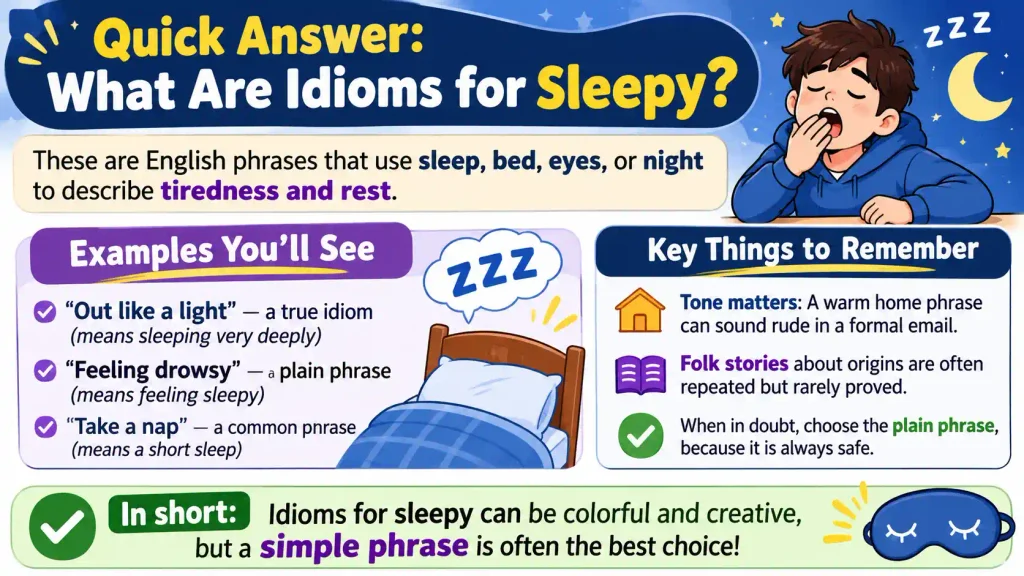
These are English phrases that use sleep, bed, eyes, or night to describe tiredness and rest. They cover feeling tired, falling asleep, sleeping deeply, taking a nap, and staying awake. Some, like “out like a light,” are true idioms with a picture like meaning.
Others, like “feeling drowsy,” are plain phrases that people still search for. Tone matters, because a warm home phrase can sound rude in a formal email. Folk stories about origins are often repeated but rarely proved, so this guide marks them as such. When in doubt, choose the plain phrase, because it is always safe.
Idioms for Sleepy When You Feel Tired
These seven phrases describe the feeling before sleep.
1. Can’t keep my eyes open
You are so sleepy that your eyes will not stay open. Tone: plain and honest.
Example: I can’t keep my eyes open during this film.
2. Half asleep
Almost asleep, but not quite. It suits a film, a class, or a long drive. Tone: plain and soft.
Example: I was half asleep during the meeting.
3. My eyes are heavy
This is a plain phrase, not a strict idiom. It describes eyes that feel tired and ready to close. Tone: plain and soft.
Example: My eyes are heavy after a long day of study.
4. Ready to drop
So tired that you feel you might fall. It is strong and a little funny. Tone: casual and strong.
Example: I am ready to drop after work today.
5. Dead on my feet
Very tired, yet still standing. Tone: casual and strong. Do not use it in formal writing.
Example: I am dead on my feet tonight.
6. Feeling drowsy
This is a plain phrase, not a strict idiom. It describes the first stage of sleepiness, often after lunch. Tone: plain and soft.
Example: I feel drowsy after lunch.
7. Bed is calling
A strong wish to go to bed. It is a warm, funny way to say you are tired. Tone: warm and casual.
Example: It is late, and bed is calling.
Idioms for Sleepy When You Fall Asleep
These seven phrases describe the moment sleep starts.
8. Nod off
Falling asleep by accident, often while sitting, as your head nods down. Tone: plain and casual.
Example: He nodded off during the long talk.
9. Doze off
Falling asleep slowly and lightly, often while resting. Tone: plain and soft.
Example: Grandpa dozed off while he watched TV.
10. Drift off
Falling asleep slowly and calmly. It suits reading, rain, or a soft song. Tone: soft and poetic.
Example: She listened to the rain and slowly drifted off.
11. Out like a light
Falling asleep very fast, like a light that goes out. Tone: bright and vivid.
Example: As soon as her head hit the pillow, she was out like a light.
12. Crash out
Falling asleep fast because you are very tired. Tone: casual, young, and strong.
Example: I crashed out the second I got home.
13. Knocked out
Falling asleep suddenly, as if by a blow. It comes from boxing. Tone: casual and strong.
Example: He was knocked out right after dinner.
14. Out cold
Fully asleep, with no sense of the world around you. It can also mean unconscious, so context matters. Tone: strong and casual.
Example: He was out cold after football practice.
Idioms for Sleepy That Describe Deep Sleep
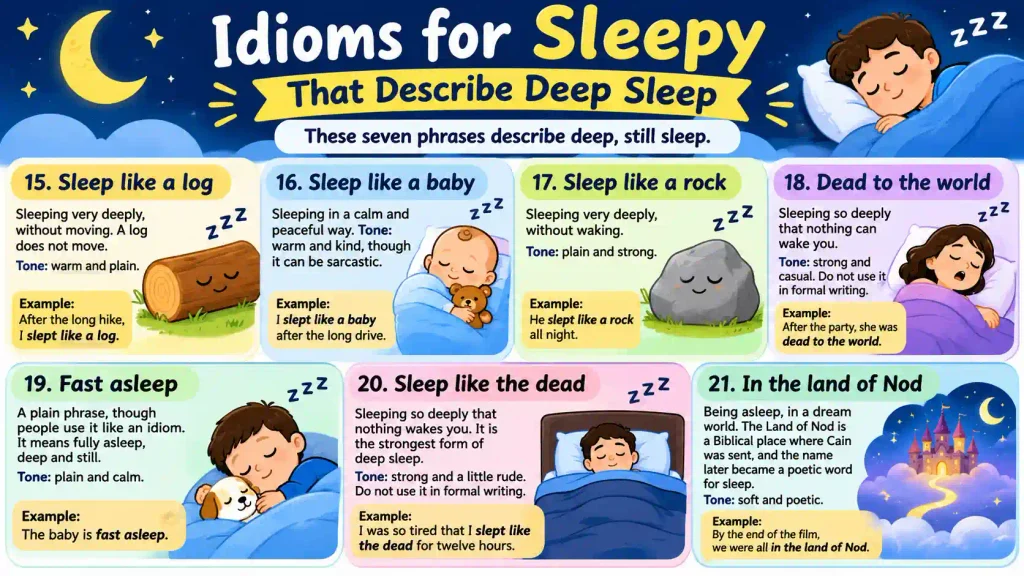
These seven phrases describe deep, still sleep.
15. Sleep like a log
Sleeping very deeply, without moving. A log does not move. Tone: warm and plain.
Example: After the long hike, I slept like a log.
16. Sleep like a baby
Sleeping in a calm and peaceful way. Tone: warm and kind, though it can be sarcastic, because real babies wake up all night.
Example: I slept like a baby after the long drive.
17. Sleep like a rock
Sleeping very deeply, without waking. Tone: plain and strong.
Example: He slept like a rock all night.
18. Dead to the world
Sleeping so deeply that nothing can wake you. Tone: strong and casual. Do not use it in formal writing.
Example: After the party, she was dead to the world.
19. Fast asleep
A plain phrase, though people use it like an idiom. It means fully asleep, deep and still. Tone: plain and calm.
Example: The baby is fast asleep.
20. Sleep like the dead
Sleeping so deeply that nothing wakes you. It is the strongest form of deep sleep. Tone: strong and a little rude. Do not use it in formal writing.
Example: I was so tired that I slept like the dead for twelve hours.
21. In the land of Nod
Being asleep, in a dream world. The Land of Nod is a Biblical place where Cain was sent, and the name later became a poetic word for sleep. Tone: soft and poetic.
Example: By the end of the film, we were all in the land of Nod.
Idioms for Sleepy About Naps and Bedtime
These seven phrases describe short naps and going to bed.
22. Forty winks
A short nap. The number 40 is not exact; it simply means a little while. The phrase has appeared in print since the 1800s. Tone: playful and old in feel.
Example: I took forty winks during my lunch break.
23. Cat nap
A short, light nap, often in the day. Cats are known for short naps. Tone: warm and casual.
Example: I took a cat nap on the sofa.
24. Power nap
A short nap that gives you fresh energy. It is a modern phrase. Tone: plain and useful.
Example: I took a quick power nap, and now I feel ready.
25. Catch some shut-eye
Getting some sleep, often a short rest. Shut-eye is a funny word for sleep. Tone: casual and warm.
Example: I need to catch some shut-eye before the trip.
26. Hit the hay
Going to bed. It comes from a time when mattresses were stuffed with hay, and it appears in print in the early 1900s. Tone: casual and warm.
Example: I am so tired, I think I will hit the hay.
27. Hit the sack
Going to bed. A sack was slang for a bed. Tone: casual and American in feel.
Example: It is late. I think I will hit the sack.
28. Turn in
Going to bed, often after a long day. Tone: plain and polite.
Example: I have an early meeting, so I am going to turn in.
Idioms for Sleepy About Late Nights and Good Nights
These seven phrases describe late nights, worry, and wishes for rest.
29. Burn the midnight oil
Staying up late to work or study. It comes from oil lamps used before electric light. Tone: strong and proud at work, but it can sound like a warning at home.
Example: She burned the midnight oil to finish her work.
30. Pull an all-nighter
Staying awake all night, often to study or finish work. Tone: casual and young in feel.
Example: I had to pull an all-nighter to finish my essay.
31. Night owl
A person who stays up late and works best at night. Tone: warm and plain.
Example: He is a night owl, so mornings are hard for him.
32. Count sheep
Trying to fall asleep by counting sheep in your mind. The story that shepherds counted flocks at night is commonly told, but not proven. Tone: playful and old in feel.
Example: I could not sleep, so I tried counting sheep.
33. Toss and turn
Moving in bed all night because you cannot sleep. It suits worry, heat, or noise. Tone: plain and honest.
Example: I tossed and turned all night before the test.
34. Sleep on it
Waiting until tomorrow to decide, after a night of sleep. It does not mean to go to bed. Tone: calm and wise.
Example: Do not rush. Sleep on it and tell me tomorrow.
35. Sleep tight
A warm wish for a good night, often said with “don’t let the bedbugs bite.” The rope-bed story is repeated everywhere, though no primary source proves it; “tight” more likely meant “soundly.” Tone: warm and kind. Use it as a wish, not as a description.
Example: Good night! Sleep tight!
Idioms for Sleepy vs. Plain Phrases
Some phrases look like idioms but are plain language. Use the Sleepy Test: if a phrase describes sleep in a picture-like, non-literal way, it is probably an idiom. If it says the thing directly, it is a plain phrase. Three plain phrases (numbers 3, 6, and 19) appear in the list with clear labels because people search for them. Others, such as “nap time,” “sleep cycle,” “sleep-deprived,” and “wide awake,” are left out.
Real idioms that did not make the main list include hit the pillow (go to bed), catch some Z’s (get sleep), call it a night (end the day), lose sleep over something (worry), not sleep a wink (not sleep at all), and sawing logs (snoring loudly). Let sleeping dogs lie is a real idiom, but it is not about sleep.
A plain phrase is not a bad phrase. “I feel drowsy” is clear and natural. Just know the difference before a test.
Tone, Comparison, and Mistakes With Idioms for Sleepy
Idioms for sleepy range from warm to strong, so check the tone before you use one at work or in an exam. A warm phrase suits a friend or a child, a strong phrase suits a funny story, and a plain phrase suits almost any place.
| Phrase | Tone | Formal writing? |
| Sleep like a baby | Warm, kind | Yes, unless sarcastic |
| Dead to the world | Strong, casual | No, too strong |
| Sleep like the dead | Strong, a little rude | No, too strong |
| Sleep on it | Calm, wise | Yes |
| Phrase A | Phrase B | Difference |
| Nod off | Doze off | Nod off is sudden and accidental; doze off is slow and light |
| Doze off | Drift off | Doze off is a light, short sleep; drift off is slow and calm |
| Sleep like a log | Sleep like a baby | Log is deep and still; baby is peaceful and can be sarcastic |
| Forty winks | Cat nap | Forty winks is old and playful; cat nap is a light nap in the day |
Common mistakes
- Use nod off, not nod away. “He nodded away in class” sounds wrong.
- Use doze off for falling asleep. Doze away exists, but it takes an object: “He dozed away the afternoon.”
- Do not use dead to the world in a formal essay. Say “sleeping very deeply” instead.
- Sleep on it does not mean go to bed. Say “sleep on the offer” for a choice.
Practice With Idioms for Sleepy
- Fill in the gap: “I can’t keep my ___ open during this film.” Answer: eyes.
- Pick the right phrase: “He ___ during the long talk.” Answer: nodded off.
- Fix the sentence: “He nodded away in class.” Answer: He nodded off in class.
- Pick the deep-sleep phrase: “After the hike, I slept like a ___.” Answer: log.
FAQs About Idioms for Sleepy
What is the difference between “nod off”, “doze off”, and “drift off”?
Nod off is falling asleep by accident, with your head dropping. Doze off is slow and light. Drift off is slow and calm, often with a soft sound like rain.
Is “sleep like a baby” always good, or can it be sarcastic?
It is usually good, describing calm and peaceful sleep. It can be sarcastic, because real babies wake up all night, so the tone decides the meaning.
Can I say “sleep like the dead” or “dead to the world” in formal writing?
Both are too strong for formal writing. In a formal essay, say “sleeping very deeply.”
Conclusion: Idioms for Sleepy
Idioms for sleepy give you warm words for tired eyes, deep sleep, and good nights. You now have 35 phrases, from “nod off” to “sleep tight,” each with a clear meaning and tone. Remember that a few entries are plain phrases, and that many origin stories are told more often than they are proved. Check the tone before you use a strong phrase at work or in a formal essay. Practice a few phrases at a time, and use them in real talk so they stay in your memory. When you are unsure, pick the plain phrase, because it is always safe. Start with one phrase tonight, and sleep tight.
To read more: Idioms for Dead: 35 Powerful Phrases for Loss & Endings