
Summer idioms are everyday English phrases that use sun, heat, and holidays to describe moods, plans, and people. Some describe the weather. Many do not. Each phrase carries a meaning that its separate words do not show.
This guide gives you the meaning of each phrase, the origin where one is known, simple examples, and tone tips. A few origins are well recorded, while others are disputed, and the article says so. Read on to learn which phrases suit a text to a friend and which suit a formal email.
Quick Answer: Idioms for Summer
Summer idioms are phrases whose meaning differs from their separate words and link to the season. “The dog days of summer” means the hottest, most tiring stretch of the year. The name comes from a star, not from pets. “Soak up the sun” means to relax in the warmth and enjoy it. “Beat the heat” means to find ways to stay cool. A “summer fling” is a short, casual romance, and “make hay while the sun shines” means to use a good chance while it lasts. These five are the best-known phrases of the season.
Idioms for Summer at a Glance
Each phrase has a positive, neutral, or negative tone. The tone decides who you can say it about.

| Idiom | Meaning | Tone | About weather? |
| Dog days of summer | The hottest, most tiring part of the season | Neutral to grumpy | Yes |
| Beat the heat | Find ways to stay cool | Neutral | Yes |
| It’s a scorcher | A very hot day | Neutral | Yes |
| Soak up the sun | Relax in the sunshine and enjoy it | Positive | Yes |
| Catch some rays | Spend time in the sun, often for a tan | Positive, casual | Yes |
| A place in the sun | A comfortable, successful position in life | Positive | No |
| A ray of sunshine | A person who brings joy | Positive, or sarcastic | No |
| Summer fling | A short, casual romance in summer | Light, playful | No |
| Beach bum | Someone who spends most of their time at the beach | Casual, teasing | No |
| Make hay while the sun shines | Use a good chance while it lasts | Encouraging | No |
| One swallow doesn’t make a summer | One good sign does not prove a trend | Warning | No |
| Come rain or shine | No matter what happens | Firm, loyal | Both |
| Indian summer | A warm spell in autumn, or a happy late stage of life | Positive, nostalgic | Both |
| Cool as a cucumber | Calm under pressure | Positive | No |
| Hot under the collar | Angry or annoyed | Negative | No |
| Full of hot air | Talking big with nothing behind it | Negative | No |
Tone often matters more than the dictionary meaning. Calling a friend “a ray of sunshine” is a compliment at a party. Said with a sigh, the same words can sting.
Idioms for Summer About Hot Weather, Sunshine and People
These phrases describe how hot a day feels, how people relax outdoors, and how one person can brighten a room.
The dog days of summer. The dog days of summer are the hottest, most tiring stretch of the year. In the Northern Hemisphere, they are often counted from July 3 to August 11. The phrase also names any slow, sleepy period, so a shop might call August its “dog days” when few customers come in.
Where the dog days come from. The Romans called the star Sirius Canicula, meaning “little dog,” and named the hot season dies caniculares. Sirius is the brightest star in Canis Major, the “Greater Dog.” Dictionary.com dates the English phrase to around 1530–40, as a translation of the Latin. Ancient observers linked the star’s rise beside the sun to the worst heat, but that link was wrong. Earth’s tilt and orbit cause summer. Sirius gave the season a name and nothing more.
Dates vary. The July 3 to August 11 range is the one Dictionary.com gives, and other writers use different dates, so treat any range as a guide. In the Southern Hemisphere, summer falls in different months, so the dog days fall in different months too. Do not confuse it with the 1975 film Dog Day Afternoon, a crime drama, not a story about summer.
Examples:
- Business always slows down in August. The dog days are hard on a small café.
Beat the heat and other heat phrases. English speakers love to exaggerate about hot weather, so most of these are playful.
- Beat the heat: find a way to cool down, such as swimming or sitting under a fan.
- It’s a scorcher: a very hot day.
- Sweating buckets: sweating heavily in humid heat.
- Sweat like a pig: to sweat a lot. The phrase is ironic, because pigs sweat very little.
Use the playful ones with friends. Save the plain ones for reports.
Soak up the sun, catch some rays, or bask in the sun. All three mean enjoying the sun. The difference is style, not meaning.
Use “soak up the sun” almost anywhere. Save “catch some rays” for friendly chat. “Bask” works best in stories.
- The whole family soaked up the sun on the pier after the picnic.
Phrases for people and mood. These summer phrases describe what people feel and do.
- A place in the sun (positive): a comfortable, successful position in life. The nervous young baker now runs her own shop. She has found her place in the sun.
- Summer fling (light, playful): a short, casual romance during the summer. They met at camp and had a summer fling that ended with the first week of school.
- A ray of sunshine (positive, or sarcastic): a person who brings joy. Our new neighbor is a ray of sunshine. She waves at everyone. Said with a sigh, it turns sharp: “Good morning, ray of sunshine,” she said as her brother growled at the alarm clock.
- Beach bum (casual, teasing): someone who spends most of their time at the beach.
- Come rain or shine (firm, loyal): no matter what happens. Our team meets every Sunday, come rain or shine.
Idioms for Summer About Timing and Opportunity
These phrases tell you when to act fast and when not to trust one good sign.
Make Hay While the Sun Shines: Idioms for Summer Advice
To make hay while the sun shines is to use a good chance while it lasts. The picture comes from farming. Cut grass has to dry in the sun to become hay, and rain can spoil it, so farmers worked on the dry days.
BookBrowse traces the saying to Alexander Barclay’s Ship of Fools (1509). John Heywood then listed it in his 1546 collection of English proverbs. Because two early dates exist, the earliest record is a point of debate. A similar saying, “strike while the iron is hot,” also urges quick action. Its picture comes from a blacksmith’s forge, not a hayfield.
- My boss is away until Friday. I’ll make hay while the sun shines and finish my own projects.
One Swallow Doesn’t Make a Summer: Idioms for Summer and Aristotle
This saying means that one good sign does not prove things have changed for good. It goes back to Aristotle’s Nicomachean Ethics. He wrote that one swallow does not make a spring, and neither does one fine day. In the same way, a short time of happiness does not make a person truly happy.
Aesop’s fable “The Spendthrift and the Swallow” tells a matching story. A young man spends his money, sees one early swallow, and sells his cloak. Cold weather returns. Sources disagree on which came first, the fable or Aristotle’s line, so treat the link between them with care.
The Greek word means “spring,” but English settled on “summer.” A 1546 English version already reads “One swalow maketh not sommer.”
- Our team won its opening game. One swallow doesn’t make a summer, so nobody is celebrating yet.
Indian Summer: Idioms for Summer in Autumn
An Indian summer is a spell of warm, dry weather in autumn, usually after the first cold snap. It can also mean a happy, successful late stage of life. It is an autumn phrase, so say it in October, not in July.
History. The Met Office dates the earliest known written use to a 1778 letter by J. Hector St. John de Crèvecœur, a French settler in New York. Grammarphobia points to Major Ebenezer Denny’s 1794 journal as another early record. The phrase first appeared in the northeastern United States in the 1700s.
Origin. The origin is disputed. Only the first use in the 18th-century northeastern US is reasonably certain. Several explanations are commonly repeated, but none is confirmed.
A note on wording. Because the origin is unclear, some writers now prefer “second summer” or “warm autumn spell.”
- October brought an Indian summer. Kids were still swimming in the lake on the last weekend of the month.
Idioms for Summer That Are Not About Weather
These phrases use heat, water, or sunshine as pictures for anger, calm, trouble, and empty talk. They have nothing to do with the temperature outside.
| Idiom | What it describes | Tone | Example |
| Hot under the collar | Feeling angry or annoyed | Negative | Dad gets hot under the collar when the Wi-Fi drops during a match. |
| Full of hot air | Talking big with nothing behind it | Negative | The mayor’s speech sounded grand, but it was full of hot air. |
| In hot water | In trouble | Negative | Forgetting the tickets put Leo in hot water with his family. |
| Cool as a cucumber | Calm and steady under pressure | Positive | The pilot stayed cool as a cucumber through the storm. |
| Like a fish out of water | Uncomfortable in a new place | Neutral | The chess champion looked like a fish out of water on the dance floor. |
The weather word is only a picture. Read “hot” as “angry” or “in trouble,” and “cool” as “calm.”
How to Use Idioms for Summer
Use summer phrases freely in speech and casual writing. Choose plainer words for reports and formal emails.
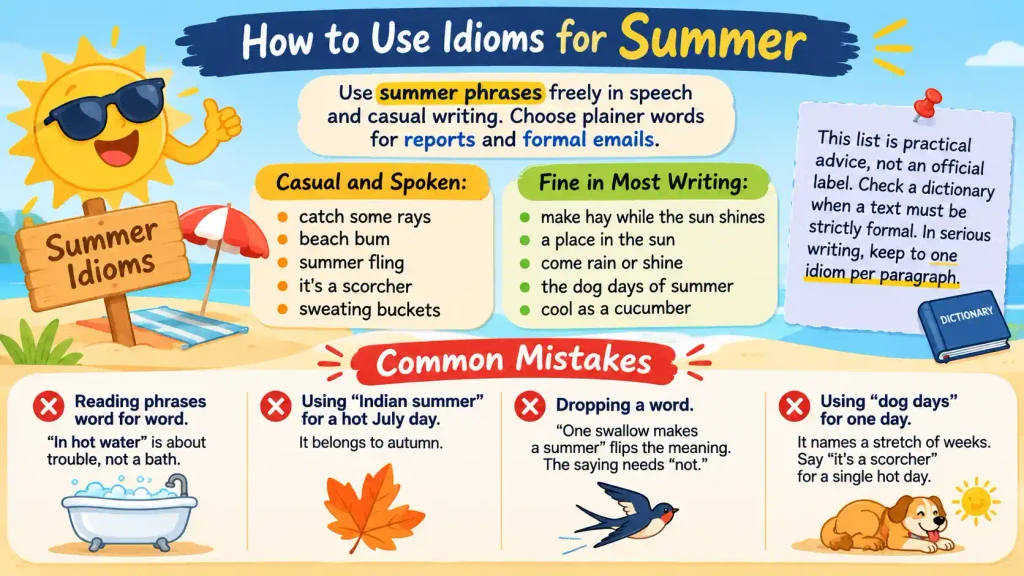
- Casual and spoken: catch some rays, beach bum, summer fling, it’s a scorcher, sweating buckets.
- Fine in most writing: make hay while the sun shines, a place in the sun, come rain or shine, the dog days of summer, cool as a cucumber.
This list is practical advice, not an official label. Check a dictionary when a text must be strictly formal. In serious writing, keep to one idiom per paragraph.
Common mistakes
- Reading phrases word for word. “In hot water” is about trouble, not a bath.
- Using “Indian summer” for a hot July day. It belongs to autumn.
- Dropping a word. “One swallow makes a summer” flips the meaning. The saying needs “not.”
- Using “dog days” for one day. It names a stretch of weeks. Say “it’s a scorcher” for a single hot day.
Idioms for Summer FAQ
What does the dog days of summer idiom mean?
The dog days of summer are the hottest, most tiring days of the year. Dictionary.com notes they are often counted from July 3 to August 11 in the Northern Hemisphere. The name comes from Sirius, the Dog Star. It can also mean any slow, sleepy stretch when little gets done.
What are some idioms and phrases that symbolize summer?
Five phrases capture summer best: “soak up the sun,” “the dog days of summer,” “beat the heat,” “summer fling,” and “make hay while the sun shines.” Together they cover relaxation, heat, cooling off, romance and opportunity.
Can summer idioms be used in writing?
Yes. They work well in stories, blog posts and casual emails. Formal reports need plainer wording. Keep to one idiom per paragraph and check the tone first, because a phrase like “a ray of sunshine” can read as a joke.
Why is it called an Indian summer?
Nobody knows for certain. The origin is disputed, and the explanations that are often repeated are unconfirmed. The earliest known written use is generally dated to 1778.
Conclusion: Idioms for Summer
Summer phrases do more than describe the weather. Some talk about heat, such as “the dog days of summer“ and “beat the heat.” Others describe mood, like “soak up the sun” and “summer fling.” Others give advice, like “make hay while the sun shines” and “one swallow doesn’t make a summer.”
Remember three things. Match the idiom to the setting, watch the tone, and use one idiom at a time. Start with “soak up the sun” and “beat the heat,” then add the more figurative phrases as you get comfortable.
To read more: Idioms for Cars: 22 Powerful Phrases and Their Real Origins