
Idioms for nature turn rain, roots, rivers, and animals into ways of talking about people and problems. Say someone is “under the weather,” and you are not discussing the sky at all. This guide covers 24 phrases, each with a plain meaning, a ready to use example, and a tone label. Every entry also carries an honest origin note, because some stories are documented and others are guesses.
Weather, plants, animals, and landscapes supply most of the pictures behind these phrases. Learning the picture makes the meaning stick and helps you choose the right moment to use it. Read on to find the idiom you need and how far to trust its story.
Quick answer:
Idioms for nature are fixed phrases that use weather, plants, animals, or land to describe people and life. “Under the weather” means feeling sick. “Once in a blue moon” means very rarely. “Out of the woods” means past the danger. “Nip it in the bud” means stopping trouble early. “Second nature” means a habit that feels automatic. Each phrase below shows how it works in a real sentence.
What Counts Among Idioms for Nature?
Idioms for nature are fixed phrases whose picture comes from weather, plants, animals, or land, while their real meaning is about people and life. “Hit the hay” names a plant yet simply means going to bed, so it does not qualify. This guide keeps phrases where the natural picture carries the idea, plus five that contain the word “nature” itself. An idiom hides its meaning inside the words, a proverb offers advice, and a simile compares with “like” or “as.” “Out of the woods” is an idiom, “Every cloud has a silver lining” is a proverb, and “fresh as a daisy” is a simile. In daily speech, you can use all three the same way.
Each entry ends with an origin label: Documented means a dictionary or early text shows the source, Plausible means the story fits but is unproven, Disputed means sources disagree, and Unknown means nothing reliable turned up. Each tone line lists tone, register, and intensity, which reflect typical usage, not strict rules.
Weather and Sky Idioms for Nature
These seven phrases use storms, clouds and the moon to describe health, hope, surprise and hard times.
Under the weather, Meaning: feeling slightly ill or low. Example: “I’m a bit under the weather, so I’ll work from home.” Tone: neutral, casual, mild. Origin: Disputed. The figurative sense appears in the early 1800s; the sick-sailors story is unconfirmed.
Weather the storm, Meaning: getting through a hard time without quitting. Example: “Our family weathered the storm after Dad lost his job.” Tone: positive, neutral, moderate. Origin: Plausible. One reference calls it a sailing idiom, a ship riding out a storm, but gives no date.
Calm before the storm, Meaning: a quiet stretch just before trouble or a rush. Example: “The room was silent before the exam papers came out, the calm before the storm.” Tone: neutral, neutral, moderate. Origin: Documented. An early form, “calm before the tempest,” appears in a 1608 play. “Storm” replaced “tempest” later.
Every cloud has a silver lining. Meaning: every bad situation has a good side. Example: “The surgery was stressful, but the rest gave me time to read.” Tone: positive, neutral, mild. Origin: Documented. The image comes from Milton’s masque Comus (1634); the full proverb took shape in the 1800s.
A bolt from the blue. Meaning: a shock that arrives with no warning. Example: “His text asking me to be best man was a bolt from the blue.” Tone: neutral, neutral, strong. Origin: Plausible. The image is lightning from a clear sky; print records appear in the 1800s.
Raining cats and dogs, Meaning: very heavy rain. Example: “The bus was late because it was raining cats and dogs.” Tone: neutral, casual, strong. Origin: Disputed. The phrase dates to the 1600s, but its source is unknown; thatched-roof and Norse-god stories are folklore.
Once in a blue moon. Meaning: something that happens very rarely. Example: “We eat out once in a blue moon, usually on birthdays.” Tone: neutral, casual, mild. Origin: Disputed. It appears in print in the 1830s; the second full moon explanation is a later idea, and sources disagree.
Plant and Garden Idioms for Nature
These phrases use buds, bushes, and lawns to talk about stopping trouble, feeling fresh, and wanting what others have.
Nip something in the bud, Meaning: stopping a problem while it is still small. Example: “The coach nipped the arguing in the bud before it split the team.” Tone: positive, neutral, moderate. Origin: Documented. It comes from pinching off garden buds; “nip in the bud” appears in 1595 and the “bud” form in 1607. Watch out: it is “bud,” never “butt.”
Fresh as a daisy. Meaning: rested, lively, and ready to go. Example: “Grandma slept ten hours and woke up fresh as a daisy.” Tone: positive, casual, mild. Origin: Plausible. “Daisy” comes from Old English for “day’s eye,” since the flower opens at dawn, but the link is unproven.
Beat around the bush (UK: beat about the bush), Meaning: dodging the main point. Example: “He beat around the bush for ten minutes before admitting he had lost the keys.” Tone: negative, casual, moderate. Origin: Documented. Beating bushes to drive birds into nets dates to the 1400s; the figurative sense appears in the 1570s.
The grass is always greener on the other side. Meaning: other people seem to have it better. Example: “My brother envies my city job, and I envy his quiet town.” Tone: neutral, casual, mild. Origin: Documented. The exact wording appears in the early 1900s, but the idea is older; Ovid wrote that crops look richer in another man’s field.
Green thumb (UK: green fingers), Meaning: a knack for growing plants. Example: “My aunt has a green thumb; her balcony is full of tomatoes.” Tone: positive, casual, mild. Origin: Disputed. Both forms appear in the early 1900s; the popular plant stain theory is unproven.

Animal and Landscape Idioms for Nature
These phrases use dogs, fish, oceans, icebergs, woods and hills to talk about mistakes, size, safety and acceptance.
Bark up the wrong tree, Meaning: chasing the wrong person, idea, or cause. Example: “If you think I took your pen, you’re barking up the wrong tree.” Tone: negative, casual, mild. Origin: Documented. It comes from American raccoon hunting, where hounds bark at a tree the animal has left; it is recorded in 1832.
Like a fish out of water. Meaning: the awkwardness of being somewhere unfamiliar. Example: “On her first day abroad, she felt like a fish out of water.” Tone: neutral, neutral, moderate. Origin: Documented. Chaucer compared a monk outside his cloister to a fish without water in the late 1300s; the modern wording appears in 1613.
A drop in the ocean. Meaning: an amount too small to matter. Example: “Our donation felt like a drop in the ocean next to the flood damage.” Tone: neutral, neutral, moderate. Origin: Documented. The older “drop in the bucket” traces to the Wycliffe Bible in the late 1300s; “drop in the ocean” turns up in 1802.
The tip of the iceberg. Meaning: a visible sign that is only a small part of something bigger. Example: “Her headaches turned out to be the tip of the iceberg.” Tone: negative, neutral, strong. Origin: Documented. Most of an iceberg sits underwater; dictionaries record the figurative use in the 1960s.
Out of the woods, Meaning: the worst trouble is over. Example: “We landed the big client, but we’re not out of the woods yet.” Tone: positive, neutral, moderate. Origin: Documented. The sense of “safe” is recorded from 1792, picturing a traveler who has left a dense forest.
Make a mountain out of a molehill. Meaning: blowing a small problem out of proportion. Example: “It’s one scratch on the car. Don’t make a mountain out of a molehill.” Tone: negative, casual, moderate. Origin: Documented. Nicholas Udall’s 1548 English version of Erasmus pairs the two words in a line about exaggeration, and “molehill” dates to the mid-1400s.
Go with the flow, Meaning: accepting events calmly instead of fighting them. Example: “I haven’t planned the trip, so I’ll just go with the flow.” Tone: positive, casual, mild. Origin: Disputed. Merriam Webster dates it to 1916, while the Online Etymology Dictionary sees it by 1977.
Idioms for Nature That Contain the Word “Nature”
These five phrases describe instincts, habits, bodily needs, and the way things unfold on their own.
Call of nature, Meaning: a polite way to say you need the toilet. Example: “Sorry, I have to answer a call of nature.” Tone: neutral, casual, mild. Origin: Documented. Merriam Webster dates this sense to 1747; earlier, the words meant the pull of the countryside.
Second nature, Meaning: a habit so practiced it feels automatic. Example: “After ten years of nursing, checking charts is second nature to her.” Tone: positive, neutral, moderate. Origin: Documented. Merriam Webster dates the sense to 1582, echoing the old saying that habit is second nature.
Force of nature, Meaning: a person or event with huge, unstoppable power. Example: “Our principal is a force of nature. Nothing gets in her way.” Tone: positive, neutral, strong. Origin: Documented. Merriam Webster dates the figurative sense to 1975; the words also name real forces such as hurricanes.
The nature of the beast. Meaning: a thing comes with its own built in problems. Example: “Late nights come with startups. That’s the nature of the beast.” Tone: negative, casual, moderate. Origin: Plausible. One reference traces it to John Ray’s 1678 proverb collection, but we found no second source.
Let nature take its course. Meaning: allowing events to unfold without stepping in. Example: “The doctor said a mild cold needs rest, so we let nature take its course.” Tone: neutral, neutral, mild. Origin: Unknown. Merriam Webster gives no date or word history.
Look Alike and Correct Uses of Idioms for Nature
Look alike phrases share a picture but differ in size, timing, or attitude.
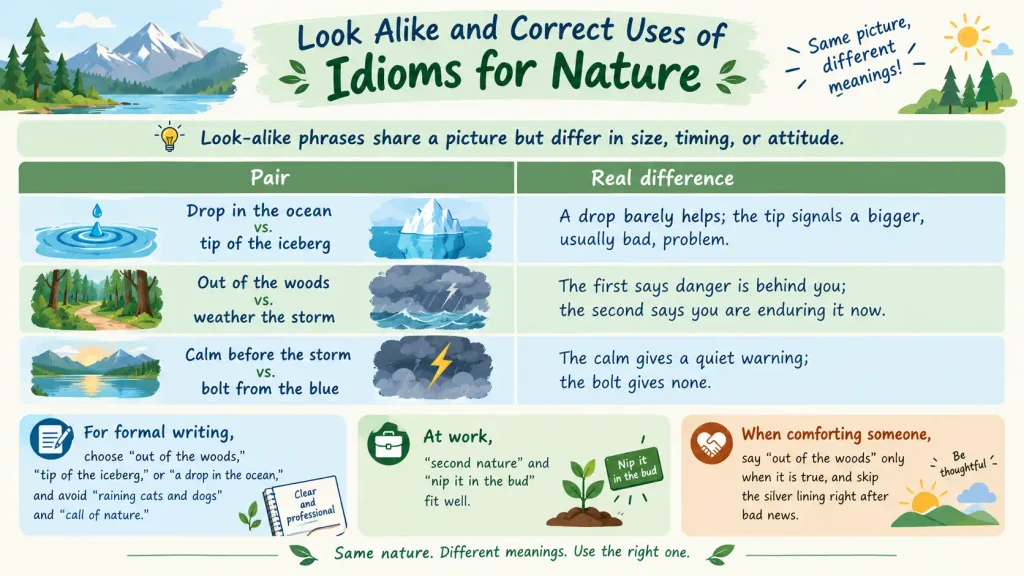
| Pair | Real difference |
| Drop in the ocean vs. tip of the iceberg | A drop barely helps; the tip signals a bigger, usually bad, problem. |
| Out of the woods vs. weather the storm | The first says danger is behind you; the second says you are enduring it now. |
| Calm before the storm vs. bolt from the blue | The calm gives a quiet warning; the bolt gives none. |
For formal writing, choose “out of the woods,” “tip of the iceberg,” or “a drop in the ocean,” and avoid “raining cats and dogs” and “call of nature.” At work, “second nature” and “nip it in the bud” fit well. When comforting someone, say “out of the woods” only when it is true, and skip the silver lining right after bad news. These are judgment calls, not dictionary rules.
Keep the wording fixed. Say “nip it in the bud,” not “butt,” and “weather the storm,” not “whether.” Accepted variants include green thumb or green fingers, drop in the ocean or drop in the bucket, and out of the woods or out of the wood. Using “tip of the iceberg” for good news is a mistake, since it carries a warning.
FAQs About Idioms for Nature
What are some weather idioms? Common weather idioms include “under the weather,” “raining cats and dogs,” “calm before the storm,” “weather the storm,” “a bolt from the blue,” and “once in a blue moon.” They cover illness, heavy rain, quiet before trouble, endurance, sudden shocks, and rare events.
What does “call of nature” mean? It is a polite euphemism for needing the toilet, dated by Merriam Webster to 1747. Today it sounds humorous and a little old fashioned, so it works best among friends.
How we checked the origins: We searched the Online Etymology Dictionary, Merriam Webster, Dictionary.com, and Phrase Finder, then labeled each origin by the strength of the evidence. Where sources disagree, we say so. Last checked: October 27, 2026.
Conclusion: Using Idioms for Nature Well
Idioms for nature become easy once you see the picture behind each one. Pick a few phrases from this list and practice them in the right setting. Check the tone before you speak, and keep the wording the same. Match the phrase to the situation, since a casual idiom can sound odd in a formal report. Treat origin stories with care, because many popular ones are folklore. Return to the origin labels whenever you want to know how far a story can be trusted. With a little practice, these phrases will feel like second nature.
To read more: Idioms for Snow: 7 Powerful, Easy Phrases with Examples

Digital Communication Writer
Focus: everyday texting slang, emoji meanings, casual chat abbreviations (NGL, LY, DND, etc.)
Bio angle: Grew up navigating group chats and social apps, explains slang the way it’s actually used, with real examples showing serious vs. joking vs. sarcastic tone.