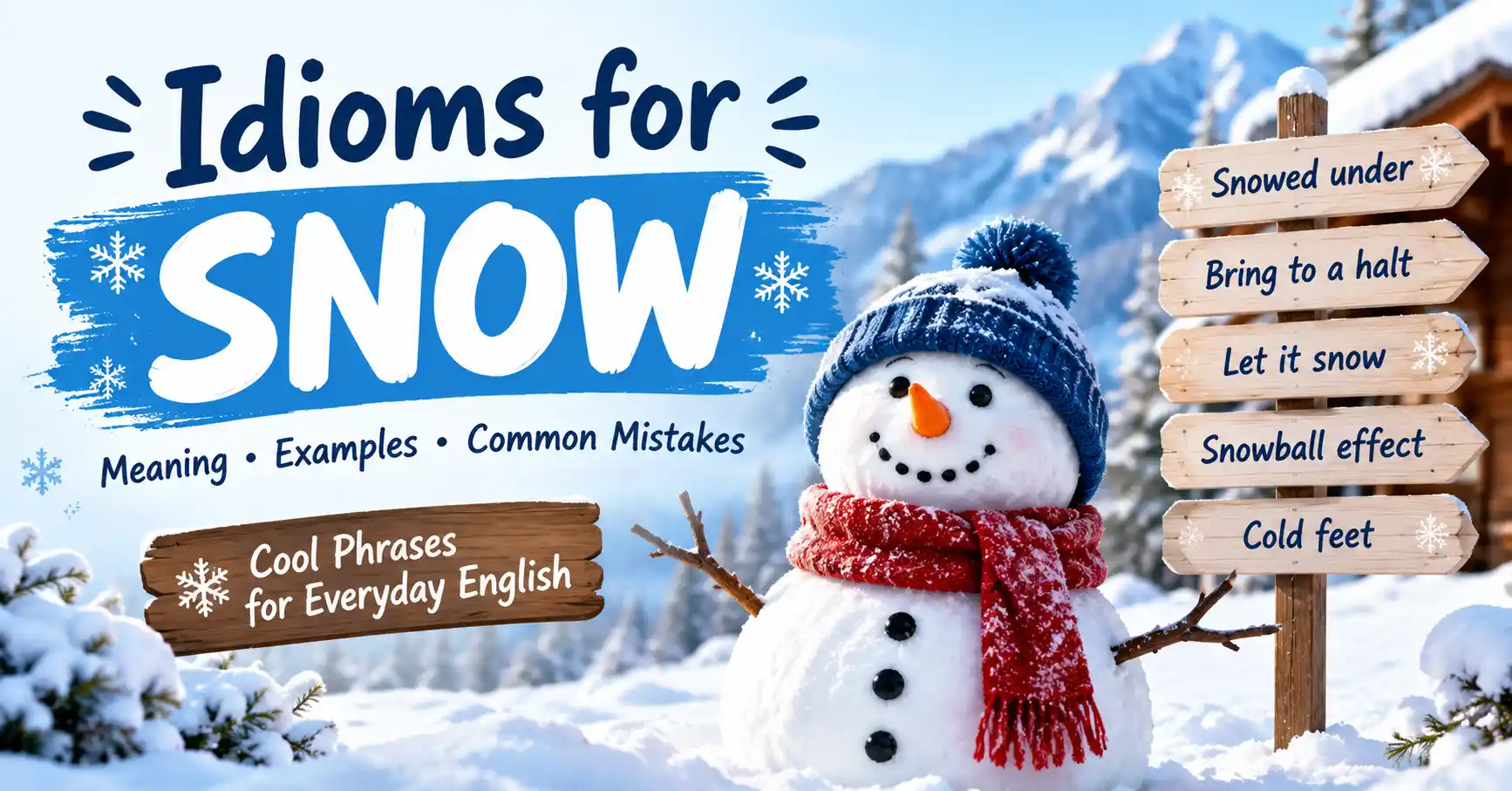
Idioms for snow are fixed phrases that use snow to talk about work, luck, honesty, and tricks instead of weather. English has seven main ones, and each paints a clear winter picture in the mind. This guide gives the meaning, origin, examples, and usage for every phrase. You will also find common mistakes and a short list of cold and ice phrases.
Dated origins are included, with clear notes where the history is not proven. Some phrases have solid records, while others rest on guesses that keep repeating online. Read on to learn which is which, and how to use each phrase with confidence.
Quick Answer on Idioms for Snow
- Snowed under: having far more work than you can finish.
- Snowed in: stuck indoors because of heavy snow.
- Snowball effect: a small start that grows faster and faster.
- A snowball’s chance in hell: no chance at all.
- Pure as the driven snow: completely innocent.
- Snow job: a smooth, flattering line meant to fool someone.
- Snow day: a day off because snow closes schools or offices.

Idioms for Snow at a Glance
The table below shows each phrase with its meaning, its tone, and the earliest evidence found for it. Tone labels are usage notes, while the dates come from dictionaries and word history sources.
| Idiom | Meaning | Tone | Earliest evidence |
| Snowed under | Overloaded with work; also, beaten by a wide margin | Negative (mild) | 1880, figurative use |
| Snowed in | Stuck indoors by heavy snow | Neutral | Not dated here |
| Snowball effect | A small start that grows faster and faster | Neutral (good or bad) | Early 1800s claimed, unsourced |
| A snowball’s chance in hell | No chance at all | Negative (strong) | 1880s |
| Pure as the driven snow | Completely innocent | Positive, often ironic | Phrase in print about 1800 |
| Snow job | A smooth line meant to fool someone | Negative | 1943 |
| Snow day | A day off because of snow | Positive | Not dated here |
The Core Idioms for Snow, Explained
Each core phrase turns a winter picture into a point about work, luck, honesty, or a day off. The entries follow the same order as the table. Each one gives the meaning, the origin where one exists, and two examples.
Snowed Under
To be snowed under is to have far more work than you can handle. Imagine a storm piling snow against your front door until it will not open. A heap of tasks can pin you in the same way.
A second sense describes a crushing defeat. One side does the snowing, and the other side gets buried. Merriam Webster dates the figurative use to 1880 in American English. It grew from the image of deep snow covering and trapping people.
For the work sense, the phrase usually appears in the passive. You are or get snowed under, often with something. The phrase fits office talk, school talk, and casual chat equally well.
- Mia can’t join us tonight because she’s snowed under with exam prep.
- The home team snowed the visitors under, 9 to 1.
Snowed In (and Snowbound)
Snowed in means stuck indoors because heavy snow blocks the roads or the door. This one is literal, so the weather is the whole story. The word “snowbound” is a near twin, and it often describes whole towns or roads rather than one household.
People usually say it about travelers, families, and small communities. It carries no blame, because nobody causes a blizzard. The tone is neutral, and many speakers even say it with a cozy smile.
- Grandpa’s street was snowed in, so he baked bread all weekend.
- The hikers stayed snowed in at the lodge until the plow came.
Snowball Effect
A snowball effect is a small start that keeps growing, faster and faster. Picture a snowball rolling downhill, gathering more snow with every turn. Results can be good or bad. People also use “snowball” as a verb, as in “The rumor snowballed.”
One reference site gives the early 1800s as the first use but names no source. Treat that date as unconfirmed. The phrase suits business, money, news, and even friendships, since growth can happen anywhere.
- Sam’s first small donation had a snowball effect, and the whole class joined in.
- One missed payment had a snowball effect, and the fees kept stacking up.
A Snowball’s Chance in Hell
This phrase says there is no chance at all. Hell is hot, so a snowball would vanish in seconds. It is almost always negative, as in “not a snowball’s chance.” The short form, “a snowball’s chance,” works too.
Early records come from American newspapers of the 1880s. One paper in 1883 used a related line, “melted away like a snowball in hell,” for a bakery lost in a fire. The expression is casual and strong. Save it for friends and family, not formal reports.
- We don’t have a snowball’s chance in hell of finishing before the bell.
- Will Dad let me skip chores? Not a snowball’s chance.
Pure as the Driven Snow
Someone pure as the driven snow is completely innocent. “Driven” refers to snow that the wind has blown into drifts. No feet have crossed it, so it looks spotless.
Shakespeare used snow as a sign of purity. In The Winter’s Tale (1611), the peddler Autolycus sings of “lawn as white as driven snow.” Lawn is a fine linen. The full phrase is not in his writing, though. It shows up in print only around 1800.
Today people often say it with a wink. The tone turns ironic when the claim sounds too good to believe.
- The new treasurer’s records were pure as the driven snow.
- “I never touched your game,” said Leo, with chocolate on his chin. “I’m pure as the driven snow.”
Snow Job (and “To Snow Someone”)
A snow job is a smooth, flattering speech meant to fool you. The verb works the same way. To “snow” a person is to charm them into believing something.
The term began as American army slang in World War II. Its first printed use was in 1943. A reader later wrote that soldiers in Hawaii had said it two years earlier. So 1943 marks the first record, not necessarily the birth of the phrase. Dictionary.com says it likely points back to “snowed under,” the idea of burying a person in words.
- The car dealer’s talk about “no hidden costs” was a snow job.
- Don’t let your cousin snow you. Read the rules yourself.
Snow Day
A snow day is a day off when snow closes schools or offices. Students celebrate, and parents rearrange their plans. It is a happy phrase, and it is common in North America, where districts often announce closures by text or on the radio.
- We got a snow day, so the whole street went sledding.
- Ms. Ortiz sent a snow day notice before dawn.
Snowed In vs Snowed Under vs Snow Job: Idioms for Snow Compared

Snowed in describes being trapped by weather, snowed under describes too much work, and snow job describes being fooled by smooth talk. These three are the ones learners mix up most often.
| Phrase | Meaning | Tone | Typical subject |
| Snowed in | Trapped by snow | Neutral | Travelers, families, towns |
| Snowed under | Too much work, or a lopsided loss | Mildly negative | A worker, a team, a shop |
| Snow job | A flattering line meant to fool | Negative | The target of a pitch or excuse |
All three share one picture. Snow covers something and stops it from moving. Weather covers a road. Work covers a desk. Smooth talk covers the truth. If you remember that single image, the three phrases are much harder to confuse.
Common Mistakes With Idioms for Snow
Learners most often slip on grammar form, a small word swap, or the tone of a phrase.
- Using “snowed under” in the active voice for work. Say “I’m snowed under with reports,” not “I snowed under with reports.” The active form belongs to a win over a rival: “The champs snowed the rookies under.”
- Swapping “in” and “under.” “I’m snowed in at work” suggests a blizzard has trapped you at the office. It does not say your inbox is full.
- Treating the snowball effect as always bad. It describes growth of any kind, including good news.
- Using “a snowball’s chance in hell” in formal writing. The phrase is strong and informal, so “highly unlikely” fits reports and emails better.
- Taking “pure as the driven snow” at face value. Many speakers use it as a joke, so check the tone before you decide the speaker means it.
Origin Fact Check: What the Evidence Supports for Idioms for Snow
Three of these phrases have dated records, one has a partial record, and one date has no source behind it. The sorted list below separates solid history from guesswork.
- Documented, snowed under: figurative use dated to 1880 by Merriam-Webster.
- Documented, snow job: first printed in 1943 according to Merriam Webster, with earlier spoken use reported by a reader.
- Documented, a snowball’s chance in hell: American newspaper examples from the 1880s, found by Word Histories.
- Partly documented, pure as the driven snow: Shakespeare’s snow imagery is real, and the exact phrase appears around 1800 according to Phrase Finder.
- Unsourced, snowball effect: the picture is clear, but no source backs the early 1800s date.
One myth links “pure” to medieval tanners, who used that word for dog droppings in leather work. Phrase Finder rejects the link, and it has nothing to do with the snow phrase. Whenever a story about a phrase sounds too neat, look for an early printed example before you repeat it.
Cold and Ice Cousins of Idioms for Snow
Five cold weather phrases often appear next to the snow ones, but none of them is about snow. They share the same winter flavor, so learners tend to study them together.
- Break the ice: to ease an awkward start. “A silly joke broke the ice on day one.”
- On thin ice: in a risky spot. “You’re on thin ice after three late slips.”
- Tip of the iceberg: a small, visible part of a bigger problem. “That leaky tap was only the tip of the iceberg.”
- Cold shoulder: unfriendly treatment. “She gave him the cold shoulder after the argument.”
- When hell freezes over: never. The earliest known use is from 1903, in Guy Wetmore Carryl’s The Lieutenant-Governor. “I’ll share my fries when hell freezes over.”
Frequently Asked Questions About Idioms for Snow
The four answers below cover the meaning, tone, and history of the most-searched phrases.
What are some common idioms for snow? The most common ones are snowed under, snowed in, snowball effect, a snowball’s chance in hell, pure as the driven snow, snow job, and snow day. Most describe work, luck, innocence, or tricks. The table near the top shows each meaning and tone.
What does “a snowball’s chance in hell” mean, and is it okay to say it? It means there is no chance at all, and it is fine in casual speech. The phrase is informal, strong, and nearly always negative. In a formal report, “highly unlikely” fits better. Some people skip it at work or school because it names hell.
What does “snowed under” mean? Snowed under means having far more work than you can finish. It has a second sense: beating a rival by a wide margin. A typical line is “We’re snowed under with orders this week.” The figurative use dates to 1880.
Is “pure as the driven snow” from Shakespeare? Not exactly. Shakespeare used snow as a symbol of purity, but the full phrase is not his. In The Winter’s Tale, Autolycus sings of “lawn as white as driven snow.” The complete phrase is first found in print around the year 1800.
Conclusion on Idioms for Snow
Snow phrases are easy to learn once you see the picture behind each one. Snow that covers a door gives you “snowed in” and “snowed under.” Snow that melts in hell gives you “no chance.” Snow that nobody has walked on gives you “pure.” These idioms for snow also teach a lesson about word history, because several dates rest on proof and others do not. Use “snowed under” in the passive for work, keep “a snowball’s chance in hell” for casual talk, and treat the snowball effect as good or bad. Copy the example sentences above and swap in your own details to practice.
To read more: Idioms for Fall: 21 Best Phrases With Meanings & Examples