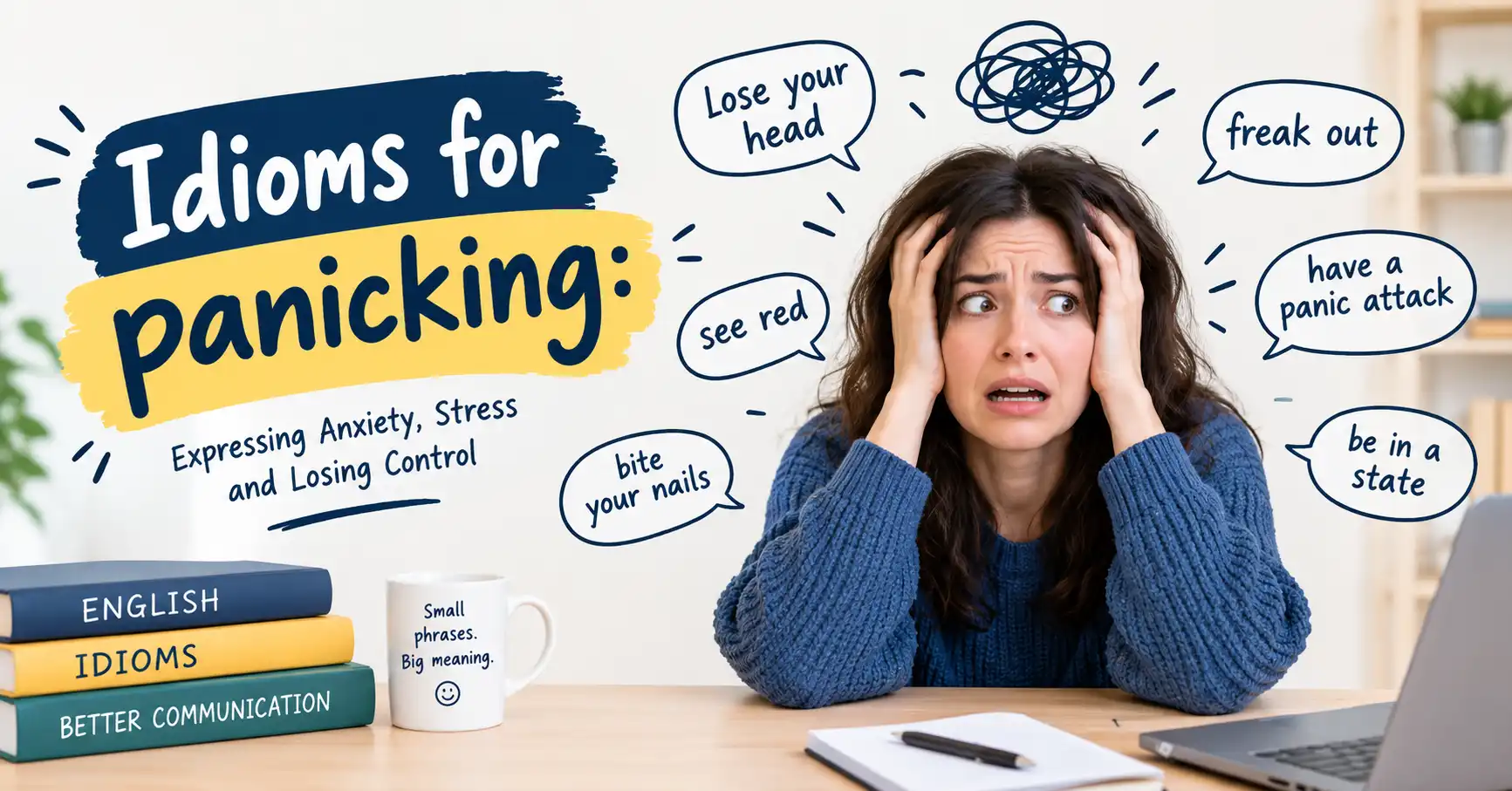
Idioms for panicking are fixed phrases that describe sudden fear, like “freak out,” “lose your head,” and “hit the panic button.” People use them when fear makes it hard to think clearly. A nervous person has butterflies, but a panicking person loses their head. Most of these phrases describe losing control, not just feeling afraid.
This guide ranks 22 phrases from mild nerves to full loss of control. You will find the meaning of each phrase and an example sentence. You will also find the story behind a few famous ones, US and UK differences, and common mistakes.
Quick Answer: Top Idioms for Panicking
- Freak out: become very scared or upset in a flash.
- Lose your head: stop thinking clearly because of fear.
- Go to pieces: fall apart under stress.
- Hit the panic button: react to a problem with alarm, often too soon.
- Run around like a headless chicken: rush around without a plan.
- Jump out of your skin: get a big, sudden fright.
- Scared stiff: be so afraid that you can barely move.

The Panic Ladder: Idioms for Panicking from Nervous to Out of Control
Oxford Learner’s Dictionaries define panic as a strong fear that you can’t control and that stops you from thinking clearly. It belongs to a family of fear words, but panic is the one that scrambles your thinking.
“Panic attack” sounds like an idiom, but it is a medical term, and the tone section below explains more. For milder worry, see our list of idioms for anxiety. If you prefer comparisons, try our similes for panicking.
These phrases fall into four steps: nervous before it happens, startled in the moment, frozen with fear, and out of control. Use a step one phrase for mild nerves and save step four for a full meltdown.
| Step | The feeling | Phrases in this step |
| 1 | Nervous before something happens | butterflies, on edge, bundle of nerves, pins and needles, cold feet, lose your nerve |
| 2 | Startled or scared in the moment | jump out of your skin, heart in your mouth, cold sweat, shake like a leaf, blood run cold |
| 3 | Frozen | scared stiff, frozen with fear, deer in headlights |
| 4 | Out of control | lose your head, go to pieces, freak out, meltdown, tailspin, headless chicken, panic button, in a flap |
Step 1: Idioms for Panicking Before It Happens
These phrases describe the worry that builds before a big moment.
- Have butterflies in your stomach. A fluttery, nervous feeling before something important. I always get butterflies in my stomach before a job interview.
- On edge. Tense and ready to snap at small things. Everyone was on edge while we waited for the layoff news.
- Get cold feet. Lose your courage just before a big step. Maya got cold feet and backed out of the talent show.
- A bundle of nerves. Extremely nervous and jumpy. My daughter was a bundle of nerves before her first piano recital.
- Lose your nerve. Feel too scared to follow through. I lost my nerve and never sent the email.
- On pins and needles. Anxiously waiting to hear an outcome. We were on pins and needles until the test results came back.
Steps 2 and 3: Idioms for Panicking When Startled or Frozen
Step two fits a quick scare, when the body reacts before the mind does.
- Jump out of your skin. Get a big, quick fright. I nearly jumped out of my skin when the fire alarm went off during the meeting.
- Have your heart in your mouth. Feel very scared about what might happen next. My heart was in my mouth as the plane shook in the storm.
- Break into a cold sweat. Start sweating from fear or worry. He broke into a cold sweat when he realized he had left the stove on.
- Shake like a leaf. Tremble badly from fear. She shook like a leaf while she waited to give her speech.
- Feel your blood run cold. Be hit by a chill of horror. My blood ran cold when I read the message from the bank.
Step three is different, because some people don’t run when they’re scared. They stop.
- Scared stiff. So afraid you can barely move. The kids were scared stiff when the lights went out in the storm.
- Frozen with fear. Unable to act because of terror. Frozen with fear, he watched the car slide toward the curb.
- Like a deer in headlights. Stuck and blank in a stressful moment. When the boss asked for the numbers, I stood there like a deer in headlights.
Step 4: Idioms for Panicking When Control Is Lost
This is full panic, where clear thinking switches off. These phrases overlap with our list of idioms for going crazy, but here the feeling is fear, not madness.
- Lose your head. Stop thinking clearly because of fear or stress. Don’t lose your head if the server goes down. Just follow the checklist.
- Go to pieces. Fall apart under stress. She went to pieces when her flight was cancelled.
- Freak out. Become very scared or upset in a flash. This one is informal. Don’t freak out, but the printer just ate your report.
- Have a meltdown. Lose control of your feelings under pressure. He had a meltdown when three deadlines landed on the same day.
- Go into a tailspin. Spiral into worry and confusion. The team went into a tailspin when the biggest client pulled out.
- Run around like a headless chicken. Rush about with no plan. We ran around like headless chickens when the guests showed up an hour early.
- Hit the panic button. React to a problem with alarm, often too soon. One bad review, and the manager hit the panic button.
- Be in a flap. Worried and flustered. It is informal and mostly British. Gran was in a flap because she couldn’t find her glasses.
Where Idioms for Panicking Come From
The word “panic” comes from the Greek god Pan. The earliest print examples I could confirm for “headless chicken” and “panic button” date to 1853 and 1948, and “freak out” began as 1960s slang.
“Panic” and the god Pan. The word comes from the Greek panikos, which refers to Pan, a god blamed for sudden, senseless fear. English has used “panic” for a sudden mass terror since 1708. “Panic-stricken” appeared by 1804, and “panic attack” by 1970.
“Running around like a headless chicken.” A fact sits behind the image. A chicken can move around for a short time after its head is removed, because of reflexes in its nervous system. The earliest example I could confirm is from 1853, when a Cleveland newspaper used it for a confused political party. That makes the earliest print record American. British speakers say “like a headless chicken,” while the American version is usually “like a chicken with its head cut off.”
Mike the Headless Chicken is the famous case, but he came later. Farmer Lloyd Olsen of Fruita, Colorado, beheaded Mike in September 1945, and the bird lived about 18 months. That is more than 90 years after the 1853 example, so Mike did not create the phrase. Some learner sites trace it to the 14th century, but they give no evidence.
“Hit the panic button.” The phrase builds on the idea of an emergency alarm button. The earliest printed figurative use I found is from 1948, in a Popular Science article about training jet pilots. It described a pilot with no plan in a tight spot who hits the panic button and spends two minutes in confusion. The earliest printed mention of a literal button I found is from 1965, in prison security. So the print record does not show which use came first.
A popular story ties the phrase to World War II bombers with a bell system that signaled a bail out. Dictionaries call that story “alleged,” and I found nothing that proves it.
“Freak out.” This one began as 1960s slang for a drug induced experience of hallucinations or paranoia. Today it can describe fear, anger, or even excitement.
US vs UK Differences and Tone in Idioms for Panicking
Britons and Americans use different phrases for the same panic, and one word, “flap,” even changes meaning across the Atlantic.
| Idiom | Where it’s used | Watch for |
| in a flap | Informal, mostly British | In North America, a “flap” is public anger over something a public figure said or did |
| have kittens | British, informal | The American version is “have a cow” |
| have a cow | North American, informal | The British version is “have kittens” |
| panic stations | British, informal | Lots of anxious, confused activity in a short time |
These labels come from Oxford Learner’s Dictionaries, Merriam Webster, and WordWeb. If you write for readers in both countries, “lose your head” is safer than “in a flap,” since the dictionaries I checked mark only the second as regional.
“Hit the panic button” often suggests overreacting. The American Heritage Idioms Dictionary defines this phrase as overreacting to a situation. An example is a person who always pushes the panic button when the baby is fine. So the phrase can carry mild criticism.
“Lose your head” can mean panic or anger. Dictionaries disagree here. Cambridge’s English Idioms in Use files it under panic or losing control. Merriam-Webster defines it as becoming very upset or angry. Both readings are valid, so context decides. She lost her head and ran back into the burning building reads as panic. He lost his head and shouted at the referee reads as anger.
“Panic attack” is not an idiom. Oxford describes a panic attack as a condition in which you suddenly feel very anxious, and your heart beats faster. It is a medical event, not a figure of speech. In casual talk, say “I freaked out” or “I panicked.” If attacks happen often, a doctor can help.
Common Mistakes with Idioms for Panicking

The most common mistakes come from mixing panic phrases with anger phrases, or using a phrase in the wrong country. Cold feet is courage fading before you act, while freaking out is a burst of panic. Head points to fear, while temper points to anger.
- Filing anger under panic. “Blow a fuse,” “fly off the handle,” and “throw a fit” describe temper, not fear.
- Bending fixed phrases. Say “break into a cold sweat,” not “have cold sweat.”
- Carrying “flap” across borders. “In a flap” means worried in British English, but not in North America.
- Treating “panic attack” as slang. It names a medical event.
- Using slang in formal writing. Dictionaries label “freak out” and “in a flap” as informal. In a report or formal email, write “become alarmed” or “react with alarm.”
FAQs About Idioms for Panicking
What is another way to say “panic”?
You can say “freak out,” “lose your head,” “go to pieces,” or “be in a flap.” Pick by strength: “freak out” fits a quick scare, and “go to pieces” fits a full collapse. In formal writing, plain words like “become alarmed” work better than idioms.
What is the difference between “freak out” and “get cold feet”?
“Freak out” describes a burst of panic. “Get cold feet” describes losing your courage just before a planned step.
Where does “running around like a headless chicken” come from?
It comes from the sight of a chicken that keeps moving briefly after its head is removed. The earliest printed example I could confirm is American, from 1853.
Does “lose your head” mean panic or anger?
Both readings appear in dictionaries, so context decides. Cambridge’s English Idioms in Use ties it to panic, while Merriam Webster defines it as becoming very upset or angry.
Conclusion: Idioms for Panicking in Practice
Choosing from the many idioms for panicking comes down to matching the phrase to the strength of the fear. Mild nerves call for “butterflies” or “on edge.” A quick scare fits “jump out of your skin,” and being frozen fits “scared stiff.” Full loss of control needs “lose your head” or “go to pieces.” Check the region and the tone before you write, because “in a flap” and “have kittens” will puzzle some readers. Keep slang like “freak out” out of formal writing. Pick the right step on the ladder, and your English will sound natural.
To read more: 7 Best Idioms for Thanksgiving: Meanings & Origins