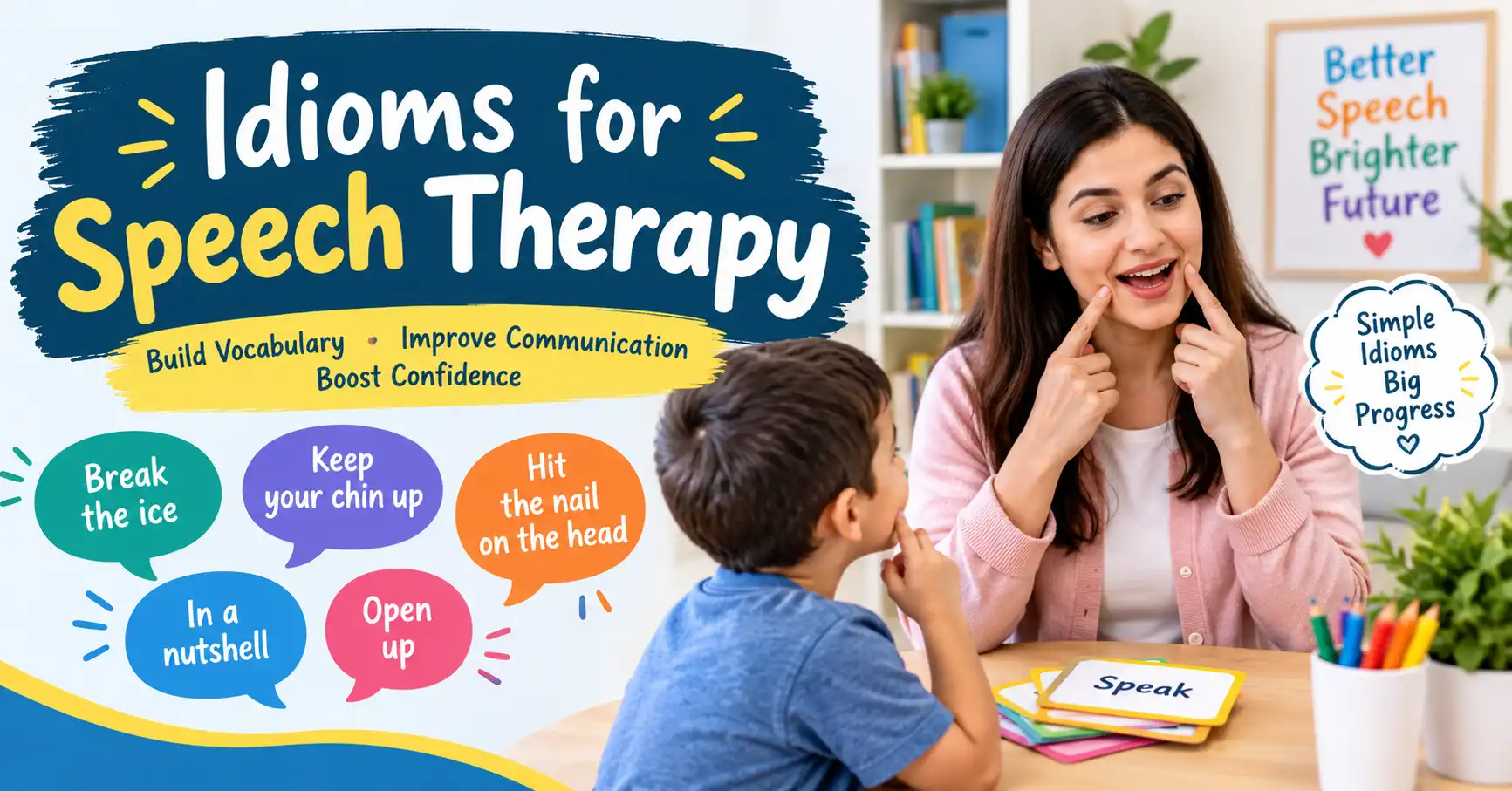
Idioms for speech therapy give children real practice at reading between the lines. An idiom is a phrase whose meaning differs from its words, like “a piece of cake” for something easy. This guide gives you a leveled idiom list with meanings and sample sentences, plus a five step teaching routine.
It is written for speech language pathologists, teachers, and caregivers who want clear steps they can use this week. You will also find common student errors, activities, and goal templates. Each step is short enough to fit into a regular session. A simple data routine shows you when a child is ready to move on. Read straight through, or jump to the section you need.
Quick Answer: Idioms for Speech Therapy in Five Steps
Teach idioms in five steps: spot it, picture it, decode it, use it, and check it later.
Choose true idioms that the child will hear soon.
Start with phrases whose scenes give clear clues.
Keep each scene short, and ask the child to name the clue that helped.
Set goals from the child’s own baseline, not from a fixed percent.
Record the error type each time: literal, keyword guess, wrong tone, overuse, or mixed up wording.
The sections below give you the idiom list, the routine, and the goal templates.

Why Idioms for Speech Therapy Are Hard, and Why They Matter
Idioms are hard because the listener must notice that a phrase isn’t literal, then guess what the speaker means.
A child has four jobs at once:
- Notice that the words don’t fit the scene.
- Use the scene as a clue.
- Guess the speaker’s message.
- Check that the guess makes sense.
A 2016 review covered 38 studies of figurative language in clinical groups. The groups included autism, aphasia, brain injury, and specific language impairment. Every group showed trouble. The reviewers found no single cause. They tied the trouble to a mix of pragmatic, language, and thinking skills, such as understanding what others think, mental planning, and word knowledge.
A 2022 editorial in Frontiers adds a caution. Few studies have tested programs that teach figurative language. So the routine below is a reasonable approach, not a proven treatment.
The cost shows up fast. Idioms turn up in class talk, reading passages, and jokes. One missed phrase can cost a child the point of a lesson or the laugh in a group.
Which Idioms for Speech Therapy Are Worth Teaching? A Three Question Filter
Teach idioms that pass three checks: the phrase is a true idiom, the child will hear it soon, and the scene gives clear clues.
Start by sorting what you find into three types.
| Type | Example | Teach it as an idiom? |
| True idiom | “spill the beans” | Yes. The words don’t add up to the message. |
| Everyday phrase | “have a seat” | No. The meaning is plain. Teach it as polite language if needed. |
| Hard word, not an idiom | “postponed” | No. Teach it as vocabulary. |
Next, ask three questions about each candidate:
- Is it a true idiom? Picture the words. If the picture looks silly or wrong, the phrase passes.
- Will the child hear it soon? Check classroom talk, shows, family chat, and games.
- How many clues does it give? “Hit the books” hints at school. “Under the weather” gives almost none. Begin with the clue-rich ones.
Idioms for Speech Therapy Bank, by Level
This bank lists 20 true idioms in three levels. Each has a meaning and a sample sentence. The levels are practical estimates, not research norms. Move an idiom up or down based on what your student already hears at home and school.
| Level | Idiom | Meaning | Sample sentence |
| Start | a piece of cake | very easy | The spelling quiz was a piece of cake. |
| Start | hit the books | study hard | I need to hit the books tonight. |
| Start | all ears | listening closely | Go ahead, I’m all ears. |
| Start | in the same boat | in the same situation | Neither of us finished, so we’re in the same boat. |
| Start | break the ice | start a talk with new people | Our manager told a joke to break the ice. |
| Start | in hot water | in trouble | Sam is in hot water for skipping practice. |
| Start | call it a day | stop for now | We fixed the last bug and called it a day. |
| Start | cost an arm and a leg | be very expensive | That jacket cost an arm and a leg. |
| Next | under the weather | a little sick | Dad stayed home because he felt under the weather. |
| Next | spill the beans | tell a secret | Please don’t spill the beans about the gift. |
| Next | let the cat out of the bag | tell a secret by accident | Ana let the cat out of the bag about the party. |
| Next | on thin ice | in a risky spot | He is on thin ice after being late again. |
| Next | get cold feet | become nervous before a big step | He got cold feet right before his speech. |
| Next | beat around the bush | avoid the main point | Stop beating around the bush and tell me. |
| Stretch | the ball is in your court | it is your turn to act | We sent our offer. Now the ball is in your court. |
| Stretch | a blessing in disguise | something good that first looked bad | Missing the bus was a blessing in disguise. I met my best friend. |
| Stretch | throw in the towel | give up | After five tries, he threw in the towel. |
| Stretch | on the fence | not able to decide | I’m on the fence about joining the team. |
| Stretch | the last straw | the final problem that ends your patience | When the dog chewed my shoes again, that was the last straw. |
| Stretch | back to square one | back at the start | The file was lost, so we’re back to square one. |
Look-alike idioms: tone and near synonyms. Similar idioms often differ in tone, timing, or how much trouble they suggest. Putting two phrases side by side helps a student choose the right one, not just decode it.
| Pair | Shared idea | What sets them apart |
| in hot water / on thin ice | trouble | The first says trouble has arrived. The second warns it may come next. |
| spill the beans / let the cat out of the bag | a secret gets out | Close to interchangeable, so a good swap test. |
These are common usage patterns, not strict rules.
A Five Step Routine for Teaching Idioms for Speech Therapy
Teach each idiom in five steps: spot it, picture it, decode it, use it, and check it later.

- Spot it. Read a short scene. Ask, “Do these words fit what’s happening?”
- Picture it. Have the child say or draw the literal image. Keep this quick.
- Decode it. Ask what the speaker really wants to say. Offer two or three choices if needed. Then ask which clue helped.
- Use it. Build a new scene together. The child decides whether the phrase fits.
- Check it later. Days later, say the phrase with no scene. Ask what it refers to. If it has faded, run the steps again.
Add a picture card when words alone are not enough.
Worked example: “in the same boat.” Maya and Leo both forgot their lunch money.
Maya: “I forgot mine too. Looks like we’re in the same boat.”
Clinician: “Are Maya and Leo in a boat?”
Student: “No.”
Clinician: “Then what is Maya telling Leo?”
Student: “They both forgot.”
Clinician: “Which word gave you the clue?”
Student: “Too.”
Activities for Idioms for Speech Therapy: In Person, Teletherapy, and Home
Good idiom activities pair a short scene with a choice, a picture, or a role play.
In-person and small group
- Literal or figurative sort. Make cards that use one phrase two ways. “The toy truck hit the books and knocked them over” goes in one pile. “She hit the books after dinner” goes in the other. Ask what changed.
Teletherapy
- Share a slide with a scene and two pictures, one literal and one figurative.
- Let the student point, type, or chat to name the clue.
Home carryover
- Choose one idiom for the week.
- Listen for it in shows, games, and family talk.
- Keep a small tally of every time the child spots it.
Common Mistakes With Idioms for Speech Therapy: Student Error Patterns
Students tend to miss idioms in five ways: literal answers, keyword guesses, wrong tone, overuse, and mixed up wording. This is a working list of patterns, not a research-based scale.
| Pattern | What it sounds like | What to do | What to record |
| Literal answer | “Under the weather” → “It’s raining on him.” | Accept the word-level reading, then add the clue: “He stayed home. Why?” | Literal or figurative response |
| Keyword guess | “Break the ice” → “It’s cold outside.” | Point back to the whole scene, not one word. | Which word drew the guess |
| Right gist, wrong tone | “Beat around the bush” read as a good thing | Compare it with a direct phrase. Ask how the listener feels. | Tone errors (positive or negative) |
| Overuse | “Piece of cake” for everything | Run a “fits / doesn’t fit” sort. | Taught context or new context |
| Mixed-up wording | “Spill the cat” | Say the phrase together. Add a cue picture. | The exact words the student used |
Goals and Data for Idioms for Speech Therapy
A good idiom goal names the task, the support level, and a target based on the child’s own baseline. Use these three templates.
- Choosing the message: Given a short story with an idiom and [two / three] choices, [student] will pick the correct meaning with __% accuracy across __ sessions.
- Explaining with no choices: Given a spoken or written sentence with an idiom, [student] will explain what it refers to with __% accuracy across __ sessions.
- Using it: Given a new situation, [student] will use a taught idiom correctly in __ of __ tries.
The first template targets receptive language. The second and third lean on expressive language.
Record these details with each response:
- The support level (full model, choices, or none)
- Whether the context was taught or new
- The response mode (say, point, draw, write, sign, or AAC)
- The error pattern, if any
Access, Language, and Culture in Idioms for Speech Therapy
Idioms vary by language, culture, and age group, so choose phrases the child will actually hear.
A 2008 SpeechPathology.com article by Cecile Spector notes that most idioms do not carry over from one language or culture to another. It also points out that each generation uses a different set of idioms, so older test items may include phrases a child has never heard.
A child who misses an English idiom may know many in another language, so ask for an example from home.
Accept pointing, drawing, writing, signing, or AAC when the goal is understanding. For AAC users, check that the system lets them say “I don’t get it” and name a feeling or a situation.
Region matters too. Britons often say “a storm in a teacup,” while Americans often say “a tempest in a teapot.”
FAQ About Idioms for Speech Therapy
What are good idiom goals for speech therapy?
A good idiom goal states the task, the support level, and a target that fits the child’s baseline. Start with a choice-based goal, then a no-choice goal, then a goal for using the phrase in a new situation.
At what age do children understand idioms?
No single age marks the start. One clinical article notes that children as young as eight can grasp some of the ambiguity in idioms. Treat that as a loose guide, not a rule.
Why do some children struggle with idioms?
Idioms ask a child to look past the words, use the scene, and guess the speaker’s message all at once. Research ties the trouble to pragmatic, language, and thinking skills rather than one cause.
How do you teach idioms in teletherapy?
Share a short scene with one literal and one figurative picture, then ask the student to pick one and name the clue. The student can point or type in the chat box.
Conclusion: Idioms for Speech Therapy Made Simple
Idioms are hard because they ask a child to look past the words and guess the speaker’s message. Pick true idioms the child will hear soon. Teach them with the five step routine, and use short scenes so the clues are easy to find. Then write goals from the child’s own baseline and record each error pattern. That record tells you when to move an idiom up a level, repeat it, or swap it out.
To read more: 26 Powerful Idioms for Change (Easy Meanings + Examples)