Idioms for mother are phrases about mothers, or built around the word mother, whose meanings go beyond the words themselves. Some praise a mom’s care. Others tease, and a few have nothing to do with mothers at all.
This guide gives you 13 real expressions with meanings, tone, examples, and sourced origins. You will also see which look-alikes to skip, how British and American speakers differ, and which mistakes to avoid.
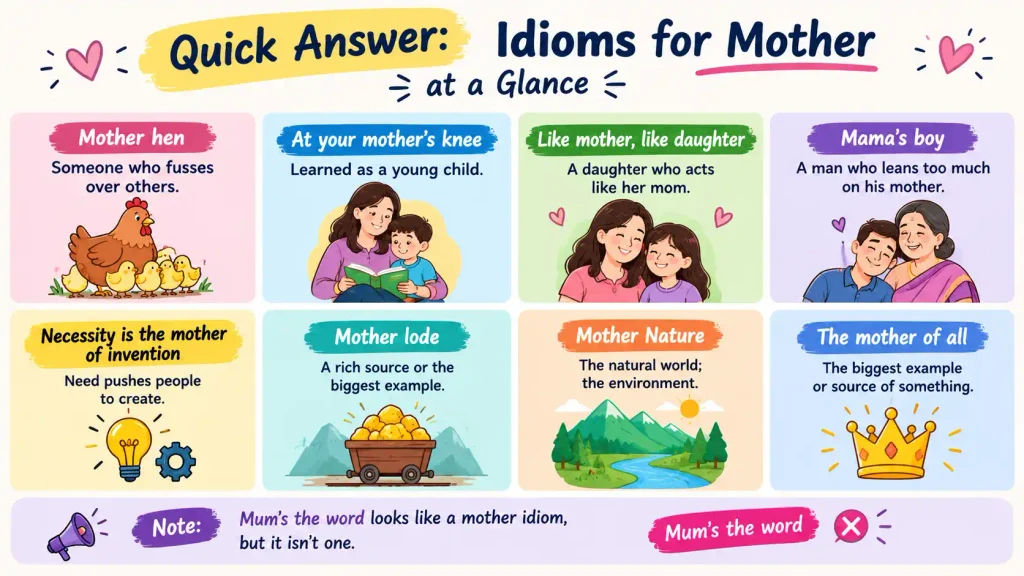
Quick Answer: Idioms for Mother at a Glance
The main idioms for mother are mother hen (someone who fusses over others), at your mother’s knee (learned as a young child), like mother, like daughter (a daughter who acts like her mom), mama’s boy (a man who leans too much on his mother), and necessity is the mother of invention (need pushes people to create). Mother lode, Mother Nature, and the mother of all use “mother” for a source or the biggest example. Mum’s the word looks like a mother idiom, but it isn’t one.
What Counts as Idioms for Mother?
A phrase counts as an idiom when you can’t guess its meaning from its words and the word mother sits at its center. Could a learner work out the meaning from the words alone? If so, it’s an ordinary phrase. If not, it’s an idiom. Some phrases carry the word mother but fail the test, so this guide sorts everything into four groups.
| Group | What it is | Examples |
| True idioms | The meaning is not in the words | mother hen, apron strings |
| Proverbs and sayings | A full sentence of advice or observation | necessity is the mother of invention, like mother, like daughter |
| Fixed phrases | Normal vocabulary that happens to use mother | mother tongue, expectant mother |
| False friends | Look related to mothers, but aren’t | mum’s the word, mother-of-pearl |
Carers and Protectors: Idioms for Mother as a Guardian
Four expressions show a mother as a carer: mother hen, at your mother’s knee, eyes in the back of her head, and tiger mother.
Mother hen. A mother hen looks after others so closely that it can feel like too much. The picture is a hen guarding her chicks. It sounds warm, with a little teasing. For example: “Our coach is a mother hen on away trips. She counts heads on the bus twice.”
At your mother’s knee. If you learned something at your mother’s knee, you picked it up in early childhood, from family at home. I found no recorded origin. The tone is warm and a bit old-fashioned. For example: “Ali’s love of old stories began at his mother’s knee.”
Eyes in the back of her head. Someone with eyes in the back of her head notices everything, even with her back turned. No origin is recorded, and people use the phrase for anyone who seems to see it all. It sounds playful and fond. For example: “My teacher has eyes in the back of her head. She always knows who is passing notes.”
Tiger mother. Strict and demanding, a tiger mother sets very high goals and pushes her children hard. I found no recorded origin, though Oxford Learner’s Dictionaries lists the term as a type of mother. Some people hear praise, and others hear blame. For example: “My cousin’s tiger mother signed her up for math camp, piano and chess in one summer.”
Source and Size: Idioms for Mother as the Origin of Everything
Five expressions use mother to stand for a source or for the biggest of something: of ideas, of gold, of natural sense, of nature itself, and of the largest example.
Necessity is the mother of invention. This saying means that when people badly need something, they find a way to make it. Its tone is neutral. For example: “When the bus strike hit, our neighbors set up a shared ride plan. Necessity is the mother of invention.”
The origin is disputed. Many sites credit Plato’s Republic (Book II, 369c), but that credit is shaky. Wikiquote says the “mother of invention” wording comes from Benjamin Jowett’s loose English version, while a plain translation reads “our need will be the real creator.” Phrase Finder says the proverb was known in England by the 1500s, first in Latin. One dictionary entry reports a close English form, “Need taught him wit,” in 1519.
Mother lode. A mother lode is a huge supply of something good. The tone is neutral and upbeat. For example: “Digging through my uncle’s garage, we found a mother lode of old toys.”
Etymonline traces the term to 1849 and says it is said to translate the Mexican Spanish veta madre, a name for rich silver veins. It first named a vein full of gold found in California’s Sierra Nevada during the gold rush. The “rich source” meaning showed up by 1916. Spell it lode, not load, because a lode is a vein of ore.
Mother wit. Common sense you are born with, not learned in school, is what mother wit describes. Etymonline places it in the mid-1400s, so it isn’t about a mom’s advice. The tone is warm and old-fashioned. For example: “Nobody taught Rina how to calm an angry customer. Her mother wit told her what to say.”
Mother Nature. Nature pictured as a woman who gives life and rules the weather is called Mother Nature. Etymonline records the phrase from the 1550s, in a translation of Thomas More’s Utopia. The tone is neutral. For example: “We planned a picnic, but Mother Nature sent a thunderstorm.”
The mother of all. This phrase describes the biggest, hardest, or worst example of something. Etymonline calls it Gulf War slang from 1991, grown from Saddam Hussein’s words about the coming battle, and adds that it is an Arabic idiom as well as an English one. The tone is informal and dramatic. For example: “The final game was the mother of all comebacks. They were 20 points down at halftime.”
Dependence and Family Ties: Idioms for Mother and Child
Four expressions cover how children stay close to a mother or grow up like her: apron strings, mama’s boy, like mother like daughter, and a face only a mother could love.
Tied to your mother’s apron strings. This means leaning on someone, often a mother, or being ruled by her. The tone is critical. For example: “Dev turned down a job abroad because his mother disliked the idea. His coworkers say he is tied to her apron strings.”
The words apron strings were first recorded between 1535 and 1545. Anne Brontë wrote a close form of the phrase in her 1848 novel The Tenant of Wildfell Hall. One dictionary guesses the idiom may link to “apron-string tenure,” an old law about property held through a wife, but it says “probably,” so treat that as a guess.
Mama’s boy. A grown boy or man who stays very close to his mom and leans on her is a mama’s boy. I found no recorded origin. The tone runs from teasing to critical. For example: “People joked that Omar was a mama’s boy when he turned down a job in another city to stay near his mom.”
Like mother, like daughter. When a daughter acts, looks, or thinks the way her mother does, people say “like mother, like daughter.” The tone is warm, or mocking if the trait is a flaw. For example: “Both of them hum while they cook. Like mother, like daughter.”
The Bible quotes this proverb in Ezekiel 16:44. The King James Version words it as “As is the mother, so is her daughter,” meant as blame aimed at Jerusalem. Whether that verse started the modern saying is not confirmed. The matching saying for sons is “like father, like son.”
A face only a mother could love. Said of someone who isn’t good-looking, this phrase is insulting, even as a joke. No origin is recorded. For example: “That old bulldog has a face only a mother could love.”
Look Alikes: Phrases That Fool Learners of Idioms for Mother
Some phrases carry the word mother or mum but are not mother idioms at all.
Mum’s the word. This phrase means keep the secret and say nothing. The tone is playful and casual. For example: “Don’t tell anyone about the job offer yet. Mum’s the word until Friday.”
The mum here has nothing to do with mothers. Etymonline says it comes from a closed-mouth “mmm” sound that shows someone can’t or won’t speak. The full phrase is recorded by 1704.
These fixed phrases are normal vocabulary, not idioms: mother tongue (your first language), mother country (a country seen in relation to its colonies, or one’s ancestral home), expectant mother (a pregnant woman), mother figure, mother ship and mother-of-pearl (the shiny inner layer of some shells).
Tone and Regional Usage: Idioms for Mother, UK vs US
The same phrase can sound warm, playful, or rude depending on who says it. These ratings are my own reading of how the phrases are usually used, not dictionary labels.
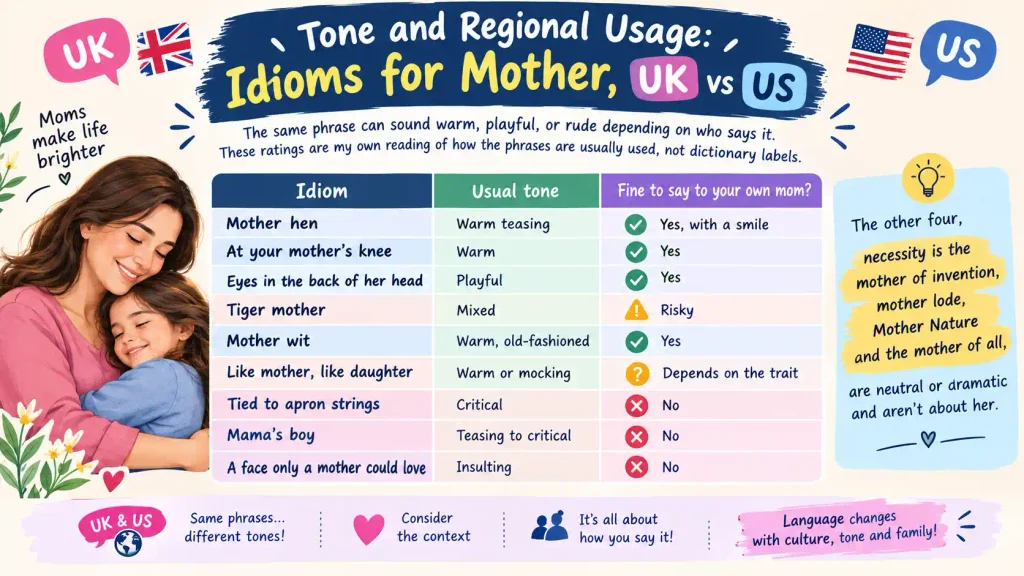
| Idiom | Usual tone | Fine to say to your own mom? |
| Mother hen | Warm teasing | Yes, with a smile |
| At your mother’s knee | Warm | Yes |
| Eyes in the back of her head | Playful | Yes |
| Tiger mother | Mixed | Risky |
| Mother wit | Warm, old-fashioned | Yes |
| Like mother, like daughter | Warm or mocking | Depends on the trait |
| Tied to apron strings | Critical | No |
| Mama’s boy | Teasing to critical | No |
| A face only a mother could love | Insulting | No |
The other four, necessity is the mother of invention, mother lode, Mother Nature and the mother of all, are neutral or dramatic and aren’t about her.
British and American speakers also use a few of these words differently:
- Mum and mom: Oxford marks mum as British English and mom as North American.
- The Bank of Mum and Dad: Oxford labels it British informal English for money that parents give to grown children.
Common Mistakes and Quick Practice for Idioms for Mother
Learners most often slip on spelling, on false friends, on mother tongue, and on tone.
- Spelling the vein of ore as a load. ❌ “We found the mother load of old photos.” ✅ “We found the mother lode of old photos.”
- Reading “mum’s the word” as a mother idiom. ❌ “Mum’s the word” praises moms. ✅ “Mum’s the word” asks someone to keep quiet. The mum is a sound.
- Using “mother tongue” for any language you speak. ❌ “English is my mother tongue.” (said by someone whose first language is Bengali) ✅ “Bengali is my mother tongue. I learned English at school.”
- Using “mama’s boy” in a formal setting. ❌ “Our client is a mama’s boy.” ✅ “Our client relies heavily on his family’s advice.”
Now test yourself with six fill-in sentences. The answers sit right below them.
Word bank: mother hen, mother lode, mother tongue, apron strings, mum’s the word, the mother of all
- Bengali is my ______, but I speak English at school.
- Don’t tell anyone about the gift. ______!
- We found a ______ of old comic books in the attic.
- She checks on every new worker like a ______.
- At 35, he still asks his mom before every choice. He can’t cut the ______.
- The storm hit, and the power stayed off for three days. It was ______ blackouts.
Answers: (1) mother tongue, (2) Mum’s the word, (3) mother lode, (4) mother hen, (5) apron strings, (6) the mother of all.
FAQs About Idioms for Mother
What is the origin of “necessity is the mother of invention”? The author is unknown, though it is often credited to Plato. That credit comes from a loose English translation, not Plato’s own words. Phrase Finder says the proverb was known in England by the 1500s.
Is it “mother lode” or “mother load”? The correct spelling is mother lode, with an e. A lode is a vein of ore, and the phrase comes from gold rush mining.
Conclusion: Choosing Idioms for Mother With Care
Mother expressions fall into a few groups: carers, sources, big things and family ties. Some sound warm, like mother hen and at your mother’s knee. Others tease or sting, like mama’s boy and apron strings.
Check the tone before you use one about someone’s mom. Then pick two or three that fit your life and try them this week. They also fit nicely into a Mother’s Day card or message.
To read more: 22 Best Idioms for Friendship: Powerful Meanings