Idioms for fire are among the oldest images in English. Fire gives light and warmth, and it also burns, spreads, and destroys. That is why so many everyday phrases use flames, heat and smoke to talk about danger, anger, drive and fast moving news.
This guide covers 30 real fire idioms. Each one has a plain meaning and an example sentence you can reuse. You will also find honest origin notes, tone and region tags, look alike pairs, and the mistakes learners make most often.
Quick Answer: What Are Idioms for Fire?
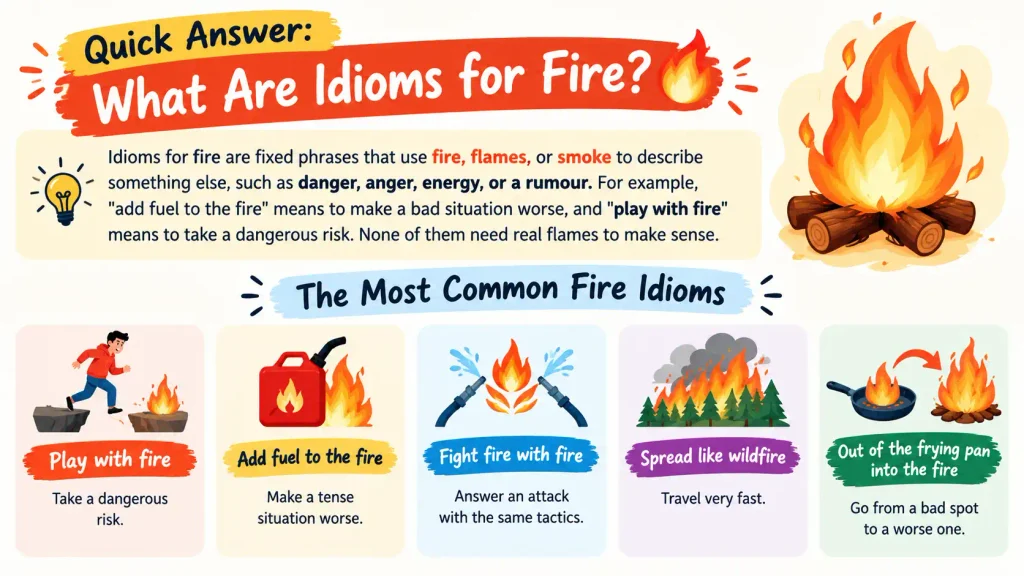
Idioms for fire are fixed phrases that use fire, flames, or smoke to describe something else, such as danger, anger, energy, or a rumour. For example, “add fuel to the fire” means to make a bad situation worse, and “play with fire” means to take a dangerous risk. None of them need real flames to make sense.
The most common fire idioms are:
- Play with fire: take a dangerous risk.
- Add fuel to the fire: make a tense situation worse.
- Fight fire with fire: answer an attack with the same tactics.
- Spread like wildfire: travel very fast.
- Out of the frying pan into the fire: go from a bad spot to a worse one
Idioms for Fire at a Glance: Tone, Formality and Region
This table tags all 30 phrases. The tone and formality tags are judgment calls. Region is marked only where a real difference exists, and “Both” means no difference was found.
| Idiom | Tone | Formality | Region |
| Play with fire | Negative | Informal | Both |
| Out of the frying pan into the fire | Negative | Informal | Both |
| Get your fingers burned | Negative | Informal | Both |
| Burn your bridges | Negative | Neutral | Both |
| Add fuel to the fire | Negative | Neutral | Both |
| Fan the flames | Negative | Neutral | Both |
| Fight fire with fire | Neutral | Neutral | Both |
| Under fire | Negative | Neutral | Both |
| Draw fire | Negative | Neutral | Both |
| Hold someone’s feet to the fire | Neutral | Neutral | Both |
| Light a fire under someone | Neutral | Informal | Both |
| On fire | Positive | Informal | Both |
| Fire in the belly | Positive | Neutral | Both |
| Set the world on fire | Positive (often negated) | Neutral | Both (UK: Thames) |
| Fired up | Positive or negative | Informal | Both |
| Breathe fire | Negative | Informal | Both |
| Spread like wildfire | Neutral | Neutral | Both |
| Where there’s smoke, there’s fire | Neutral | Neutral | US (UK: no smoke without fire) |
| Baptism of fire | Neutral | Neutral | Both |
| Trial by fire | Neutral | Neutral | Both |
| Go through fire and water | Positive | Old-fashioned | Both |
| Burn the midnight oil | Neutral | Neutral | Both |
| Burn the candle at both ends | Negative | Neutral | Both |
| Burn a hole in your pocket | Neutral | Informal | Both |
| Go down in flames | Negative | Informal | Both |
| Flame out | Negative | Informal | Both |
| Fire away | Neutral | Informal | Both |
| Where’s the fire? | Teasing | Informal | Both |
| Irons in the fire | Neutral | Neutral | Both |
| Hang fire | Neutral | Neutral | Both |
Idioms for Fire by Meaning: Pick the Phrase That Fits
The 30 phrases below are grouped by what they describe, so you can choose the one that suits your situation.
Risk and Consequences
Play with fire describes a dangerous risk, often one you were warned about. Skipping the safety check to finish early is playing with fire.
Out of the frying pan into the fire means leaving a bad spot only to land in a worse one. We left the crowded flat for a cheaper one with no heating.
Get your fingers burned points to a loss after a risky choice. Marco got his fingers burned on a “sure thing” bet.
Burn your bridges means wrecking a relationship so badly that going back is impossible. Be polite when you resign, so you don’t burn your bridges.
Conflict and Arguments
Add fuel to the fire means making a tense moment worse. Mum was already upset, and my joke only added fuel to the fire.
Fan the flames stands for stirring up anger, fear, or conflict that already exists. The rumour fanned the flames of the quarrel.
Fight fire with fire means answering an attack with the same tactics. When the rival café cut its prices, Nia fought fire with fire and cut hers too.
Under fire describes facing heavy blame or an open attack. The school came under fire for dropping its music classes.
Draw fire covers pulling criticism toward you. His blunt email drew fire from the whole department.
Hold someone’s feet to the fire signals pressure on a person to keep a promise or answer hard questions. Residents asked the council to hold the mayor’s feet to the fire.
Motivation, Energy and Passion
Light a fire under someone means the push that gets a slow person moving. Friday’s deadline lit a fire under the whole team.
On fire refers to performing at your very best. Our striker was on fire last night and scored three.
Fire in the belly points to a deep inner drive. The best interns have fire in the belly.
Set the world on fire describes doing something amazing that wins huge attention. It is often negated: The film was fine, but it won’t set the world on fire.
Fired up means excited, or angry, and ready to act. I’m fired up for tomorrow’s school play.
Breathing fire is what a furious person does. Dad was breathing fire when he saw the dent in the car.
Rumours, News and Truth
Spread like wildfire describes news or trends that travel very fast. News of the snow day spread like wildfire through the school.
Where there’s smoke, there’s fire suggests that a rumour probably holds some truth. The shop denied it was closing, but the shelves are bare. A rumour is a clue, not proof.
Hardship and Testing
Baptism of fire refers to a rough start that shows what you can do. Her first night shift as a nurse was a baptism of fire.
Trial by fire puts the focus on the test itself. Running the school fair alone was a trial by fire for the new teacher.
Going through fire and water means facing any danger for someone you love. He would go through fire and water for his little sister.
Work, Tiredness and Money
Burn the midnight oil means staying up late to finish work or study. We burned the midnight oil to finish the science project.
Burn the candle at both ends means wearing yourself out with too much work and too little rest.
Burn a hole in your pocket names the urge to spend money right away. My birthday cash was burning a hole in my pocket.
Failure and Fading Out
Go down in flames describes failing in a big, public way. The plan went down in flames after the first vote.
Flame out refers to fading or failing after a bright start. The band flamed out after one hit song.
Everyday Fire Expressions
Fire away is a casual go ahead to start asking. “Got a minute?” “Sure, fire away.”
Where’s the fire? Teases someone who is rushing. Slow down, where’s the fire?
Irons in the fire covers juggling many projects at once. She has too many irons in the fire to take on another job.
Hang fire suggests waiting before you act. Let’s hang fire on the order until we see the budget.
Where Idioms for Fire Come From: Origin Verdicts
Some of these phrases have a documented origin, some have a popular story that cannot be confirmed, and a few have no known source at all. Each verdict below rests on the evidence, so you can tell fact from folklore.
Out of the frying pan into the fire (documented). In 1532, Thomas More wrote that his opponent, William Tyndale, had neatly slipped from the frying pan into the fire. An Italian writer, Abstemius, also told a fable in which fish thrown live into hot fat leap out and land on burning coals. The link between the fable and the phrase is a good guess, not a proven chain.
Baptism of fire (religious). The phrase starts in the Bible. Matthew 3:11 speaks of baptism with the Holy Spirit and with fire. It is also used for a soldier’s first battle, but how the two uses connect is not confirmed.
Fight fire with fire (disputed). You will often read that this phrase comes from pioneers who lit small fires to stop big ones. That story is repeated often, but it has not been confirmed. The timing is a problem. Shakespeare used a close form in 1596, and in King John he wrote: “be fire with fire.” One reference site dates the firebreak method itself to 19th century American settlers, over two centuries later. If that date is right, the pioneer story cannot explain Shakespeare’s line, and nobody has shown that it explains the modern phrase either. Treat it as folklore until someone produces a source.
Play with fire (unknown). No documented first use has turned up. People have linked fire with danger and temptation across many cultures for a very long time, so the picture needs no special story.
Tone and UK vs US Usage of Idioms for Fire
Most idioms for fire sound casual or neutral, but a few carry a clear tone, and a few change between British and American English.
- Critical tone: “add fuel to the fire,” “fan the flames,” “burn your bridges,” and “go down in flames” all suggest blame or regret.
- Warm tone: “fire in the belly,” “on fire,” and “fired up” praise energy.
- Informal words: “light a fire under someone,” “where’s the fire?” and “fire away” suit speech and friendly emails. Skip them in legal papers or formal client letters.
- Region: US English says “where there’s smoke, there’s fire,” while UK English says “no smoke without fire.” A British variant of “set the world on fire” swaps in a place name: “set the Thames on fire.”
Idioms for Fire People Confuse: Look Alike Pairs and Common Mistakes
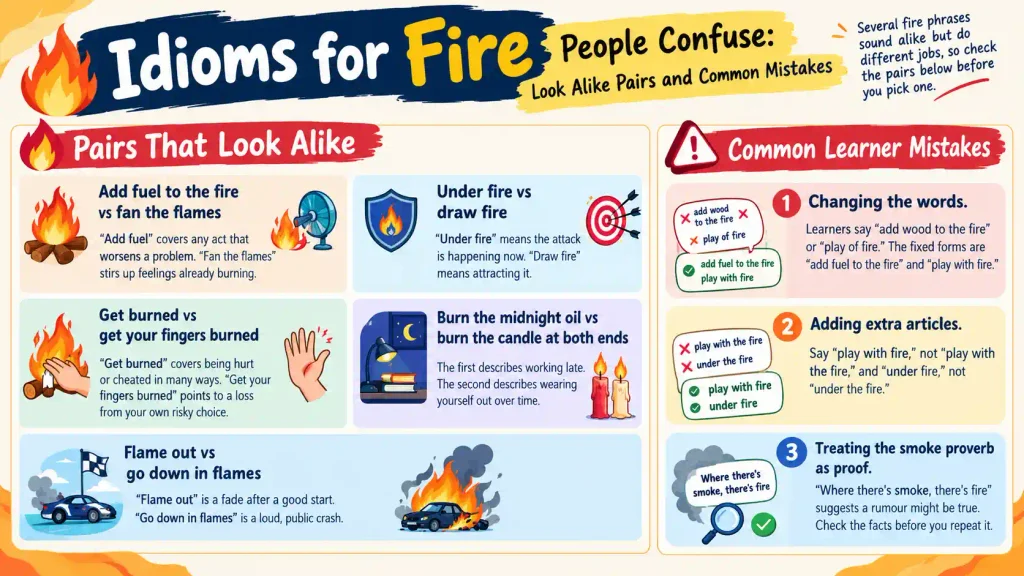
Several fire phrases sound alike but do different jobs, so check the pairs below before you pick one.
Pairs That Look Alike
- Add fuel to the fire vs fan the flames: “Add fuel” covers any act that worsens a problem. “Fan the flames” stirs up feelings already burning.
- Under fire vs draw fire: “Under fire” means the attack is happening now. “Draw fire” means attracting it.
- Get burned vs get your fingers burned: “Get burned” covers being hurt or cheated in many ways. “Get your fingers burned” points to a loss from your own risky choice.
- Burn the midnight oil vs burn the candle at both ends: The first describes working late. The second describes wearing yourself out over time.
- Flame out vs go down in flames: “Flame out” is a fade after a good start. “Go down in flames” is a loud, public crash.
Common Learner Mistakes
- Changing the words. Learners say “add wood to the fire” or “play of fire.” The fixed forms are “add fuel to the fire” and “play with fire.”
- Adding extra articles. Say “play with fire,” not “play with the fire,” and “under fire,” not “under the fire.”
- Treating the smoke proverb as proof. “Where there’s smoke, there’s fire” suggests a rumour might be true. Check the facts before you repeat it.
Idioms for Fire FAQs: Quick Answers
What does “playing with fire” mean? Playing with fire means taking a dangerous or foolish risk that could cause you trouble later. It has nothing to do with real flames.
What is the most common idiom related to fire? No reliable count exists, but “play with fire” and “add fuel to the fire” appear on nearly every list of fire phrases, and “fight fire with fire” appears on most.
Is “playing with fire” formal or informal? It is informal to neutral. It fits conversation, news writing, and emails to colleagues.
Are fire idioms used in everyday conversation? Yes. They turn up in daily speech, especially when people talk about emotions, conflict, rumours, and deadlines. “Fire away,” “where’s the fire?” and “on fire” are typical spoken phrases.
Conclusion: Using Idioms for Fire With Confidence
These phrases work because everyone understands the picture: flames spread, heat warns, and smoke hints that something is burning. Pick a phrase by tone first, then by picture. A rumour needs “spread like wildfire,” a quarrel needs “add fuel,” and a worn out student needs “burn the midnight oil.”
Keep the fixed wording, watch the tone, and be careful with origin stories, since several popular ones, like the pioneer tale behind “fight fire with fire,“ have no confirmed source. Try using three of these idioms for fire in real conversation this week.
To read more: Idioms for Flowers: 20 Powerful Sayings & Easy Examples