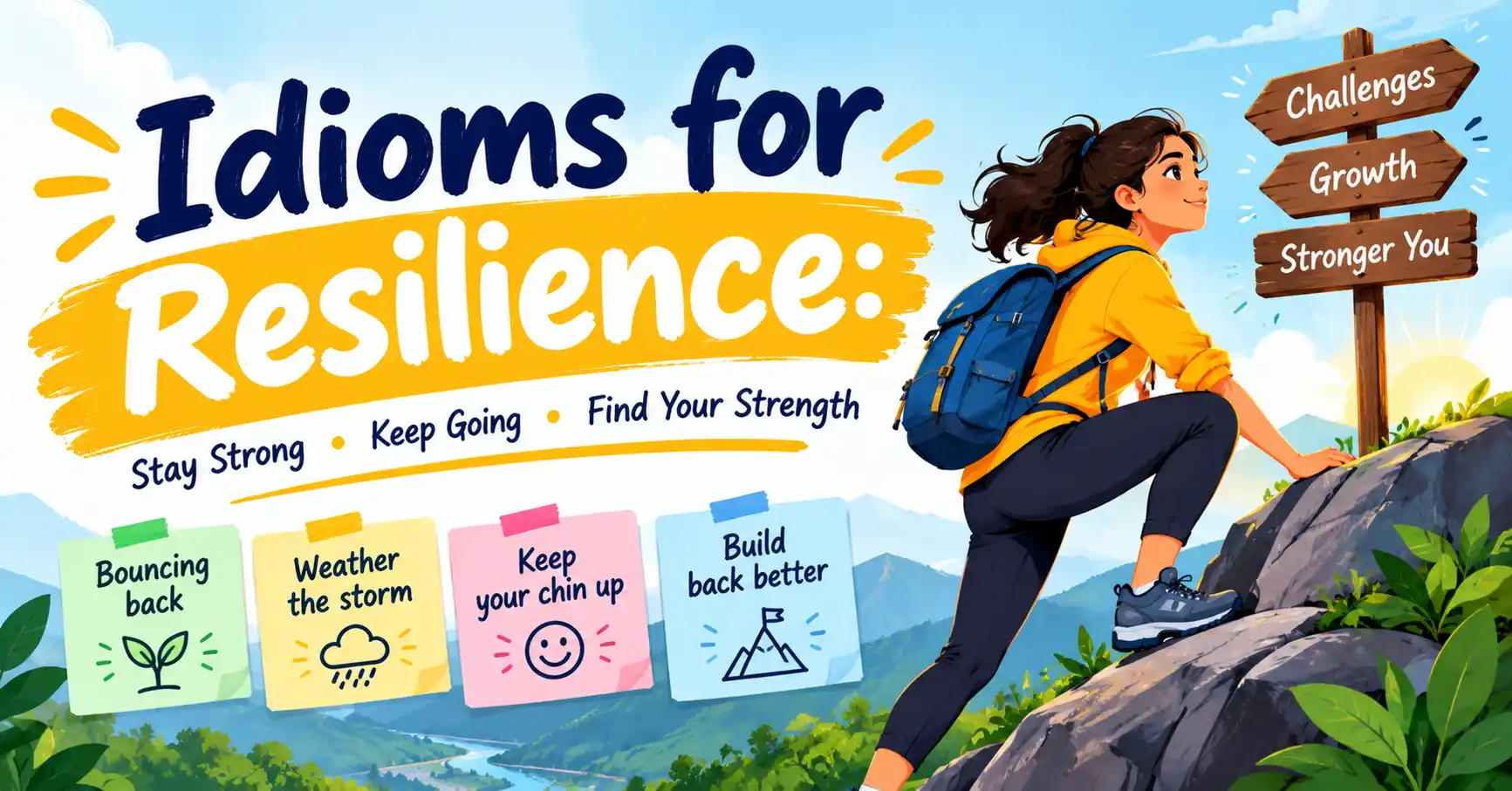
Idioms for resilience are fixed phrases that describe recovering from hard times. Their words rarely mean what they say, so “weather the storm” has nothing to do with rain. This guide covers 15 of them, each with a plain meaning, example sentences, and an origin where one can be found. You will also learn which phrases comfort people and which can hurt.
Here are the five you will hear most often: bounce back, weather the storm, hang in there, tough as nails, and roll with the punches. Each one paints a slightly different picture of strength. Read on to learn when to use each, and when to say something kinder instead.
Quick Answer: What Are Idioms for Resilience?
A resilience idiom is a set phrase that describes bouncing back, enduring, adapting, or refusing to quit when life gets hard. The 15 phrases in this guide fall into five groups: recovering, enduring, adapting, not giving up, and staying composed. Use “bounce back” for recovery after the worst is over.
Use “weather the storm” for surviving a rough period while it is still happening. Use “roll with the punches” for adjusting to bad surprises. Use “hang in there” to encourage someone who feels like quitting. Check the tone before you speak, because some phrases can sound dismissive to a person in pain.

Resilience Meaning and 15 Idioms for Resilience at a Glance
Resilience is the ability to recover after something hard happens. The word comes from the Latin resilire, which means to leap or spring back. People borrowed that picture to describe human strength, and English now has many phrases for the idea.
Resilience is about recovering and adapting, while perseverance is about continuing toward a goal. Grit adds a long-term passion for that goal.
| Idiom | Plain meaning | Group |
| Bounce back | Recover quickly | Recovering |
| Get back on your feet | Become steady again after a fall | Recovering |
| Rise from the ashes | Return after a total loss | Recovering |
| Weather the storm | Survive a rough period | Enduring |
| Tough it out | Push through without quitting | Enduring |
| Keep your head above water | Barely cope with a heavy load | Enduring |
| Roll with the punches | Adjust to bad surprises | Adapting |
| When life gives you lemons, make lemonade | Turn a bad deal into something good | Adapting |
| Hang in there | Don’t give up | Not giving up |
| Stay the course | Keep following your plan | Not giving up |
| When the going gets tough, the tough get going | Strong people try harder when things get rough | Not giving up |
| Keep your chin up | Stay positive | Composed |
| Keep a stiff upper lip | Hide your feelings and stay calm | Composed |
| Pull yourself up by your bootstraps | Improve your life through your own effort | Composed |
| Tough as nails | Very strong and hard to break | Composed |
Idioms for Resilience for Recovering After a Setback
These phrases describe the moment a person gets up and starts again. Use them once the worst is over and the repair has begun.
Bounce back
- Meaning: To recover quickly after trouble.
- Examples: Our team lost the final, but it bounced back the next season. She is bouncing back well after her surgery.
- Origin: Unclear. The picture is simple: a ball hits the ground and springs up again.
Get back on your feet.
- Meaning: To become steady again after a rough patch, often with money or health.
- Examples: My brother stayed with us until he got back on his feet. After the flood, the shop owners worked to get back on their feet.
- Origin: Unclear. It likely comes from the plain image of standing up after a fall.
Rise from the ashes
- Meaning: To come back strong after total loss or ruin.
- Examples: The old stadium burned down, and a bigger one rose from the ashes. Her small business rose from the ashes of two failed shops.
- Origin: The phrase draws on the phoenix, a mythical bird that burns up and is born again from its own ashes. The myth is ancient, but when the phrase first appeared in English is unclear.
Idioms for Resilience for Enduring a Hard Time
These phrases describe staying steady while the trouble is still going on. The focus is survival, and nobody is cheering yet.
Weather the storm
- Meaning: To survive a difficult period without being broken by it.
- Examples: The company weathered the storm by cutting costs for a year. Our family weathered the storm after Dad lost his job.
- Origin: Unclear. It likely comes from ships surviving bad weather at sea, though that link isn’t confirmed.
Tough it out
- Meaning: To push through a bad situation without giving in.
- Examples: The heat was awful, but the players toughed it out until the whistle. I had a cold, so I toughed it out and went to class.
- Origin: Unclear. It is an informal phrase built from the word “tough.”
Keep your head above water.
- Meaning: To barely manage a heavy load, such as bills or work.
- Examples: With two jobs, she is just keeping her head above water.
- Origin: Unclear. The picture comes from swimming, where staying afloat means staying alive.
Idioms for Resilience for Adapting to Change
These phrases describe bending to a new situation instead of fighting it. Resilience isn’t always about being rigid, and sometimes the smartest move is to change shape.
Roll with the punches.
- Meaning: To handle bad surprises by adjusting instead of breaking.
- Examples: New bosses and new rules came all year, but he rolled with the punches. You have to roll with the punches when you travel with small kids.
- Origin: It comes from boxing, where a fighter moves with a blow to soften it. Early examples in the Oxford English Dictionary date from the 1940s and 1950s.
When life gives you lemons, make lemonade.
- Meaning: To turn a bad situation into something useful.
- Examples: The rain ruined our picnic, so we baked cookies and watched movies. He lost his office space, so he made lemonade and started working from home.
- Origin: The earliest close version is credited to writer Elbert Hubbard, in a 1915 obituary of the actor Marshall Pinckney Wilder. Dale Carnegie gave the modern wording in 1948 and credited Julius Rosenwald.
Idioms for Resilience for Not Giving Up

These phrases are for the moment when quitting feels easier than going on. Coaches and friends use them a lot.
Hang in there
- Meaning: To keep going and not give up.
- Examples: Exams end Friday, so hang in there! I hung in there through a tough first year at my job.
- Origin: Unclear. It paints the image of holding on to something tightly.
Stay the course
- Meaning: To keep following your plan even when it gets rough.
- Examples: The coach asked the team to stay the course after two losses.
- Origin: Unclear. It is often linked to sailing, where a ship holds its heading, though that link isn’t confirmed.
When the going gets tough, the tough get going.
- Meaning: Strong people try harder when things become difficult.
- Examples: Sales dropped in March, but when the going gets tough, the tough get going.
- Origin: It started as a coaching saying in American football. The earliest example found in print is from 1953, in a Texas newspaper quoting coach John Thomas. Stories crediting Joseph P. Kennedy or Knute Rockne are unconfirmed.
Idioms for Resilience for Staying Composed or Tough
These phrases describe the face a person shows the world in a rough moment. Some praise calm and strength, while others carry a heavier message.
Keep your chin up
- Meaning: To stay positive in a hard moment.
- Examples: Keep your chin up, because the next interview will go better. She kept her chin up even after the team cut her.
- Origin: Unclear. A raised chin is a common sign of courage in body language.
Keep a stiff upper lip.
- Meaning: To hide your feelings and stay calm in hard times.
- Examples: The pilot kept a stiff upper lip while the plane shook. He kept a stiff upper lip at the funeral, but cried later at home.
- Origin: The phrase is tied to British culture, yet it began in America. The earliest known example appeared in the Massachusetts Spy in June 1815. A Royal Navy shroud story circulates online, but it is a legend.
Pull yourself up by your bootstraps.
- Meaning: To improve your life through your own effort, with no outside help.
- Examples: She pulled herself up by her bootstraps and opened her own bakery. Not everyone can pull themselves up by their bootstraps without support.
- Origin: An early record appears in Joel Dorman Steele’s 1888 schoolbook Popular Physics. The story that it began as a joke about an impossible act is unconfirmed, and Phrase Finder says the true origin isn’t known.
Tough as nails
- Meaning: Very strong, hard to hurt, and not easily scared.
- Examples: Our nurse is tough as nails, and nothing rattles her.
- Origin: Unclear. The comparison points to nails, which are hard and don’t bend easily.
Choosing Idioms for Resilience: Usage, Tone and Common Mistakes
Which phrase fits? Pick the idiom that matches where the person stands: inside the crisis, coming out of it, or helping someone else through it.
Say “weather the storm” while you are in the middle of it, “bounce back” once you are out the other side, and “hang in there” when you are cheering someone on. “Weather the storm” is for surviving the rough part, while “bounce back” is for the recovery that follows. “Tough it out” describes your own effort, while “hang in there” is usually something you say to another person. “Keep your chin up” invites hope, while “keep a stiff upper lip” asks someone to hide pain.
Tone guide. Some of these phrases comfort the listener, and others can sound like blame. The table below is a guide, not a rule, because tone depends on voice, setting, and relationship.
Warm phrases include “bounce back,” “get back on your feet,” “rise from the ashes,” “weather the storm,” “hang in there,” and “keep your chin up.” Phrases that can sound dismissive include “tough it out,” “lemonade from lemons,” “when the going gets tough,” “keep a stiff upper lip,” and “pull yourself up by your bootstraps.” Use the dismissive group with care when someone faces grief, serious pain, or a lack of support.
When someone is in pain, name what they feel first. Try “That sounds really hard,” or “I’m here if you want to talk.” Save the idioms for later, when the person is ready for encouragement.
Common mistakes. The most frequent errors are wrong prepositions, extra words, broken fixed forms, and clashing images.
- Wrong preposition: ❌ She bounced back of the failure. ✅ She bounced back from the failure.
- Extra preposition: ❌ We weathered through the storm. ✅ We weathered the storm.
- Changed fixed form: ❌ He is more tough as nails than me. ✅ He is tougher than me, or he is as tough as nails.
- Mixed images: ❌ The team pulled itself up by its bootstraps and weathered the storm. ✅ The team weathered the storm and came out stronger.
FAQ and Research on Idioms for Resilience
In research, “idioms of resilience” refers to the ways people in a culture talk about coping, hope, and recovery. This is a different meaning from the English list above. A 2021 paper by Raghavan, Brown, Coope, and colleagues in the International Journal of Social Psychiatry studied 30 migrants in Pune, India.
What is the origin of “pull yourself up by your bootstraps”?
The earliest known record is in Joel Dorman Steele’s 1888 schoolbook Popular Physics, though the true origin isn’t confirmed.
What is the difference between resilience and perseverance?
Resilience is the ability to recover and adapt after hard times, while perseverance is the choice to keep working toward a goal.
Conclusion on Idioms for Resilience
The best of all idioms for resilience is the one that fits both the moment and the listener. Use “bounce back” for recovery and “weather the storm” for survival. Use “roll with the punches” when flexibility matters most. Check the tone before you speak, especially with someone in pain. Name the feeling first and offer a phrase only when the person is ready. Choose one clear picture per sentence so your meaning stays sharp. With these phrases in your toolkit, you can encourage others and describe your own comebacks with confidence.
To read more: Idioms for Work Hard: 20 Best Phrases You Must Know