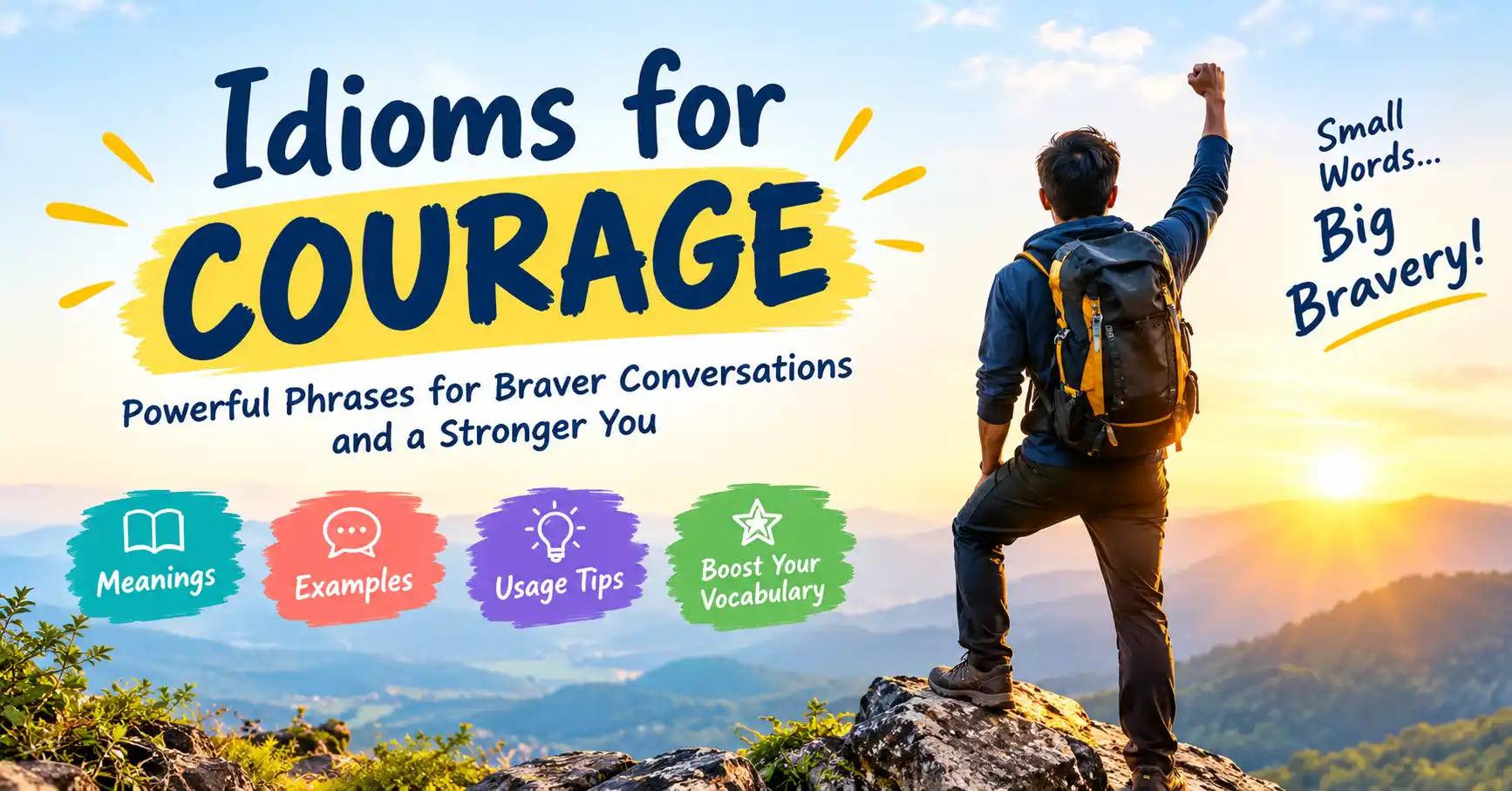
Idioms for courage are fixed phrases that describe facing fear or hard times with nerve. “Bite the bullet” and “take the plunge” are two of the best known. Some of these phrases come from Latin, Shakespeare, and old newspapers. Others have origin stories that sound good but cannot be proven.
This guide gives plain meanings, honest origin grades, and example sentences. Tone labels show which phrases sound like praise but carry a sting. Read the quick answer first, then the full list.
Quick Answer: The Best Idioms for Courage
The best pick is “bite the bullet,” a phrase for accepting something hard and carrying on. “Take the plunge” describes making a bold choice after a long think. “Face the music” refers to accepting the result of your own actions. “Grasp the nettle” points to tackling a job you have dodged. “Fortune favors the brave” suggests that bold people tend to succeed. “Dutch courage” is a backhanded phrase for nerve that comes from alcohol. Each origin below carries a grade: Documented, Disputed, or Unknown.
Idioms for Courage at a Glance
The best known phrases are bite the bullet, take the plunge, face the music, and fortune favors the brave.
This table lists all 17. Documented means a reliable source records the first use. Disputed means sources disagree. Unknown means no solid origin has turned up.

| Phrase | Meaning | Origin |
| Bite the bullet | Accept something hard | Disputed |
| Take the bull by the horns | Tackle a problem head on | Unknown |
| Grasp the nettle | Face a job you avoided | Documented |
| Face the music | Accept the result of your acts | Unknown |
| Take the plunge | Make a bold choice | Documented |
| Pluck up your courage | Gather the nerve | Documented (dating) |
| Fortune favors the brave | Bold people tend to win | Documented |
| Have the courage of your convictions | Act on your beliefs | Unknown |
| Stand your ground | Refuse to back down | Unknown |
| Screw your courage to the sticking place | Hold your nerve | Documented line |
| Dutch courage | Nerve from alcohol | Disputed |
| Put on a brave face | Hide fear or sadness | Unknown |
| As bold as brass | Boldly shameless | Documented |
| Nerves of steel | Calm under pressure | Documented |
| Keep a stiff upper lip | Hide emotion calmly | Documented |
| Grit your teeth | Push through pain | Unknown |
| Keep your chin up | Stay hopeful | Unknown |
Idioms for Courage When Facing Something Hard
Four phrases cover facing something hard head-on: bite the bullet, take the bull by the horns, grasp the nettle and face the music.
Bite the bullet
This phrase refers to accepting something unpleasant without a fuss. The first non literal use found so far is Rudyard Kipling’s 1891 novel The Light That Failed. A famous story says wounded soldiers bit a bullet during surgery. That tale is often told as fact, but it is unconfirmed, and one source says a leather strap was more common. You can bite the bullet over a bill, a deadline, or an awkward phone call. Example: “I hated cancelling the trip, but I bit the bullet and told everyone.” Tone: neutral to admiring.
Take the bull by the horns
It describes facing a problem head on and taking charge. Writers used it in the early 1700s. Bullfighting and the American Old West are the usual guesses. Neither is proven, and the early date makes the Old West story unlikely. It fits school life too: a student who finally asks the teacher for help is taking the bull by the horns. Example: “After months of dodging the budget talk, Priya took the bull by the horns and booked a meeting.” Tone: positive.
Grasp the nettle
This phrase points to dealing firmly with a job you have avoided. It rests on an old belief that a nettle stings less if you grip it hard. John Lyly’s Euphues (1578) records that belief, and Aaron Hill used the image in his 1753 Works. It is mainly British, and it is “nettle,” never “mettle.” Example: “The council finally grasped the nettle and closed the unsafe bridge.” Tone: positive.
Face the music
It refers to accepting the result of something you did wrong. One phrase-history site cites a New Hampshire newspaper from 1834 as the earliest printed example, so the phrase looks American. Theories point to stage performers facing the orchestra pit or soldiers being drummed out of a regiment. Neither is proven. People use it for blame, punishment, or a hard talk. Example: “He broke the window, so he walked home and faced the music.” Tone: neutral.
Idioms for Courage When Taking a Leap
Take the plunge, pluck up your courage, and fortune favors the brave all describe acting in spite of fear.

Take the plunge
This one describes a bold or risky choice, often after a long think. The figurative use is on record by 1823. It grew from an older noun sense meaning a point of trouble or danger. One word history source suggests the novel The Vicar of Wakefield (1766) helped make it popular. It often points to big life steps, such as a move, a new job, or a wedding. Example: “After years of renting, they took the plunge and bought a small flat.” Tone: positive.
Pluck up your courage
It suggests working up the nerve to do something that scares you. The phrase has been in use since at least the 1500s. “Screw up your courage” works the same way, and British dictionaries also list “take your courage in both hands.” Example: “Zara plucked up her courage and spoke in front of the class.” Tone: positive.
Fortune favors the brave
This saying suggests that bold people are likelier to succeed. It is Latin. Virgil gives a version in the Aeneid, Book 10, line 284, and forms of it appear in Ennius, Terence and Pliny the Elder. Pliny the Younger reports that his uncle used it during the Vesuvius eruption of 79 CE. The words “bold” and “daring” also circulate, and British writers spell it “favours.” Example: “Fortune favors the brave,” Omar said, and he sent his app to the investors. Tone: encouraging.
Idioms for Courage When Standing Firm
Have the courage of your convictions, stand your ground, and screw your courage to the sticking place all describe holding firm.
Have the courage of your convictions
This phrase refers to acting on your beliefs even when others criticize you. The word “courage” entered English in the 1200s from Old French corage, built on cuer, “heart.” Nobody has traced who first paired it with “convictions.” Example: “The student had the courage of her convictions and told the class why she disagreed.” Tone: positive.
Stand your ground
It describes refusing to back down when someone pushes you. No solid origin has turned up. A close cousin is “hold your ground.” It fits arguments at work, at school, and at home. Example: “The shopkeeper stood her ground when the crowd demanded a discount.” Tone: positive, or stubborn if the other side is right.
Screw your courage to the sticking place
This line comes from Shakespeare’s Macbeth (1605), Act 1, Scene 7, where Lady Macbeth pushes her husband toward killing King Duncan. The best known reading of “sticking place” is a crossbow string pulled back until it locks. Other readings exist. Today people usually quote it with a wink. Example: “I screwed my courage to the sticking place and knocked on the dean’s door.” Tone: intense and literary.
Idioms for Courage With a Catch
Dutch courage, put on a brave face, and bold as brass sound like courage, but each one has a catch.
Dutch courage
It refers to nerve that comes from drinking alcohol. The phrase points to a reputation for heavy drinking among the Dutch. One source cites Edmund Waller’s 1665 poem Instructions to a Painter, while another dictionary lists first use around 1805 to 1815. It is no compliment, and it is not advice to drink. Example: “He had a drink before the speech for Dutch courage, then forgot half of it.” Tone: backhanded.
Put on a brave face
This phrase describes hiding worry or sadness and acting as if all is well. No solid origin has turned up. A close variant is “put a brave front on.” Use it with care around someone who is grieving. Example: “She put on a brave face at the airport, though she was close to tears.” Tone: sympathetic.
As bold as brass
It describes someone boldly confident, often with no shame. The earliest printed example found is George Parker’s Life’s Painter of Variegated Characters (1789). A popular tale ties it to Brass Crosby, a Lord Mayor of London in the 1770s. That tale is unconfirmed, since “brass” already referred to cheek before then. Example: “He strolled into the meeting bold as brass, forty minutes late.” Tone: backhanded and informal.
Idiom for Courage Under Pressure
Four phrases describe staying calm and strong when pressure builds: nerves of steel, stiff upper lip, grit your teeth, and chin up.

- Nerves of steel: Staying calm in a scary moment. The “courage” sense of “nerve” dates to about 1600, and one word-history source lists “nerves of steel” by 1869. Example: “A pilot needs nerves of steel in a storm.”
- Keep a stiff upper lip: Hiding emotion and staying calm in hard times. The earliest example found is from a Massachusetts newspaper in 1815, so the phrase began in America. Example: “He kept a stiff upper lip through the whole awful trial.”
- Grit your teeth: Pushing on through pain or trouble. Example: “She gritted her teeth and finished the last mile.”
- Keep your chin up: Staying hopeful when times are bad. Example: “Keep your chin up, the test results come out on Friday.”
Common Mistakes With Idioms for Courage
The most common errors are swapping “nettle” for “mettle,” treating Dutch courage as praise, and telling folklore as fact.
- “Grasp the mettle.” The correct phrase is “grasp the nettle.” The picture only works with the stinging plant.
- Using “Dutch courage” as a compliment. It points to drink, and it can offend.
- Stating the “bite the bullet” surgery story as fact. Call it a popular theory.
- Calling “stiff upper lip” an old British phrase. The earliest example found is American, from 1815. Some web pages credit P.G. Wodehouse, but the phrase was in print long before his books.
- Using “play with fire” or “throw caution to the wind” for courage. Both describe recklessness, not bravery.
- Treating “brave new world” as a courage phrase. It is the title of Aldous Huxley’s novel about a controlled society, not a phrase about bravery.
Idioms for Courage FAQs
Readers ask four things most about these phrases, and the short answers are below.
What does “bite the bullet” really mean? It means accepting something unpleasant and carrying on anyway. The surgery story is often told as fact, but it is unconfirmed. The earliest non literal use found is from 1891.
Is it “grasp the nettle” or “grasp the mettle”? The correct phrase is “grasp the nettle.” A stinging nettle hurts less when gripped firmly. “Mettle” refers to spirit, so the mix-up is easy but breaks the picture.
Where does “Dutch courage” come from? It refers to courage from drinking alcohol and points to a Dutch reputation for heavy drinking. Sources disagree on the date, so no single answer is safe.
What is the difference between courage, bravery, and valor? Courage is facing danger, fear, or pain. Bravery adds daring, and valor means heroic courage in a just fight. Bravado is only a boastful show.
Conclusion on Choosing Idioms for Courage
The right idiom for courage depends on the moment, so match the phrase to the situation. Accepting a cost calls for “bite the bullet.” A problem you have dodged calls for “grasp the nettle” or “take the bull by the horns.” Consequences call for “face the music,” and a risky leap calls for “take the plunge.” Standing firm calls for “courage of your convictions.” Check the tone first, because some phrases carry a sting. Treat folklore origins as stories, not facts, and you will sound confident and accurate.
To read more: 15 Powerful Idioms for Loyalty (Easy Meanings & Examples)

Digital Communication Writer
Focus: everyday texting slang, emoji meanings, casual chat abbreviations (NGL, LY, DND, etc.)
Bio angle: Grew up navigating group chats and social apps, explains slang the way it’s actually used, with real examples showing serious vs. joking vs. sarcastic tone.