
Thanksgiving idioms are everyday phrases linked to turkey, the holiday meal, and giving thanks. Each one means something different from its plain words. This guide gives the meaning, the origin, and real example sentences for each phrase. You will also find tone notes, common mistakes, and a short quiz.
Many of these phrases are heard at family tables long after the holiday ends. Some origins are well recorded, while others are only stories. This guide tells you which is which.
Quick Answer: Idioms for Thanksgiving
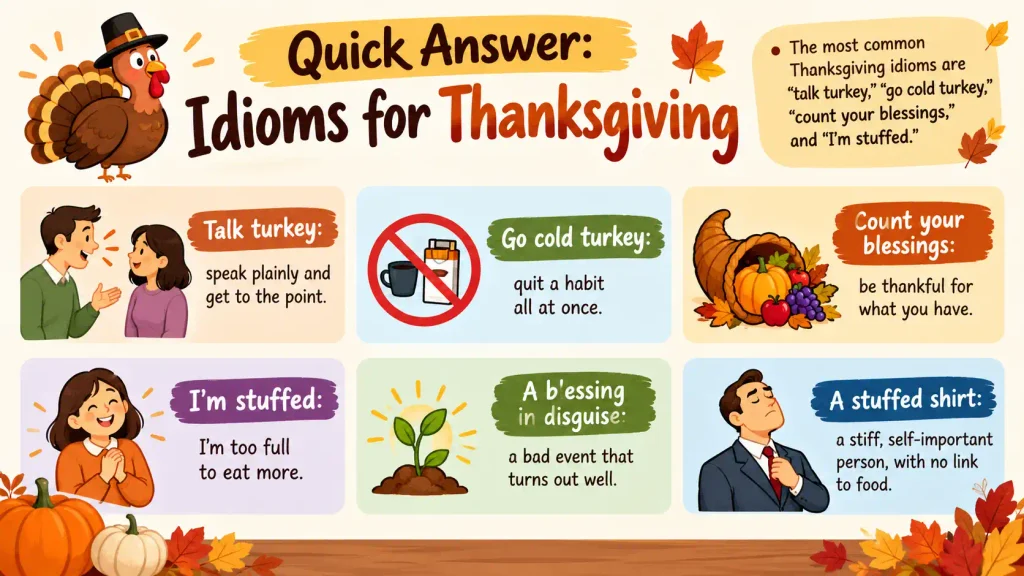
- The most common Thanksgiving idioms are “talk turkey,” “go cold turkey,” “count your blessings,” and “I’m stuffed.”
- Talk turkey: speak plainly and get to the point.
- Go cold turkey: quit a habit all at once.
- Count your blessings: be thankful for what you have.
- I’m stuffed: I’m too full to eat more.
- A blessing in disguise: a bad event that turns out well.
- A stuffed shirt: a stiff, self-important person, with no link to food.
What Counts as Idioms for Thanksgiving?
A Thanksgiving idiom is a phrase tied to turkey, the holiday meal, or giving thanks, with a meaning beyond its plain words. Thanksgiving falls on the fourth Thursday of November in the US. A phrase makes this guide only if it passes three tests:
- It connects to turkey, the feast, or gratitude.
- A dictionary or word history source records it.
- It is not a brand slogan or an invented phrase.
Many food idioms work all year, like “butter up,” and they get a short section near the end.
Idioms for Thanksgiving at a Glance
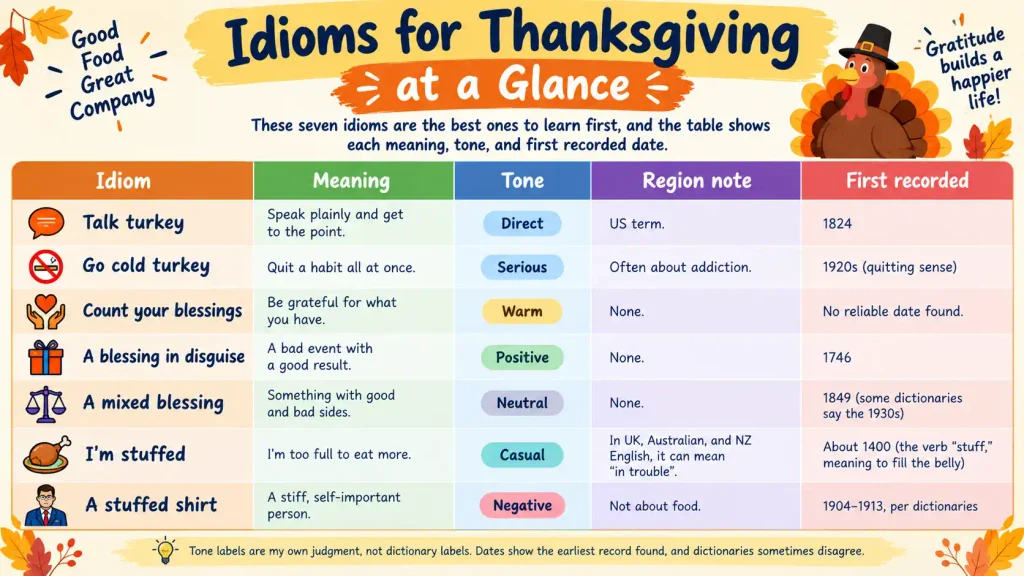
These seven idioms are the best ones to learn first, and the table shows each meaning, tone, and first recorded date.
| Idiom | Meaning | Tone | Region note | First recorded |
| Talk turkey | Speak plainly and get to the point | Direct | US term | 1824 |
| Go cold turkey | Quit a habit all at once | Serious | Often about addiction | 1920s (quitting sense) |
| Count your blessings | Be grateful for what you have | Warm | None | No reliable date found |
| A blessing in disguise | A bad event with a good result | Positive | None | 1746 |
| A mixed blessing | Something with good and bad sides | Neutral | None | 1849 (some dictionaries say the 1930s) |
| I’m stuffed | I’m too full to eat more | Casual | In UK, Australian, and NZ English, it can mean “in trouble” | About 1400 (the verb “stuff,” meaning to fill the belly) |
| A stuffed shirt | A stiff, self-important person | Negative | Not about food | 1904–1913, per dictionaries |
Tone labels are my own judgment, not dictionary labels. Dates show the earliest record found, and dictionaries sometimes disagree.
Turkey Idioms for Thanksgiving
The two turkey idioms are “talk turkey,” which means to speak plainly, and “go cold turkey,” which means to quit all at once.
Talk turkey
Meaning: To speak plainly and get to the point.
Examples:
- “The client likes the draft. Now it’s time to talk turkey about the deadline.”
- “Before we book the trip, let’s talk turkey about how much each of us can spend.”
How sure are we? The date is solid. The phrase was first recorded in 1824, and it first meant a pleasant chat. By the early 1900s, it had shifted toward plain, frank talk.
The start of the phrase is less clear. World Wide Words found three origin stories and called none of them convincing. One ties it to friendly talk at the family dinner table. Another tells of a settler and a Native American sharing birds after a hunt. People often repeat the hunting tale, but no one has proven it.
Tone and region: Direct and neutral. It began as a US term.
Go cold turkey
Meaning: To quit a habit all at once, with no slow cutting back.
Examples:
- “My uncle gave up coffee cold turkey. The headaches lasted three days.”
- “She went cold turkey on her phone during exam week.”
How sure are we? The quitting sense dates to the 1920s. No one has settled why the words fit. Three ideas come up most:
- Cold turkey is a dish that needs no cooking, so the phrase came to mean doing something with no preparation.
- The goosebumps people get when they quit a drug look like the skin of a plucked turkey.
- One article reports that Merriam Webster reads “cold” as “plain and direct,” which links it to “talk turkey.”
None of these is confirmed.
Tone and region: Serious. The phrase often comes up with addiction, so keep jokes light when the topic is real.
Are “talk turkey” and “cold turkey” related?
Sources disagree on whether the two phrases are related. Mental Floss says the quitting sense likely grew on its own, and World Wide Words calls it unrelated. So the two phrases share a bird, and perhaps nothing more.
Blessing Idioms for Thanksgiving
The blessing idioms are “count your blessings” (be thankful), “a blessing in disguise” (bad news that turns good), and “a mixed blessing” (good and bad together).
Count your blessings
Meaning: To think about the good things in your life and feel thankful.
Examples:
- “The flight was late, but count your blessings. Nobody lost a bag.”
- “Whenever work gets stressful, I count my blessings: good friends, a warm home, and a short commute.”
How sure are we? No reliable first date turned up. The phrase suits the holiday because Thanksgiving is about gratitude.
Tone and region: Warm.
A blessing in disguise
Meaning: Something that seems bad at first but turns out well.
Example: “We got lost on the way to the lake. It was a blessing in disguise, because we found a better beach.”
How sure are we? Etymonline records the phrase from 1746.
Tone and region: Positive.
A mixed blessing
Meaning: Something that has both good and bad sides.
Example: “A big yard is a mixed blessing: lots of space, lots of mowing.”
How sure are we? Etymonline says the phrase was already in use in 1849. Dictionary.com lists 1930–35, so sources differ.
Tone and region: Neutral.
Which blessing idiom should you use?
Pick the idiom that matches the timing: advice now, hindsight later, or a mixed result today.
| Idiom | Use it when | Example |
| Count your blessings | You want to encourage thanks | “Count your blessings. The storm missed our street.” |
| A blessing in disguise | You look back at a bad event with a good result | “The delay was a blessing in disguise. We met our new neighbors.” |
| A mixed blessing | A situation is good and bad right now | “Fame can be a mixed blessing: you get doors opened and privacy lost.” |
Full, Stuffed and Kitchen Idioms for Thanksgiving
The “full” idioms are “I’m stuffed” and “your eyes are bigger than your stomach,” and the odd one out, “a stuffed shirt,” has nothing to do with food.
I’m stuffed
Meaning: I’m so full I can’t eat another bite.
Examples:
- “No more rice for me, thanks. I’m stuffed.”
- “We ate for two hours, and now I’m stuffed.”
How sure are we? The verb “stuff” has meant to fill the belly since about 1400, so the idea is old. The turkey is stuffed with bread and herbs too, which makes the joke easy at the table.
Tone and region: Casual. In UK, Australian, and New Zealand English, “stuffed” can also mean broken or in trouble, as in “If we miss the train, we’re stuffed.” Check the context before you use it abroad.
Your eyes are bigger than your stomach.
Meaning: You took more food than you can finish.
Examples:
- “He stacked three slices of pie on his plate. His eyes were bigger than his stomach.”
- “Little Mia asked for a giant ice cream, then gave up halfway. Her eyes were bigger than her stomach.”
How sure are we? No reliable first date turned up.
Tone and region: Joking, and gentle enough for family talk.
A stuffed shirt (not about eating)
Meaning: A stiff, formal person who acts more important than they are.
Example: “The new manager is a stuffed shirt. He never laughs at a joke.”
How sure are we? Dictionaries disagree. Merriam-Webster gives 1904, Etymonline gives 1913, and one word site cites the 1840s. The phrase likely comes from the look of a formally dressed person.
Tone and region: Negative. It has nothing to do with a full stomach.
More table and kitchen idioms
Four kitchen idioms (“have a full plate,” “stew in your own juices,” “butter up,” and “gobble up”) fit the Thanksgiving table and everyday talk.
| Idiom | Meaning | Example |
| Have a full plate | Be very busy | “I can’t join the committee. I have a full plate this month.” |
| Stew in your own juices | Suffer the results of your own mistake, alone | “Mia sent the rude text, then had to stew in her own juices until her friend replied.” |
| Butter up | Praise someone to win a favor | “He buttered up his boss with praise before asking for Friday off.” |
| Gobble up | Eat something fast and with joy | “The puppy gobbled up its dinner in ten seconds.” |
“Stew in your own juices” comes from the kitchen, where stewing cooks food slowly in its own liquid.
Common Mistakes with Idioms for Thanksgiving
Learners most often mix up similar idioms or read them too literally.
- Using “cold turkey” for slow change. The phrase means all at once. Cutting back slowly is the opposite.
- Mixing up the two turkey phrases. “Talk turkey” is about speech. “Cold turkey” is about quitting.
- Swapping the blessing idioms. Use “a blessing in disguise” only when a bad event ended well. If the result was good and bad together, choose “a mixed blessing.”
- Reading “a stuffed shirt” as a food phrase. It describes a stiff person, not a full stomach.
- Using “I’m stuffed” abroad without checking. In the UK, Australia, and New Zealand, it can mean “I’m in trouble.”
Quick Practice Quiz on Idioms for Thanksgiving
This five-question quiz checks the core Thanksgiving idioms. Fill each blank from the word bank, then check your answers below.
Word bank: stuffed, cold turkey, talk turkey, a blessing in disguise, a stuffed shirt
- After three plates of food, I was ______.
- The doctor told him to quit sugar ______.
- Let’s ______ about the budget before we book the trip.
- Missing that bus felt like bad luck. It turned out to be ______, because we met our best client on the next one.
- Our boss is ______. He never smiles at anyone.
Answers: 1) stuffed, 2) cold turkey, 3) talk turkey, 4) a blessing in disguise, 5) a stuffed shirt.
FAQs about Idioms for Thanksgiving
These four answers cover the questions people ask most about the holiday phrases in this guide.
What are some common Thanksgiving idioms?
The most common ones are “talk turkey,” “go cold turkey,” “count your blessings,” and “I’m stuffed.” Others include “a blessing in disguise,” “a mixed blessing,” and “your eyes are bigger than your stomach.” Most of them work all year, not only in November.
Where does “talk turkey” come from?
Nobody knows exactly where “talk turkey” comes from, but it was first recorded in 1824 and began as a pleasant chat. Stories link it to talk at the family dinner table or to a tale about a settler and a Native American sharing birds. Neither story has been proven.
Is “cold turkey” related to Thanksgiving turkey?
Nobody has proven that “cold turkey” comes from Thanksgiving. One theory points to cold turkey meat, which needs no cooking. Another points to the goosebumps of someone quitting a drug. Sources also disagree on whether it connects to “talk turkey.”
How can I use Thanksgiving idioms in everyday conversation?
Use a Thanksgiving idiom whenever the situation matches its meaning, since most of them work all year. At work, “let’s talk turkey” opens a price talk. With friends, “I’m stuffed” ends a long dinner.
Conclusion: Idioms for Thanksgiving
Idioms for Thanksgiving are easy to learn when you start small. Begin with the core four: talk turkey, cold turkey, count your blessings, and I’m stuffed. Then add the blessing idioms and the kitchen phrases as you hear them at the table. Remember that some origins are solid and others are only stories. “Talk turkey” has a recorded date of 1824, but its birth story is unproven. “Cold turkey” has several theories and no winner, and dates can shift when researchers find older uses. Practice each phrase in a real sentence, and it will soon feel natural.
To read more: 21 Best Idioms for Fear and Anxiety: Ultimate Guide

Digital Communication Writer
Focus: everyday texting slang, emoji meanings, casual chat abbreviations (NGL, LY, DND, etc.)
Bio angle: Grew up navigating group chats and social apps, explains slang the way it’s actually used, with real examples showing serious vs. joking vs. sarcastic tone.