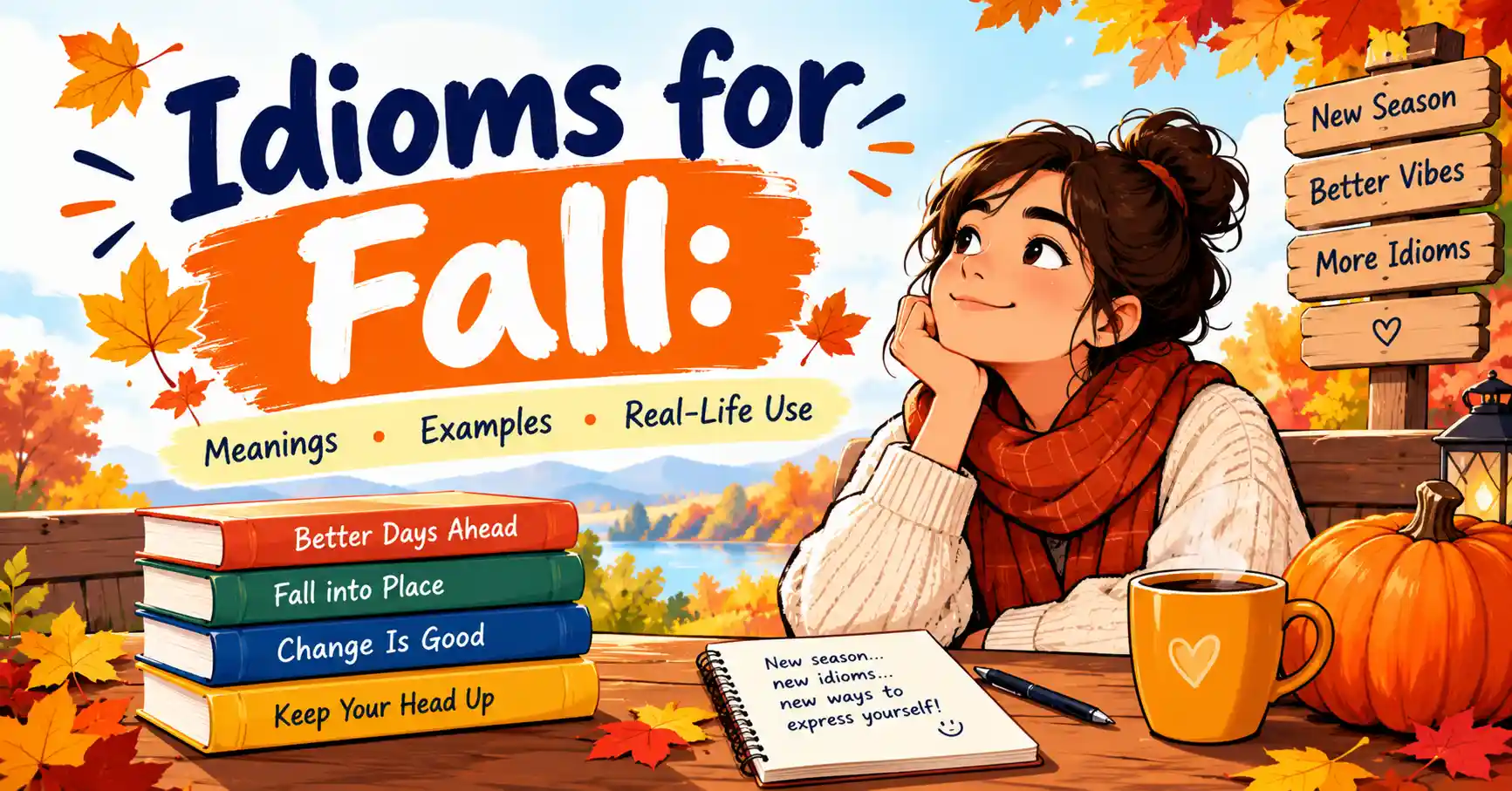
Idioms for fall are everyday phrases that either borrow autumn imagery or use the word “fall” figuratively. Some sound warm, like “apple of my eye,” while others sound gloomy, like “fall apart.” This guide covers 21 of them, each with a meaning, an origin, and easy examples. You will also find common mistakes, a US versus UK note, and a short quiz.
A quick tone table comes first, so you can choose the right phrase fast. Tone matters, because the wrong phrase can sound rude or strange in conversation. Read on, and you will soon use these expressions with confidence.
Quick Answer: What Are the Best Idioms for Fall?
Idioms for fall are phrases that describe autumn or use the word “fall” in a non-literal way. “Turn over a new leaf” means to start fresh and act better. “Apple of my eye” means a person you love most. “The apple doesn’t fall far from the tree” means a child resembles a parent. “Squirrel away” means saving something for later, while “fall into place” means things start working out. “Fall through” means a plan fails, and “take the fall” means accepting blame. “Pride comes before a fall” warns that being too proud leads to failure.

Tone Guide to Idioms for Fall: Warm and Negative Phrases
Seasonal phrases tend to sound warm or neutral, while most phrases built on the verb “fall” sound negative. Use “apple of my eye” to praise someone, and use “pride comes before a fall” to warn them. In the formality column, informal suits casual chat, neutral works almost anywhere, and formal suits essays and speeches.
| Positive | Apple of my eye | A person you cherish most | Neutral |
| Positive | Turn over a new leaf | Start fresh and act better | Informal |
| Positive | Indian summer | A warm autumn spell, or a pleasant late life | Neutral |
| Positive | Autumn years | Later life | Neutral |
| Positive | Fall into place | Things work out and fit together | Neutral |
| Positive | Fall into someone’s lap | Something good arrives without effort | Informal |
| Positive | Fall in love | Begin to love someone | Neutral |
| Neutral | The apple doesn’t fall far from the tree | A child resembles a parent | Informal |
| Neutral | Squirrel away | Save something for later | Informal |
| Neutral | Ripe for the picking | Ready to be taken or used | Informal |
| Neutral | The autumn of one’s life | Later life | Formal |
| Neutral | Reap what you sow | You face the results of your actions | Neutral |
| Negative | Fall through | A plan fails to happen | Neutral |
| Negative | Fall apart | Break down or lose control | Neutral |
| Negative | Fall short | Miss a goal | Neutral |
| Negative | Fall flat | Get no reaction, like a joke | Neutral |
| Negative | Fall through the cracks | Get missed by mistake | Informal |
| Negative | Take the fall | Accept blame | Informal |
| Negative | Fall guy | A person who gets blamed | Informal |
| Negative | Pride comes before a fall | Pride leads to failure | Formal |
| Negative | Fall from grace | Lose respect or status | Formal |
A few phrases swing both ways. “The apple doesn’t fall far from the tree” can praise or tease, depending on the trait. “Fall into someone’s lap” can signal good luck, or hint that a reward was not earned. The sections below explain the details.
Seasonal Idioms for Fall: Leaves, Apples and Harvest
Most seasonal phrases borrow pictures from leaves, apples, nuts, and the harvest to talk about change, love, saving, and ripeness. Nine phrases follow, and each grew from something you can see in an orchard or forest. Only the apple proverb actually contains the word “fall.”

Turn over a new leaf
Meaning: To start fresh and act in a better way.
Examples: After missing three deadlines, Priya turned over a new leaf and began planning her week every Sunday. Dad turned over a new leaf and now cooks dinner every night.
Origin: By the 1500s, “leaf” was a common word for a page, and Roger Ascham used the phrase in The Scholemaster in 1570. Sources disagree on the earliest use.
The apple doesn’t fall far from the tree
Meaning: A child tends to look or act like a parent.
Examples: Her daughter sings beautifully, just like her mom. The coach’s son is already the hardest worker on the team.
Origin: The saying is often traced to a German proverb, and printed English uses appear in the 1800s, including a letter by Ralph Waldo Emerson in 1839. A near match is “a chip off the old block.”
Apple of my eye
Meaning: Someone you love and cherish above others.
Examples: Our baby cousin is the apple of every aunt’s eye. That old red bike is the apple of Jake’s eye.
Origin: Old English used “apple” for the pupil of the eye. King Alfred the Great used an early form of the phrase around 885 to 890 AD. It also appears in the Bible, and Shakespeare used it in A Midsummer Night’s Dream.
Squirrel away
Meaning: To save or hide something for later, often in secret.
Examples: Ben squirrels away coins in a sock drawer to buy a guitar.
Origin: Squirrels bury nuts to eat during winter, and the verb borrows that picture.
Ripe for the picking
Meaning: Ready to be taken or used, like fruit ready to pick.
Examples: The empty corner store was ripe for the picking by any new bakery.
Origin: It comes straight from the orchard, where ripe fruit should be picked now.
Autumn years, the autumn of one’s life, and Indian summer
Meaning: The first two phrases mean later life. “Indian summer” names a warm, sunny spell in early fall, and it can also mean a pleasant late stage of life or career.
Examples: Our neighbor spends his autumn years painting by the sea. We had an Indian summer last week, so we ate lunch outside in October.
Origin: “Indian summer” has no confirmed origin, so treat popular guesses with care. Use it only for warm weather that follows the first cool days.
Reap what you sow
Meaning: You face the results of what you do, good or bad.
Examples: He never studied, and now he failed the test. She helped her neighbors for years, and now they bring her soup when she is sick.
Origin: It comes from Galatians 6:7 in the Bible, and fall is harvest time, so the farming picture fits.
Idioms for Fall That Use the Verb “Fall”: Luck, Failure and Blame
These phrases use the picture of dropping to talk about luck, failure, blame, and love. None is about autumn, and they share only a word with the season.
Fall into place: Pieces that start to fit together fall into place. Once the funding arrived, every piece fell into place.
Fall into someone’s lap: Something good that arrives with no effort falls into someone’s lap. Free tickets fell into my lap when a coworker got sick.
Fall in love: To begin to love someone or something is to fall in love. I fell in love with the old house the moment I saw it.
Fall through: A plan that never happens has fallen through. The picnic fell through when the rain started.
Fall apart: Things that break down, and people who lose control of their feelings, fall apart. He held it together all day, then fell apart at home.
Fall short: To miss a goal or standard is to fall short. The soup fell short of Grandma’s recipe.
Fall flat: A joke, event, or idea that gets no reaction falls flat. His joke fell flat, and the room went quiet.
Fall through the cracks: People or tasks that get missed by mistake fall through the cracks, and you may also hear “fall between the cracks.” The bill fell through the cracks, so nobody paid it.
Take the fall: Accepting blame, often for another person’s act, is called taking the fall. The manager took the fall for the late report.
Fall guy: The fall guy is the person who gets blamed for someone else’s act. The term began as US underworld slang. A popular story ties it to Albert B. Fall and the Teapot Dome scandal, but that story is folklore, because the term was already in use.
Pride comes before a fall: Anyone who boasts too much hears this warning, which traces to Proverbs 16:18 in the Bible. She boasted that she would pass without studying, but pride comes before a fall.
Fall from grace: To lose respect, status, or favor after being admired is to fall from grace. The famous coach fell from grace after the scandal.
Common Mistakes With Idioms for Fall
Learners most often mix up phrases that share a word or a theme, such as “fall through” and “fall apart.”

| Fall through the cracks / fall between two stools | Cracks means something is missed by accident, while two stools means failing at two goals because you tried both. | Do not use “two stools” for a lost email. |
| Fall for someone / fall for something | Someone means you start to like or love them, while something means you believe a trick. | “She fell for the story” is about being fooled, not romance. |
| Fall through / fall apart / fall short / fall flat | Through means a plan does not happen, apart means something breaks, short means a missed target, and flat means no reaction. | A canceled trip fell through, but it did not fall flat. |
| Take the fall / fall guy | One is an action, and the other is a person. | Say “he is the fall guy” or “he took the fall.” |
| Fall into place / fall into someone’s lap | Place means pieces fit together, often after effort, while lap means a gift arrives with no effort. | Do not say a promotion fell into your lap if you worked hard for it. |
Fall or Autumn? US and UK Usage of Idioms for Fall
Fall and autumn name the same season. Americans usually say “fall,” and people in Britain usually say “autumn.” The history explains the split. Old English had its own word, hærfest, which gave us “harvest.” Later, English borrowed autumnus from Latin through Old French. By the 1540s, people also said “fall of the leaf,” and later just “fall.” The short form crossed to colonial America and stayed, while Britain kept “autumn.” John Keats wrote “To Autumn” in 1819.
“Spring forward, fall back” is built on the American word, but verb phrases like “fall through” work in both countries.
Frequently Asked Questions About Idioms for Fall
What is the difference between autumn and fall?
They name the same season, and “autumn” is the usual word in Britain while “fall” is usual in the United States. The difference is history, not meaning.
Do British and American English share the same autumn idioms?
Mostly yes. The apple phrases, “turn over a new leaf,” and the “fall” verb idioms appear on both sides of the Atlantic.
Is “fall guy” an autumn idiom?
No, it comes from US underworld slang and means a person who takes the blame for others.
Can I use autumn idioms all year round?
Yes, nearly all of them work in any season. The exception is “Indian summer,” which describes warm weather in early fall.
Practice: Test Yourself With Idioms for Fall
Fill in each blank with an idiom from this guide. The answers are below.
- After years of fighting, the two brothers decided to ______ and start over.
- The deal ______ when the bank changed its mind.
- His joke ______, and the room went silent.
- The manager ______ for the team’s mistake.
- Her granddaughter is the ______, and she smiles whenever the girl walks in.
Answers: 1. turn over a new leaf. 2. fell through. 3. fell flat. 4. took the fall. 5. apple of her eye.
Conclusion: Using Idioms for Fall With Confidence
Idioms for fall come in two groups: season phrases like “squirrel away” and verb phrases like “fall through.” The season phrases sound warm or neutral. The verb phrases often sound negative, so check the tone before you use one. Choose “autumn” or “fall” to match your audience, and the phrases work either way. Avoid the common mistakes in this guide, especially mixing up similar phrases. Practice with the quiz until each meaning feels natural. Pick two or three phrases and use them in a real sentence today.
To read more: Idioms for Birds: 24 Amazing Phrases With Meanings