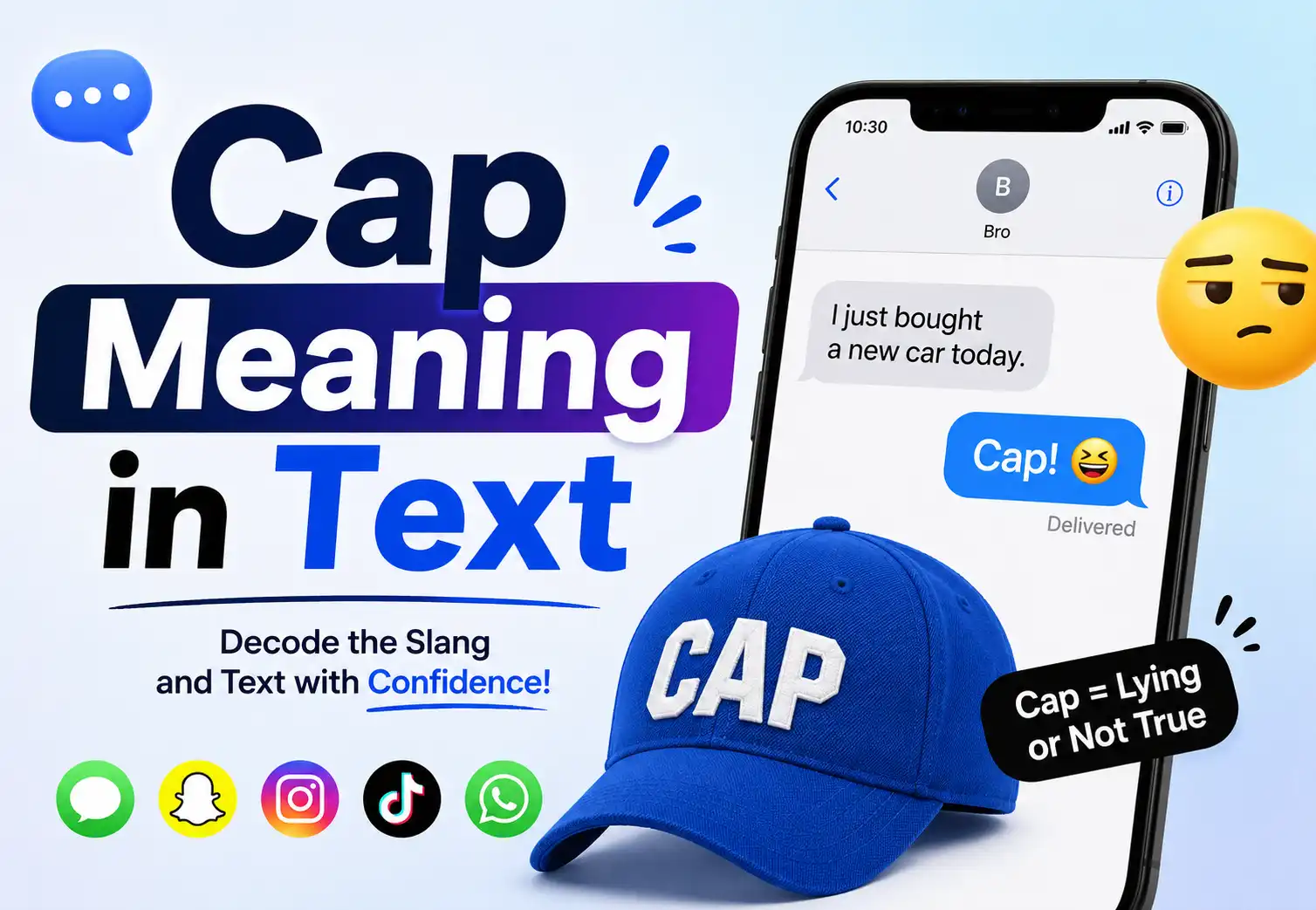
If you saw someone text “that’s cap” and got confused, you’re not alone. The cap meaning in text is simple: it’s slang for a lie or an exaggeration, not a hat. This guide breaks down what “cap” and “no cap” mean, where they came from, how to use them correctly, and how to respond when someone calls you “cap”.
What Does Cap Mean in Text? Quick Answer
The cap meaning in text comes down to one idea: a lie, an exaggeration, or something that isn’t true. This is the meaning you’ll see almost everywhere online today.
“Cap” is a common word with multiple meanings. It can also mean:
- A type of headwear, like a baseball cap
- A spending limit, like a “salary cap”
But in a text, a comment, or a caption, “cap” almost always means the slang sense: a lie.
Here’s the flip side. “No cap” means “no lie” or “I’m being honest.” It’s the exact opposite of “cap.”
The two work as a pair:
- “That’s cap” : “That’s a lie.”
- “No cap” : “I’m telling the truth.”
Cap vs. No Cap: Quick Comparison
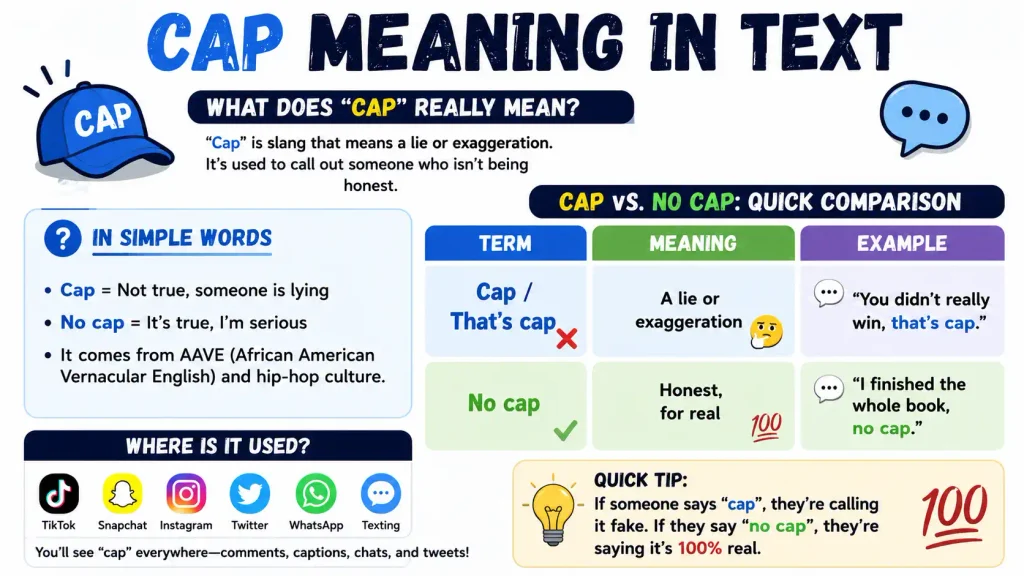
| Cap / That’s cap | A lie or exaggeration | “You didn’t really win, that’s cap.” |
| No cap | Honest, for real | “I finished the whole book, no cap.” |
The Two Sides Explained
What “That’s Cap” Means
“That’s cap” is how you call out a statement as false. Someone says something hard to believe. You reply with “cap” to say you don’t buy it.
For example:
- “You ran a mile in three minutes? Cap.”
- “He said he met a celebrity at the store. That’s cap.”
What “No Cap” Means
“No cap” adds weight to a statement. It tells the other person you’re being fully honest, not joking or stretching the truth.
For example:
- “This is the best pizza I’ve ever had, no cap.”
- “I studied for five hours straight, no cap.”
Where Does “Cap” Come From?
African American Vernacular English (AAVE) Roots
The meaning of ” cap ” in text traces back to African American Vernacular English (AAVE). AAVE is a dialect spoken mainly within Black communities in the United States, with its own words, grammar, and long history.
According to Green’s Dictionary of Slang, “to cap” dates back to at least the 1900s, when it meant to brag or “talk big.” Bragging often stretches the truth, and over time, that meaning shifted into today’s sense: to lie. Some word historians also point to an older idiom, “capping a story,” meaning to top someone else’s tale with a bigger, less believable one, which lines up with the same drift from bragging toward outright exaggeration.
How Hip-Hop and Social Media Spread It
Hip-hop culture carried “cap” and “no cap” into wider use for decades before social media picked it up. Rappers used both phrases in lyrics and interviews long before most casual texters had heard them. Then TikTok and Instagram helped the words spread even faster, turning a phrase rooted in music culture into everyday texting shorthand. Today, people use “cap” far beyond hip-hop, in group chats, comments, and everyday conversation, often without knowing where it started.
Real Texts and Comments Using Cap
Here’s how “cap” and “no cap” show up in real conversations:
Friend A: “I got a 100 on the test.”
Friend B: “Cap. You didn’t even study.”
Friend A: “This show is actually amazing.”
Friend B: “No cap, I binged it in one night too.”
Friend A: “I ran into our old teacher at the mall.”
Friend B: “No cap? What did she say?”
Friend A: “My phone survived a full drop in the pool.”
Friend B: “That’s big cap; phones don’t just survive that.”
Notice how “no cap” can also work as a question, asking “for real?” rather than making a statement. Context in the conversation usually makes the intended use clear.
Other Forms You’ll See
“Cap” changes shape depending on the sentence:
- Capping (verb): the act of lying, as in “you’re capping right now”
- Capper (noun): someone who lies a lot, as in “he’s such a capper”
- Stop capping: a direct callout, as in “stop capping, we all saw what happened”
- Big cap / all cap: an especially obvious lie, as in “saying you built that app solo is big cap”
How to Reply When Someone Calls You Cap
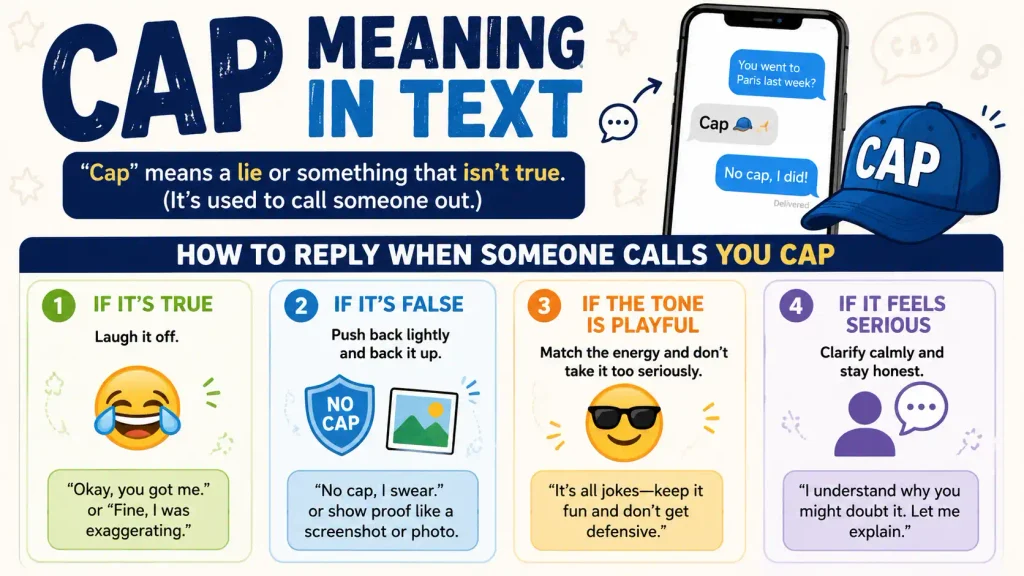
Getting called “cap” can feel like a small accusation, even when it’s meant as a joke. A few ways people typically respond:
- If it’s true: Laugh it off with something like “okay, you got me” or “fine, I was exaggerating.”
- If it’s false: Push back lightly with “no cap, I swear” or back it up with proof, like a screenshot or photo.
- If the tone is playful: Match the energy instead of getting defensive, since most “cap” callouts among friends are lighthearted.
- If it feels serious: If someone genuinely doubts something important you shared, it’s fine to clarify calmly rather than treat it as a joke.
Understanding the cap meaning in text ahead of time makes these moments easier to read, since you’ll already know whether a reply is a joke or a genuine callout.
Reading the Tone: Is “Cap” Rude or Playful?
A definition alone won’t tell you how “cap” actually lands. The tone depends a lot on who’s saying it, and why.
While researching this guide, I read real conversations on Instagram, TikTok, and Discord instead of just leaning on other glossaries. One thing stood out fast: in a group chat I came across, one friend claimed he’d beaten a video game level in record time, and another shot back a single word, “cap,” followed by three laughing emojis. Nobody thought he’d actually lied. It was a nudge, not an accusation.
That’s the difference. Among close friends joking about something small, “cap” is playful. But say someone shares something they genuinely care about a job offer, a real achievement and calling that “cap” can land as an accusation instead of a joke.
The simple rule: the closer the friendship and the lighter the topic, the more playful “cap” sounds. The more serious the topic, the more it can sting.
The Cap Emoji and Where You’ll See It
The billed cap emoji works as a visual stand in for the word “cap,” calling out a lie without typing anything. Repeating it means someone really doesn’t believe you.
You’ll spot “cap” and the emoji most often on:
- TikTok comments
- Snapchat and Instagram captions
- Group texts
- Gaming chat during matches
When NOT to Use “Cap”
In professional settings: “Cap” is casual slang; skip it in a work email or with a client. Try “that’s inaccurate” or “I don’t think that’s quite right” instead.
With sensitive topics: Skip “cap” when someone is talking about health, grief, or a hard personal experience. Even as a joke, it can sound dismissive of something real.
Out of respect for its roots: “Cap” comes from AAVE. Use it the way it’s meant to be used, not to mock or exaggerate a dialect that isn’t your own.
Cap Synonyms and Related Slang
Plain-English alternatives: “That’s a lie,” “you’re bluffing,” “stop playing,” “no way that’s true.”
Related slang you’ll hear nearby:
- Fr (for real): agreeing something is true.
- Facts: confirming something is correct.
- Sus: something that seems suspicious.
- Bussin: something really good, especially food.
Cap around the world: “Cap” is mostly American slang. In the UK and Australia, people are more likely to just say “that’s a lie.” That’s also why non native English speakers often search for the cap meaning in text, since it hasn’t made it into most traditional dictionaries or classroom English yet.
Is “Cap” Still Used in 2026?
Yes. “Cap” and “no cap” are still common in texting and everyday talk, especially among Gen Z. Some slang fades fast; this pair has stuck around for years, likely because it’s short, easy to say, and fits almost any conversation. Search interest in the cap meaning in text has also stayed steady rather than dropping off the way many short lived trends do.
FAQ
What does cap meaning in texting?
In texting, “cap” is slang for a lie or an exaggeration, not a reference to headwear. If someone texts “that’s cap,” they mean the statement isn’t true. You’ll see this meaning most often in comments, captions, and group chats, especially among younger users on apps like TikTok and Instagram.
What does no cap mean?
“No cap” means “no lie” or “I’m being honest.” People add it to the end of a sentence to stress that they aren’t joking or exaggerating, much like saying “I swear” or “for real.” It’s the direct opposite of “cap,” which signals a lie rather than the truth.
Where does the slang “cap” come from?
The cap meaning in text comes from African American Vernacular English (AAVE), where “to cap” first meant to brag or exaggerate as far back as the 1900s. Hip hop culture carried the phrase for decades before social media apps like TikTok helped it spread into everyday texting and comments.
What does capping mean?
“Capping” is the verb form of “cap.” It describes the act of lying or exaggerating in real time, as in “you’re capping right now” or “stop capping.” A person who does this often can also be called a “capper,” a related noun form of the same slang term.
Is cap still used in 2026?
Yes, “cap” and “no cap” remain common in texting, TikTok comments, and everyday conversation. While many slang terms fade within a year or two, this pair has held on for years, likely because both words are short, easy to say, and fit almost any casual exchange.
What does the cap emoji mean in texting?
The cap emoji is a visual way to say “cap” without typing the word out. It signals that the sender doesn’t believe what was just said. Repeating the emoji adds extra emphasis, showing the sender finds a claim especially hard to believe.
Is it rude to say cap to someone?
It depends on the relationship and the topic. Among close friends joking about something small, “cap” usually feels playful and harmless. But when the topic is serious or personal, like a real achievement or hard news, calling something “cap” can come across as dismissive or accusatory instead.
Bottom Line
” cap ” meaning in text comes down to two words: “cap” means a lie, “no cap” means the truth. The rest is just tone. Say it to a close friend about something small, and it’s a joke. Say it about something someone actually cares about, and it can sting. Know that difference, and you’ll never misread the cap meaning in text again.
To read more: PWTP Meaning in Text: 7 Amazing Facts You Need to Know

Digital Communication Writer
Focus: everyday texting slang, emoji meanings, casual chat abbreviations (NGL, LY, DND, etc.)
Bio angle: Grew up navigating group chats and social apps, explains slang the way it’s actually used, with real examples showing serious vs. joking vs. sarcastic tone.