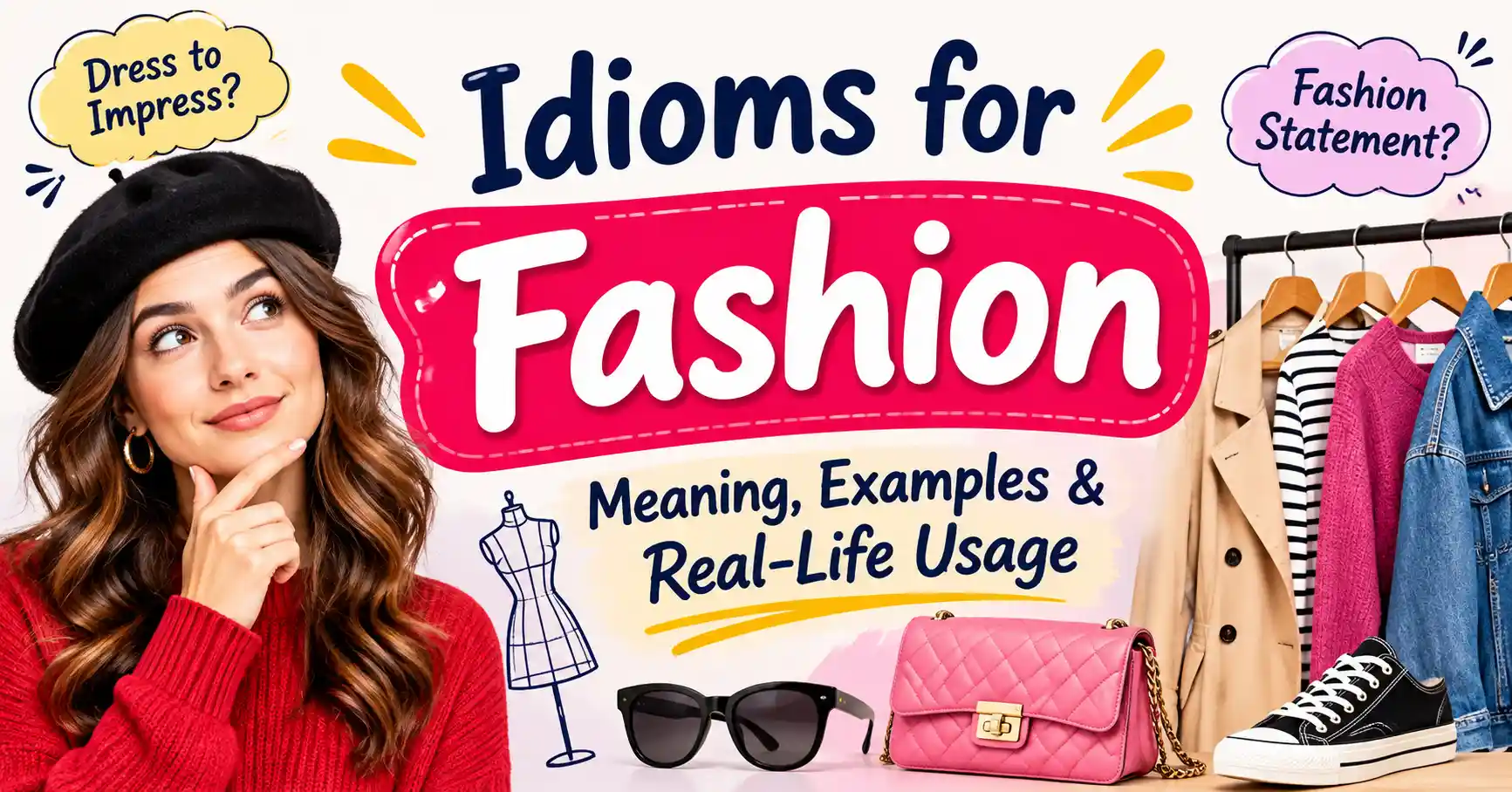
Idioms for fashion are set phrases that use clothes, style, and dress to talk about looks, trends, and behaviour. You will find 40 of them here, each with a plain meaning, a tone note, and a natural example. Honest origins appear only where they are known, and unproven stories are labelled. Each group answers one simple question, so you can pick the right phrase fast.
Some phrases praise, some mock, and some only borrow a few words to talk about money or effort. Each entry is labelled, so you never use a rude phrase by mistake. Common mistakes, a short practice set, and FAQs finish the lesson.
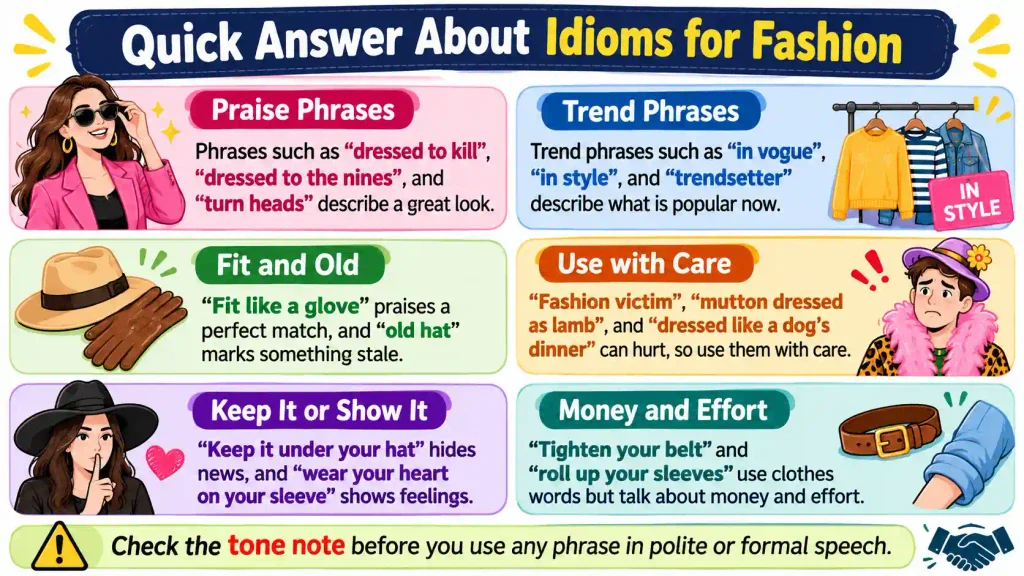
Quick Answer About Idioms for Fashion
- Praise phrases such as “dressed to kill”, “dressed to the nines”, and “turn heads” describe a great look.
- Trend phrases such as “in vogue”, “in style”, and “trendsetter” describe what is popular now.
- “Fit like a glove” praises a perfect match, and “old hat” marks something stale.
- “Fashion victim”, “mutton dressed as lamb”, and “dressed like a dog’s dinner” can hurt, so use them with care.
- “Keep it under your hat” hides news, and “wear your heart on your sleeve” shows feelings.
- “Tighten your belt” and “roll up your sleeves” use clothes words but talk about money and effort.
- Check the tone note before you use any phrase in polite or formal speech.
What Are Idioms for Fashion?
A phrase counts when its clothes words point to style, dress, or how a person looks. A few entries, such as “not a good fit” and “trendsetter”, are common collocations rather than strict idioms, and the guide says so. Eight phrases only borrow a clothes word for money, effort, or feelings, and they sit in their own section. Other look-alike phrases are not idioms at all, and that section names them too.
Idioms for Fashion to Look Great and Dress Up
These eight phrases answer one question: do I look great?
Dressed to kill: dressing in a very stylish way to impress people. It is not violent or rude. Tone: warm praise, informal. Example: “Sara came to the party dressed to kill in a red dress.”
Dressed to the nines: wearing your best outfit with every detail right. “To the nines” first appears in a Scots poem by William Hamilton in 1719, meaning “to perfection”; the nine yards of cloth story isn’t confirmed. Tone: warm praise, informal to neutral. Example: “Tom arrived at the wedding dressed to the nines.”
All dolled up: wearing fancy clothes and makeup for a special event. It is often used about women and children and can sound teasing. Tone: kind, informal. Example: “The girls got all dolled up for the school dance.”
Dressed to impress: wearing smart clothes to make a good impression on others. It is safe for work, school, and interviews. Tone: neutral, suits formal or informal use. Example: “Ali dressed to impress for his job interview.”
Look like a million dollars: looking wonderful, polished, and full of life. It praises the whole look, not one item. Tone: warm praise, informal. Example: “After her haircut, Mum looked like a million dollars.”
Turn heads: catching the attention of people as you pass. It works for a person, a car, or an outfit. Tone: neutral to warm, informal. Example: “Her yellow coat turned heads on the high street.”
Steal the show: getting all the attention at an event. It is about the person, not the clothes alone. Tone: warm praise, informal. Example: “The little boy stole the show in his tiny suit.”
Best bib and tucker: your best clothes, saved for a fine day out. It is old and British. Tone: kind, informal. Example: “Grandad put on his best bib and tucker for Sunday lunch.”
Idioms for Fashion to Follow or Set a Trend
These eight phrases answer one question: do I follow or set a trend?
In vogue: popular and fashionable right now. It comes from French, where vogue means fashion. Tone: neutral, formal. Example: “Soft pastel colours are in vogue this spring.”
In style: the plain, everyday way to say the same thing as “in vogue”. Tone: neutral, informal. Example: “Wide trousers are back in style this year.”
The in thing: the one item or idea everyone wants right now. It is casual. Tone: neutral, informal. Example: “Chunky trainers are the in thing at school.”
À la mode: in the latest French style. It can sound showy in plain speech. Tone: neutral, formal. Example: “The café has à la mode chairs and bright lights.”
Fashion-forward: staying ahead of new trends and trying fresh looks first. It praises taste and courage. Tone: warm praise, neutral. Example: “Lena is fashion-forward and tries new colours first.”
Trendsetter: a person whose style other people copy. It is a collocation, not a strict idiom. Tone: warm praise, neutral. Example: “The singer is a trendsetter, and fans copy her hats.”
Make a fashion statement: dressing boldly to show who you are or what you think. Tone: neutral, informal. Example: “He wore a bright green suit to make a fashion statement.”
Have a flair for fashion: a natural gift for choosing clothes that look good together. Tone: warm praise, neutral. Example: “As a child, she had a flair for fashion.”
Idioms for Fashion About Fit, Suit, and Out-of-Date Style
These eight phrases answer one question: does it fit or suit me?
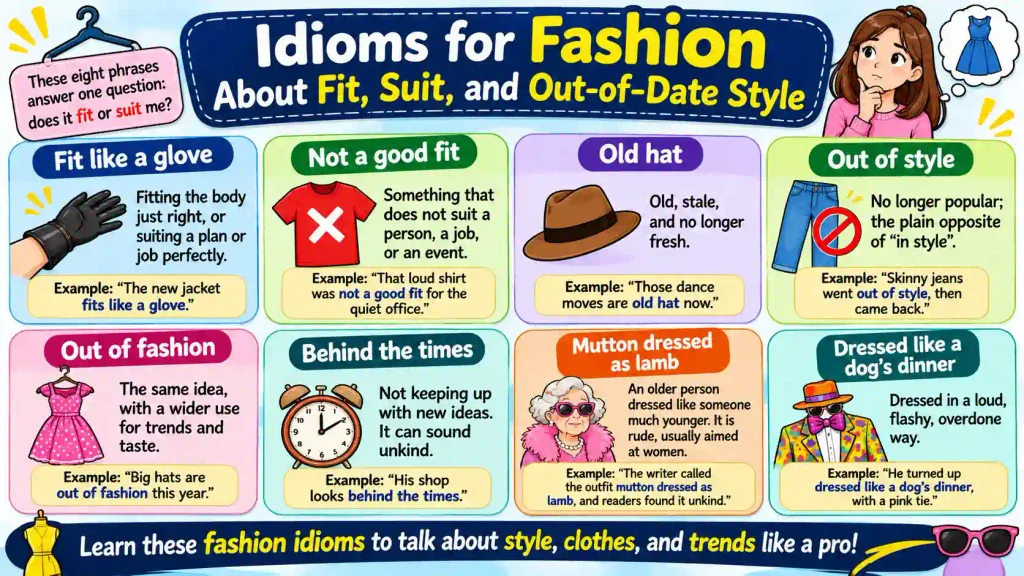
Fit like a glove: fitting the body just right, or suiting a plan or job perfectly. Tone: warm praise, informal. Example: “The new jacket fits like a glove.”
Not a good fit: something that does not suit a person, a job, or an event. It is a common collocation, not a strict idiom. Tone: neutral, informal. Example: “That loud shirt was not a good fit for the quiet office.”
Old hat: old, stale, and no longer fresh. It works for clothes, ideas, and jokes. Tone: mild, informal. Example: “Those dance moves are old hat now.”
Out of style: no longer popular; the plain opposite of “in style”. Tone: neutral, informal. Example: “Skinny jeans went out of style, then came back.”
Out of fashion: the same idea, with a wider use for trends and taste. Tone: neutral, informal. Example: “Big hats are out of fashion this year.”
Behind the times: not keeping up with new ideas. It can sound unkind. Tone: mild, informal. Example: “His shop looks behind the times.”
Mutton dressed as lamb: an older person dressed like someone much younger. It is rude, usually aimed at women, so avoid it in kind speech. Tone: rude, informal, British. Example: “The writer called the outfit mutton dressed as lamb, and readers found it unkind.”
Dressed like a dog’s dinner: dressed in a loud, flashy, overdone way. Tone: rude, informal, British. Example: “He turned up dressed like a dog’s dinner, with a pink tie.”
Idioms for Fashion to Judge, Hide, or Control
These eight phrases answer one question: do I judge, control, or hide?
Fashion victim: a person who follows every trend without thinking about what suits them. It mocks, even with a smile. Tone: mocking, informal. Example: “Her friends call her a fashion victim.”
Follow fashion blindly: copying trends without taste or thought. It is a gentle warning. Tone: mild, neutral. Example: “He follows fashion blindly and wears little of it.”
Clothes make the man: people judge you by how you dress. It is old and often aimed at men, though it fits anyone. Tone: neutral, formal. Example: “Clothes make the man, so he wore a clean suit to court.”
Dress the part: dressing in the right way for a job, role, or event. Tone: neutral, informal. Example: “Dress the part for the interview, with clean shoes.”
Wear the pants: the person who makes the choices at home or in a team. It is American; British speakers say “wear the trousers”. Tone: neutral, informal. Example: “Everyone knows Mum wears the pants in our house.”
Wear your heart on your sleeve: showing your feelings openly. In Shakespeare’s Othello, Iago says he would wear his heart on his sleeve for jackdaws to peck at, meaning he refuses to expose his real feelings. The jousting-knight story isn’t confirmed. Tone: neutral, informal. Example: “Sam wears his heart on his sleeve.”
Keep it under your hat: keeping news secret. The picture is a secret hidden close to the head. Tone: neutral, informal. Example: “Keep the party plan under your hat until Friday.”
A wolf in sheep’s clothing: a person who looks harmless but plans harm. It comes from Aesop, and the same picture appears in Matthew 7:15. Tone: serious, neutral. Example: “The new friend seemed sweet, but he was a wolf in sheep’s clothing.”
Money and Effort Phrases That Are Not Idioms for Fashion
These eight phrases borrow a clothes word but talk about money, effort, or feelings, not style.
Tighten your belt: spending less money. It is a money phrase. The Great Depression is often named as its source, though this isn’t confirmed. Tone: neutral, informal. Example: “We had to tighten our belts after the car broke down.”
On a shoestring: doing something with very little money. Tone: neutral, informal. Example: “They opened the small shop on a shoestring.”
Lose your shirt: losing a lot of money in a bad deal or bet. Tone: neutral, informal. Example: “He nearly lost his shirt on that deal.”
Pull up your socks: trying harder and doing better work. It is an effort phrase. Tone: firm, informal, British. Example: “Pull up your socks if you want to pass the test.”
Roll up your sleeves: getting ready to work hard. Tone: neutral, informal. Example: “We rolled up our sleeves and cleaned the whole house.”
In someone’s shoes: imagining life from another person’s place. The shoe picture dates to about 1700, though the first use is not settled. Tone: kind, neutral. Example: “Try to put yourself in her shoes before you judge her choice.”
Cut from the same cloth: two people very alike in nature or habit. Tone: neutral, informal. Example: “The two brothers are cut from the same cloth, both kind and calm.”
Take your hat off to someone: showing respect for what a person has done. The picture is the old act of lifting a hat in greeting. Tone: warm praise, informal. Example: “I take my hat off to the nurse who worked all night.”
Some phrases only sound like they belong on a fashion list. “At the drop of a hat” means at once. “Zip it” means be quiet. “Smart as a whip” means clever. “Put a sock in it” means stop talking, and it is rude.
Near-Synonym Idioms for Fashion Compared
- In vogue / in style: “in vogue” sounds formal and smart; “in style” is plain and everyday.
- Dressed to kill/dressed to the nines: the first aims to impress; the second aims for perfect detail.
- Old hat / out of style: “old hat” means stale and boring; “out of style” means no longer popular.
- Fashion victim / follow fashion blindly: the first mocks the person; the second describes the habit.
Common Mistakes and Practice With Idioms for Fashion
- Dressed to the nine is wrong. Say “dressed to the nines”, with an s.
- Wear the pant is wrong. Use “wear the pants” (US) or “wear the trousers” (UK).
- “These shoes fits like a glove” is wrong. Say “fit” with a plural subject.
- “In the vogue” should be avoided. The usual phrase is “in vogue”, with no the.
Try these five, then check the answers below.
- She wore a red gown and turned every head: “dressed to kill” or “old hat”?
- Pastel colours are popular this spring: “in vogue” or “out of fashion”?
- He buys every new trend, even when it does not suit him: “fashion victim” or “trendsetter”?
- The new jacket fits you just right: “fit like a glove” or “not a good fit”?
- Keep the surprise party secret: “keep it under your hat” or “wear your heart on your sleeve”?
Answers: 1. dressed to kill. 2. in vogue. 3. fashion victim. 4. fit like a glove. 5. keep it under your hat.
FAQs About Idioms for Fashion
Is “dressed to kill” violent or rude? No. It means dressing in a very stylish way to impress people, and it is warm praise for a party, a wedding, or a big night out.
Is “fashion victim” a compliment? No. It mocks a person who follows every new trend without thinking about what suits them, even when it is said with a smile.
Can I use fashion idioms in formal writing or IELTS? Yes, but choose with care. “In vogue”, “clothes make the man”, and “fit like a glove” are safe, while “mutton dressed as lamb” and “dressed like a dog’s dinner” belong only in casual speech.
Conclusion: Idioms for Fashion in Short
Idioms for fashion give you short, natural ways to talk about style, trends, fit, and the people behind the clothes. Use the kind phrases for praise and keep the rude ones out of polite speech. Check each tone note before you speak or write. Use the money and effort phrases only when you mean money and effort. Practise the five questions until the right phrase comes without thought. Return to the quick answer whenever you need a fast reminder. With these 40 phrases, you can describe any outfit, any trend, and any first impression with ease.
To read more: Idioms for Shoes: 35 Important Phrases With Examples

Digital Communication Writer
Focus: everyday texting slang, emoji meanings, casual chat abbreviations (NGL, LY, DND, etc.)
Bio angle: Grew up navigating group chats and social apps, explains slang the way it’s actually used, with real examples showing serious vs. joking vs. sarcastic tone.