Introduction
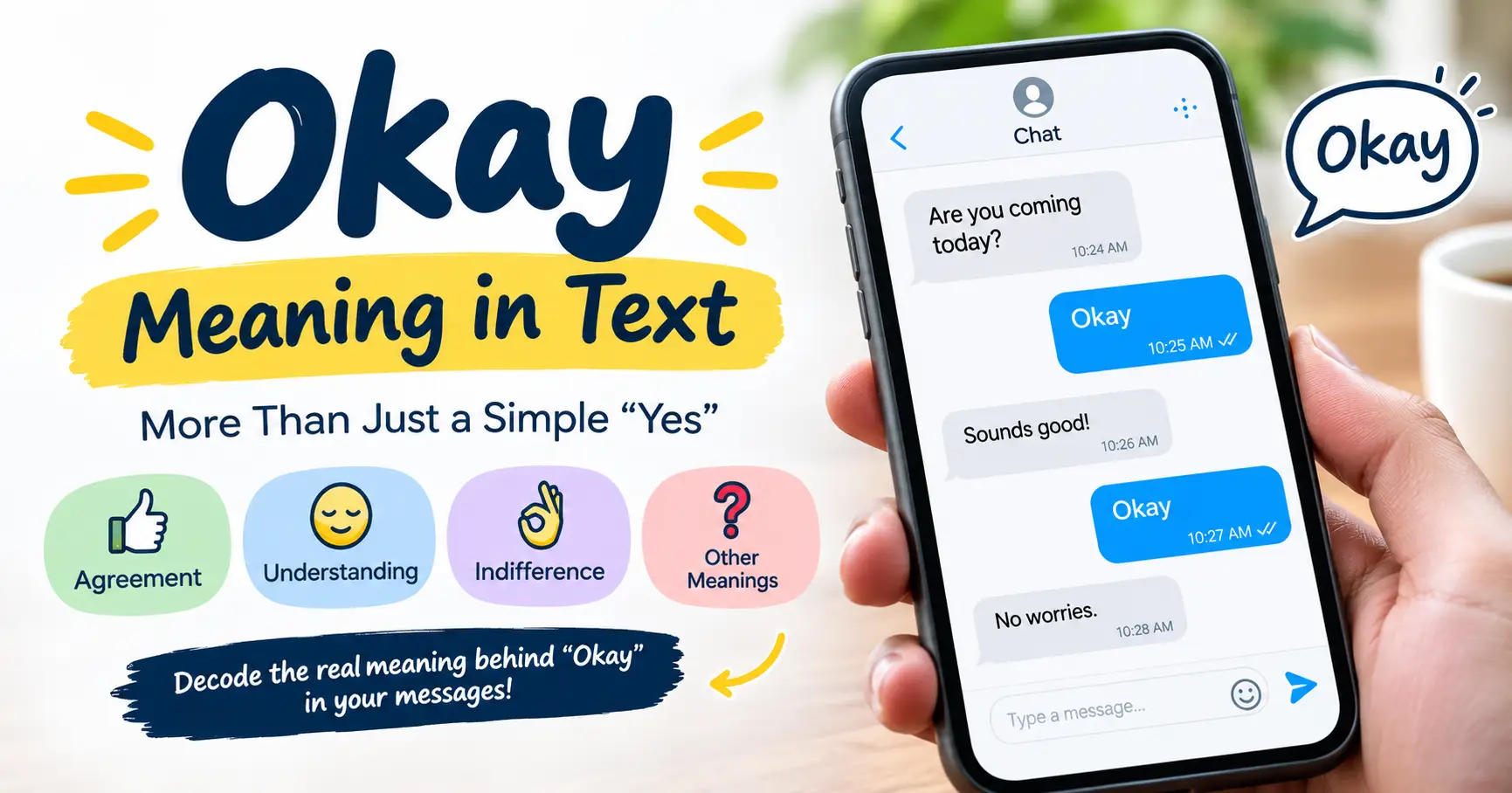
“Okay” might be the most used word in texting. People type it dozens of times a day, often without thinking twice. Yet the same short word can mean very different things depending on how you spell it, punctuate it, or place it in a conversation.
Maybe a friend replied “k,” and you’re not sure if they’re upset. Maybe someone texted “Okay.” and the message felt colder than expected. These moments are common, and they happen because “okay” carries more emotional weight than its size suggests.
This guide breaks down the real okay meaning in text, where the word comes from, how spelling changes its tone, why “k” and “kk” feel so different, and what to say back when a short reply leaves you guessing.
Okay Meaning in Text: Quick Answer
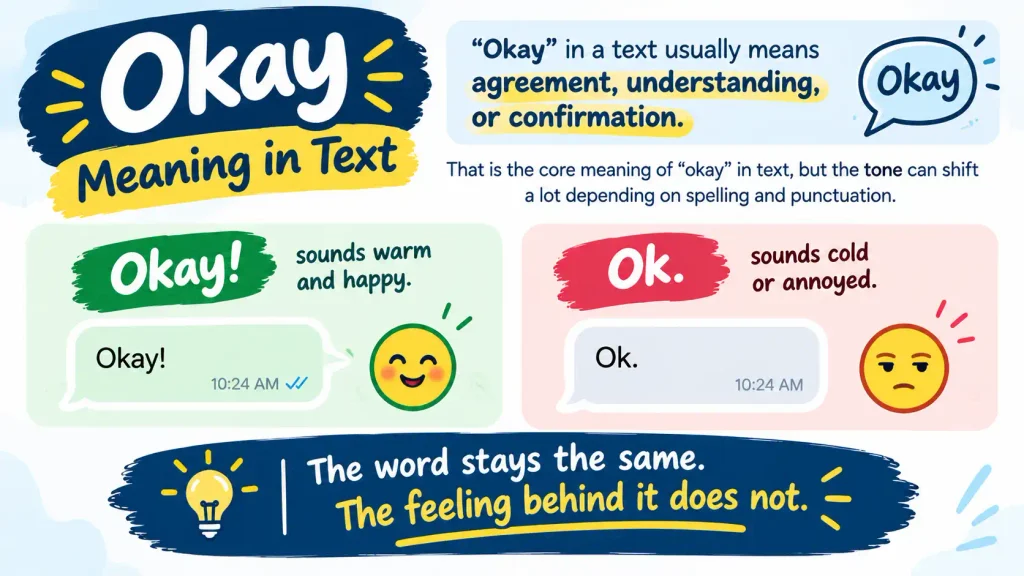
“Okay” in a text usually means agreement, understanding, or confirmation. That is the core meaning of “okay” in text, but the tone can shift a lot depending on spelling and punctuation. “Okay!” sounds warm and happy. “Ok.” sounds cold or annoyed. The word stays the same. The feeling behind it does not.
Okay Meaning in Text: The Core Definition
At its core, “okay” meaning in text is a way to say yes, I understand, or I agree. People use it to move a conversation forward without writing a lot. That is the plain okay meaning in text most people rely on every day, whether they are replying to a friend or confirming a work request.
The Core Meaning: Agreement, Acknowledgment, Confirmation
When someone texts “okay,” they are usually doing one of these things:
- Agreeing to a plan (“Okay, let’s meet at 6”)
- Confirming they understood (“Okay, got it”)
- Accepting an idea without much comment (“Okay, sounds good”)
- Checking on someone’s well-being (“Are you okay?”)
The word is short. But it carries a lot of weight in a conversation.
“Okay” as an Adjective vs. an Interjection
“Okay” does not always mean agreement. It can also describe something as average. If someone asks “How was the movie?” and you reply “It was okay,” you mean it was fine, not great and not bad. This adjective sense is a little different from the agreement-based okay meaning in text used to accept a plan. Both uses are common in texting, so it helps to notice which one fits the sentence.
Quick Note: Not to Be Confused With
“OK” has other meanings outside of texting. OK is also the abbreviation for the U.S. state of Oklahoma. And a lowercase “k” by itself can mean “thousand,” like in “50k views.” This article covers only “okay,” “ok,” and “k” as they are used to reply to someone in a text message.
Where Does “Okay” Come From?
“Okay” has a fun history that goes back almost 200 years. Knowing where it came from helps explain why it became so popular.
The 1830s “Oll Korrect” Origin
Many word historians trace “okay” back to 1830s Boston newspapers. Writers at the time liked to joke around by misspelling common phrases on purpose. “All correct” was jokingly spelled “oll korrect,” which was shortened to “OK.”
Martin Van Buren and “Old Kinderhook”
The word got a big boost in 1840. President Martin Van Buren was nicknamed “Old Kinderhook,” after his hometown of Kinderhook, New York. His supporters shortened this nickname to “OK” as a campaign slogan. This slogan helped “OK” spread across the country and stick around for good.
Nearly two centuries later, the word has outlived election slogans, telegrams, and typewriters, and it now lives inside a text bubble on a phone screen. That long history is part of why “okay” feels so natural to type. It has had almost 200 years to become part of everyday language.
Every Spelling of “Okay,” and What Each One Really Signals
The spelling of “okay” changes how it feels. Here is a simple guide:
| Form | Common Tone | Typical Use |
| Okay | Neutral to warm | Thoughtful agreement |
| OK | Neutral, standard | Everyday texting, work chats |
| ok | Casual, low-effort | Friend-to-friend texting |
| Ok. (with period) | Flat, curt, or annoyed | Passive-aggressive replies |
| okay! / ok! | Enthusiastic, friendly | Excited agreement |
| okayyy / okkk | Playful or sarcastic | Joking disbelief |
| k | Short, sometimes cold | Quick, low-warmth reply |
| kk | Casual, friendly | Confirms understanding |
| k. (with period) | Almost always negative | Seen as annoyed or upset |
Okay / OK: Neutral and Standard
“Okay” and “OK” are the safest choices. They work in almost any setting, from texting a friend to messaging a coworker. Neither one sounds cold or overly excited on its own.
Ok. (With a Period): Why It Sounds Cold
Adding a period after “ok” often makes the reply feel short and final. Many people read “Ok.” as a sign that the sender is annoyed, bored, or done talking. The period acts like a stop sign in a conversation that was otherwise moving along.
Okay! / Ok!: Enthusiastic and Warm
An exclamation point adds energy. “Okay!” feels excited and friendly, almost like the sender is smiling while typing. This spelling is common when someone is happy to agree with a plan.
Okayyy / Okkk: Playful or Sarcastic
Stretching out the letters usually signals playfulness or doubt. “Okayyy” can mean “sure, if you say so,” rather than true agreement. This spelling is common when a friend is teasing another friend.
“K” vs “Kk”: Why One Letter Changes Everything
This mix-up is one of the most misunderstood parts of texting. A single letter can flip the whole meaning of a reply.
Why a Single “K” Often Feels Rude or Dismissive
A bare “k” gives no warmth and no extra words. Because of this, many people read it as cold, annoyed, or as if the sender wants to end the conversation. This happens even when the sender did not mean it that way.
Why “Kk” Reads as Friendly Instead
Doubling the letter softens the tone. “Kk” is usually read as casual and friendly, almost like a quick, easygoing nod. This one letter change makes a big difference in how the message feels.
What to Say Back When Someone Texts You Just “K”
Getting a bare “k” can feel confusing. Here is how to handle it without overreacting.
How to Tell If They’re Actually Upset
Look at how that person usually texts you. If they normally send longer, warmer messages and suddenly send just “k,” something might be wrong. If short replies are just their normal style, the “k” probably means nothing extra.
Responses That De-escalate Without Overreacting
If you are unsure, a light, friendly follow up works well. Try something simple and low-pressure, like:
- “Everything good?”
- “Let me know if you want to talk about it”
- “No worries either way!”
These replies open the door without pushing the other person to explain themselves.
Does the Meaning of ” Okay ” in Text Change on Every App?
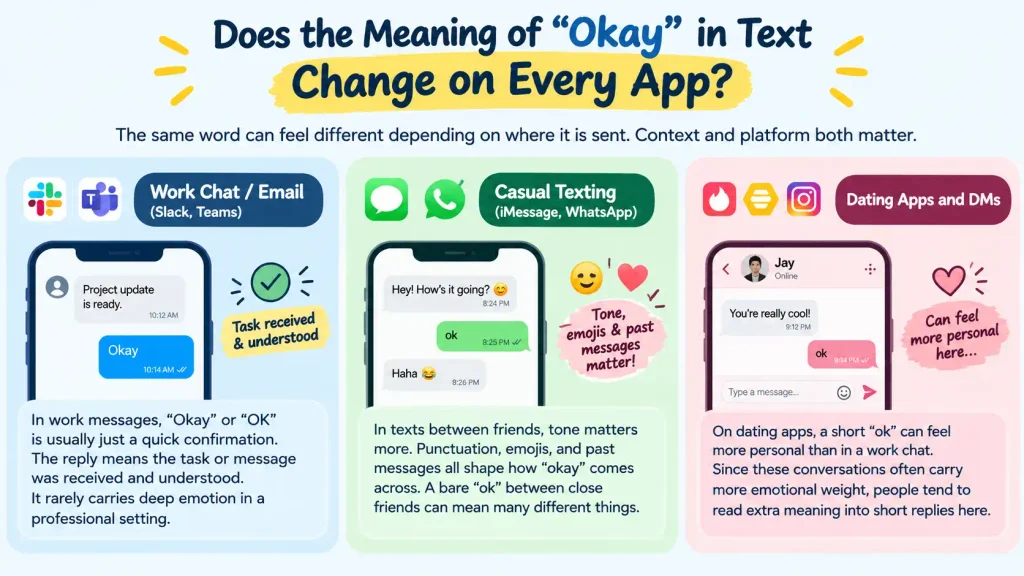
The same word can feel different depending on where it is sent. Context and platform both matter.
Work Chat / Email (Slack, Teams)
In work messages, “Okay” or “OK” is usually just a quick confirmation. The reply means the task or message was received and understood. It rarely carries deep emotion in a professional setting.
Casual Texting (iMessage, WhatsApp)
In texts between friends, tone matters more. Punctuation, emojis, and past messages all shape how “okay” comes across. A bare “ok” between close friends can mean many different things.
Dating Apps and DMs
On dating apps, a short “ok” can feel more personal than in a work chat. Since these conversations often carry more emotional weight, people tend to read extra meaning into short replies here.
My Experience Reading “Okay” in Real Conversations
I’ve used the word “okay” meaning in text messages more times than I can count, and over time I noticed its meaning shifts depending on the conversation. At first, I assumed “okay” always meant someone agreed with me or understood what I was saying. But after seeing it used in different situations, I realized the same word can carry agreement, understanding, acceptance, uncertainty, or even a little frustration.
When someone texts “Okay, I’ll do it,” I read that as clear agreement or acceptance. But when the reply is just “Okay” on its own, the meaning changes. Depending on what was said before and my relationship with that person, “Okay” can mean “I understand,” “fine,” or that they’d rather not keep the conversation going.
Punctuation makes a real difference too. “Okay!” tends to feel friendly or enthusiastic, while “Okay…” usually suggests hesitation or uncertainty. This pattern convinced me that decoding “okay” in a text isn’t about the word in isolation. It’s about reading the whole conversation.
In my experience, the most reliable way to interpret “okay” is to look at the context, the sender’s normal texting style, and the messages that came right before it. A short reply like this rarely has just one fixed meaning.
Frequently Asked Questions
What does “ok” mean from a girl (or guy) in a text? On its own, “ok” usually just means acknowledgment. But if the reply feels shorter than that person’s normal texting style, it can signal they are busy, distracted, or a little annoyed. The surrounding conversation matters more than the single word.
Why does “k” sound rude in texting? A single “k” removes any warmth or extra words from a reply. Because of this, it often comes across as curt or dismissive, even when the sender did not mean it that way. It is one of the most misread replies in texting today.
Is “kk” the same as “k”? No. “Kk” is usually read as casual and friendly, while a single “k,” especially with a period, tends to feel cold. Doubling the letter softens the tone and makes the whole message feel more relaxed and easygoing.
What’s the difference between “ok” and “okay” in texting? There is no major difference in meaning between the two. “Okay” is simply the fuller spelling. Some people see it as slightly warmer or more thoughtful than the shorter “ok,” but both point to the same basic okay meaning in text: agreement or acknowledgment.
Why do people say “ok” is passive-aggressive? It is rarely the word itself that causes this reaction. A plain “Ok.” with no emoji, no exclamation point, and no follow up, especially right after an apology or explanation, is often read as hidden frustration or annoyance.
What does it mean when someone replies “okayyy” with extra Y’s? Extra letters usually add a playful or sarcastic tone to a reply. “Okayyy” often means “sure, if you say so,” rather than real agreement. This spelling is common between friends who are gently teasing each other.
What should you text back if someone just says “k”? It depends on the person and the situation at hand. If a short “k” feels out of character for them, a light check in like “everything good?” usually works better than replying with an equally short message.
The Bottom Line(Okay Meaning in Text)
Texting will never come with a tone of voice built in, which is exactly why a tiny word like “okay” can carry so many different feelings. The spelling, the punctuation, and the person’s usual style all work together to tell the real story behind that one short reply.
Understanding the ” okay ” meaning in text really comes down to reading the whole conversation, not just the word itself. A single “k” is not automatically rude, and a doubled “kk” is not automatically warm; both depend on who sent them, what came before, and how that person usually texts.
To read more: RYT Meaning in Text: The Simple, Trusted Guide in 2026