Idioms for fear and anxiety are short phrases that use a picture to show fright or worry. “Butterflies in the stomach,” “break out in a cold sweat,” and “heart in your mouth” are three well known examples. This guide lists 21 of them, sorted by feeling and strength. You will find meanings, example sentences, origins, common mistakes, and a short quiz.
Fear and worry feel alike in the body, but they are not the same thing. The wrong phrase makes a sentence sound odd. Use this guide to match each phrase to its timing, its mood, and its strength.
Quick Answer: Idioms for Fear and Anxiety
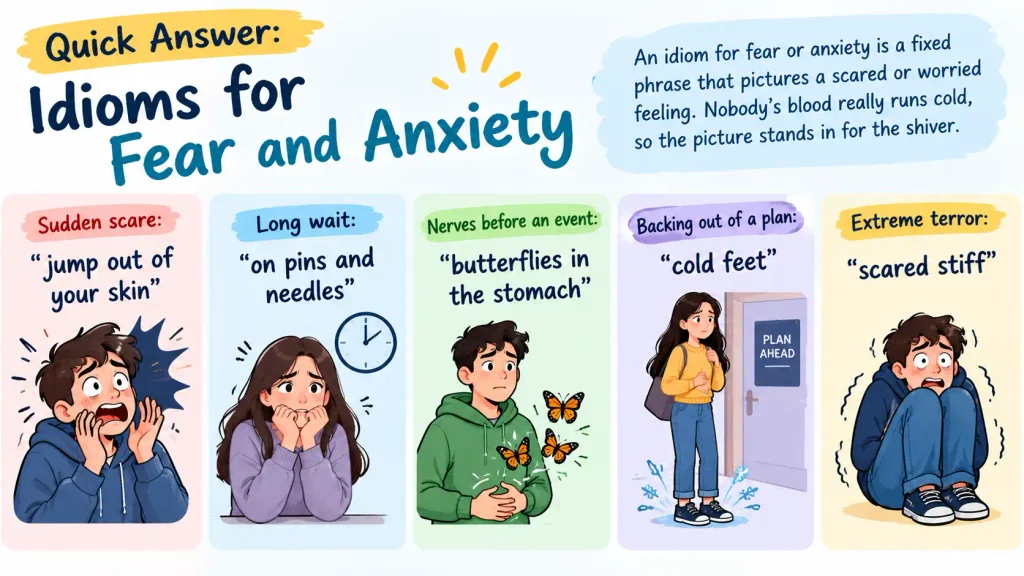
An idiom for fear or anxiety is a fixed phrase that pictures a scared or worried feeling. Nobody’s blood really runs cold, so the picture stands in for the shiver.
- Sudden scare: “jump out of your skin”
- Long wait: “on pins and needles”
- Nerves before an event: “butterflies in the stomach”
- Backing out of a plan: “cold feet”
- Extreme terror: “scared stiff”
Idioms for Fear and Anxiety Compared: Fear vs. Anxiety
Fear is a reaction to danger that is here now, and anxiety is worry about danger that might come later. The word “fear” comes from Old English fǣr, which meant sudden danger or disaster.
Your body shows the difference too. A sudden scare sets off the fight or flight response. Your heart pounds, you sweat, and you may shake. Long worry keeps you tense for hours or days.
Idioms follow the same split. A loud bang fits “jump out of your skin.” A long wait for exam results fits “on pins and needles.” To choose, ask yourself if the scary thing is happening now or is still ahead.
Idioms for Fear and Anxiety at a Glance
Strength runs from 1 (mild) to 4 (extreme). It is my own rating, based on how people usually use each phrase. For origins, Strong means the first use is documented in print. Disputed means sources disagree. Unverified means the claim is often repeated, but I could not confirm it. A dash means I found no reliable source.
| Idiom | Feeling | Body or action | Strength | Origin |
| Jump out of your skin | Fear | Startle | 3 | — |
| Make your blood run cold | Fear | Chill | 4 | — |
| Make your hair stand on end | Fear | Prickling skin | 3 | — |
| Scared stiff | Fear | Freezing | 4 | — |
| Shake like a leaf | Fear or anxiety | Trembling | 3 | — |
| Break out in a cold sweat | Fear or anxiety | Sweating | 3 | — |
| Like a deer in headlights | Fear | Freezing | 3 | — |
| Afraid of your own shadow | Fear | Personality trait | 2 | — |
| The heebie-jeebies | Fear (creepy) | Uneasy shiver | 2 | Unverified |
| On pins and needles | Anxiety | Tingling nerves | 2 | — |
| With bated breath | Anxiety or excitement | Holding your breath | 2 | Strong |
| On tenterhooks | Anxiety | Tense waiting | 3 | Strong |
| Heart in your mouth | Fear or anxiety | Racing heart | 3 | — |
| Butterflies in the stomach | Anxiety or excitement | Fluttering stomach | 1 | Disputed |
| Stomach in knots | Anxiety | Tight stomach | 3 | — |
| Bundle of nerves | Anxiety | Tense state | 3 | — |
| The jitters | Anxiety | Restless nerves | 1 | — |
| Like a cat on hot bricks | Anxiety | Restless pacing | 2 | Strong |
| At your wits’ end | Anxiety | Worn-out state | 3 | — |
| Walking on eggshells | Anxiety | Careful behavior | 2 | — |
| Cold feet | Fear or doubt | Backing out | 2 | Disputed |
Idioms for Fear and Anxiety That Describe a Present Threat
Fear idioms describe fright that hits while something scary is happening right now. They range from a small jolt to full terror.
Sudden fright
Jump out of your skin means to be startled so much that your body seems to leap. “Dad walked in without a sound, and I almost jumped out of my skin.”
Make your blood run cold describes a shock that fills you with horror. “The message on my car window made my blood run cold.”
Make your hair stand on end suggests fear so sharp that the hairs on your neck rise. “The creak on the stairs made my hair stand on end.”
Frozen or shaking
Scared stiff refers to fear so strong that you cannot move. “Ana was scared stiff when the dog growled at her.”
Shake like a leaf means trembling from fear or nerves.
Break out in a cold sweat is a sudden sweat that comes with fear or panic.
Like a deer in headlights: pictures someone so surprised or scared that they freeze and can’t think.
Easily frightened or creeped out.
Afraid of your own shadow fits a person who gets scared by tiny things. It can sound unkind about someone else, so use it with care.
The heebie-jeebies stand for a creepy, uneasy feeling. “That empty hallway gives me the heebie-jeebies.”
Idioms for Fear and Anxiety About a Threat That May Come
Anxiety idioms describe worry about something that has not happened yet. Many appear while people wait, get ready, or feel pressure.
While waiting for news
On pins and needles means nervous waiting. “We were on pins and needles until the doctor called.”
With bated breath suggests waiting so eagerly or nervously that you barely breathe. “The class waited with bated breath for the test scores.” Watch the spelling. It is “bated,” not “baited.”
On tenterhooks points to tense, stretched-tight waiting. “The whole office was on tenterhooks before the budget decision.” Spell it “tenterhooks,” not “tenderhooks.”
Heart in your mouth means fear that jumps up your throat when something risky is about to happen. “My heart was in my mouth as my little brother climbed the tall tree.”
Nerves before an event
Butterflies in the stomach is a light, fluttery feeling before something big. “I always get butterflies before a job interview.”
Stomach in knots is a tight, sick feeling from worry. “My stomach was in knots on my first day at the new school.”
Bundle of nerves labels a person who is very tense and jumpy.
The jitters means shaky, restless nerves.
Like a cat on hot bricks pictures someone who can’t sit still from worry. “Dad paced the hall like a cat on hot bricks while we waited for the baby to arrive.” This is the British form. Americans say “cat on a hot tin roof.”
Pressure and tension
At your wits’ end means you are so worried or worn out that you don’t know what to do next. “With three deadlines due Friday, I was at my wits’ end.”
Walking on eggshells is being extra careful around someone so you don’t upset them. The worry here is about another person’s mood.
Losing your nerve
Cold feet is a sudden fear that makes you back out of a plan. “Sam got cold feet the night before the move.” It names an action, not a body feeling.
When fear and excitement overlap
“Butterflies in the stomach” and “with bated breath” can show either dread or excitement, so the rest of the sentence must make your meaning clear. “The family waited with bated breath for the scan results” shows dread. “The crowd waited with bated breath for the winner” shows excitement.
Some phrases lean one way. “Heart in your mouth” and “make your blood run cold” point toward dread. “Cold feet” is about backing out, so it never shows excitement. When a phrase could go either way, add a clue word such as “nervous” or “thrilled.”
Where Idioms for Fear and Anxiety Come From
Only a few of these idioms have an origin traced in print, and some of those stories are still argued over. Strong means a first use is documented. Disputed means sources give different dates or stories. Unverified means a claim is often repeated, but I could not confirm it with a second source.
| Idiom | What the record shows | Grade |
| On tenterhooks | A tenter was a wooden frame that stretched wet cloth, and tenterhooks held the cloth in place. The “in suspense” meaning appears in Tobias Smollett’s Roderick Random (1748). | Strong |
| With bated breath | Shakespeare’s The Merchant of Venice, written in the 1590s, has an early recorded use. “Bated” is short for “abated,” which means held back. | Strong |
| Like a cat on hot bricks | An early form, “like a cat on a hot bakestone,” appears in John Ray’s book of English proverbs in 1678. The “hot bricks” version turns up in an 1838 magazine. | Strong |
| Cold feet | The earliest known use for nerves is often credited to Stephen Crane’s Maggie: A Girl of the Streets, dated 1893 (some sources say 1896). A play by Ben Jonson has a similar line about money trouble. No one has settled it. | Disputed |
| Butterflies in the stomach | One source points to a 1908 novel. Another gives a 1930s newspaper as the earliest nervous use. The dates don’t match. | Disputed |
| The heebie-jeebies | Often credited to cartoonist Billy DeBeck and a 1923 cartoon, but I could not find a second source. | Unverified |
The other fifteen idioms are not in this table because I found no reliable source for them. A made-up story does more harm than a blank. If you see a tidy origin for “scared stiff” or “hair stand on end” elsewhere, ask where it was first printed.
Common Mistakes With Idioms for Fear and Anxiety
The most common errors are spelling swaps like “baited breath” and “tenderhooks,” and using an action idiom like “cold feet” for a plain scare.
| Wrong | Right | Why it happens |
| with baited breath | with bated breath | The two words sound the same. “Baited” goes with bait on a hook. “Bated” is short for “abated.” |
| on tenderhooks | on tenterhooks | “Tender” is a familiar word, and “tenter” is not. Real tenterhooks were sharp metal hooks. |
| “I got cold feet when the dog barked.” | “I was scared stiff when the dog barked.” | Cold feet is about backing out of a plan. It doesn’t fit a sudden scare. |
How to Pick the Right Idioms for Fear and Anxiety
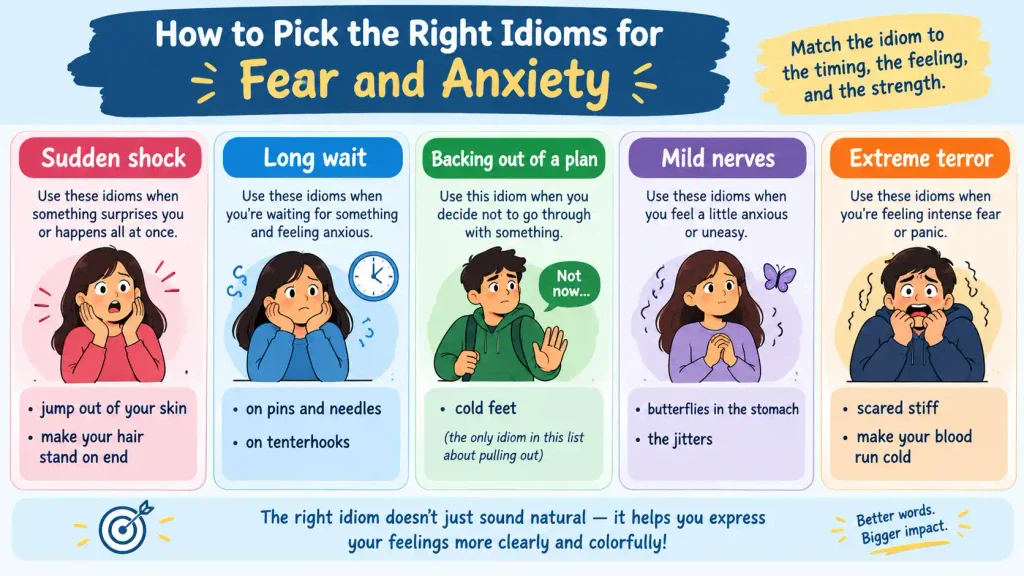
Match the idiom to the timing, the feeling, and the strength.
- Sudden shock: use “jump out of your skin” or “make your hair stand on end.”
- Long wait: use “on pins and needles” or “on tenterhooks.”
- Backing out of a plan: use “cold feet,” the only idiom in this list about pulling out.
- Mild nerves: use “butterflies in the stomach” or “the jitters.”
- Extreme terror: use “scared stiff” or “make your blood run cold.”
Quick Practice on Idioms for Fear and Anxiety
Six short questions test whether you can pick the right idiom. The answers are at the end.
- The door slammed behind me, and I nearly ___. (a) got cold feet (b) jumped out of my skin © walked on eggshells
- Which idiom means backing out of a plan?
- Fill in the blank: “The crowd waited with ___ breath.” (bated/baited)
- Which is milder: “butterflies in the stomach” or “scared stiff”?
- Which fits a long wait for test results: “on pins and needles” or “make your hair stand on end”?
- What do Americans say instead of “like a cat on hot bricks”?
Answers: 1. (b). 2. Cold feet. 3. Bated. 4. Butterflies in the stomach. 5. On pins and needles. 6. Like a cat on a hot tin roof.
FAQs About Idioms for Fear and Anxiety
What are idioms for fear and anxiety?
They are fixed phrases that use a picture to show fright or worry. “Make your blood run cold” shows sudden horror, and “on pins and needles” shows nervous waiting.
Which idiom describes nervousness before an important event?
“Butterflies in the stomach” is the best known one. “Stomach in knots” fits heavier worry, and “the jitters” fits shaky nerves right before going on stage.
What is an idiom for being easily frightened?
“Afraid of your own shadow” fits someone who gets scared by tiny things. For a creepy, uneasy feeling, say “the heebie jeebies.”
What is the difference between fear idioms and anxiety idioms?
Fear idioms describe a danger that is here now, while anxiety idioms describe worry about a danger that might come later. “Jump out of your skin” fits a sudden bang, and “on tenterhooks” fits a long wait for news.
Conclusion: Idioms for Fear and Anxiety
Fear idioms fit a scare in the moment, and anxiety idioms fit a worry that is still ahead. Pick by timing first, then by strength. Add a clue word when a phrase could mean dread or excitement. Check the spelling of “bated breath” and “tenterhooks.” Use “cold feet” only for backing out of a plan.
To read more: Idioms for Resilience: 15 Powerful Phrases to Bounce Back