
Idioms for advertising are short phrases that help ads grab attention, sell products, and spread a message. Their meaning goes beyond the words, so “sell like hotcakes” has nothing to do with pancakes. Copywriters love them because readers already know them. A familiar phrase sticks in memory faster than a new claim.
This guide shares 20 phrases with meanings, original ad copy examples, and usage tips. You will also learn where “It pays to advertise” began and how real brands twist old sayings. Finish with a short quiz to test yourself.
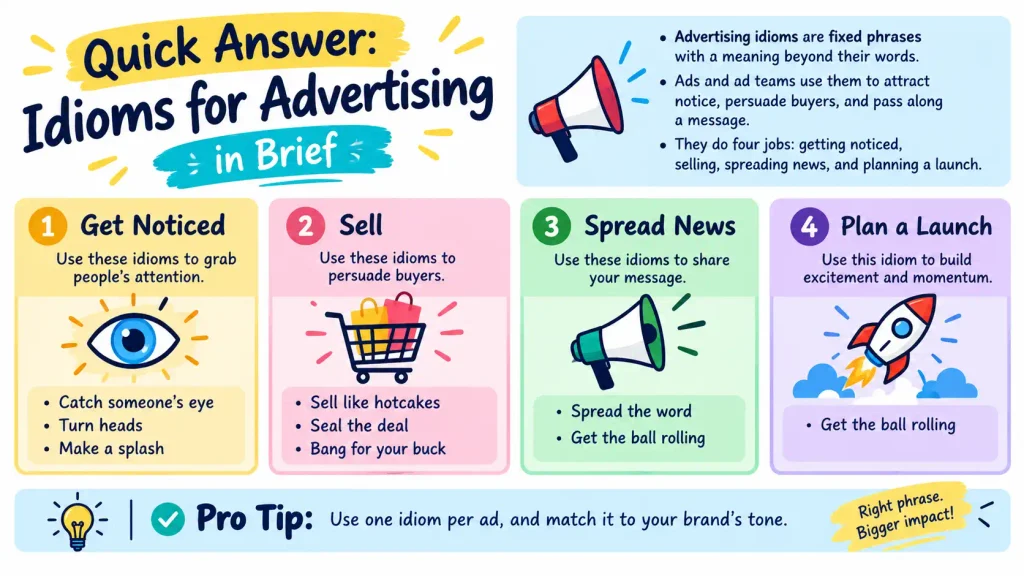
Quick Answer: Idioms for Advertising in Brief
- Advertising idioms are fixed phrases with a meaning beyond their words.
- Ads and ad teams use them to attract notice, persuade buyers, and pass along a message.
- They do four jobs: getting noticed, selling, spreading news, and planning a launch.
- To get noticed, try “catch someone’s eye,” “turn heads,” or “make a splash.”
- To sell, use “sell like hotcakes,” “seal the deal,” or “bang for your buck.”
- To spread news and plan a launch, use “spread the word” or “get the ball rolling.”
- Use one idiom per ad, and match it to your brand’s tone.
What Counts as Idioms for Advertising?
A phrase counts when it describes, powers, or comes from the work of selling. Three kinds fit this label.
Selling and ad talk. “Sell like hotcakes” and “make a splash” describe sales and attention directly.
Phrases born inside an ad. Some lines grew so popular that people borrow them for daily talk. “When it rains, it pours” started this way.
General business talk. Agency meetings run on “think outside the box” and “get the ball rolling.”
Some terms on other lists are not idioms at all. “Target audience” and “brand voice” are plain job terms, because their words say exactly what they mean. This page leaves them out.
Idiom vs proverb vs slogan. These three tools do different jobs.
| Type | What it is | Example |
| Idiom | A phrase whose meaning differs from its words | “Turn heads” (to attract admiring looks) |
| Proverb | A short saying that gives advice or shares a lesson | “It pays to advertise” |
| Slogan | A catchy line that a brand uses again and again | “Where’s the beef?” |
The lines blur at times. A slogan can become an idiom once people use it without the brand in mind.
20 Idioms for Advertising, Grouped by What They Do
These 20 phrases handle four jobs: attention, selling, news, and launches. All examples are original.
| Job | Idiom | Meaning | Ad-copy example |
| Attention | Catch someone’s eye | To get noticed right away | “A bright label that will catch your eye on any shelf.” |
| Attention | Turn heads | To draw admiring looks | “Turn heads on every street in the new Vela.” |
| Attention | Make a splash | To get big attention all at once | “The shoe brand made a splash with a one-minute film.” |
| Attention | Cut through the noise | To stand out among many other messages | “Short, bold words help a brand cut through the noise.” |
| Attention | Steal the show | To be the best part of an event | “Our jingle stole the show at the awards night.” |
| Selling | Sell like hotcakes | To sell very fast | “Fans say the new flavor is selling like hotcakes.” |
| Selling | Seal the deal | To finish an agreement | “Free shipping might seal the deal for shoppers on the fence.” |
| Selling | Sweeten the deal | To add a bonus that makes an offer tempting | “Order today and we’ll sweeten the deal with a free case.” |
| Selling | Put your money where your mouth is | To back up your words with action | “Love it or get a full refund. We put our money where our mouth is.” |
| Selling | Bang for your buck | Good value for the price | “Get more bang for your buck with our family plan.” |
| Message | Spread the word | To tell as many people as you can | “Love the app? Spread the word and earn a reward.” |
| Message | Word of mouth | News passed along by talking | “Our best ads are our happy customers, by word of mouth.” |
| Message | Ring a bell | To sound familiar | “The tune should ring a bell, even for first-time buyers.” |
| Message | Spread like wildfire | To travel very fast | “The challenge spread like wildfire across social media.” |
| Message | Drum up interest | To stir up attention for something | “A teaser clip helped drum up interest before the launch.” |
| Launch | Think outside the box | To come up with a fresh, unusual idea | “The team had to think outside the box to sell snow tires in July.” |
| Launch | Hit the ground running | To start strong with no slow warm-up | “Be ready to hit the ground running on launch day.” |
| Launch | Get the ball rolling | To start a project | “A single post got the ball rolling for the whole campaign.” |
| Launch | Raise the bar | To set a higher standard | “This ad raises the bar for car commercials.” |
| Launch | Play your cards right | To make smart choices and get a good result | “Play your cards right, and one slogan can last for decades.” |

How Real Ads Twist Idioms for Advertising
Ads twist idioms by adding a line or swapping a word, so the plain meaning and the playful meaning show up together. The reader hears the old phrase first. Then a small change makes the reader smile.
Linguist Carita Lundmark has studied how copywriters stretch and change idioms to fit a product. Two moves stand out.
Extended idioms. An extended idiom keeps the original words and adds a second line that makes the plain meaning come alive. Here is an invented example. The original is “Break the ice.” The ad twist is “Break the ice with our new mint chip. Ice not included.” The first line uses the usual meaning, which is to start a chat. The second line jumps to real ice and surprises the reader.
Altered idioms. An altered idiom changes one word so that the phrase points straight at the product. Apple’s computer slogan “I think, therefore iMac” bends the famous saying “I think, therefore I am” by working in the brand name. Here is a second invented example for an outdoor store. The original is “Let sleeping dogs lie.” The ad twist is “Let sleeping bags lie. (They’re just that comfy.)” Only one word changes, yet the ad now sells camping gear.
A real case is the Morton Salt slogan “When it rains, it pours,” introduced in 1914. It reworks an older saying, “It never rains, but it pours,” which warned that troubles arrive in bunches. The new line turned that warning into a promise: the salt keeps pouring on damp days.
Tone Check and Common Mistakes With Idioms for Advertising
Some idioms praise a brand, while others hint at tricks, so every phrase needs a tone check before it goes into copy. A phrase can sound friendly in a chat and sound like an insult on a billboard.
| Tier | Idiom | Why it feels that way | Use in your own copy? |
| Praising | Sell like hotcakes | Points to strong demand | Yes, if the claim is true |
| Praising | Steal the show | Says you were the best part | Yes |
| Blaming | Sell a bill of goods | Hints that buyers were fooled | No |
| Blaming | Hook, line, and sinker | Pictures buyers as tricked | No |
| Blaming | Blow out of proportion | Implies unfair exaggeration | No |
| Blaming | Talk a good game | Describes big words with no results | No |
| It depends | Blow your own horn | Sounds like bragging | Use with care |
| It depends | Steal the spotlight | Praise for a star, but a complaint when a rival does it | Depends on who is speaking |
When not to use one. An idiom is the wrong choice whenever the reader might miss it, misread it, or tire of it. Four traps are common.
- Too many in one ad. One idiom feels fun, but four in a row feels like a pile-up.
- Global readers. Idioms rarely translate word for word, so a phrase that works in New York can confuse a reader in Seoul.
- Unclear audience. Younger readers, new learners, and non-native speakers may not know older phrases.
- Literal traps. If the plain meaning is silly or unsafe, the joke may backfire. “Drive someone crazy” in a car ad is a good example.
Common mistakes. Writers slip in the same few places.
- Changing a word by accident. The correct form is “hit the nail on the head,” not “hit the nail in the head.”
- Mixing up the tone. “Sell a bill of goods” sounds like a skill, but it describes cheating buyers.
- Misreading “ring a bell.” It means sounding familiar and has nothing to do with noise.
- Cutting words. Write “cut through the noise,” not “cut the noise,” because the two phrases say different things.
- Treating “put your money where your mouth is” as praise. It is a challenge to prove your claim with action.
Matching Idioms for Advertising to Brand Voice
Luxury brands suit calm, polished phrases, while mass market brands can play with louder, funnier ones. This is editorial advice, not survey data, so check it against your own audience.
| Brand type | Tone to aim for | Idioms that often fit | Idioms to skip |
| Luxury | Quiet, confident, polished | “Worth its weight in gold,” “a cut above,” “in a league of its own” | “Sell like hotcakes,” “bang for your buck” |
| Mass market | Friendly, quick, playful | “Bang for your buck,” “sell like hotcakes,” “spread the word” | Stiff, old-fashioned phrases that need explaining |
A luxury watch ad that shouts about a bargain sends the wrong message. A snack ad that sounds like a legal letter does the same.
Origins of Idioms for Advertising: It Pays to Advertise
“It pays to advertise.” This old saying means money spent on ads comes back as more sales. It has been in print since the nineteenth century, according to word-history researchers. A stage play titled It Pays to Advertise, by Roi Cooper Megrue and Walter Hackett, opened in 1914, and films followed in 1919 and 1931. The word “advertise” also has deep roots. It comes from Old French avertir and Latin advertere, which means turning one’s attention toward something.
Slogans that became everyday speech. Three escaped the commercial.
- “When it rains, it pours.” Morton Salt began using it in 1914 to show its salt stayed free-flowing in damp weather. Today, people say it when problems pile up.
- “Where’s the beef?” Wendy’s made it famous in 1984. People now use it to ask where the real substance is.
- “Don’t leave home without it.” American Express used it from the 1970s. Today, it can describe any must-have item.
Quick Quiz on Idioms for Advertising
- Which idiom means to sell very fast? (a) hit the road, (b) sell like hotcakes, (c) ring a bell
- Fill in the blank: “Her new ad made a ___ at the awards.” (a) splash, (b) noise, (c) bell.
- Which phrase means finishing a sale? (a) seal the deal, (b) drum up interest, (c) raise the bar
- True or false: “Sell a bill of goods” is a safe compliment.
- What does “that name rings a bell” suggest? (a) it is loud, (b) it sounds familiar, (c) it is annoying
- Which saying became a 1914 stage play title? (a) “Where’s the beef?” (b) “It pays to advertise” (c) “When it rains, it pours”
Answers: 1) b. 2) a. 3) a. 4) False; it describes tricking buyers. 5) b. 6) b.
FAQs About Idioms for Advertising
Why are advertising idioms useful?
They pack a big idea into a few familiar words. Twisting them gives readers a small jolt of surprise that helps the message stick.
Should ads use idioms often?
No. One well chosen phrase can shine, but too many crowd the copy. Consider your audience and how the line reads after translation.
What does “It pays to advertise” mean?
It means money spent on ads brings back more money in sales.
How do an idiom, a proverb, and a slogan differ?
An idiom has a meaning beyond its words, a proverb gives advice, and a slogan belongs to a brand.
Conclusion: Make Idioms for Advertising Work
Strong idioms for advertising do three things: they get noticed, stay in memory, and fit the brand. Pick phrases with the right tone. Keep them rare, because one idiom per ad works best. Test every line on real readers before it goes live. Check how each phrase reads for global audiences. Next, try rewriting one of your own slogans with a single swapped word. Then compare the result with the original and keep the stronger line.
To read more: Idioms for Halloween: 16 Terrifying Phrases With Meanings