

Idioms for food are phrases that use a food word to talk about something else. When you say a test was “a piece of cake,” nobody is eating, because you mean it was easy. English has hundreds of these phrases, and some are warm, some are neutral, and some can sound rude. Many of them also come with origin stories that are not true.
This guide gives you 24 common phrases with simple meanings and fresh examples. It sorts each phrase by tone, so you know when it is safe to use. It also shows which origin stories have proof and which are only popular tales.
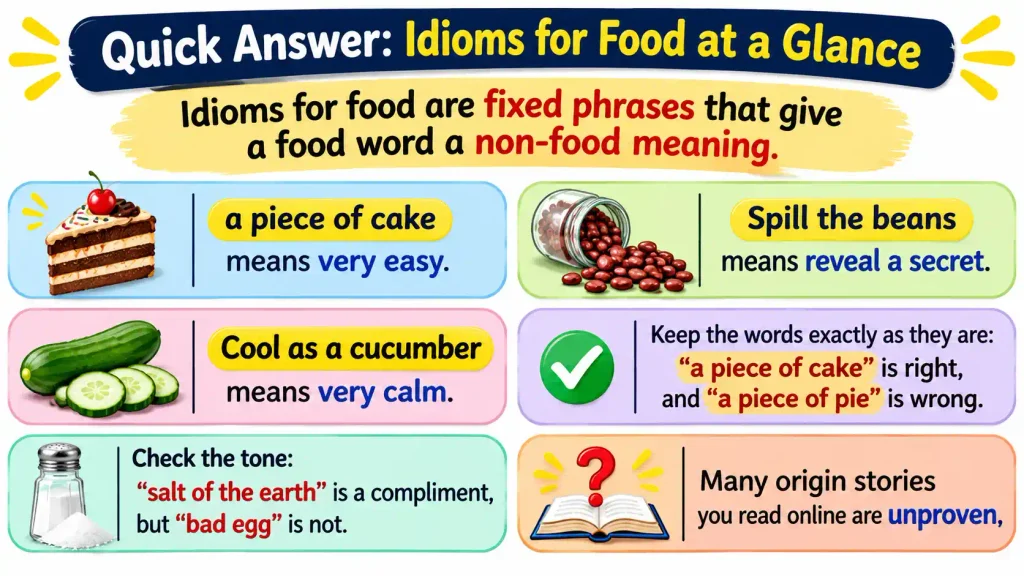
Quick Answer: Idioms for Food at a Glance
Idioms for food are fixed phrases that give a food word a non-food meaning.
A piece of cake means very easy.
Spill the beans means reveal a secret.
Cool as a cucumber means very calm.
Keep the words exactly as they are: “a piece of cake” is right, and “a piece of pie” is wrong.
Check the tone: “salt of the earth” is a compliment, but “bad egg” is not.
Many origin stories you read online are unproven.
What Are Idioms for Food, and Why Does English Use So Many?
A food idiom is a set phrase where the food stays the same but the meaning changes. English has so many because everyone knows food. Meals connect to family, comfort, money, and work, so a food word brings a feeling with it. Idioms for food also stay popular because the listener gets a picture in the mind before the real meaning arrives. That picture makes the phrase easy to remember, and it is why teachers, writers, and speakers reach for these phrases so often.
| A piece of cake | A slice of dessert | A very easy task |
| In a pickle | Sitting in a jar | In a tricky spot |
| Spill the beans | Beans falling out of a pot | Reveal a secret |
The picture and the meaning rarely match. A pickle is a cucumber in a jar, yet the phrase describes a tricky spot. Beans fall out of a pot in the picture, but in real life a secret slips out. Learning that gap is the key to using these phrases well.
24 Idioms for Food by Tone: Warm, Neutral, or Critical
The 24 phrases below fall into three groups of eight. The labels are my own judgment of how each phrase usually sounds. The speaker’s voice can change them, so treat the groups as a guide and not a rule.
Warm and Positive
These work as compliments.
| The apple of my eye | Someone you treasure most | “Her little nephew is the apple of her eye.” | Best for family and close friends |
| Cool as a cucumber | Calm under pressure | “He stayed cool as a cucumber when the power went out.” | Praises calm nerves |
| A smart cookie | A clever person | “Ask Mei. She’s a smart cookie.” | Can sound patronizing from a boss |
| The icing on the cake | A bonus on top of something good | “The bonus was the icing on the cake after a great year.” | Needs a good result first |
| Full of beans | Lively and energetic | “The puppy is full of beans today.” | Fits kids and pets best |
| Like two peas in a pod | Very similar or very close | “The twins are like two peas in a pod.” | Works for people and objects |
| The salt of the earth | A decent, hardworking person | “Our mail carrier is the salt of the earth.” | A strong compliment |
| Worth your salt | Good at your job | “Any editor worth her salt would catch that.” | Usually follows “any” plus a role |
Neutral and Descriptive
These describe a situation without judging anyone.
| A piece of cake | Very easy | “The driving test was a piece of cake.” | So common it can feel stale |
| Bread and butter | Your main income or core work | “Repairs are our bread and butter.” | Refers to work, not meals |
| Bring home the bacon | Earn the household’s money | “She takes night shifts to bring home the bacon.” | Fits anyone who earns for others |
| Food for thought | Something worth thinking about | “That article gave me food for thought.” | Often follows “give” |
| In a nutshell | In short | “In a nutshell, we ran out of time.” | Opens a summary |
| Not my cup of tea | Not something I enjoy | “Loud concerts aren’t my cup of tea.” | Usually used in the negative |
| A grain of salt | Doubt a claim a little | “Take that review with a grain of salt.” | “A pinch of salt” means the same |
| Spill the beans | Reveal a secret | “Don’t spill the beans about the party.” | Best for small, fun secrets |
Critical or Use with Care
These can criticize, tease, or hint at a bad motive.
| A bad egg | A troublemaker | “The neighbors call him a bad egg.” | Harsh to someone’s face |
| Couch potato | Someone who sits and watches screens | “I was a couch potato all Sunday.” | Fine about yourself, rude about others |
| Butter someone up | Flatter to get a favor | “He buttered up his boss before asking for a day off.” | Hints at a hidden motive |
| Egg someone on | Push someone toward a silly or risky act | “The crowd egged him on to dive in.” | Rarely a kind act |
| Egg on your face | Embarrassed by a public mistake | “She had egg on her face when the data was wrong.” | Always about a visible failure |
| Eat humble pie | Admit you were wrong | “The mayor had to eat humble pie.” | Implies forced humility |
| Sour grapes | Bitterness over something you can’t have | “Calling the award silly is just sour grapes.” | Works as an accusation |
| Half-baked | Poorly planned | “That half-baked plan won’t survive a meeting.” | Use it on ideas, not people |
Where Idioms for Food Really Come From: Verified, Disputed, or Myth
Every origin below names its source and says how well it holds up. A fun story is not always a true one, so the table gives a quick verdict before the details.
| Egg someone on | Documented | Mental Floss |
| Cool as a cucumber | Documented (1732) | Phrase Finder |
| In a pickle | Documented, with a twist | Phrase Finder, Mental Floss |
| Worth your salt | Documented; the salt-pay story is a myth | Phrase Finder |
| A grain of salt | Likely | Mental Floss |
| Bring home the bacon | Earliest record 1906; Dunmow link unsupported | Phrase Finder |
| Spill the beans, butter someone up | Unconfirmed | Smithsonian, CulinaryLore |
Verified
Egg someone on. The “egg” comes from an old Norse verb that means to urge. Chickens have nothing to do with it, according to Mental Floss.
Cool as a cucumber. The phrase is first recorded in John Gay’s 1732 poem “New Song on New Similies.” Cucumbers feel cool to the touch, which explains the picture.
In a pickle. The story has a twist. The phrase appears in Shakespeare’s The Tempest, written around 1610. But the line suggests the character was drunk, not simply in trouble. The idea of a “pickle” as a mess is older, since Thomas Tusser used “ill pickle” in a 1573 farming guide.
Worth your salt. Phrase Finder says the Roman word salarium most likely meant money for buying salt, and that soldiers were not paid in salt. The phrase itself is much newer than Rome. The earliest print use found is from 1805.
Likely, but Not Proven
A grain of salt. The best link is an antidote recipe in Pliny the Elder’s writing. Mental Floss lists it as the probable source, but no one has proven it.
A piece of cake. It probably grew out of the cakewalk, a 19th century contest where a cake was the prize. The exact step between the two is not documented.
Disputed or Unsupported
Bring home the bacon. Two stories circulate, but they are not equal. Mental Floss lists both the Dunmow Flitch, a bacon prize said to date from 1104, and a 1906 boxing match as possible origins. Phrase Finder is firmer. It finds no printed record before September 1906 and calls the phrase a 20th century American coinage. The 1906 record is a telegram from boxer Joe Gans’s mother. Treat the Dunmow tale as a fun custom with no proven link to the phrase.
Commonly Repeated, but Unconfirmed
Spill the beans. The story of ancient Greek voters using black and white beans is everywhere. The Smithsonian calls it the probable source, but no earlier record backs it up.
Butter someone up. The tale about Hindu worshippers throwing butter at statues is popular. CulinaryLore calls it a myth.
Look Alike Idioms for Food: Which One Do You Mean?
Some pairs look alike but mean different things. Check the table before you pick one, because a wrong match can change your message.
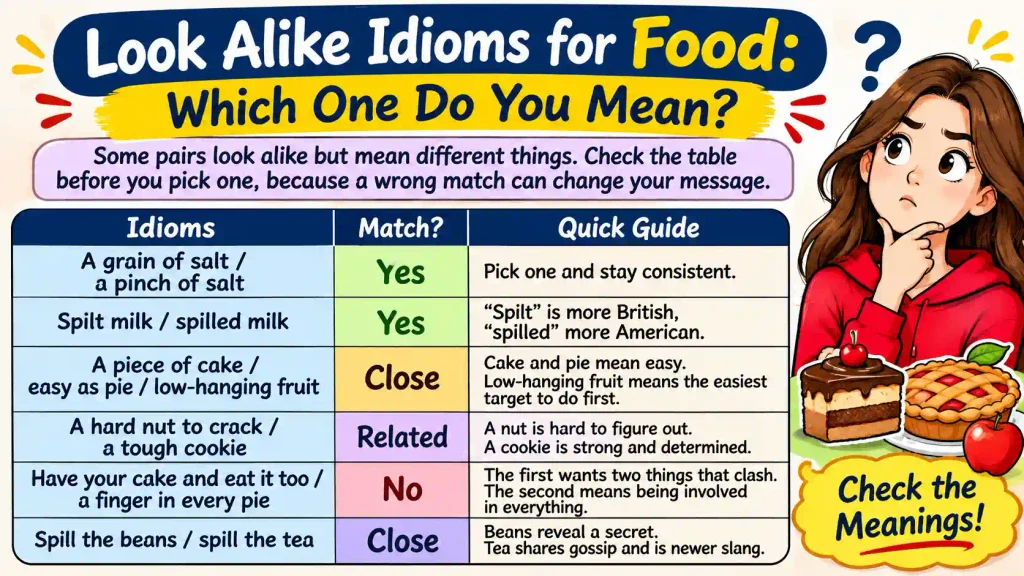
| A grain of salt / a pinch of salt | Yes | Pick one and stay consistent |
| Spilt milk / spilled milk | Yes | “Spilt” is more British, “spilled” more American |
| A piece of cake / easy as pie / low-hanging fruit | Close | Cake and pie mean easy. Low-hanging fruit means the easiest target to do first |
| A hard nut to crack / a tough cookie | Related | A nut is hard to figure out. A cookie is strong and determined |
| Have your cake and eat it too / a finger in every pie | No | The first wants two things that clash. The second means being involved in everything |
| Spill the beans / spill the tea | Close | Beans reveal a secret. Tea shares gossip and is newer slang |
Using Idioms for Food Correctly
Can You Change an Idiom?
You can change the grammar around an idiom, but not its words. Tense and pronouns are fine: “She spilled the beans” and “They brought home the bacon” both work. Swapping the food, dropping a word, or changing the order breaks the phrase.
Five Common Mistakes
| Dropping a word | “That film isn’t my tea.” | “That film isn’t my cup of tea.” |
| Changing the order | “He works to bring the bacon home.” | “He works to bring home the bacon.” |
| Swapping the food | “The quiz was a piece of pie.” | “The quiz was a piece of cake.” |
| Wrong preposition | “He had egg in his face.” | “He had egg on his face.” |
| Stacking idioms | “A piece of cake, cool as a cucumber, bread and butter.” | “It was a piece of cake.” |
Use one idiom per paragraph. Learn each one as a single block, like one long word.
Formal vs. Informal
Most food phrases belong to speech, chats, and friendly emails. In reports and client messages, use plain words:
“The plan is half baked” becomes “The plan lacks detail.”
“He’s a bad egg” becomes “I have concerns about his conduct.”
“It’s our bread and butter” becomes “It’s our main source of income.”
Mild phrases like “in a nutshell” and “food for thought” pass more easily in business talk.
Frequently Asked Questions About Idioms for Food
Where do these phrases come from?
They come from kitchens, farms, old customs, fables, and writers. Some have a documented source, like “cool as a cucumber” in a 1732 poem. Many do not, and several popular stories are folk tales.
Can you use food phrases in a formal setting?
Mostly no. They suit speech and friendly writing. In reports and client emails, use plain words. A few mild ones, like “in a nutshell,” work in business talk.
Are food phrases used differently in other languages?
Yes. Other languages use different foods for similar ideas, and the phrases rarely translate word for word. Learn each one as a whole phrase.
What is the difference between traditional phrases and modern foodie slang?
Traditional idioms are fixed phrases that have lasted for generations, like “spill the beans.” Modern foodie phrases are newer slang spread through chats and social media, like “spill the tea.”
Conclusion: Idioms for Food Made Simple
Idioms for food make your English more colorful, but only if you use them the right way. Keep the words fixed, check the tone before you speak, and save them for relaxed settings. Be careful with origin stories too. Some, like “cool as a cucumber,” have clear proof. Others, like the Dunmow tale behind “bring home the bacon” and the Greek bean story, are popular but unproven. Start with a few warm and neutral phrases, such as “a piece of cake” and “not my cup of tea,” and add more as they feel natural.
To read more: Idioms for Courage: 17 Powerful Phrases With Honest Origins

Digital Communication Writer
Focus: everyday texting slang, emoji meanings, casual chat abbreviations (NGL, LY, DND, etc.)
Bio angle: Grew up navigating group chats and social apps, explains slang the way it’s actually used, with real examples showing serious vs. joking vs. sarcastic tone.