Idioms for winning are phrases that talk about beating others, getting a prize, winning a person, or doing very well.
They help you sound natural in English. They also show success, not just a real game. A plain word says “won,” but a good phrase paints a picture.
This guide groups the idioms for winning by what is won so that you can pick the right one with care. You will find clear meanings, notes on origin where known, and simple examples. Tone notes show when a phrase fits work, school, family, and casual chat.
Quick Answer for Idioms for Winning
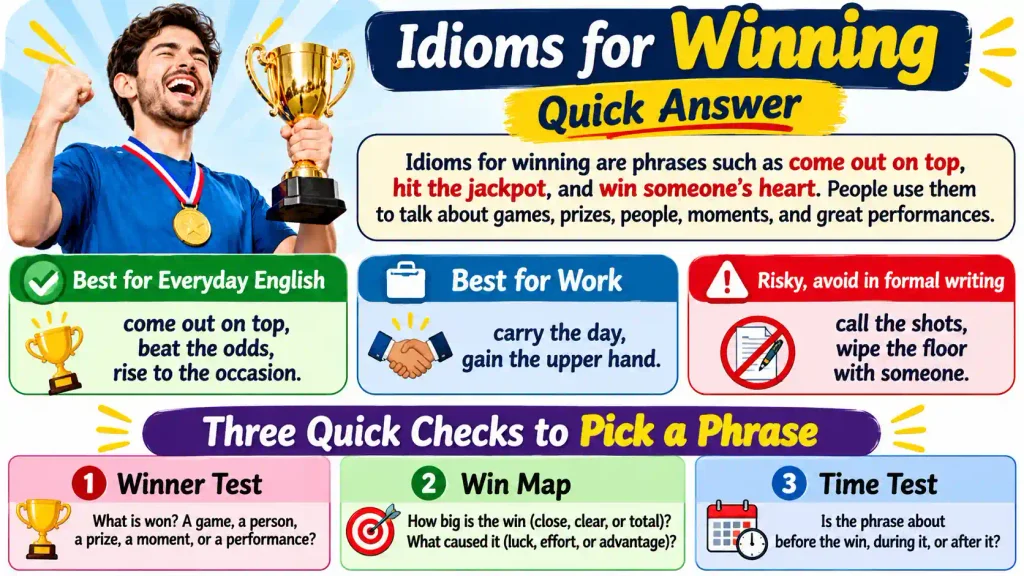
Idioms for winning are phrases such as come out on top, hit the jackpot, and win someone’s heart. People use them to talk about games, prizes, people, moments, and great performances.
- Best for everyday English: come out on top, beat the odds, rise to the occasion.
- Best for work: carry the day, gain the upper hand.
- Risky, avoid in formal writing: call the shots, wipe the floor with someone.
Use three quick checks to pick a phrase:
- Winner Test: What is won? A game, a person, a prize, a moment, or a performance?
- Win Map: How big is the win (close, clear, or total)? What caused it (luck, effort, or advantage)?
- Time Test: Is the phrase about before the win, during it, or after it?
What Are Idioms for Winning?
These phrases use “win” as a symbol for success, not only for a real game or race. Many of them come from sport, racing, and gambling. That is why they can be used to talk about a game, a prize, or even a person.
A literal sentence says, “Our team won the match.” An idiom paints a picture: “Our team came out on top.” Learning idioms for winning helps you talk about success in school, work, and sport.
The Win Map
The Win Map shows the size of a win and its cause.
- Close win: win by a nose, edge out, nip and tuck, down to the wire.
- Clear win: win hands down, win by a landslide, carry the day, come out on top.
- Total win: sweep the board, clean up, wipe the floor with someone.
- Luck cause: hit the jackpot, strike gold, hit pay dirt, dark horse.
- Effort cause: beat the odds, rise to the occasion, hit it out of the park, ace it.
- Advantage cause: have the edge, hold all the cards, gain the upper hand, be in the driver’s seat.
Each entry below ends with tags: the size of the win, the cause, and the time. “No margin” means the phrase is not about the score of a contest.
Core Idioms for Winning by What Is Won
1. Win a Game or Contest
Come out on top: To finish first after effort or competition.
After three hard rounds, Lina came out on top in the chess club.
Tags: clear win, effort, after.
Win hands down: To win with ease, with no real contest.
Our quiz team won hands down, with twice the points of the next team.
Tags: clear win, advantage, after.
Origin: Often linked to horse racing, but this is not confirmed.
Win by a landslide: To win by a very large margin, often in votes.
The class captain won by a landslide, with 28 votes to 4.
Tags: clear win, effort, after.
Sweep the board: To win everything in a contest.
The art class swept the board at the school fair, taking every prize.
Tags: total win, effort, after.
Carry the day: To win in the end, often after a hard contest or debate.
Her calm speech carried the day in the class vote.
Tags: clear win, effort, after.
Beat the odds: To win even when success looked unlikely.
The small football club beat the odds and reached the final.
Tags: no margin, effort, after.
Come from behind: To win after trailing or losing early.
Down by two goals, the team came from behind to win in extra time.
Tags: no margin, effort, during and after.
2. Win by a Little, a Lot, or by Surprise
Win by a nose: To win by a very small gap. The phrase comes from horse racing, where one horse can win by the length of its nose.
Our relay team won by a nose after a last-second push.
Tags: close win, effort, after.
Edge out: To beat someone by a small gap.
Nina edged out her friend for first place in the spelling quiz.
Tags: close win, effort, after.
Down to the wire: Not decided until the very last moment.
The match went down to the wire, and we won in the final minute.
Tags: close win, effort, during.
Nip and tuck: A very close contest where the lead keeps changing.
The race was nip and tuck until the last lap.
Tags: close win, effort, during.
Wipe the floor with someone: To beat someone very badly.
Our team wiped the floor with the other side, 9 to 0.
Tags: total win, advantage, after.
Tone: harsh and boastful. Use it as a joke only.
Dark horse: A person or team that no one expected to win, but who might.
Nobody expected Jo to win, but the dark horse took first place.
Tags: no margin, luck, before.
Origin: Often linked to horse racing, but this is not confirmed.
Ace in the hole: A hidden advantage that you save for the right moment.
Her ace in the hole was a map she had kept secret.
Tags: no margin, advantage, before.
Origin: Often linked to poker, but this is not confirmed.
3. Win a Person
Win over someone: To gain a person’s support or goodwill.
With kind words and a clear plan, Sara won over the new class.
Tags: no margin, effort, after.
Win favour with someone: To gain approval from a person in charge.
His neat work won favour with the head teacher.
Tags: no margin, effort, after.
Win someone’s support: To gain backing for an idea or a plan.
The mayor won the town’s support with a simple, honest speech.
Tags: no margin, effort, after.
Win someone’s trust: To gain faith through honest, steady work.
By keeping every promise, Omar won his team’s trust.
Tags: no margin, effort, after.
Win someone’s heart: To gain love or deep affection.
Through kindness and patience, Ali won his new friend’s heart.
Tags: no margin, effort, after.
4. Win Money or a Prize
Hit the jackpot: To have a big, lucky success or win a big prize.
When she found a free place on the art course, she hit the jackpot.
Tags: no margin, luck, after.
Take the prize: To win a reward in a contest.
At the science fair, Dan took the prize for the best model.
Tags: clear win, effort, after.
Bring home the bacon: To earn money to support a home. This phrase is about earning, not about winning a contest.
Dad works nights to bring home the bacon for our family.
Tags: no margin, effort, after.
Strike gold: To find great success, often by luck or after a search.
The small shop struck gold with a new cake that sold out each day.
Tags: no margin, luck, after.
Hit pay dirt: To find a reward or a good result after effort.
After months of practice, the band hit pay dirt with a song on the radio.
Tags: no margin, luck and effort, after.
Clean up: To win a lot of things, often prizes or money.
At the game night, Priya cleaned up, taking three prizes home.
Tags: total win, effort, after.
Walk away with it: To win and leave with a prize, often with ease.
With a calm final round, he walked away with the trophy.
Tags: clear win, advantage, after.
5. Win a Moment or a Deal
Seal the deal: To make an agreement final.
One phone call sealed the deal for the school trip.
Tags: no margin, effort, after.
Clinch the deal: To win an agreement or a contest at the last stage.
A final offer clinched the deal for the new hall.
Tags: close win, effort, after.
Win the day: To succeed in a contest or a debate. It means the same as carry the day.
Her clear plan won the day in the meeting.
Tags: clear win, effort, after.
6. Win an Advantage
Have the edge: To have a small advantage that helps you win.
Our team has the edge, with extra practice each week.
Tags: close win, advantage, before.
Have a leg up: To have an advantage from extra help or preparation.
Extra study gave her a leg up in the spelling test.
Tags: close win, advantage, before.
Hold all the cards: To be in a strong position to win.
With all the facts, she held all the cards in the talk.
Tags: clear win, advantage, before.
Gain the upper hand: To take a dominant position over a rival.
After the second round, our side gained the upper hand.
Tags: clear win, advantage, during.
Be in the driver’s seat: To be in control of a situation or a plan. It means you hold the power, not that you have won yet.
After the first round, our team was in the driver’s seat.
Tags: no margin, advantage, before and during.
Call the shots: To be in control and make the decisions. It can sound bossy, so use it with care.
In our group, Maya calls the shots and sets the plan.
Tags: no margin, advantage, during.
7. Do Well, Not a Win at All
Ace it: To do very well, often on a test or a task.
I aced the maths quiz after a week of short practice.
Tags: no margin, effort, after.
Hit it out of the park: To do something extremely well.
Her speech hit it out of the park, and the hall stood up to clap.
Tags: no margin, effort, after.
Origin: Often linked to baseball, but this is not confirmed.
Knock it out of the park: Another form of hit it out of the park, with the same meaning.
His first design knocked it out of the park in the review.
Tags: no margin, effort, after.
Take the cake: To be the best or the most surprising, often with humour. People also use it in an ironic way for something shocking.
That goal takes the cake. It was the best of the day.
Tags: no margin, effort, after.
Show your stuff: To show how good you are.
On stage, Mia showed her stuff with a song she wrote herself.
Tags: no margin, effort, during.
Make the cut: To be good enough to be chosen.
She made the cut for the school team after two trials.
Tags: no margin, effort, after.
Rise to the occasion: To do your best when a serious moment demands it.
When the lead singer fell ill, Tom rose to the occasion and sang the part.
Tags: no margin, effort, during.
Tone, Mistakes, and Memory for Idioms for Winning
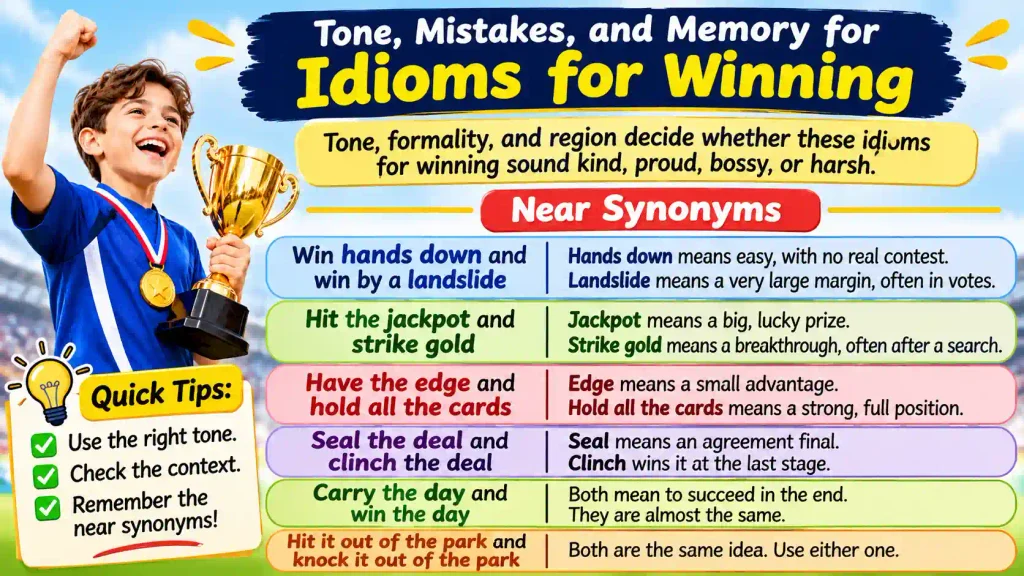
Tone, formality, and region decide whether these idioms for winning sound kind, proud, bossy, or harsh.
Near synonyms
- Win hands down and win by a landslide: Hands down means easy, with no real contest. Landslide means a very large margin, often in votes.
- Hit the jackpot and strike gold: Jackpot means a big, lucky prize. Strike gold means a breakthrough, often after a search.
- Have the edge and hold all the cards: Edge means a small advantage. Hold all the cards means a strong, full position.
- Seal the deal and clinch the deal: Seal makes an agreement final. Clinch wins it at the last stage.
- Carry the day and win the day: Both mean to succeed in the end. They are almost the same.
- Hit it out of the park and knock it out of the park: Both are the same idea. Use either one.
Tone list
- Call the shots: Bossy and about control. Fine in work talk, but use it with care.
- Wipe the floor with someone: Harsh and boastful. Joke only, never formal.
- Bring home the bacon: Warm and about earning. Good for family talk and chat.
- Hit it out of the park: Proud and casual. Common in American English. Fine in chat and IELTS Speaking.
- Win by a nose: Neutral. Common in sport talk in both British and American English.
Common mistakes
- Using the wrong tense with “win hands down.”
Wrong: “Our team win hands down.”
Right: “Our team won hands down.” - Using “call the shots” to mean “win.”
Wrong: “Our team called the shots in the final.” (when you mean you won)
Right: “Our team won the final.”
Call the shots means you decide. It does not mean you win. - Using “take the cake” for a plain win.
Wrong: “He took the cake in the race.”
Right: “He won the race. His last-second finish took the cake.”
Being the best or the most surprising is not the same as winning by score. - Using “bring home the bacon” for a contest prize.
Wrong: “She brought home the bacon in the quiz.”
Right: “She won the quiz prize.”
Bring home the bacon is about earning for a home. - Using a general word after “win by.”
Wrong: “We won by a big win.”
Right: “We won by a nose” (a close win) or “We won by a landslide” (a clear win).
Use a size word after “by,” not the word “win” again.
How to remember
Group the phrases by what is won, then tag each one by size, cause, and time. Try this short practice.
- Close win: We won by a ___ in the final vote, with one vote more.
- Clear win: Our team won ___, with twice the points of the next team.
- Total win: The class swept the ___ at the fair, taking every prize.
- Luck win: When she found a free course place, she hit the ___.
Answers: 1. nose, 2. hands down, 3. board, 4. jackpot.
FAQs About Idioms for Winning
What is the best phrase for everyday English?
The best idioms for winning in everyday English are come out on top, beat the odds, and rise to the occasion. Start with those three. Add more only when they feel natural.
Are winning phrases formal or informal?
Most idioms for winning are informal. Carry the day and gain the upper hand fit work settings. Call the shots can sound bossy in a report, and wipe the floor with someone sounds harsh.
Can I use idioms for winning in IELTS?
You can use them in IELTS Speaking, but avoid them in formal IELTS Writing. In Speaking, come out on top and beat the odds sound natural. In Writing, plain words often score better.
What is the origin of “dark horse” and “ace in the hole”?
Dark horse describes an unexpected winner. Its story is often repeated as coming from horse racing, but this is not confirmed. Ace in the hole describes a hidden advantage. Its story is often repeated as coming from poker, but this is not confirmed.
Conclusion for Idioms for Winning
Idioms for winning give you a clear way to pick a phrase by what is won, the size of the win, and the time.
Start with five phrases that fit your daily life. Add more only when those feel natural.
- Use the Winner Test to check game, person, prize, moment, or performance.
- Use the Win Map to check size and cause.
- Use the Time Test to check before, during, or after.
These checks will keep your English clear, proud, and fair for the moment. Try one phrase today, in chat, at school, or at work, and let it grow from there.
To read more: 41 Powerful Idioms for Heart with Meanings & Examples