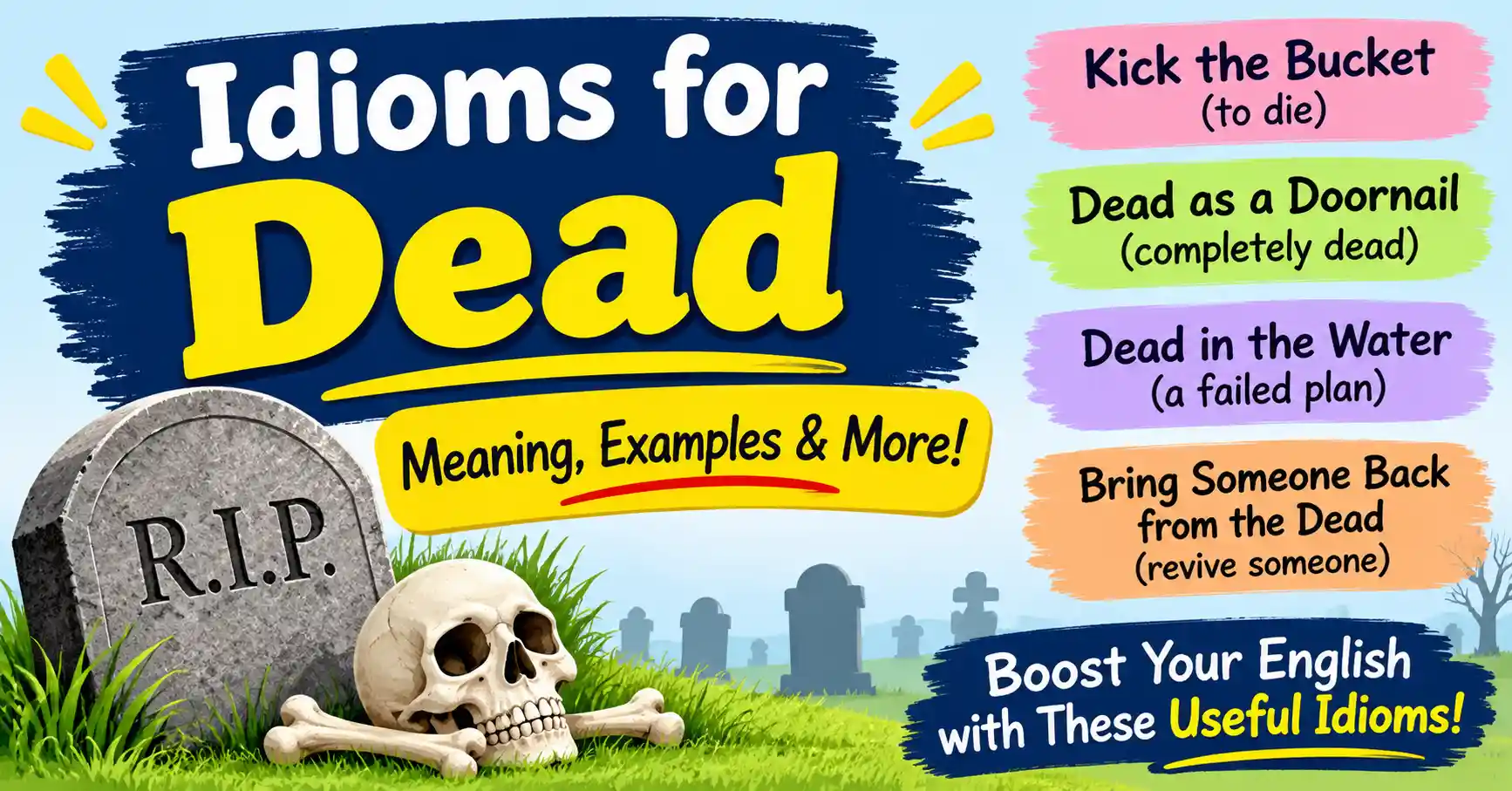
Idioms for dead are short, natural phrases that describe dying gently, dying bluntly, being close to death, or being completely stopped. The word dead does five different jobs in English, so one phrase can mean death in a story and failure in an office. This guide gives you 35 phrases with plain meanings, honest notes on origins, reusable examples, and clear warnings about tone. Disputed origins are marked as not confirmed, so you can trust what you read.
Choose a phrase by its use first, then by whether it is kind or rude, then by time. That order stops most mistakes before they happen. A gentle phrase for a real loss differs greatly from a joke about a fictional pirate. Read on, and these idioms for dead will land in the right place.
Quick Answer About Idioms for Dead
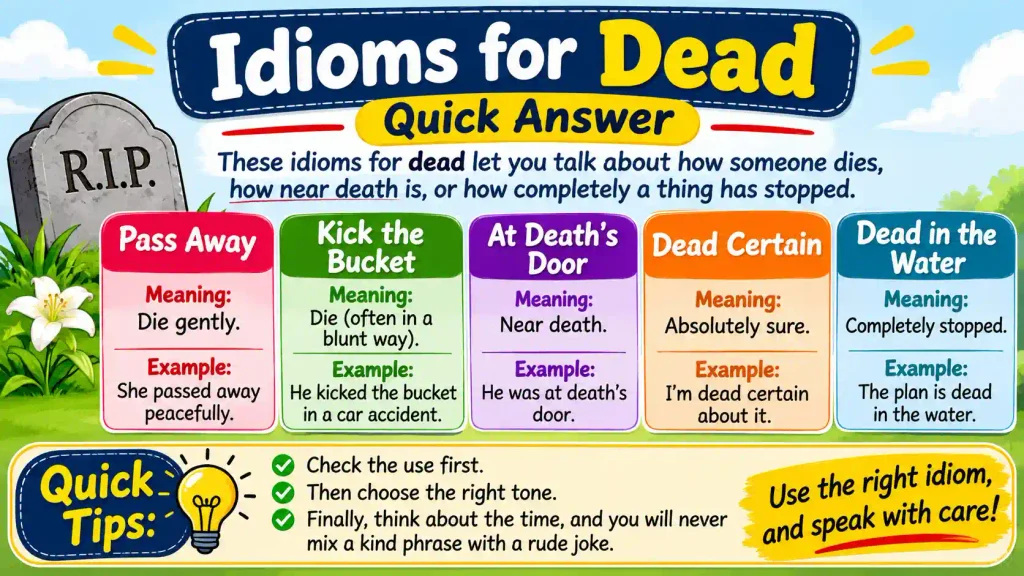
These idioms for dead let you talk about how someone dies, how near death is, or how completely a thing has stopped. Want gentle dying? Pick a phrase like pass away. Want blunt dying? Pick a phrase like kick the bucket, but only for fiction or jokes. Want near death? Pick a phrase like at death’s door. Want total? Pick dead certain. Want stopped? Pick dead in the water. Check the use first, then the tone, then the time, and you will never mix a kind phrase with a rude joke.
What Are Idioms for Dead?
These phrases use pictures of buckets, dust, farms, chips, ghosts, daisies, graves, ships, doors, nails, and water to stand for life and its end, not just death itself.
In older English, death was pictured as a journey, a game, a sleep, or a stop. That mix is why the word dead has five uses, and why one phrase can mean dying in one place and failure in another.
The Dead Map below sorts the 35 phrases by use and tone, so you can see at a glance whether a phrase is about actual dying, a total amount, a stopped thing, or a danger.
| Map spot | Meaning | Phrases |
| Die gently | Kind, respectful dying | Pass away, slip away, go to a better place, no longer with us |
| Die bluntly | Funny or blunt dying | Kick the bucket, bite the dust, buy the farm, cash in one’s chips |
| Die near | Close to death or danger | At death’s door, dance with death, breathe one’s last, meet one’s maker |
| Dead as total | Complete, exact, or sure | Dead as a doornail, dead tired, dead serious, dead certain |
| Dead as stopped | Stalled, failed, or no way forward | Dead in the water, dead on arrival, dead end, dead duck |
A kind, gentle phrase is not a rude joke, and a total or stopped phrase is not a death phrase.
Core Idioms for Dead by Dead Test
The 35 phrases below are sorted by one question, the Dead Test: what does the phrase do with the word dead? Each entry gives a plain meaning and one example you can reuse. Learn them in groups, and idioms for dead become far easier to remember.
Dying Gently
These seven phrases mean dying in a kind, respectful way, never as a joke.
- Pass away. Dying in a gentle, respectful way. Our old neighbour passed away in spring, after a long illness. Use it for real loss.
- Slip away. Dying quietly and peacefully, often in sleep. After a long illness, the old gardener slipped away at home. Use it for a quiet death, not a sudden one.
- Go to a better place. Dying and reaching a peaceful afterlife, often in a religious sense. The family said their mother had gone to a better place. Use it for comfort.
- No longer with us. A soft, indirect way to say someone has died. Our teacher is no longer with us, but her lessons live on.
- Rest in peace. A wish that a dead person may rest calmly, often written on a card or grave. We wrote rest in peace on the card for the family.
- Depart this life. Dying, in a formal, literary way. The old poet departed this life at the age of ninety. Use it in formal writing, not casual chat.
- Go to one’s rest. Dying and finding peace, often after a hard life. After years of hard work, the old farmer went to his rest.
Dying Bluntly or Jokingly
These seven phrases are funny or blunt, and each needs a warning about use.
- Kick the bucket. Dying, in a funny, informal way. In the film, the old clown kicked the bucket at the end. Use it for fiction or jokes, never about a real person who just died. The hanging-from-a-bucket origin is not confirmed.
- Bite the dust. Dying or failing, often suddenly or in a fight. In the story, the old knight bit the dust in battle. It also works for a thing that fails: The old radio bit the dust after twenty years.
- Buy the farm. Dying, often in a military or flying sense. In the novel, the young pilot bought the farm in a crash. Never use it about a real person who just died. The wartime-compensation origin is not confirmed.
- Cash in one’s chips. Dying, as if ending a game by cashing in chips. In the play, the old gambler cashed in his chips at the end. Use it for fiction.
- Give up the ghost. Dying or stopping, as if a soul leaves the body. The old radio gave up the ghost after twenty years. Use it for a thing or fiction.
- Pushing up daisies. Being dead and buried, with flowers growing above. In the poem, the old sailor was pushing up daisies in the churchyard. Never use it about a real person who just died.
- Six feet under. Being dead and buried, six feet deep. In the story, the old king was six feet under in the royal tomb. The plague-burial origin is not confirmed.
Near Death or in Danger
These seven phrases mean being close to death, facing death, or standing in great danger.
- At death’s door. Being very sick or close to dying. After the fever, the old baker was at death’s door, but he recovered. Use it for near death, not actual death.
- Dance with death. Being in great danger, as if dancing with death itself. Crossing the frozen river at night is dancing with death.
- Meet one’s maker. Dying and facing God or judgement, often in a religious sense. In the sermon, the priest said we will all meet our maker one day.
- Meet one’s end. Dying, often after a struggle or a bad choice. In the tale, the cruel king met his end in the forest.
- Breathe one’s last. Taking the last breath before dying. In the book, the old queen breathed her last in her sleep. Use it in literary writing.
- Sleep with the fishes. Being dead and buried at sea, often in a crime story. In the film, the gangster was left to sleep with the fishes. Use it for fiction only.
- Go to Davy Jones’s locker. Dying at sea, in a sailor’s tale. In the old song, the sailors feared going to Davy Jones’s locker.
Dead Means Total or Exact
These seven phrases mean totally, exactly, or completely. They are not about dying.
- Dead as a doornail. Completely dead or inactive, with no hope. After the storm, the old lamp was as dead as a doornail. Use it for a thing, not for a tired person. Its origin is disputed and not confirmed.
- Dead tired. Extremely exhausted. After the long hike, the students were dead tired.
- Dead serious. Completely serious, not joking. When the coach said he was dead serious, the team listened.
- Dead wrong. Completely mistaken. I thought the bus would come at noon, but I was dead wrong.
- Dead certain. Sure. The teacher was dead certain the answer was correct.
- Dead silence. A complete absence of sound. When the lights went out, dead silence filled the hall.
- Dead to the world. Sleeping very deeply and completely. After the long shift, the nurse was dead to the world. Never use it about a person who has died.
Dead Means Stopped or No Way Forward
These seven phrases mean stalled, failed, or blocked. They are not about dying.
- Dead in the water. Unable to move forward or succeed, like a ship that cannot sail. Without money, the school play was dead in the water. Use it for a plan, not a person.
- Dead on arrival. Already a failure before it begins. The new rule was dead on arrival, since no one followed it.
- Dead end. A situation or street with no way forward. After weeks of searching, the clues led to a dead end.
- Dead duck. A person or thing doomed to fail. After the scandal, the old plan was a dead duck. Use it for a plan, not as an insult.
- Dead letter. A law or rule that is no longer enforced. The old rule about hats in class is a dead letter now.
- Dead weight. A heavy, unhelpful burden. The broken printer was dead weight in the office. Use it for a thing, not as an insult.
- Dead stop. A sudden, complete halt. The train came to a dead stop on the bridge.
Near Synonym Comparison and Tone for Idioms for Dead
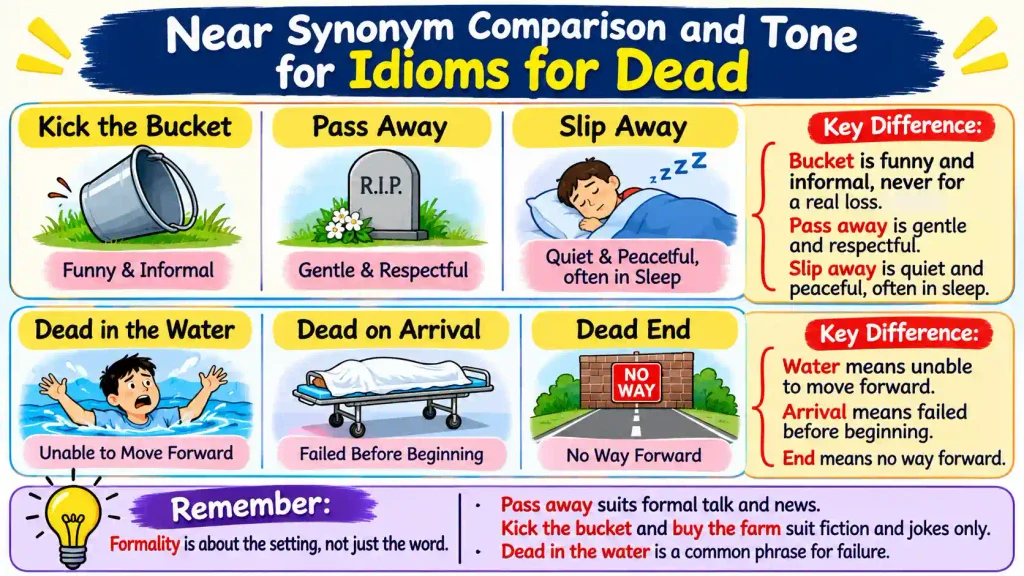
Near synonyms differ in use, tone, and grammar, even when they share the word dead. Pick by use first, then by tone.
| Pair or group | Difference in plain words |
| Kick the bucket vs pass away vs slip away | Bucket is funny and informal, never for a real loss. Pass away is gentle and respectful. Slip away is quiet and peaceful, often in sleep. |
| Dead in the water vs dead on arrival vs dead end | Water means unable to move forward. Arrival means failed before beginning. End means no way forward. |
Formality is about the setting, not just the word. Pass away suits formal talk and news. Kick the bucket and buy the farm suit fiction and jokes only. Dead in the water suits a plan.
Common Mistakes and Practice with Idioms for Dead
Learners make real errors with these phrases, and each one has a simple fix. Avoid these slips, and idioms for dead will sound natural.
Kick the bucket: about a real loss. Wrong: “Our neighbour kicked the bucket last week.” Right: “Our old neighbour passed away in spring.” Bucket is funny and never kind.
Bite the dust about a real person. Wrong: “The old teacher bit the dust last week.” Right: “The old radio bit the dust after twenty years.” Dust suits fiction or a failing thing, not a real death.
Fixed words. Say doornail, not door. Say dead to the world, not in the world. Say dead in the water, not on the water.
Now fill each gap with the best phrase.
- Our old neighbour __________ in spring, after a long illness.
- In the film, the old clown __________ at the end.
- After the fever, the old baker was at __________ door, but he recovered.
- After the long hike, the students were __________ tired.
- Without money, the school play was __________ in the water.
Answers: 1. passed away. 2. kicked the bucket. 3. death’s. 4. dead. 5. dead.
FAQs About Idioms for Dead
What is the difference between kick the bucket and pass away? Both can mean die, but the tone is opposite. Kick the bucket is funny and informal, so it is never safe to use about a real person who just died. Pass away is gentle and respectful, so it suits real loss, formal talk, and news.
Can I use these phrases in formal writing? Pass away, dead certain, dead in the water, and dead end are safe in work and school writing. Kick the bucket, buy the farm, and pushing up daisies are not, since they sound blunt or rude about real loss.
Conclusion: Idioms for Dead Made Simple
Pick a phrase by the Dead Test, then by tone, then by time. Start with what the phrase does: die, total, or stopped. Then check whether it is kind, neutral, or rude. Then check whether it speaks of before death, the moment of death, after death, or no death at all. With these three checks, idioms for death will help you describe loss, endings, and total failure with the right words. Keep gentle phrases for real people and blunt phrases for stories. Your English will then feel clear, warm, and true.
To read more: 35 Powerful Idioms for Emotions: Joy, Sadness, Anger & Fear

Digital Communication Writer
Focus: everyday texting slang, emoji meanings, casual chat abbreviations (NGL, LY, DND, etc.)
Bio angle: Grew up navigating group chats and social apps, explains slang the way it’s actually used, with real examples showing serious vs. joking vs. sarcastic tone.