
Idioms for spring describe fresh starts, sudden energy, and new growth in everyday English. This guide gives you 35 phrases with plain meanings, honest origins, natural examples, tone notes, and common mistakes. Use them at work, at school, with family, and in casual chat. Each phrase is marked clearly, so you know which are strict idioms and which are only plain or loosely linked phrases.
Spring brings new leaves, warm days, and longer light, and English uses that picture for a new job, a good mood, or a sudden idea. Some phrases contain the word spring, while others use flowers, rain, or leaves. Read a few at a time, and your English will start to bloom.
Quick Answer: What Are Idioms for Spring?
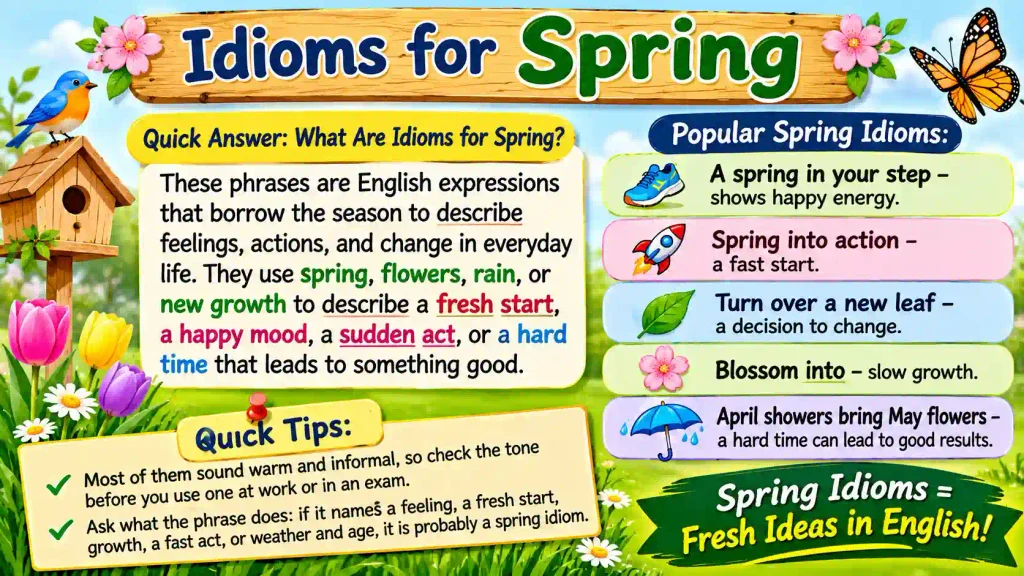
These phrases are English expressions that borrow the season to describe feelings, actions, and change in everyday life. They use spring, flowers, rain, or new growth to describe a fresh start, a happy mood, a sudden act, or a hard time that leads to something good. A spring in your step shows happy energy, and spring into action shows a fast start.
Turn over a new leaf shows a decision to change, and blossom into shows slow growth. April showers bring May flowers tells you that a hard time can lead to good results. Most of them sound warm and informal, so check the tone before you use one at work or in an exam. Ask what the phrase does: if it names a feeling, a fresh start, growth, a fast act, or weather and age, it is probably a spring idiom.
Idioms for Spring About Feeling Fresh and Happy
Seven phrases for a good mood.
1. A spring in your step. Walking with light, quick energy because you feel happy. Tone: warm and bright; use it after a win, not after bad news. Example: She got the job, and she has had a spring in her step all week.
2. Full of the joys of spring. Very happy and full of life. Tone: cheerful and informal; avoid it in a formal report. Example: After his holiday, Tom came back full of the joys of spring.
3. Spring fever. A restless, excited feeling when warm weather first arrives; the wish to go out and start things. Tone: light and casual. Example: The class has spring fever, and no one can sit still today.
4. Fresh as a daisy. Looking or feeling clean, rested, and full of energy. The daisy opens at dawn (its name comes from “day’s eye”), though the exact origin of the phrase is uncertain. Tone: warm and kind. Example: After a good night of sleep, she woke up fresh as a daisy.
5. Spring is in the air. A clear sign that spring, or a fresh time, has arrived. Tone: soft and hopeful. Example: The windows are open, the birds are out, and spring is in the air.
6. Spring has sprung. The season has clearly started. Tone: playful and informal; good for chat or a card. Example: The first flowers are out, so spring has sprung at last.
7. A breath of fresh air. A person, idea, or change that feels new and welcome after a dull time. Tone: warm and positive. Example: Her clear plan was a breath of fresh air for the tired team.
Idioms for Spring About Starting Again
Seven phrases for a clean start, some linked to spring only by theme.
8. Spring cleaning. A deep clean of a home, a room, or a whole system. The custom is often linked to opening windows after dark winter months. Tone: plain and useful. Example: On Saturday we did the spring cleaning for the whole flat.
9. Turn over a new leaf. To decide to change and act in a better way, like turning to a fresh page. Tone: hopeful and calm; use it for habits, not for a single day. Example: He decided to turn over a new leaf and study each night.
10. A fresh start. A plain phrase, not a strict idiom. It sits here with a clear label because people search for it with spring idioms. Tone: plain and hopeful. Example: The new school gave her a fresh start.
11. Start with a clean slate. To begin again with no blame from the past. A slate was a small school board, wiped clean for a new lesson. Tone: calm and fair. Example: Let us start with a clean slate and forget the last row.
12. A new lease of life. Fresh energy or a new chance after illness or a hard time. American English usually says “a new lease on life.” Tone: hopeful and a little formal. Example: The walk each morning gave him a new lease of life.
13. Out with the old, in with the new. Clearing out old things, habits, or plans to make room for new ones. Tone: bright and direct. Example: “Out with the old, in with the new,” she said, and cleared her desk.
14. Make a clean break. To end something fully so you can move on without going back. Tone: firm and clear. Example: He made a clean break from the old team and joined a new one.
Idioms for Spring: About Growing and Blooming
Seven phrases for slow growth.
15. In full bloom. A plain phrase, not a strict idiom. It describes a flower, a person, or an idea at its best. Tone: warm and bright. Example: Her garden is in full bloom, and so is her confidence.
16. Blossom into. To grow slowly into something good, like a flower that opens over days. Tone: warm and patient. Example: She blossomed into a calm and sure speaker.
17. Spring up. To appear fast and in many places, like new plants after rain. Tone: plain and quick. Example: New cafes spring up on every street once the weather turns warm.
18. Spring forth. To come out fast and clear, like water or new leaves. Tone: formal and poetic. Example: New ideas sprang forth in the meeting, one after another.
19. Come into bloom. To start to show your best side after a slow start. Tone: soft and hopeful. Example: After months of hard work, his small business finally came into bloom.
20. Budding romance. Love at its first stage, like a bud that has not yet opened. Tone: warm and gentle. Example: Their long walks point to a budding romance.
21. Take root. When an idea or a habit settles in and starts to grow strong. Tone: calm and steady. Example: Her new routine took root after three weeks of practice.
Idioms for Spring: About Acting Fast and Suddenly
Seven phrases for quick moves and surprises.
22. Spring into action. To start work fast, with full energy, often in a crisis. The usual explanation is a coiled spring that jumps when released. Tone: strong and urgent. Example: When the alarm rang, the team sprang into action.
23. Spring to life. A place or group suddenly becomes busy and lively after a quiet time. Tone: bright and lively. Example: The small town springs to life when the market opens.
24. Spring to mind. An idea that comes to you fast, with no effort. Use to, not in. Tone: plain and natural. Example: When I think of spring, my gran’s garden springs to mind.
25. Spring something on someone. To give a person sudden news or a sudden task with no warning. Tone: sharp and a little rude. Example: Do not spring extra work on the team on a Friday night.
26. Spring a surprise. To give someone a surprise, often a party or a gift, with no hint. Tone: warm and playful. Example: They planned to spring a surprise party for her birthday.
27. Spring to your feet. To stand up fast, often in shock, joy, or fear. Tone: quick and vivid. Example: The crowd sprang to their feet when the singer came on.
28. Spring to someone’s defence. To defend a person fast, often in a meeting. Write defence in British English and defense in American English. Tone: loyal and strong. Example: She sprang to her friend’s defence when the boss blamed him.
Idioms for Spring About Weather, Age, and Trouble
Seven phrases for rain, age, and hard times.
29. April showers bring May flowers. A proverb meaning a hard time now can lead to good growth later. An early form appears in Thomas Tusser’s 1557 book A Hundred Good Pointes of Husbandrie: “Sweet April showers / Do spring May flowers.” Tone: hopeful and wise. Example: Study is hard now, but April showers bring May flowers.
30. Come rain or shine. Doing something no matter what the weather, or no matter what happens. Tone: firm and loyal. Example: I will walk each morning, come rain or shine.
31. Rain on someone’s parade. To spoil a happy moment or a good plan with bad news. Tone: blunt and can sound unkind, so use it with care. Example: I hate to rain on your parade, but the hall is shut today.
32. Take a rain check. To put off a plan for now, hoping to do it later. It comes from the “rain check” ticket given for a rained-out baseball game. Tone: polite and casual. Example: Can we take a rain check on lunch? I have a lot of work.
33. No spring chicken. A person who is no longer young. A “spring chicken” was a young chicken, and the phrase has been used for centuries, but its exact origin is unclear. Tone: funny and informal; fine about yourself or a close friend, rude about a boss. Example: I am no spring chicken, but I still walk five miles a day.
34. Spring a leak. A sudden leak in a pipe, a boat, or a plan. Tone: plain and urgent. Example: The old roof sprang a leak in the night rain.
35. In like a lion, out like a lamb. A proverb about March weather that starts rough and ends calm. Tone: calm and wise. Example: March came in like a lion, but it went out like a lamb.
Plain Phrases That Are Not Idioms for Spring
Some phrases look like spring idioms but are not. Use the Spring Test: if a phrase names a feeling, a fresh start, growth, a fast act, or weather and age, it may be an idiom. If it only names a thing that happens in spring, it is a plain phrase.
Spring rain, spring blossom, and spring training are plain words with plain meanings. Others are real phrases outside the strict spring theme. Hope springs eternal is a real idiom from Alexander Pope’s An Essay on Man (1733-34), meaning hope never dies.
Near-Synonym Comparison: Which of the Idioms for Spring Fits?
Some phrases look alike, so pick the one that fits the moment.
| Phrase A | Phrase B | Difference |
| Spring to life | Spring into action | A place or group becomes lively; a person or team starts work fast |
| Spring to mind | Spring something on someone | An idea comes to you; news is pushed on a person with no warning |
| Fresh as a daisy | A breath of fresh air | A person feels rested; a change feels new and welcome |
| Spring fever | Full of the joys of spring | Restless and excited; cheerful and full of life |
Tone, Formality, and Common Mistakes With Idioms for Spring
Most of these phrases are warm and informal, so check the tone before you use one at work or in an exam. Spring fever, no spring chicken, and rain on someone’s parade suit chat only, while spring into action and April showers bring May flowers work in formal writing.
Common mistakes
- Spring fever means restless excitement. Say “I have spring fever, so I want to go out,” not “I am so tired with spring fever.”
- Use spring to mind, not “spring in mind.”
- Use sprang, not “springed.”
Practice time. Fix the sentence: “It springed to mind at once.” (Answer: It sprang to mind at once.)
FAQs About Idioms for Spring
What is the difference between “spring to life” and “spring into action”? Spring to life describes a place or group that becomes lively. Spring into action describes a person or team that starts work fast.
Is “spring fever” about being tired or excited? Mainly excited and restless: the wish to go out and start new things when warm weather arrives.
Is “no spring chicken” rude? Not about yourself or a close friend, in a warm, funny tone. It can sound rude about a boss or a stranger.
Can I use these phrases in formal writing or IELTS? Some fit well, such as spring into action, spring to mind, and April showers bring May flowers. Spring fever, no spring chicken, and rain on someone’s parade are too casual or too blunt.
Conclusion: Idioms for Spring
Idioms for spring give you warm words for fresh starts, new energy, and slow growth. Some describe a good mood, such as a spring in your step. Others describe a clean start, such as turning over a new leaf. A few describe a fast act, such as spring into action. Always check the tone before you use one at work, in an exam, or with a boss. Learn a few at a time, and use them in real talk. Start with one phrase today, and let it grow.
To read more: Idioms for Dancing: 35 Powerful Phrases for Joy & Skill