If someone just texted you “oh,” you’re probably staring at your phone trying to work out what it means. The meaning of “oh” in text isn’t fixed; it shifts with punctuation, emojis, and who sent it. This guide breaks the word down piece by piece so you won’t be left guessing every time it lands in your inbox.
One quick note before we start: this article is about “oh,” the word people say or text, not Ohio, and not the letter O. Just the small word that somehow carries a lot of feeling.
This guide draws on research into modern digital communication and how people actually use the word across texts, social media, and messaging apps, written in clear English so anyone can follow it quickly.
Quick Answer: Oh Meaning in Text
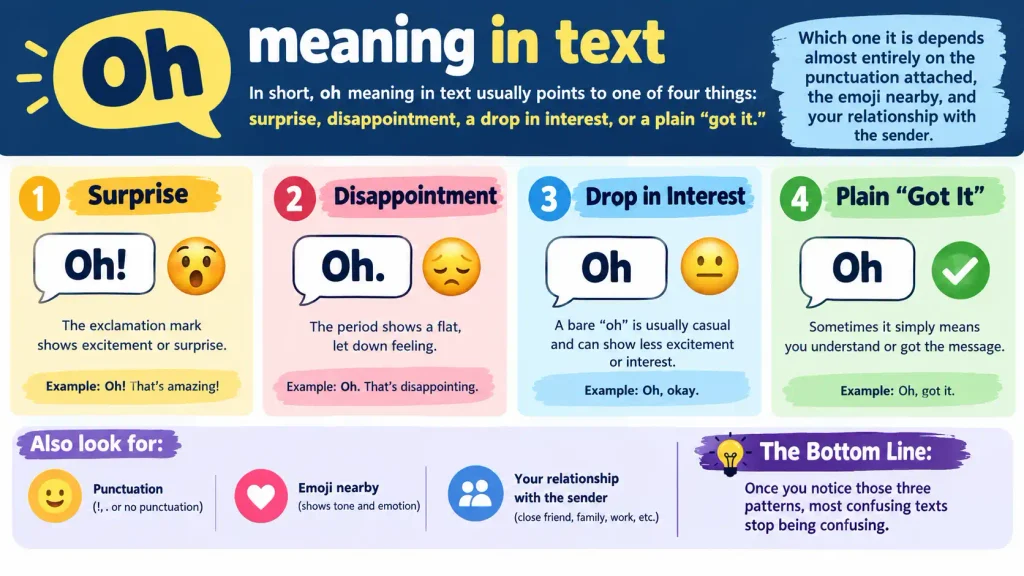
In short, oh meaning in text usually points to one of four things: surprise, disappointment, a drop in interest, or a plain “got it.” Which one it is depends almost entirely on the punctuation attached, the emoji nearby, and your relationship with the sender. A bare “oh” is casual. “Oh!” reads as excited. “Oh.” reads as flat or let down. Once you notice those three patterns, most confusing texts stop being confusing.
What Does “Oh” Mean, Generally?
“Oh” is an interjection, a short exclamation that carries emotion, similar to “wow” or “ouch.” People have used it this way in speech and in writing for centuries, long before texting existed.
The Core Meanings of “Oh”
At its most basic, the word can express a handful of different feelings:
- Surprise: “Oh! I didn’t see you there.”
- Realization: “Oh, now I get it.”
- Acknowledgment: “Oh, okay, thanks for telling me.”
- Mild discomfort: “Oh, that hurt.”
None of these is the “correct” meaning on its own. The word only makes full sense once you know the situation surrounding it.
“Oh” as a Backchannel: Why We Say It Without Meaning Much
Sometimes “oh” doesn’t carry much weight at all. Linguists call this kind of response a backchannel: a short reply that shows you’re listening without adding new information. Think of it as the verbal version of nodding along while someone talks.
“Oh” can also work as a discourse marker, a small word that helps a conversation move from one idea to the next. In many everyday chats, it’s simply a placeholder that proves you’re still paying attention, nothing more.
Oh Meaning in Text: A Full Breakdown
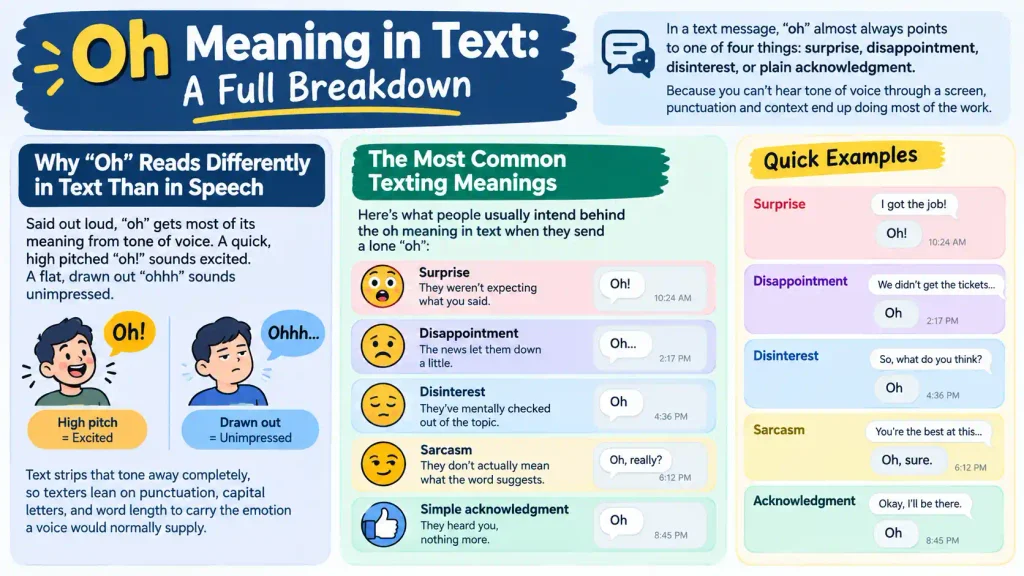
In a text message, “oh” almost always points to one of four things: surprise, disappointment, disinterest, or plain acknowledgment. Because you can’t hear tone of voice through a screen, punctuation and context end up doing most of the work.
Why “Oh” Reads Differently in Text Than in Speech
Said out loud, “oh” gets most of its meaning from tone of voice. A quick, high pitched “oh!” sounds excited. A flat, drawn out “ohhh” sounds unimpressed.
Text strips that tone away completely, so texters lean on punctuation, capital letters, and word length to carry the emotion a voice would normally supply.
The Most Common Texting Meanings
Here’s what people usually intend behind the oh meaning in text when they send a lone “oh”:
- Surprise, they weren’t expecting what you said.
- Disappointment, the news let them down a little
- Disinterest, they’ve mentally checked out of the topic.
- Sarcasm: they don’t actually mean what the word suggests.
- Simple acknowledgment: they heard you, nothing more.
The “Oh” Punctuation Decoder: How Punctuation Changes the Oh Meaning in Text
Punctuation changes the emotional weight of “oh” more than almost any other single word reply. This is the part most guides skip, and it’s usually the real reason a text feels confusing in the first place.
“oh” vs. “Oh!” vs. “Oh.”
A bare “oh” with no punctuation usually feels casual and low key, often just a backchannel. Add an exclamation point and “Oh!” signals real surprise or excitement. Add a period instead, and “Oh.” tends to feel flat and final. It often reads as disappointed, annoyed, or done with the topic, almost like the period is closing the door on the conversation. That single mark matters more than most people realize, and it’s frequently the difference between a friendly reply and a cold one.
Elongated Versions: “Ohh” and “Ohhh”
Stretching the word out usually adds intensity, in either direction. “Ohhh, that makes sense now” sounds like genuine realization. “Ohhh” on its own, with no follow up, often reads as unimpressed or mildly sarcastic. The more letters someone adds, the more emotion they’re typically trying to show, whether that’s good or bad.
“Oh…”, Trailing Off
Three dots suggest hesitation, or something left unsaid. This version often means the sender is thinking, unsure, or holding back a bigger reaction they haven’t typed out yet. It can also work as an invitation for you to ask a follow up question.
“Oh?” and “OH” in Capital Letters
A question mark turns “oh” into genuine curiosity or mild suspicion; the sender wants more information. All capital letters signal a big, sudden reaction, either excited or shocked, since caps naturally read as louder in text.
“Oh” Paired With Emojis
Emojis attached to “oh” often make the meaning clearer than punctuation alone. “Oh 😭” signals a dramatic, over the top reaction, often used jokingly. “Oh 💀” points to something shocking or hilarious. “Oh 🙃” often reads as awkward or sarcastic, especially when the news wasn’t great. If you’re unsure how to read a bare “oh,” check for an emoji nearby; it usually removes the guesswork.
| Style | Feeling | Example | Suggested Reply |
| oh | Casual, low-key | “oh nice” | Keep chatting normally |
| Oh! | Surprise, excitement | “Oh! I forgot about that!” | Match the energy |
| Oh. | Disappointed, flat | “Oh.” | Ask what’s wrong |
| Ohhh | Realization or mild sarcasm | “Ohhh okay” | Clarify your point |
| Oh… | Hesitant, unsure | “Oh… I guess” | Ask a follow-up question |
| Oh? | Curious, mildly suspicious | “Oh? Tell me more” | Explain further |
| OH | Big reaction | “OH NO WAY” | Enjoy the moment |
| Oh 🙃 | Awkward, sarcastic | “Oh 🙃 guess that’s that” | Address the awkwardness directly |
Oh Meaning in Text Based on Who Sends It
The same word can mean something very different depending on your relationship with the sender. Who sent the text matters just as much as the punctuation they used.
When a Crush or Love Interest Says “Oh”
A flat “oh” meaning in text from someone you’re interested in can feel like a punch to the gut. It often just means they were caught off guard and need a moment to process what you said. It doesn’t automatically mean they’ve lost interest, but it’s worth watching how the rest of the conversation unfolds from there.
This is by far the most common scenario people ask about in forum threads, and the takeaway stays the same: people tend to assume the worst when a flat “oh” usually just means someone needs a beat to react, not a final verdict.
When a Friend Says “Oh”
Between friends, “oh” meaning in text is often just casual filler, the texting equivalent of “hm” or “okay.” Friends text quickly and loosely, so a bare “oh” is less likely to carry deep meaning than the same word from a love interest.
When It’s a Work or Professional Text
In a work chat, “oh” meaning in text is almost always neutral acknowledgment. It usually just means “got it” or “noted,” with no emotional charge behind it. Coworkers rarely have the time, or the reason, to load a single word with hidden meaning.
When a Family Member Says “Oh”
Family texting habits vary a lot by person. A parent’s “oh” might signal genuine surprise at news. A sibling’s “oh” is probably just a quick acknowledgment. Pay attention to how that specific person usually texts, since family members often have their own shorthand you’ve picked up over the years.
How to Reply When Someone Texts You Just “Oh”
The best reply depends on how the message felt: flat and short, or open and curious.
If It Feels Disappointed or Distant
Gently check in. Something like “Hey, everything okay?” opens the door without pressuring them to explain right away.
If It Feels Neutral or Just Conversational
Keep the conversation moving. Ask a follow up question or add a bit more detail to what you were saying. A plain “oh” often just means they’re still listening and want more.
When to Just Ask Directly Instead of Guessing
If you’re genuinely unsure what someone meant, it’s almost always better to ask than to guess. A simple “What do you mean by that?” saves hours of overthinking a single word.
Is Saying “Oh” Rude?
No, “oh” is not inherently rude. It’s often just a backchannel word that shows you’re listening, not a deliberate insult.
That said, a bare “oh” with no follow up during a serious conversation can come across as dismissive, even when that isn’t the intent. It’s mostly automatic, low effort listening feedback, not a strong statement, so it’s rarely meant as a snub.
Frequently Asked Questions
What does it mean when someone says “oh”? The oh meaning in text usually signals surprise, acknowledgment, or mild disappointment, and the exact meaning depends on tone, punctuation, and the situation around it. On its own, the word doesn’t carry one fixed meaning; context decides which feeling it’s expressing.
What does it mean when a guy says “oh” through a text message? It often means he’s processing what you said, feels mildly surprised, or is a little let down by the news. It rarely means nothing, especially if the conversation carried real emotional weight beforehand.
What does it mean when a girl just says “oh”? The same factors apply as with anyone else; tone, punctuation, and context matter more than gender. Don’t assume a girl’s “oh” carries a different meaning just because of who sent it; read the situation the same way you would with anyone.
What’s the difference between “oh” and “oh”? The period adds a flat, final feeling to the word. “Oh.” often reads as more disappointed or closed off than a plain “oh,” which usually feels casual and easygoing by comparison.
Is “oh” a rude reply? Not inherently. It’s often just a quick acknowledgment that shows someone is listening. It can feel dismissive during a serious or emotional conversation, but that’s about the context, not the word itself being impolite.
How do you reply when someone texts you just “oh”? Check in gently if it feels distant, with something like “Everything okay?” Keep chatting normally if it feels neutral. If you’re still unsure, simply ask what they meant; asking directly beats guessing almost every time.
Why do native English speakers say “oh” so much in conversation? It works as a backchannel, a small verbal signal that shows you’re actively listening. It’s mostly automatic and doesn’t usually carry deep meaning on its own, similar to nodding along during a conversation.
Bottom Line
“Oh” is one of the smallest words in English, but it carries some of the biggest guesswork in texting. The word itself never changes; what changes is the punctuation around it, the emoji beside it, and the person sending it.
A plain “oh” is usually just casual listening. “Oh!” usually means real surprise. “Oh.” usually means something closer to disappointment. Once you read those three signals together, the meaning of ” oh ” in text stops being a mystery and starts being easy to spot the next time it lands on your screen.
To read more: CY Meaning in Text: 5 Costly Mistakes People Make (Stop Guessing)