Idioms for weird are fixed phrases that describe something or someone as strange, odd, or unusual. This page gives you more than 25. Each one comes with a plain meaning, a tone label, and an example you can reuse. You will also find the disputed history of “mad as a hatter,” a look at similar phrases that get mixed up, common mistakes, and quick answers to common questions.
Quick answer: Idioms for Weird
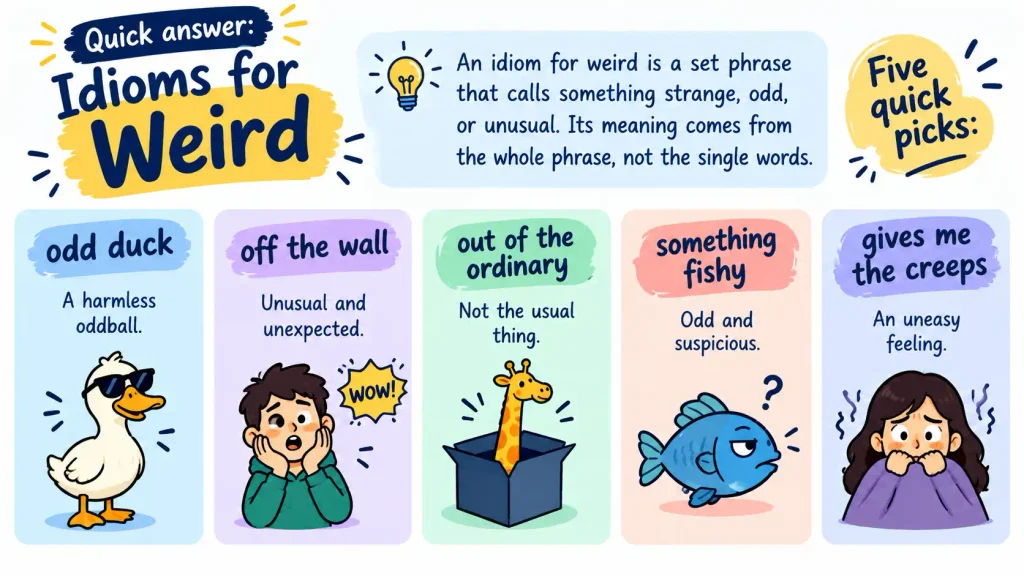
An idiom for weird is a set phrase that calls something strange, odd, or unusual. Its meaning comes from the whole phrase, not the single words. Five quick picks: odd duck (a harmless oddball), off the wall (unusual and unexpected), out of the ordinary (not the usual thing), something fishy (odd and suspicious), and gives me the creeps (an uneasy feeling).
How to Choose: The Tone Ladder
Choose by tone first: friendly phrases for people you like, neutral ones for most settings, uneasy ones for creepy moments, and skip the rude ones at work or with strangers.
Two idioms can both describe a strange person, yet one sounds warm, and the other sounds cruel. The ladder below sorts the phrases in this guide by how they land.
| Tier | How it feels | Examples | Safe at work? |
| Playful or admiring | Affectionate | odd duck, quite a character, marches to the beat of his own drum | Yes, with people you know |
| Neutral or mild | Plain and factual | out of the ordinary, out of whack, way out there | Yes |
| Uneasy or suspicious | Creepy or worried | something fishy, gives me the creeps, weirded out | Yes, but it sounds negative |
| Insulting or dated | Mocking | off your rocker, a screw loose, lose your marbles, mad as a hatter | No |
These labels reflect everyday use. Tone can shift by region and by who is listening.
Idioms for Weird People
The best idiom for a weird person is “odd duck,” a gentle phrase for someone different in a harmless way.
Some of these phrases are kind. Others tease, and a few sting. The two tables below split them that way.
Friendly or Playful
| Idiom | Meaning | Tone | Example |
| odd duck | a person who is different in a harmless way | Gentle | “Our new landlord is an odd duck, but he fixes every leak within a day.” |
| march to the beat of your own drum | live by your own rules instead of the crowd’s | Admiring | “Our art teacher wears a cape to class. He marches to the beat of his own drum.” |
| crazy like a fox | looks silly but is actually clever | Admiring | “Her plan looked wild, yet it saved us hours. She’s crazy like a fox.” |
| quite a character | an unusual person who is fun to be around | Warm | “Grandpa is quite a character. He tells jokes in three accents.” |
Mocking or Dated (Use With Care)
Several phrases in this list make fun of mental illness, such as “off your rocker” and “lose your marbles.” Aiming them at a real person can hurt. They fit better in stories or in jokes about yourself.
| Idiom | Meaning | Tone | Example |
| not all there | seems confused or slightly out of touch | Mild put-down | “After two late nights, I was not all there in class.” |
| off your rocker | acting in a wild or foolish way | Teasing | “You want to swim in December? You’re off your rocker!” |
| a screw loose | acts in odd or senseless ways | Blunt | “He talks to his printer. I think he has a screw loose.” |
| lose your marbles | lose good sense or self control | Casual | “If I hear that song once more, I’ll lose my marbles.” |
| a few sandwiches short of a picnic | not thinking clearly; a bit odd | Rude | “He forgot his own birthday. He’s a few sandwiches short of a picnic.” |
| not playing with a full deck | not thinking clearly | Rude | “She tried to pay with a pizza coupon. She’s not playing with a full deck.” |
| queer fish | an odd person (older, mostly British) | Dated | “The old clerk was a queer fish who never took a holiday.” |
| mad as a hatter | acting wildly, as if crazy | Mocking | “After a week with no sleep, I felt mad as a hatter.” |
“Queer fish” is an older phrase. The word “queer” has other uses today, so the idiom can confuse or surprise listeners. “Odd duck” is a safer pick.
Idioms for a Weird Situation or Event
For a weird situation, “out of the ordinary” is the safest choice, and “stranger than fiction” works when a story is hard to believe.
These phrases suit events, days, places, and plot twists.
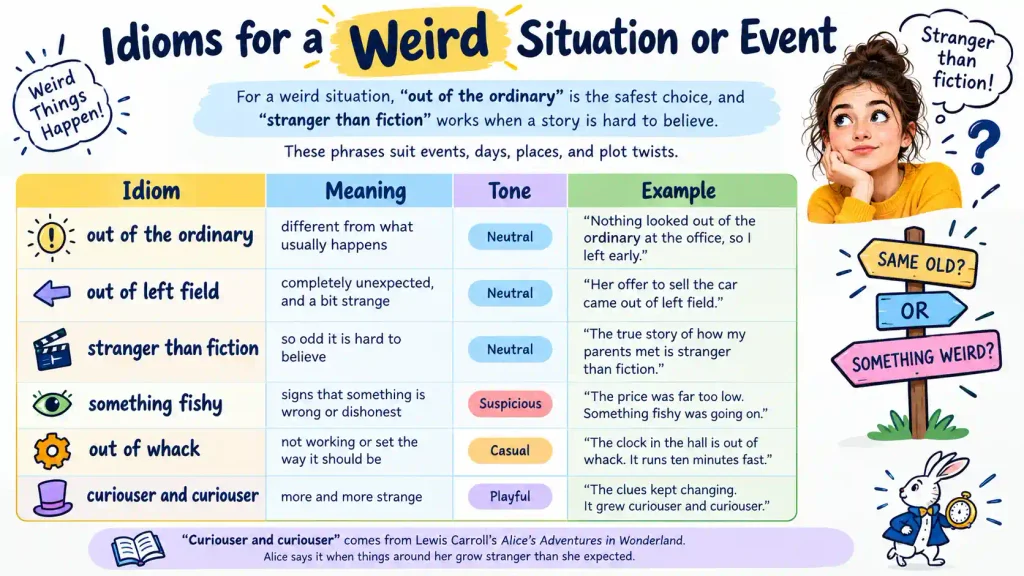
| Idiom | Meaning | Tone | Example |
| out of the ordinary | different from what usually happens | Neutral | “Nothing looked out of the ordinary at the office, so I left early.” |
| out of left field | completely unexpected, and a bit strange | Neutral | “Her offer to sell the car came out of left field.” |
| stranger than fiction | so odd it is hard to believe | Neutral | “The true story of how my parents met is stranger than fiction.” |
| something fishy | signs that something is wrong or dishonest | Suspicious | “The price was far too low. Something fishy was going on.” |
| out of whack | not working or set the way it should be | Casual | “The clock in the hall is out of whack. It runs ten minutes fast.” |
| curiouser and curiouser | more and more strange | Playful | “The clues kept changing. It grew curiouser and curiouser.” |
“Curiouser and curiouser” comes from Lewis Carroll’s Alice’s Adventures in Wonderland. Alice says it when things around her grow stranger than she expected.
Idioms for a Weird Idea or Style
“Off the wall” is the go-to idiom for an idea or style that is unusual in a fun, unexpected way.
Use these when a plan, joke, outfit, or design feels offbeat.
| Idiom | Meaning | Tone | Example |
| off the wall | unusual and unexpected, often in a fun way | Playful | “His off the wall idea for a lemonade robot won the science fair.” |
| way out there | very unusual, far from normal thinking | Neutral | “Her theory about talking cats is way out there.” |
| stick out like a sore thumb | look strange or out of place next to others | Blunt | “The bright orange van stuck out like a sore thumb in the parking lot.” |
Idioms for Feeling Weird or Uneasy
When something strange makes you nervous, say it gives you the creeps or that you feel weirded out.
These phrases describe your reaction, not the thing itself. They fit haunted houses, odd strangers, and moments when the air just feels wrong.
| Idiom | Meaning | Tone | Example |
| give me the creeps | make me feel uneasy or scared | Uneasy | “That empty hallway gives me the creeps.” |
| weirded out | uncomfortable because something is strange | Casual | “I got weirded out when the stranger knew my name.” |
| make my skin crawl | cause strong unease or disgust | Strong | “The way he stared made my skin crawl.” |
| a chill ran down my spine | a sudden wave of fear | Dramatic | “A chill ran down my spine when the lights went out.” |
| make my hair stand on end | terrify or shock | Dramatic | “The howl outside made my hair stand on end.” |
| something feels off | a sense that something is not right | Neutral | “The quiet house felt off, so I called my sister.” |
Where “Mad as a Hatter” Comes From
Nobody knows for sure where “mad as a hatter” comes from, though it is often traced back to hat makers poisoned by mercury.
The Mercury Theory
In the 1700s, hat makers used mercury salts to make felt for fancy hats. Workers handled the soaked fabric every day. Over time, the poison could harm their nerves and cause twitches and shaking. That is the story. It shows up on many websites, but it isn’t confirmed.
What the Record Shows
The earliest known printing of the phrase is from 1829, in Blackwood’s Edinburgh Magazine. Thackeray used it in his 1849 novel Pendennis. Lewis Carroll’s Alice’s Adventures in Wonderland came out in 1865, decades after that first printing.
So Carroll did not invent the phrase. His books never use the name “Mad Hatter” either. The character is just the Hatter. The Cheshire Cat tells Alice that the Hatter and the March Hare are both mad.
Older sayings were already around. “Mad as a March hare” was first recorded in the early 1500s. Snopes notes that “mad as a buck” and “mad as a wet hen” are older too. That leaves room for “hatter” being a twist on an older pattern. The Oxford English Dictionary, as reported by Interesting Literature, calls the origin uncertain and treats the mercury link as a maybe.
Treat mercury as a fair guess, not a fact.
Idioms People Think Mean “Weird” (But Don’t)
Some popular idioms sound like they mean weird, but each one refers to something else.
Lists online often mix these in. Keep them out of your weird vocabulary.
| Idiom | What it really refers to |
| fish out of water | someone uncomfortable in an unfamiliar place |
| out of line | crossing a rule or a line of good behavior |
| out of this world | amazing, usually as praise |
| like talking to a brick wall | speaking to someone who will not listen |
| off the rails | a plan or person going wrong or out of control |
| bent out of shape | upset or annoyed |
Look Alike Idioms Compared
The easiest way to tell look alike idioms apart is to ask what each one covers: an idea, a surprise, a person, or a state of mind.
Off the Wall vs. Out of Left Field
“Off the wall” fits an unusual idea, often a creative one. “Out of left field” fits something that arrives without warning. One thing can be both, but they answer different questions. The shoe-shaped cake was off the wall. The fire alarm at noon came out of left field.
Odd Duck vs. Fish Out of Water
An odd duck is different by nature. A fish out of water is in the wrong place and feels awkward. Jo is an odd duck who hums during exams. On her first day abroad, she felt like a fish out of water.
Mad as a Hatter vs. Crazy Like a Fox
“Mad as a hatter” paints someone as wildly senseless. “Crazy like a fox” points the other way: the person seems foolish but is sharp underneath. The first is a jab. The second is closer to a compliment.
Common Mistakes
Learners most often pick an idiom that sounds right but has a different meaning.
- Mixing up “fish out of water.” It refers to discomfort in a new place, not to oddness.
- Using “out of this world” for something bad. It usually praises.
- Writing “Mad Hatter” for the idiom. The idiom is “mad as a hatter.” The storybook name is a later, popular label.
- Dropping or adding hyphens. Write “an off the wall idea” before a noun, but “the idea was off the wall” after a verb.
- Saying “I am weird” when you mean “I feel weirded out.” The second one names your reaction.
- Stacking idioms. “Off the wall and out of left field and way out there” is too much. One is enough.
Frequently Asked Questions
The four questions below come up most often, and each answer starts with a one sentence reply.
What is a good idiom for a strange person?
“Odd duck” is a good, gentle idiom for a strange person. “Quite a character” adds warmth, and “marches to the beat of his own drum” adds admiration. Skip “off your rocker” or “a screw loose” for anyone who might hear you.
What does “mad as a hatter” mean, and where does it come from?
“Mad as a hatter” refers to someone who acts wildly or seems crazy. Nobody has confirmed its origin. The earliest known printing is from 1829, and the mercury poisoning story is only a guess.
What is the difference between weird, strange, and odd?
Weird often carries an eerie or creepy feel, strange means unfamiliar or hard to explain, and odd means different from what you expect. The three words overlap a lot in daily speech, so context matters more than the label.
What does “off the wall” mean?
“Off the wall” points to an idea, joke, or style that is unusual and unexpected, often in a fun way. A robot that makes lemonade is an off the wall invention. The phrase is usually friendly, not insulting.
Final Thoughts: Picking the Right Idiom for Weird
Pick the idiom for weird that fits both the thing you are describing and the person who will hear it.
For a friend or coworker, “odd duck” and “quite a character” are safe. A surprise calls for “out of the ordinary” or “out of left field.” When something feels creepy, say it gives you the creeps. Keep phrases like “off your rocker” for stories or jokes about yourself, since they poke fun at mental illness.
Look alikes can trip you up too. “Fish out of water” means feeling out of place, not being strange. Treat the mercury tale behind “mad as a hatter” as a good guess, not a proven fact.
Try two or three phrases from this list this week. A text, a school essay, or a chat over dinner is enough practice. Soon they will feel natural.
To read more: 22 Essential Idioms About Ears: Easy Meanings & Examples

Digital Communication Writer
Focus: everyday texting slang, emoji meanings, casual chat abbreviations (NGL, LY, DND, etc.)
Bio angle: Grew up navigating group chats and social apps, explains slang the way it’s actually used, with real examples showing serious vs. joking vs. sarcastic tone.