An ear idiom is a saying that uses the word “ear” to talk about listening, ignoring, gossip, or feelings, not the body part itself. English speakers reach for these phrases all the time, in casual chats, at work, and even in books and song lyrics. Once you know them, you’ll start to notice how often they show up in everyday conversation, and you’ll understand what people really mean instead of picturing an actual ear.
This guide walks through the most common ear idioms, grouped by theme for easy learning. You’ll find a clear meaning for each phrase, real example sentences you can reuse, and honest notes on where each one came from. You’ll also learn which phrases sound formal or old-fashioned, which carry a positive or negative tone, and which pairs get mixed up most often.
Quick Answer: (Idioms About Ears)
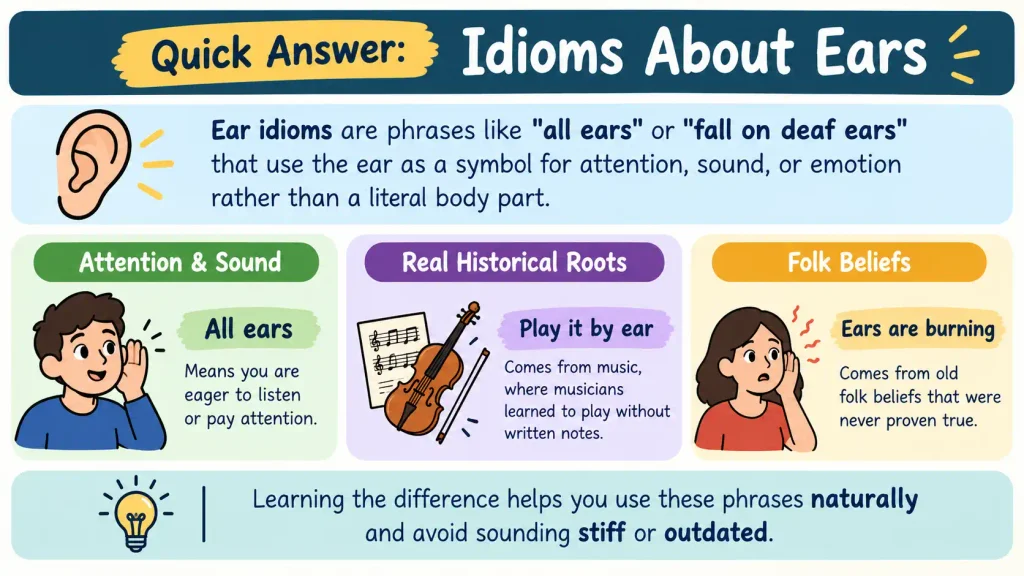
Ear idioms are phrases like “all ears” or “fall on deaf ears” that use the ear as a symbol for attention, sound, or emotion rather than a literal body part. A few, like “play it by ear,” have real historical roots in music. Others, like “ears are burning,” come from old folk beliefs that were never proven true. Learning the difference helps you use these phrases naturally and avoid sounding stiff or outdated.
Idioms About Ears for Listening and Attention
These phrases describe someone who is paying close attention or offering to listen.
All Ears
Someone who is all ears is giving you their full attention.
“Tell me what happened at the doctor’s office; I’m all ears.”
My daughter is all ears whenever her grandmother starts a story.
Lend an Ear
This means listening patiently, often to offer comfort.
He lent an ear to his coworker after a rough shift.
If you ever need to vent, I’ll lend an ear.
Keep an Ear to the Ground
Use this idiom for staying alert to news before it spreads.
She kept an ear to the ground and heard about the layoffs early.
Good managers keep an ear to the ground for team frustrations.
Prick Up Your Ears
This captures a sudden burst of attention when something interesting is said.
The cat pricked up its ears when the can opener started.
I pricked up my ears when I heard my name in the hallway.
Give Ear To
Giving ear to someone means listening carefully and respectfully, though it sounds old-fashioned today.
The judge gave ear to both sides before deciding.
Give ear to your elders, the saying goes.
Idioms About Ears for Ignoring and Dismissal
Not every ear idiom is about listening. Some describe the opposite: tuning something out on purpose or by accident.
Turn a Deaf Ear
A person turns a deaf ear when they choose not to listen.
The landlord turned a deaf ear to complaints about the heater.
She turned a deaf ear to the rumors about her promotion.
Fall on Deaf Ears
This happens to a message, not a person: it gets ignored despite being said clearly.
His warnings fell on deaf ears at the safety meeting.
The petition fell on deaf ears in city hall.
Don’t confuse these two. “Turn a deaf ear” is something a person does on purpose, while “fall on deaf ears” is something that happens to advice or a request, often because several people ignore it. Use the first to describe an action and the second to describe an outcome.
In One Ear and Out the Other
Something goes in one ear and out the other when it’s heard but forgotten right away.
My advice went in one ear and out the other.
Homework reminders go in one ear and out the other with my little brother.
Close Your Ears To
This means refusing to take in certain information on purpose.
She closed her ears to the negative reviews and kept painting.
He closed his ears to gossip about his teammates.
Idioms About Ears for Music, Sound, and Skill
Since ears pick up sound, several idioms connect to music, talent, and how pleasant something sounds.
Play It by Ear
This means deciding what to do as things unfold instead of planning.
We haven’t booked anything; we’ll just play it by ear.
Let’s play it by ear and see how the weather looks.
Have an Ear for Music
Someone with this trait can naturally pick up and reproduce musical sounds.
My cousin has an ear for music and can hum any tune after one listen.
You don’t need lessons if you have an ear for music.
Don’t mix these two up. “Have an ear for music” is about talent, while “play it by ear” is about improvising without a plan. They share a word, but one concerns ability and the other flexibility.
Tin Ear
A person with a tin ear struggles to judge music, tone, or the mood in a room.
He has a tin ear for office politics and always says the wrong thing.
My tin ear made karaoke night painful for everyone.
Music to My Ears
This describes news that brings real relief or joy.
“The tests came back clear.” “That’s music to my ears.”
Hearing my rent stayed the same was music to my ears.
Idioms About Ears for Gossip, Secrets, and Information
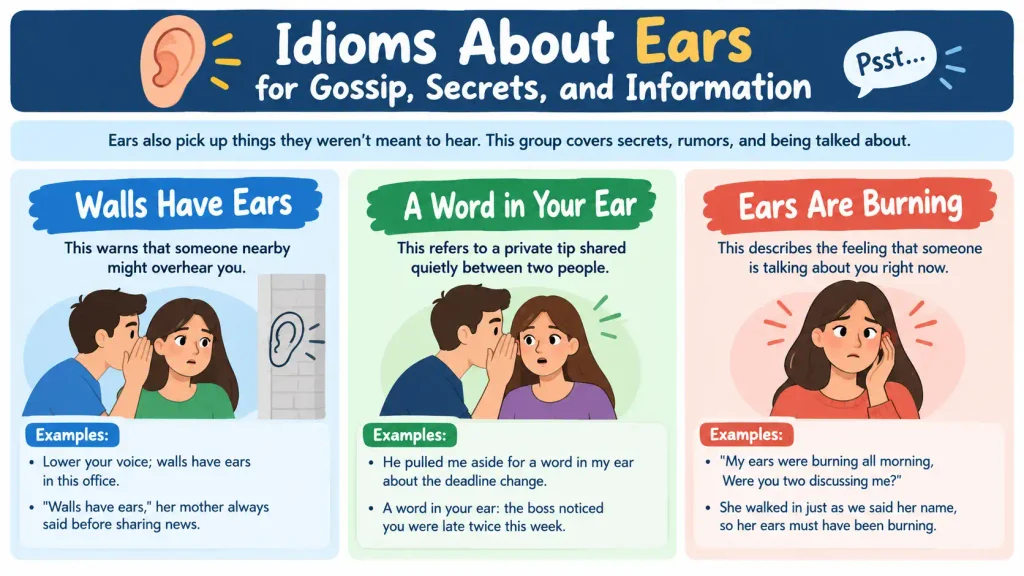
Ears also pick up things they weren’t meant to hear. This group covers secrets, rumors, and being talked about.
Walls Have Ears
This warns that someone nearby might overhear you.
Lower your voice; walls have ears in this office.
“Walls have ears,” her mother always said before sharing news.
A Word in Your Ear
This refers to a private tip shared quietly between two people.
He pulled me aside for a word in my ear about the deadline change.
A word in your ear: the boss noticed you were late twice this week.
Ears Are Burning
This describes the feeling that someone is talking about you right now.
“My ears were burning all morning. Were you two discussing me?”
She walked in just as we said her name, so her ears must have been burning.
Little Pitchers Have Big Ears
This reminds adults that children often hear more than expected.
Watch what you say; little pitchers have big ears.
She found out about the surprise because little pitchers have big ears.
Don’t confuse the direction of listening here. “Walls have ears” warns that someone else might overhear you, while “keep an ear to the ground” describes you gathering information on purpose. One is a caution, and the other is a strategy, so they aren’t interchangeable.
Idioms About Ears for Trouble, Experience, and Overwhelm
This last group covers inexperience, trouble, and being buried in work.
Wet Behind the Ears
Someone described this way is new to a role and still learning the basics.
The new hire is wet behind the ears but eager to learn.
Don’t judge him too fast; he’s wet behind the ears.
Up to Your Ears
This means buried in work, stress, or responsibility.
I can’t make it out tonight; I’m up to my ears in grading.
The support team was up to its ears in requests after the outage.
Bend Someone’s Ear
Bending someone’s ear means talking at them for a long stretch, often about something dull.
My neighbor bends my ear about his garden every weekend.
Sorry for bending your ear; I know I’ve gone on too long.
Chew Someone’s Ear Off
This goes a step further: talking so much that the listener grows tired.
She chewed my ear off about her diet plan for an hour.
Watch out; he’ll chew your ear off about football if you let him start.
Don’t confuse being comforted with being talked at. “Lend an ear” means offering patient listening, while “bend someone’s ear” or “chew someone’s ear off” describes one-sided talk the listener often didn’t want. Mixing them up can flip the meaning of a sentence.
Out on Your Ear
This means being forced out of a job or place, often suddenly.
Keep missing deadlines, and you’ll be out on your ear.
The rowdy guests were tossed out on their ears.
Where Do Idioms About Ears Come From? A Quick Origin Roundup
Some of these phrases trace back to real history, while others come from folk belief that was never confirmed.
| Idiom | Origin story | Documented or folk belief? |
| Play It by Ear | Began in music, meaning to perform without written notes; the everyday use grew later | Reasonably well documented |
| Ears Are Burning | Tied to an old Roman belief that a burning or ringing ear meant someone was gossiping; the left ear signaled criticism and the right ear praise | Folk belief, not confirmed |
| Wet Behind the Ears | Comes from newborn farm animals, such as calves and foals, that stay damp behind the ears right after birth | Widely repeated, likely folk origin |
| Little Pitchers Have Big Ears | “Pitcher” once meant jug, and a jug’s handle was called an “ear” | Traced through wordplay, reasonably solid |
Treat the folk stories as fun backstory rather than fact. The burning-ear tale is repeated across idiom sources, but it comes from folklore, not a documented historical record.
Tone and Register of Idioms About Ears
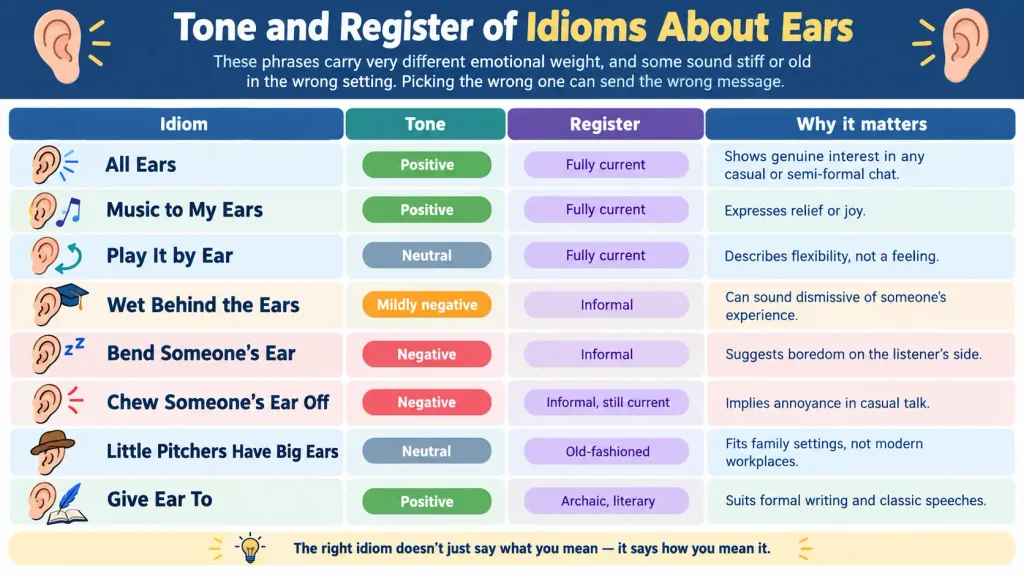
These phrases carry very different emotional weight, and some sound stiff or old in the wrong setting. Picking the wrong one can send the wrong message.
| Idiom | Tone | Register | Why it matters |
| All Ears | Positive | Fully current | Shows genuine interest in any casual or semi-formal chat |
| Music to My Ears | Positive | Fully current | Expresses relief or joy |
| Play It by Ear | Neutral | Fully current | Describes flexibility, not a feeling |
| Wet Behind the Ears | Mildly negative | Informal | Can sound dismissive of someone’s experience |
| Bend Someone’s Ear | Negative | Informal | Suggests boredom on the listener’s side |
| Chew Someone’s Ear Off | Negative | Informal, still current | Implies annoyance in casual talk |
| Little Pitchers Have Big Ears | Neutral | Old-fashioned | Fits family settings, not modern workplaces |
| Give Ear To | Positive | Archaic, literary | Suits formal writing and classic speeches |
A quick rule: if you want to encourage someone, skip “wet behind the ears.” Even though it’s technically accurate, it can land as a mild insult instead of gentle feedback. Likewise, if you’re writing something formal, like a cover letter or business email, skip ear idioms altogether, since they read as too casual.
Common Mistakes with Idioms About Ears
Small mix ups can change the meaning or make a sentence sound unnatural.
- Using “turn a deaf ear” when the sentence describes advice being ignored rather than a person choosing to ignore it; “fall on deaf ears” fits better there.
- Saying “have someone’s ear,” which means influencing a powerful person, when you meant simple sympathy; “lend an ear” fits that instead.
- Translating a similar idiom from another language word for word, which can create a phrase that sounds odd or means nothing in English.
- Using dated phrases like “give ear to” in professional writing, where they can seem strange or overly dramatic.
- Linking “play it by ear” to musical talent, when its everyday meaning has nothing to do with skill.
FAQs: Idioms About Ears Explained
What does it mean when your ears are burning?
It means you sense that someone is talking about you. The phrase is often traced to an old Roman belief, but that origin is folklore, not proven history.
Where does “play it by ear” come from?
It comes from music, where playing by ear means performing without written notes. People later borrowed it for everyday plans.
What’s the difference between “fall on deaf ears” and “turn a deaf ear”?
“Fall on deaf ears” describes a request that gets ignored; “turn a deaf ear” describes a person choosing not to listen.
Final Thoughts on Idioms About Ears
These phrases cover a wide range of moods, from warm and supportive to blunt and dismissive. Knowing where they come from and how they sound helps you use them with confidence. Start small: pick two or three from this list and try them in your next conversation.
To read more: Idioms for Weird: 25+ Phrases With Meanings & Examples