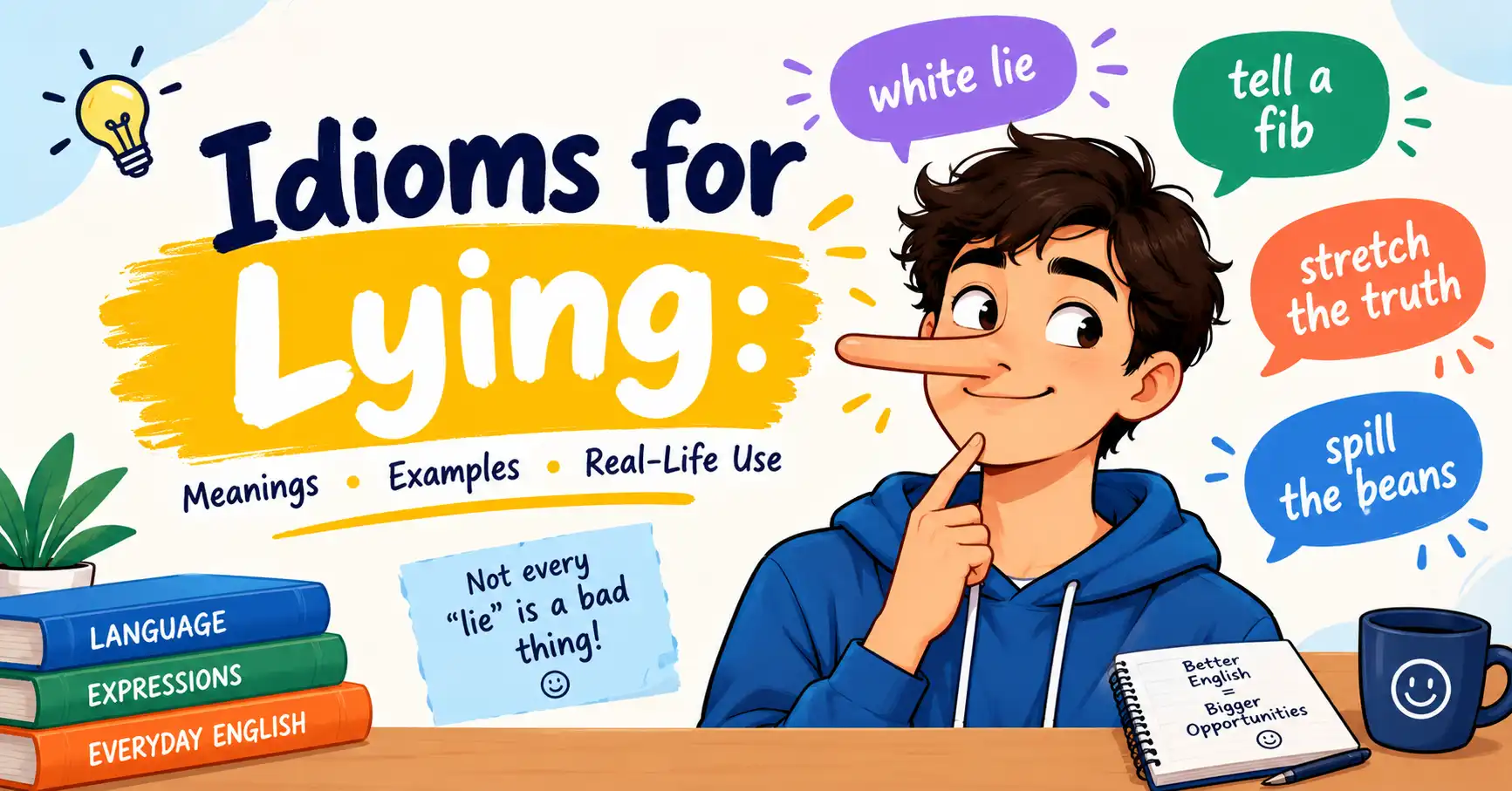
Idioms for lying are fixed phrases that describe dishonesty without just saying “lie.” Some name a huge, shameless falsehood. Others describe a small fib, a joke, or a sly trick. Each one carries its own tone, from playful to accusing.
This guide covers 19 phrases, with meanings, origin notes, sample sentences, and tone labels. Each origin note is marked as sourced, disputed, or no known origin. A comparison table, a mistakes section, and an FAQ follow.
Quick Reference: How Serious Is Each of These Idioms for Lying?
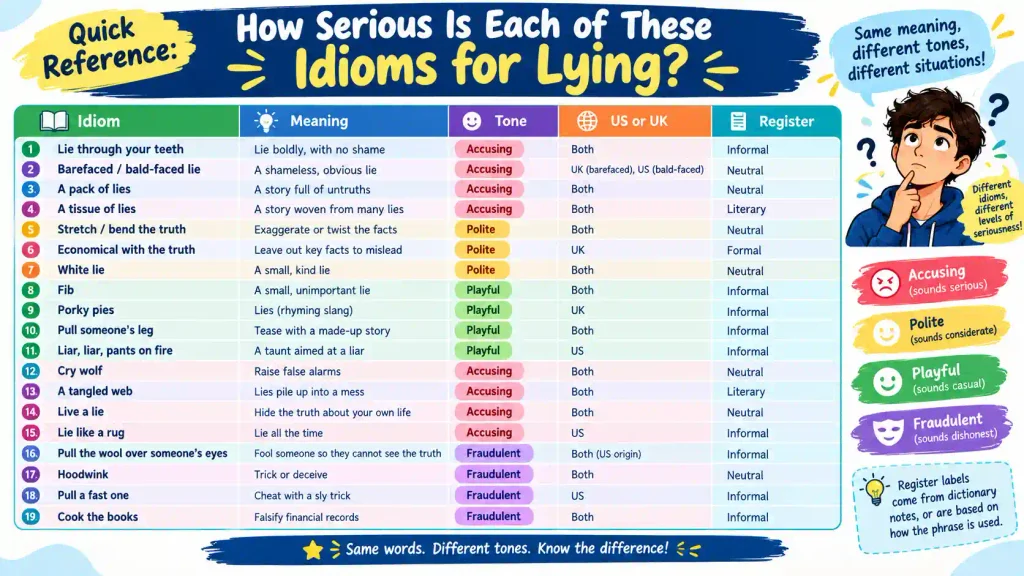
Most phrases in this list sound playful, polite, accusatory, or fraudulent, and the tone decides whether you can say them out loud. Register labels follow dictionary notes where one exists. Where a dictionary gave no label, the entry says “Neutral” or “Both” based on how the phrase is used.
| Idiom | Meaning | Tone | US or UK | Register |
| Lie through your teeth | Lie boldly, with no shame | Accusing | Both | Informal |
| Barefaced / bald-faced lie | A shameless, obvious lie | Accusing | UK (barefaced), US (bald-faced) | Neutral |
| A pack of lies | A story full of untruths | Accusing | Both | Neutral |
| A tissue of lies | A story woven from many lies | Accusing | Both | Literary |
| Stretch / bend the truth | Exaggerate or twist the facts | Polite | Both | Neutral |
| Economical with the truth | Leave out key facts to mislead | Polite | UK | Formal |
| White lie | A small, kind lie | Polite | Both | Neutral |
| Fib | A small, unimportant lie | Playful | Both | Informal |
| Porky pies | Lies (rhyming slang) | Playful | UK | Informal |
| Pull someone’s leg | Tease with a made-up story | Playful | Both | Informal |
| Liar, liar, pants on fire | A taunt aimed at a liar | Playful | US | Informal |
| Cry wolf | Raise false alarms | Accusing | Both | Neutral |
| A tangled web | Lies pile up into a mess | Accusing | Both | Literary |
| Live a lie | Hide the truth about your own life | Accusing | Both | Neutral |
| Lie like a rug | Lie all the time | Accusing | US | Informal |
| Pull the wool over someone’s eyes | Fool someone so they cannot see the truth | Fraudulent | Both (US origin) | Informal |
| Hoodwink | Trick or deceive | Fraudulent | Both | Neutral |
| Pull a fast one | Cheat with a sly trick | Fraudulent | US | Informal |
| Cook the books | Falsify financial records | Fraudulent | Both | Informal |
Idioms for Lying by Type: Blatant, Playful, Habitual and Deceptive
The 19 phrases fall into five groups: blatant lies, bent truths, playful lies, habitual lying, and tricks. Each entry has a meaning, a sample sentence, and an origin line.
Blatant lies
Lie through your teeth.
Meaning: to lie boldly, with no shame at all.
Example: “The salesman lied through his teeth about the car’s age.”
Origin (disputed): Etymonline dates the strong form “lie through your teeth” to the 1940s. The older “lie in your teeth” is often placed in the 1300s, but no dictionary checked confirms that date. Treat it as unverified.
Barefaced lie / bald-faced lie
Meaning: a lie told openly, with no shame.
Example: “That was a barefaced lie, and everyone in the room knew it.”
Origin (sourced): “Barefaced” first meant beardless or unmasked, then “shameless.” “Bald faced” first described white faced animals and later borrowed the lie sense. Merriam Webster calls “bald faced lie” the most common form in edited writing today.
A pack of lies
Meaning: a whole story made of untruths.
Example: “His excuse was a pack of lies from start to finish.”
Origin (no known origin): Oxford Learner’s Dictionaries lists it as a common pairing, but no source found explains how it began or when it first appeared.
A tissue of lies
Meaning: a story built from many lies that only looks solid.
Example: “The report turned out to be a tissue of lies.”
Origin (no known origin): No source checked explains it. “Tissue” can mean woven cloth, so the picture is likely of lies stitched together. That reading is a guess, not a confirmed origin.
Bent truths
Stretch the truth / bend the truth.
Meaning: to exaggerate, or to twist facts without a flat-out lie.
Example: “She stretched the truth when she said she ran the whole team.”
Origin (no known origin): These read like plain figures of speech, with truth treated as something elastic. No dated first use was found, so no source can be given.
Economical with the truth
Meaning: to leave out key facts so people get a false picture.
Example: “The manager was economical with the truth about the layoffs.”
Origin (sourced): Sir Robert Armstrong made it famous at the 1986 Spycatcher trial in Sydney, using it to explain how a misleading impression differs from a straight lie. The exact phrase is attested from 1897, and Edmund Burke wrote of an “economy of truth” in 1796.
Harmless and playful lies
White lie
Meaning: a small, kind lie told to spare someone’s feelings.
Example: “I told a white lie and said I loved her new haircut.”
Origin (sourced): Reports on the Oxford English Dictionary entry date it to a 1567 letter. Some sites say 14th century, which does not match that letter. “White” points to purity and goodness, as in white magic.
Fib
Meaning: a small, unimportant lie, often one a child tells.
Example: “Did you really finish your homework, or is that a fib?”
Origin (disputed): Merriam Webster dates it to 1610 and calls the source unknown. One guess links it to “fible fable,” a nonsense word, but that word has only one recorded use, from 1581.
Porky pies
Meaning: lies. British slang, often shortened to “porkies.”
Example: “Don’t tell me porkies. I saw the broken window.”
Origin (sourced): It is Cockney rhyming slang, where “pork pies” rhymes with “lies.” Rhyming slang began in London in the early to mid 1800s, but no dated first use of this phrase was found.
Pull someone’s leg
Meaning: to tease someone with a made up story, as a joke.
Example: “You won the lottery? Stop pulling my leg.”
Origin (disputed): Early dates differ by source: 1852, 1859, and 1883 all appear. Popular tales about thieves tripping people, hangmen, or a Scottish origin have no solid evidence behind them.
Liar, liar, pants on fire
Meaning: a childish taunt aimed at someone caught lying.
Example: “Liar, liar, pants on fire!” the twins shouted when he denied it.
Origin (disputed): Researcher Barry Popik found a version in a 1922 newspaper. The longer rhyme with a telephone wire ending shows up in print from 1941. Nothing older is confirmed.
Habitual liars and false alarms
Cry wolf
Meaning: to raise a false alarm so often that people stop believing you.
Example: “After three fake emergencies, he had cried wolf once too often.”
Origin (sourced): It comes from the fable of the shepherd boy, number 210 in the Perry Index of Aesop’s fables. The boy tricks the villagers, then nobody comes when a real wolf attacks. Scholars doubt Aesop wrote every fable under his name.
A tangled web
Meaning: lies pile up into a mess that is hard to escape.
Example: “He lied about being late, then lied again. What a tangled web.”
Origin (sourced): It comes from Sir Walter Scott’s poem Marmion, published in Edinburgh on 22 February 1808. Scott began writing in 1806 and shaped parts in autumn 1807, which explains why some sources print 1807. It is not from Shakespeare.
Live a lie
Meaning: to hide the truth about your own life, day after day.
Example: “He lived a lie for years, pretending to love his job.”
Origin (no known origin): Oxford Learner’s Dictionaries lists it as a common pairing. No source found says when or where it began.
Lie like a rug
Meaning: to lie all the time. American slang.
Example: “Don’t trust him. He lies like a rug.”
Origin (disputed): Print examples run back to at least 1923. The usual explanation is a pun on “lie” as in lying flat, like a rug on a floor. That explanation is a guess, not a confirmed fact.
Tricking and deceiving
Pull the wool over someone’s eyes.
Meaning: to fool someone so they cannot see what is really going on.
Example: “The seller tried to pull the wool over my eyes about the repairs.”
Origin (disputed): The earliest print uses are American, from the 1820s and 1830s. A popular story blames wigs slipping over judges’ eyes. That idea is doubtful, since wigs had mostly faded from fashion in the US by then.
Hoodwink
Meaning: to trick or deceive someone.
Example: “The ad tried to hoodwink shoppers with a fake discount.”
Origin (sourced): It joins “hood” and “wink,” and it first meant to cover someone’s eyes. Here “wink” meant “close the eyes.” Merriam Webster dates the word to 1562. The trick sense appears around 1600.
Pull a fast one
Meaning: to cheat someone with a sly, unfair move.
Example: “He pulled a fast one by switching the price tags.”
Origin (no known origin): It is an Americanism from the early 1900s. Dictionary.com dates “fast one” to 1920–25. Card-trick and trapshooting stories are guesses with no proof.
Cook the books
Meaning: to falsify financial records.
Example: “The manager was fired for cooking the books.”
Origin (disputed): The figurative sense of “cook,” meaning to falsify, dates to the 1630s. Etymonline attests the full phrase from 1954, though slang dictionaries place it in the 1940s. A 1751 novel by Tobias Smollett used “cooked up” for false accounts.
Origins of Idioms for Lying: Verified, Disputed and Unknown
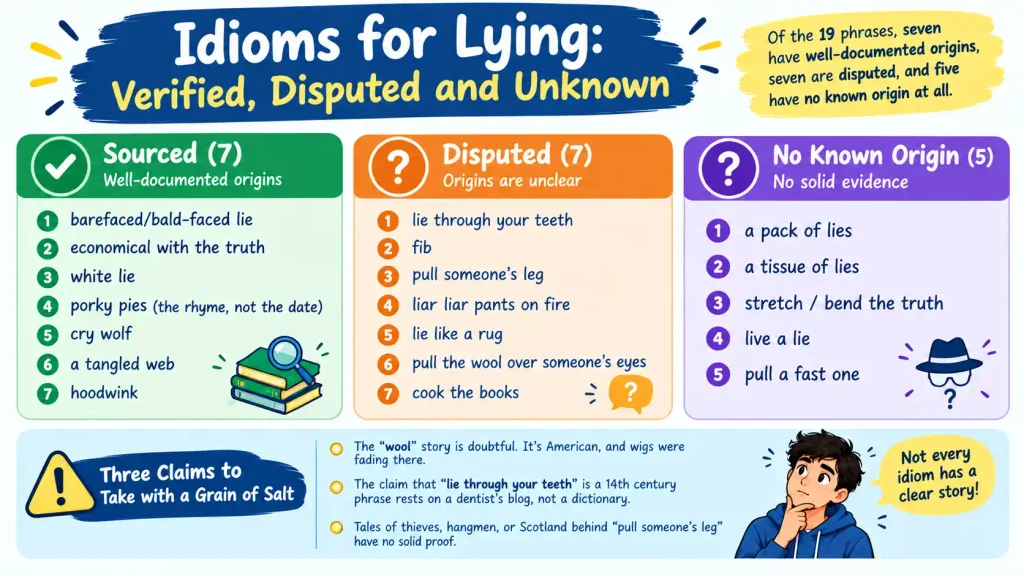
Of the 19 phrases, seven have well-documented origins, seven are disputed, and five have no known origin at all.
- Sourced (7): barefaced/bald-faced lie, economical with the truth, white lie, porky pies (the rhyme, not the date), cry wolf, a tangled web, hoodwink.
- Disputed (7): lie through your teeth, fib, pull someone’s leg, liar liar pants on fire, lie like a rug, pull the wool over someone’s eyes, cook the books.
- No known origin (5): a pack of lies, a tissue of lies, stretch / bend the truth, live a lie, pull a fast one.
Three claims are repeated often and should be treated with care. The wig story for “wool” is doubtful, because the phrase is American and wigs were fading there. The claim that “lie through your teeth” is a 14th century phrase rests on a dentist’s blog, not a dictionary. Tales of thieves, hangmen, or Scotland behind “pull someone’s leg” have no solid proof.
Common Mistakes and Look Alike Idioms for Lying
The three most common errors are mixing up “lie” and “lay,” misreading “I tell a lie,” and treating look-alike expressions as lying phrases.
“Lie” vs. “lay.” “Lie” (to rest flat) goes lie, lay, lain: “I lay on the sofa all day.” “Lay” (to put something down) goes lay, laid, laid: “I laid the book on the table.” “Lie” (to say something false) goes lie, lied, lied.
“I tell a lie” does not mean what it sounds like. British speakers use “I tell a lie” to correct themselves, not to confess to lying. Merriam Webster labels it British and informal. Say it in the middle of a sentence: “We met on Monday. No, I tell a lie; it was Tuesday.”
Looks like lying, but isn’t. Some expressions sit close to this topic without describing a false statement.
| Idiom | What it really means |
| Cry wolf | To raise a false alarm. The person may not be lying about facts at all. |
| Pull someone’s leg | To tease as a joke. No harm is meant. |
| Play possum | To pretend to be asleep, dead, or unaware. |
FAQ: Questions About Idioms for Lying
Readers mainly ask how a white lie differs from a fib, who made “economical with the truth” famous, what slang means lying, and which phrases fit a habitual liar.
White Lie vs Fib: What Is the Difference in Idioms for Lying?
A white lie is a kind lie told to spare someone’s feelings, while a fib is a small, unimportant lie that is often childish. Merriam Webster defines a white lie by its purpose, which is avoiding hurt. It defines a fib by its size, which is trivial. One lie can be both, such as telling a friend you love a so so gift.
Who Popularized “Economical with the Truth” Among Idioms for Lying?
Sir Robert Armstrong, Britain’s Cabinet Secretary, made it famous at the 1986 Spycatcher trial in Sydney. Asked how a misleading impression differs from a lie, he said it was perhaps being economical with the truth. The phrase is older. It is attested from 1897, and Edmund Burke wrote of an economy of truth in 1796.
What Is Slang for Lying? Slang Idioms for Lying Explained
In British English, “porkies” and “porky pies” are the best known slang words for lies. Both come from Cockney rhyming slang, where “pork pies” rhymes with “lies.” In American English, people often say “lie like a rug” for someone who lies all the time, and “fib” for a small untruth.
Which Idioms for Lying Describe Someone Who Lies a Lot?
“Lie like a rug” describes a person who lies constantly. “Cry wolf” fits someone whose repeated false alarms make people stop listening. “Live a lie” describes someone who hides the truth about their whole life, and “a tangled web” names the mess that piles up when lies keep growing.
Conclusion: Choosing the Right Idioms for Lying
Idioms for lying range from gentle to harsh, so pick the phrase that matches the weight of the lie. Use “white lie” or “fib” for small kindnesses. Save “barefaced lie” and “cook the books” for serious charges. Remember that many idioms for lying have guessed origins, so say “often traced to” when you share one.
To read more: Idioms for Reading: 30 Essential Phrases and Meanings