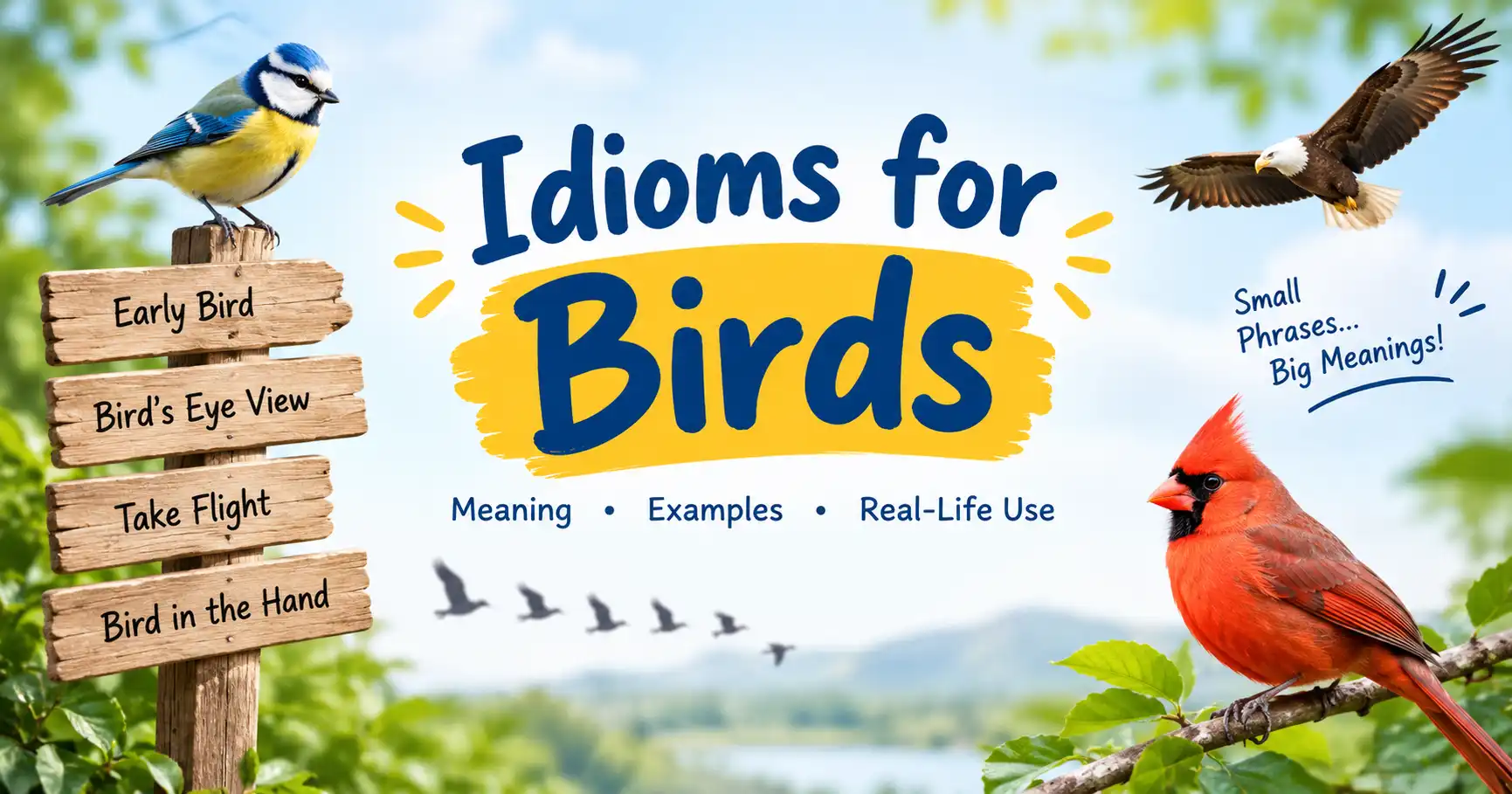
Bird idioms show up in English more often than you might think. We say someone is “free as a bird,” that a plan is “a wild goose chase,” or that a friend is “a night owl.” These phrases make speech colorful, and they are easy to get wrong if you only know the words and not the meaning. A wrong guess can change your whole message.
This guide explains 24 popular bird phrases in simple language. Each entry gives the meaning, a short origin note, and an example sentence you can copy. You will also find a tone guide, a US vs UK section, and the most common mistakes.
Quick Answer: What Are Idioms for Birds?
Idioms for birds are phrases that use birds to describe people, plans, and situations.
The most common are “the early bird catches the worm” and “a bird in the hand is worth two in the bush.”
Others include “kill two birds with one stone” and “birds of a feather flock together.”
Acting early and playing it safe are covered by “the early bird” and “a bird in the hand.”
Secrets and tall tales are covered by “a little bird told me” and “a cock-and-bull story.”
Freedom and escape are covered by “free as a bird,” “clip someone’s wings,” and “fly the coop.”
Fear and failure are covered by “chicken out,” “eat crow,” and “a wild goose chase.”

Idioms for Birds at a Glance
This table lets you find a phrase fast. Read the full entry below for the origin and an example.
| Idiom | Short meaning | Tone |
| The early bird catches the worm | Acting first gives an advantage | Neutral |
| A bird in the hand is worth two in the bush | Keep what you have | Neutral |
| Don’t count your chickens before they hatch | Don’t celebrate too soon | Neutral |
| Kill two birds with one stone | Solve two problems at once | Neutral |
| A little bird told me | I heard it, but won’t say from whom | Playful |
| A cock-and-bull story | An unbelievable tale | Mildly negative |
| Pecking order | Ranking in a group | Neutral |
| Rule the roost | Be in charge | Neutral |
| Feather your nest | Make yourself rich or comfortable | Often negative |
| Free as a bird | Carefree and unrestricted | Positive |
| Clip someone’s wings | Limit someone’s freedom | Negative |
| Fly the coop | Leave or escape | Neutral |
| Chicken out | Back out from fear | Negative |
| Eat crow | Admit you were wrong | Negative |
| A wild goose chase | A hopeless search | Negative |
| Dead as a dodo | Gone or out of date | Neutral |
| Birds of a feather flock together | Similar people stick together | Neutral |
| Night owl | Someone who stays up late | Neutral |
| Rare bird | An unusual person | Positive |
| For the birds | Worthless | Negative |
| The birds and the bees | Basic sex education | Delicate |
| Eat like a bird | Eat very little | Neutral |
| As the crow flies | In a straight line | Neutral |
| Cold turkey | Quit a habit suddenly | Neutral |
Idioms for Birds: Idiom, Proverb or Slang?
An idiom is a phrase whose meaning is not literal. A proverb is a short saying that gives advice, and slang is casual speech used by certain groups. “Kill two birds with one stone” is an idiom, “a bird in the hand is worth two in the bush” is a proverb, and “for the birds” is slang. Dictionaries sometimes sort the same phrase differently, so don’t worry about perfect labels.
Idioms for Birds by Theme
The 24 phrases below are grouped into seven themes. Each origin is marked Documented (a written source exists), Disputed (writers disagree or the popular story may be invented), or Unknown (no source settles it). Where no solid history exists, the entry describes the picture behind the phrase.
Theme 1: Opportunity, Timing and Caution
The early bird catches the worm. The person who acts first gets the best chance. Origin (Documented): John Ray printed it in his 1670 proverb collection. In nature, it is only partly true: one Dutch farmland study found earthworms on the surface mostly after dark. Example: “I applied the morning the job went live. The early bird catches the worm.”
A bird in the hand is worth two in the bush. Keep something certain instead of risking it for something better. Origin (Documented): The earliest English use is in John Capgrave’s 1450 Life of St Katharine of Alexandria, and a 13th-century Latin version exists. The popular falconry explanation is unconfirmed. Example: “He kept his steady job instead of joining a risky start-up.”
Don’t count your chickens before they hatch. Don’t treat a hoped for result as certain. Origin (Documented): Thomas Howell printed a rhyming version in 1570, and Samuel Butler’s Hudibras repeated the idea in 1664. Example: “You don’t have your exam results yet. Don’t count your chickens.”
Kill two birds with one stone. Do one thing that solves two problems. Origin (Documented): Thomas Hobbes used the modern wording in 1656, and an older saying, “stop two gaps with one bush,” likely shaped it. Example: “I’ll call Mum while walking to the shop. That kills two birds with one stone.”
Theme 2: Secrets, Gossip and Tall Tales
A little bird told me. You know something but won’t name your source. Origin (Disputed): The idea likely comes from Ecclesiastes 10:20, where a bird of the air carries a message. Jonathan Swift used “I heard a little bird say so” in 1711. Example: “How did you know about the party?” “A little bird told me.”
A cock-and-bull story. A tale nobody should believe, often an excuse. Origin (Disputed): The popular story about two inns in Stony Stratford is unconfirmed. The French phrase coq-à-l’âne, meaning a jumbled, rambling story, is a likelier source. Example: “He gave us a cock-and-bull story about a flat tire and a sick goat.”
Theme 3: Status, Pride and Power
Pecking order. The ranking of who counts most in a group. Origin (Documented): Norwegian zoologist Thorleif Schjelderup Ebbe studied how hens rank each other in 1921, and the English phrase appears in a 1927 translation. Example: “As the new intern, you sit at the bottom of the pecking order.”
Rule the roost. Be the boss, especially at home. The picture: a rooster in charge of the henhouse.
Feather your nest. Make yourself comfortable or rich, often by using your job. The picture: birds line their nests with feathers. Example: “The manager feathered his nest with bonuses while the team got nothing.”
Theme 4: Freedom and Restraint
Free as a bird. Carefree and not tied down. The picture: a bird flies wherever it likes.
Clip someone’s wings. Limit someone’s freedom or plans. The picture: trimming wing feathers stops a bird from flying. Example: “Her parents didn’t want to clip her wings, so they let her study abroad.”
Fly the coop. Leave or escape, often from home. The picture: a hen slipping out of the chicken coop.
Theme 5: Cowardice, Failure and Futility
Chicken out. Back away from something because of fear. The picture: “chicken” means coward. Teasing among friends, rude to a stranger. Example: “Sam chickened out at the top of the high board.”
Eat crow. Admit you were wrong in an embarrassing way. Origin (Disputed): It probably began with an American humor story from around 1850. The British version is “eat humble pie.” Example: “The numbers came in, and I had to eat crow.”
A wild goose chase. A hopeless search that leads nowhere. Origin (Documented): Romeo and Juliet (early to mid 1590s) gives the first use, describing a horse race where riders followed a leader like geese in formation. People later forgot that sense and read it as chasing a real goose. Example: “Finding the form online was a wild goose chase.”
Dead as a dodo. Gone for good or hopelessly out of date. Origin (Documented): The last live dodo was seen on Mauritius in 1662, and Lewis Carroll’s 1865 Alice book made the bird famous. Example: “Dial-up internet is dead as a dodo.”
Theme 6: People and Character
Birds of a feather flock together. People with similar tastes end up together. Origin (Documented): William Turner used an early version in 1545. Example: “Maya and Jo both love chess club. Birds of a feather.”
Night owl. Someone who stays up late and works best after dark. The picture: owls are active at night. Example: “I’m a night owl, so I’ll send the file after midnight.”
Rare bird. An unusual or special person. The picture: a bird you rarely see.
Theme 7: Phrases That Don’t Mean What They Seem
For the birds. Worthless or not worth taking seriously. Origin (Disputed): It is slang from the first half of the 1900s. The guess about birds picking seeds from horse droppings is unconfirmed. Example: “The whole meeting was for the birds.”
The birds and the bees. The first talk about sex and where babies come from. Origin (Unknown): Coleridge’s 1825 poem is often named but only mentions bees and birds. John Burroughs’s 1875 essays, Birds and Bees, are another candidate. Example: “Dad finally gave my brother the birds-and-the-bees talk.”
Eat like a bird. Eat very little. Origin (Unknown): The idea is wrong. BirdNote gives rough figures: a Cooper’s hawk eats about 12% of its body weight daily, a chickadee 35%, and a hummingbird 100%.
As the crow flies. In a straight line. Origin (Documented): The earliest known use with this meaning is in a 1767 review by W. Kenrick. Crows often circle while hunting, so read it as “the shortest path,” not a fact about crows.
Cold turkey. Quit a habit all at once. Origin (Disputed): Dictionary.com calls it American, first recorded around 1910 to 1915, probably from “talk cold turkey,” meaning to speak bluntly. The goosebumps explanation is unconfirmed. Example: “I gave up soda cold turkey and had a headache for three days.”
Idioms for Birds: A Compliment or Insult Tone Guide
Most bird phrases are safe, a few sting, and some change tone depending on who says them. Praise like “rare bird” and “free as a bird” lands well. Teasing like “chicken out” and “eat crow” can sting when aimed at someone. “For the birds” is best avoided in formal writing, and “a cock-and-bull story” suggests someone is lying, so use it with care.
Idioms for Birds in US vs UK Usage
A few bird phrases belong mostly to one side of the Atlantic. “Eat crow” is American, while the British say “eat humble pie.” “Cold turkey” is American in origin but common in both countries. “Do bird” is British slang for serving a prison sentence, from rhyming slang: “birdlime” rhymes with “time.” “Give someone the bird” is British for booing, while “flip someone the bird” is American for a rude gesture.
Five Common Mistakes With Idioms for Birds
- Misspelling “pecking order.” “Packing order” and “peaking order” are wrong.
- Mixing up “wild goose chase” and “cock and bull story.” One is a pointless search; the other is a tall tale.
- Treating “eat like a bird” as fact. Real birds eat a lot for their size.
- Reading “birds of a feather flock together” as an insult. The proverb only notes similarity. The tone comes from the speaker.
- Using “the birds and the bees” in formal writing. It is a casual phrase, so keep it informal.

Frequently Asked Questions About Idioms for Birds
What does “the birds and the bees” mean?
It is a polite phrase for the basic facts about sex and reproduction that adults explain to children. Its origin is uncertain, though a poem and a set of nature essays are often named.
Why does the early bird get the worm? Is it true?
The proverb says acting first gives an advantage. Nature only partly backs it up, but as advice for people it works, since the first person in line often gets the best choice.
Do birds really eat little, as “eat like a bird” suggests?
No. The phrase describes a small appetite, but real birds eat a lot for their size. A hummingbird eats roughly its own body weight daily.
Conclusion: Idioms for Birds in Everyday English
Idioms for birds give English a lot of its color. They help you talk about timing, secrets, status, freedom, and failure in a few words. Some, like “the early bird catches the worm,” are well documented. Others, like “cock and bull,” come with popular origin stories that may not be true.
Pick the phrase that fits your tone and your audience. Use friendly ones like “free as a bird” freely, and handle sharper ones like “chicken out” with care.
To read more: Idioms for Speech Therapy: 20 Proven Examples & Steps

Digital Communication Writer
Focus: everyday texting slang, emoji meanings, casual chat abbreviations (NGL, LY, DND, etc.)
Bio angle: Grew up navigating group chats and social apps, explains slang the way it’s actually used, with real examples showing serious vs. joking vs. sarcastic tone.