Idioms for trees are everyday phrases that borrow images from bark, roots, branches, and leaves to describe situations that have nothing to do with plants. People use them to talk about mistakes, risk, money, family, and change, often without noticing the plant based image at all. Some, like “bark up the wrong tree,” show up in casual talk, work meetings, and even news writing.
This guide explains what each idiom means, where it came from, and how to use it without sounding off. You will find the documented origins of the two idioms that have one, honest notes on the ones nobody can trace, a look at phrases people often mix up, and guidance on tone so you know which are safe for a work email and which are not.
Quick Answer: Idioms for Trees in Brief
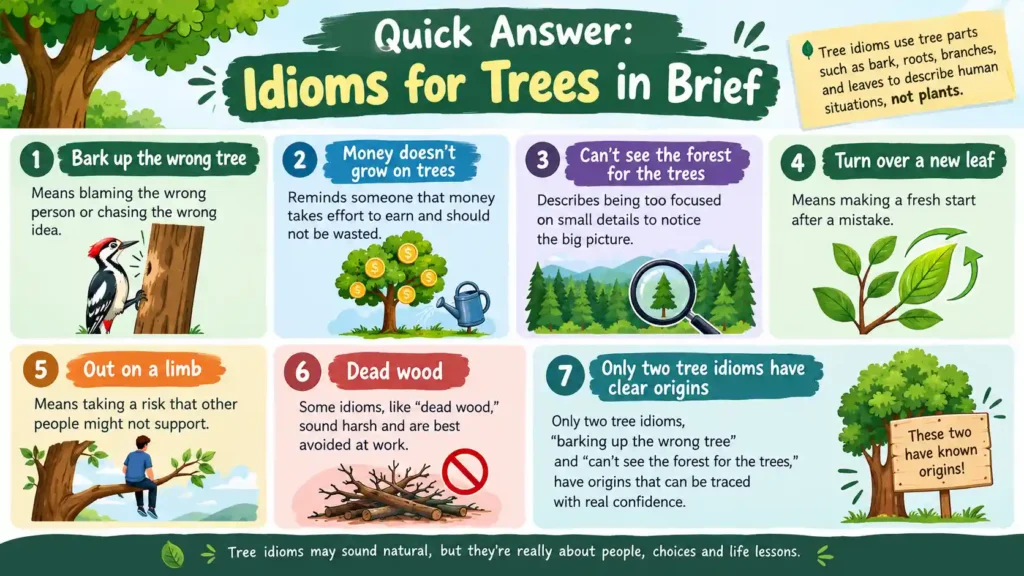
- Tree idioms use tree parts such as bark, roots, branches, and leaves to describe human situations, not plants.
- “Bark up the wrong tree” means blaming the wrong person or chasing the wrong idea.
- “Money doesn’t grow on trees” reminds someone that money takes effort to earn and should not be wasted.
- “Can’t see the forest for the trees” describes being too focused on small details to notice the big picture.
- “Turn over a new leaf” means making a fresh start after a mistake.
- “Out on a limb” means taking a risk that other people might not support.
- Some idioms, like “dead wood,” sound harsh and are best avoided at work.
- Only two tree idioms, “barking up the wrong tree” and “can’t see the forest for the trees,” have origins that can be traced with real confidence.
Core Idioms for Trees, Meanings and Examples
Here are the tree idioms most people search for, each with a plain meaning and one example.
- Bark up the wrong tree: to blame the wrong person or chase the wrong idea. Example: She thought I broke the vase, but she’s barking up the wrong tree. It was the cat.
- Can’t see the forest for the trees: to focus so much on small details that you miss the bigger picture. Example: He kept fixing typos and missed the deadline. He couldn’t see the forest for the trees.
- Money doesn’t grow on trees: money takes effort to earn, so don’t waste it. Example: Turn off the TV before bed. Money doesn’t grow on trees.
- The apple doesn’t fall far from the tree: children often act like their parents. Example: She loves painting, just like her mom. The apple doesn’t fall far from the tree.
- Turn over a new leaf: to make a fresh start and change for the better. Example: After the accident, he turned over a new leaf and started wearing his seatbelt every time.
- Out on a limb: to take a risk that others might not support. Example: I went out on a limb and told my boss the plan wouldn’t work.
- Up a tree: stuck in a hard situation with no easy way out. Example: We were up a tree when the car broke down miles from home.
- Family tree: a chart showing how relatives are connected across generations. Example: My grandmother helped me build our family tree back to the 1800s.
- Put down roots: to settle in one place, often to build a life there. Example: They moved a lot for years, but now they’ve put down roots in Ohio.
- Branch out: to try something new outside your usual routine. Example: After years in sales, she decided to branch out into teaching.
- Nip it in the bud: to stop a problem early, before it grows. Example: The manager nipped the rumor in the bud before it spread further.
These eleven appear in almost every list, so they are worth learning first. The rest of this guide covers what most lists skip.
Where Idioms for Trees Come From
Two tree idioms have origins we can trace with real confidence. The rest come from folk speech with no clear paper trail.
Bark up the wrong tree. This idiom is usually traced to American hunting in the 1800s. Hunters used dogs to chase animals such as raccoons up trees. Sometimes the animal escaped to a different tree, but the dog kept barking at the empty one. Over time, people began using the phrase for any mistaken chase or wrong guess.
Can’t see the forest for the trees. This one is older. Language historians trace it to English writing from the 1500s. It compares getting stuck on small details to standing so close to the trees that you lose sight of the whole forest, which makes it one of the oldest idioms still in common use.
The ones nobody can fully trace. “Money doesn’t grow on trees,” “family tree,” and “the apple doesn’t fall far from the tree” entered everyday speech gradually. No single writer or event created them. Word-history sites often repeat rough guesses about their age, but nothing is confirmed. When a confident date is attached to one of these, treat it as a common guess, not a fact.
Confusable Idioms for Trees People Mix Up
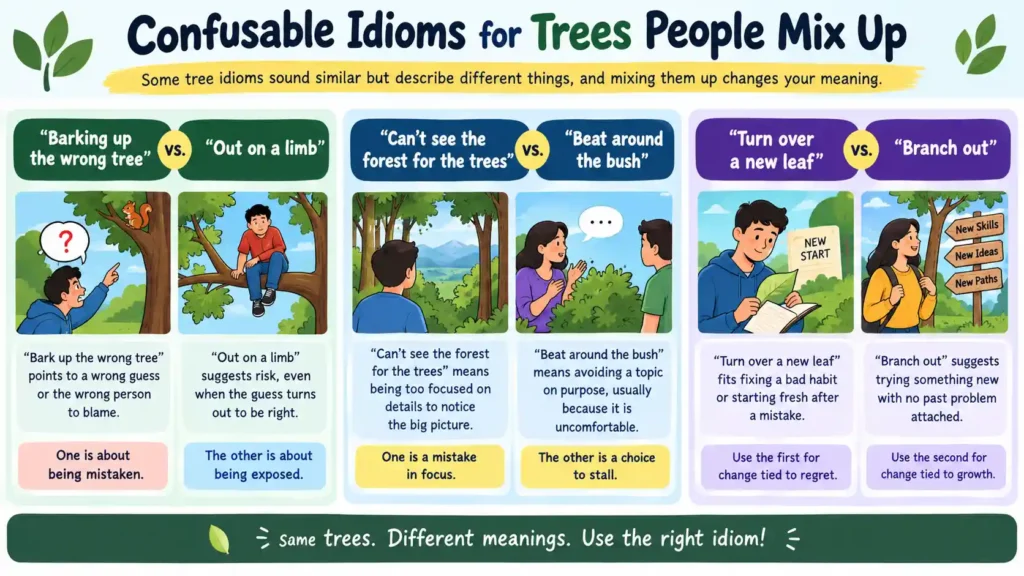
Some tree idioms sound similar but describe different things, and mixing them up changes your meaning.
“Barking up the wrong tree” vs. “out on a limb.” Both picture someone in a tree, but they describe different problems. “Bark up the wrong tree” points to a wrong guess or the wrong person to blame. “Out on a limb” suggests risk, even when the guess turns out to be right. One is about being mistaken. The other is about being exposed.
“Can’t see the forest for the trees” vs. “beat around the bush.” These get confused because both involve missing the point. “Can’t see the forest for the trees” means being too focused on details to notice the big picture. “Beat around the bush” means avoiding a topic on purpose, usually because it is uncomfortable. One is a mistake in focus. The other is a choice to stall.
“Turn over a new leaf” vs. “branch out.” Both sound positive, but they point to different kinds of change. “Turn over a new leaf” fits fixing a bad habit or starting fresh after a mistake. “Branch out” suggests trying something new with no past problem attached. Use the first for change tied to regret and the second for change tied to growth.
Tone and Connotation: When Idioms for Trees Backfire
Some tree idioms sound harmless but can come across as rude or judgmental, depending on who you are talking to.
- Bark up the wrong tree: neutral tone and low risk in almost any spoken setting. In formal writing, plain language is still the better choice.
- The apple doesn’t fall far from the tree: can be positive or negative. It might sound like a compliment or a dig, depending on context, so use it with care.
- Money doesn’t grow on trees: slightly scolding and casual only. It can sound preachy if said to a coworker or family member.
- Dead wood: negative tone, so avoid it at work. Calling a coworker “dead wood” sounds harsh and personal.
- Out of your tree: very informal and negative. It suggests someone is acting crazy, which is too blunt for professional settings.
Before you use one around your boss, a client, or someone you don’t know well, check whether it carries a hidden edge.
Formal vs Casual Idioms for Trees
Some tree idioms change tone depending on how formal the setting is.
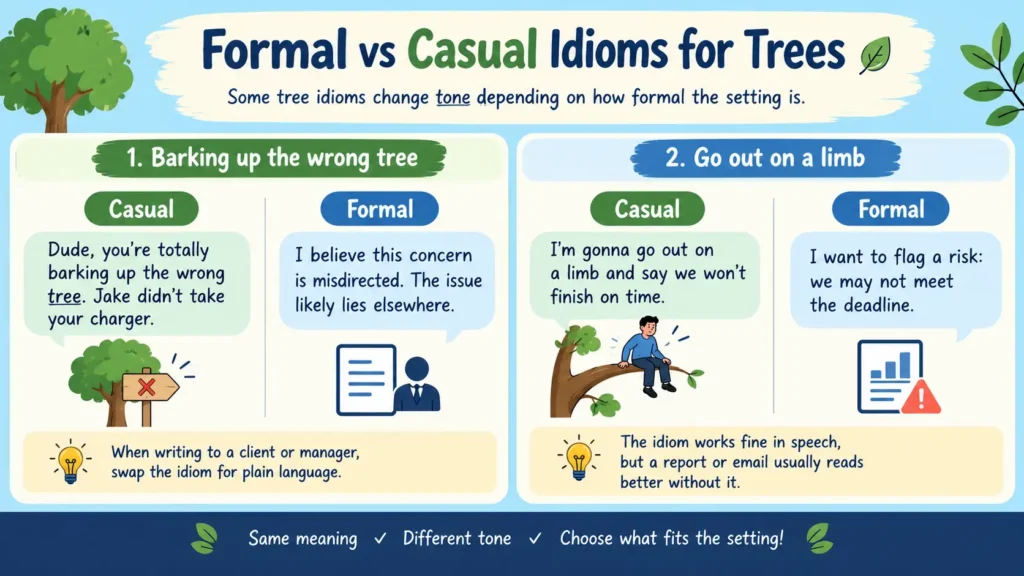
- Casual: “Dude, you’re totally barking up the wrong tree. Jake didn’t take your charger.” Formal: “I believe this concern is misdirected. The issue likely lies elsewhere.” When writing to a client or manager, swap the idiom for plain language.
- Casual: “I’m gonna go out on a limb and say we won’t finish on time.” Formal: “I want to flag a risk: we may not meet the deadline.” The idiom works fine in speech, but a report or email usually reads better without it.
Real Idioms for Trees vs Made Up Ones Online
Not everything labeled a “tree idiom” online is a real, established phrase. Some articles pad their lists with invented lines that sound clever but are not part of everyday English, such as fake sayings about trees “filing complaints” or “loading updates.” These are written for content, not pulled from real usage. To check whether a phrase is genuine, look it up in a dictionary or a trusted language database. If it appears only on one blog post, it is probably not a real idiom yet.
Common Mistakes with Idioms for Trees
Learners often mix up which word goes with which idiom, since many of these phrases sound close to each other.
- Wrong: “He’s out on a branch.” Right: “He’s out on a limb.” The idiom uses “limb,” even though the two words mean nearly the same thing in real life.
- Wrong: “She can’t see the tree for the forest.” Right: “She can’t see the forest for the trees.” The order matters. The small thing, the trees, blocks the big thing, the forest, not the other way around.
- Wrong: using “bark up the wrong tree” to describe taking a risk. Right: save it for being mistaken. “Out on a limb” is the phrase for risk-taking.
- Wrong: treating “dead wood” as neutral. Right: remember it carries a harsh, negative tone, especially about people at work.
FAQ About Idioms for Trees
What does “shake like a leaf” mean? It means to tremble from fear, cold, or nerves. It compares a shaking body to a leaf trembling in the wind. People often use it before something stressful, like a test or a speech.
Where does “barking up the wrong tree” come from? It is usually traced to American hunting in the 1800s, when dogs sometimes barked at the wrong tree after an animal escaped to another one. Over time, the phrase came to mean chasing a wrong idea or blaming the wrong person. This origin is well documented in language history sources.
Can I use tree idioms in formal writing? Some work in formal writing, but many don’t. Neutral ones like “put down roots” or “branch out” fit reports and emails. Casual ones like “money doesn’t grow on trees” or “dead wood” usually sound too blunt or too harsh for professional writing.
What is the difference between “barking up the wrong tree” and “out on a limb”? “Bark up the wrong tree” points to a wrong guess or the wrong person to blame. “Out on a limb” suggests risk from saying or doing something others might not support. One is about being mistaken. The other is about exposure, whether or not you are right.
Conclusion: Using Idioms for Trees with Confidence
Tree idioms give English many ways to talk about mistakes, risk, money, and change without stating those ideas directly. Knowing which are safe for work, which carry a hidden edge, and which are simply made up will help you use them with real confidence. Start with the eleven core phrases above, then return to the FAQ whenever a new one catches your ear.
To read more: Idioms for Music: 30 Powerful Phrases with Meanings