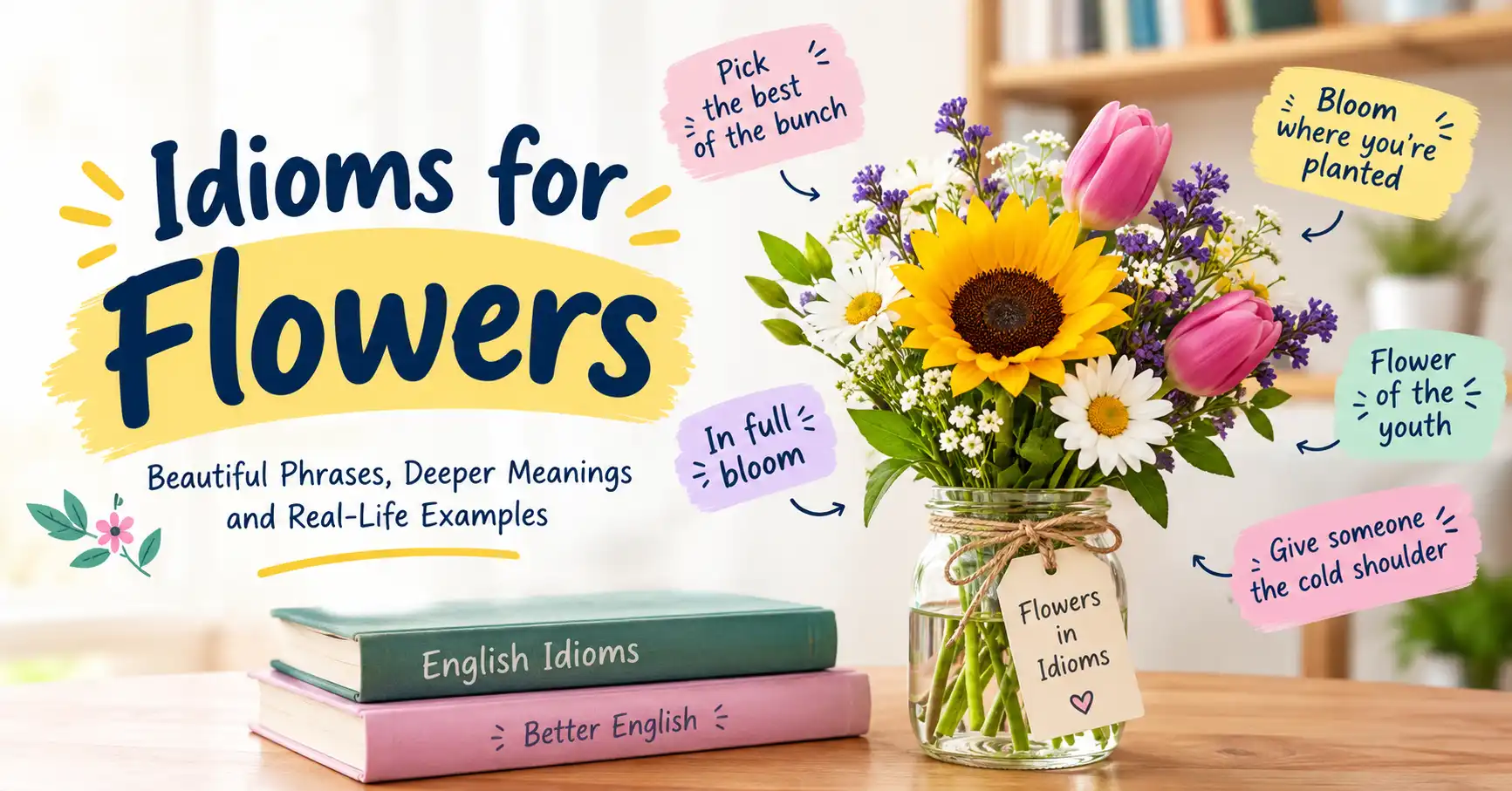
Idioms for flowers are sayings that use blooms, buds, and thorns to describe people, moods, and events. This guide runs from “gild the lily” to “pushing up daisies.” You will find each phrase’s meaning, its origin, and an example you can reuse. It also shows which phrases get mixed up and which ones suit formal or casual speech.
Quick Answer About Idioms for Flowers
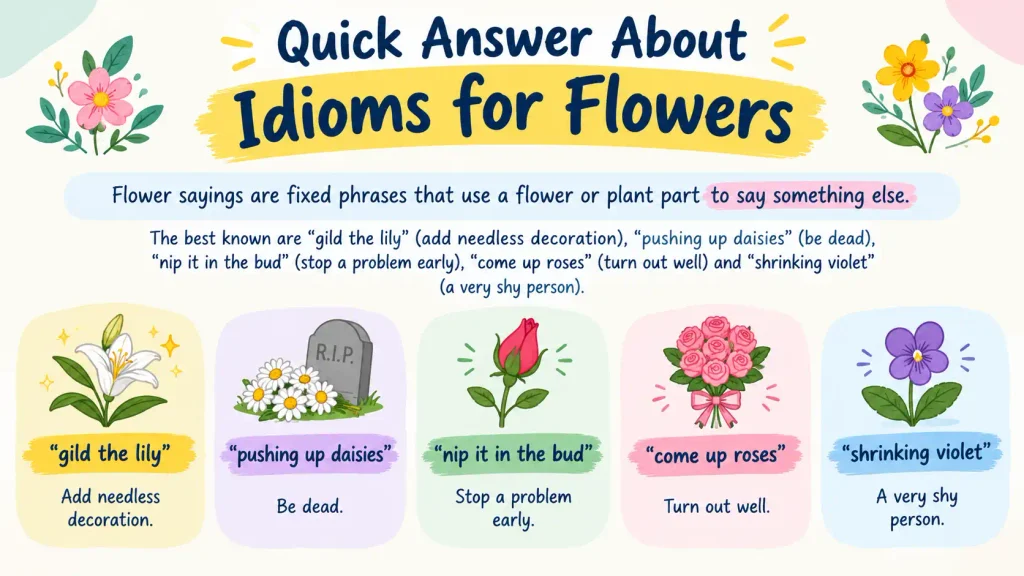
Flower sayings are fixed phrases that use a flower or plant part to say something else. The best known are “gild the lily” (add needless decoration), “pushing up daisies” (be dead), “nip it in the bud” (stop a problem early), “come up roses” (turn out well) and “shrinking violet” (a very shy person).
Idioms for Flowers at a Glance
The table sorts all 20 sayings by meaning and tone.
| Idiom | Meaning | Tone |
| Gild the lily | Add needless decoration to something already good | Mildly critical |
| Pushing up daisies | Being dead | Gentle, informal |
| Nip it in the bud | Stop a problem early | Neutral, firm |
| A bed of roses | An easy, comfortable situation (often “no bed of roses”) | Mixed |
| Shrinking violet | A very shy person | Teasing |
| Primrose path | An easy life that may end badly | Warning |
| Come up roses | Things turning out well | Positive |
| Come up smelling of roses | Escaping trouble with your reputation safe | Positive, cheeky |
| Stop and smell the roses | Slowing down to enjoy life | Positive |
| Fresh as a daisy | Looking or feeling rested and energetic | Positive |
| Late bloomer | Someone who develops later than others | Kind |
| Wallflower | A person who stays at the edge of social events | Mildly negative |
| Under the rose | In secret | Neutral, old-fashioned |
| Cut down tall poppies | Attacking people because they are successful | Negative |
| A thorn in your side | A person or thing that keeps bothering you | Negative |
| No rose without a thorn | Good things come with problems | Neutral |
| Flowery language | Fancy, over-decorated wording | Mildly negative |
| Oops-a-daisy | A light reaction to a small slip or fall | Playful |
| Rose-colored glasses | Seeing things as better than they are | Mildly negative |
| Lily-livered | Cowardly | Insulting, old-fashioned |
The 10 Most Common Idioms for Flowers, Explained
Each origin note carries one of four labels. Documented points to a written source. Traced shows records of when the phrase first appeared. Contested flags sources that disagree. Unknown admits that nobody has found a reliable answer.
Idioms for Flowers About Luck, Ease and Comfort
A Bed of Roses
A bed of roses stands for an easy, comfortable situation. Speakers almost always say “no bed of roses,” so a job described that way is hard work.
Origin (Traced): Linguist Anne Curzan notes that the Oxford English Dictionary traces the saying to at least the end of the 16th century.
Example: “Being a new parent is no bed of roses, but it is worth it.”
Come Up Roses
When things come up roses, they turn out well. People often say “everything’s coming up roses” during a lucky streak.
Origin (Contested): Dictionaries record “come up roses” from 1969. A song in the 1959 musical Gypsy is often given as the source of “everything’s coming up roses,” and it may have helped the phrase spread. Still, the written record for “come up roses” starts later than the song, so the link is commonly repeated but unconfirmed.
Example: “After two slow months, sales are up, and everything’s coming up roses.”
Come Up Smelling of Roses
Someone who comes up smelling of roses gets through a messy situation with a good name intact.
Origin (Traced): Dictionaries record “come out smelling like a rose” from 1968. Language writer Eric Partridge believed the phrase began with a rougher opening line that speakers later dropped, so only the pleasant ending survived.
Example: “The manager made a costly error, yet she came up smelling of roses because the client forgave it.”
Stop and Smell the Roses
To stop and smell the roses is to slow down and enjoy the small pleasures in life.
Origin (Unknown): No one has pinned down where this saying began. A florist blog ties it to the song in Gypsy, but no record confirms that, so treat the link as folklore. A newer twist, “wake up and smell the roses,” blends it with the older “wake up and smell the coffee.”
Example: “You have worked all week. This weekend, stop and smell the roses.”
Fresh as a Daisy
Being fresh as a daisy means looking or feeling rested, clean, and full of energy.
Origin (Unknown): No firm record explains why the daisy became the symbol of freshness. Older versions swapped in other words, such as “fresh as a rose” and “fresh as paint,” according to Curzan.
Example: “After coffee and a short walk, Sam was fresh as a daisy at the morning meeting.”
Idioms for Flowers About Warnings, Death and Shyness
Gild the Lily
To gild the lily is to add decoration to something that already looks good enough. The phrase warns against effort that adds nothing.
Origin (Documented): In Shakespeare’s King John, written in the mid 1590s, a nobleman calls it wasteful excess “to gild refined gold, to paint the lily.” Later speakers blended the two images into “gild the lily.” The earliest printed use found so far is in an 1895 American newspaper.
Example: “The cake already looked perfect, so more icing would be gilding the lily.”
Nip It in the Bud
To nip something in the bud is to stop a problem while it is still small.
Origin (Traced): The picture comes from gardening, where pinching off a bud keeps a flower from opening. A 1607 play, The Woman Hater by Francis Beaumont and John Fletcher, has a character who can nip a passion in the bud, wording close to ours.
Example: “Let’s call the client today and nip this misunderstanding in the bud.”
Primrose Path
The primrose path describes an easy, pleasant way of life that may end badly.
Origin (Documented): Shakespeare’s Hamlet, written around 1600, uses the image in a line about “the primrose path of dalliance.” Dalliance is light, idle pleasure, so the phrase pictures a soft road that leads toward trouble.
Example: “The company took the primrose path of cheap shortcuts, and customers paid for it.”
Pushing Up Daisies
Pushing up daisies is a gentle, joking way to say someone has died. The picture is of flowers growing over a grave.
Origin (Traced): Dictionaries trace similar phrases with the same sense back to 1842. The form we use today is recorded in 1918, in a World War I poem by Wilfred Owen. The site Word Histories ties it to British soldiers’ slang from that war.
Example: “My uncle jokes that he’ll be pushing up daisies before the road gets fixed.”
Shrinking Violet
A shrinking violet is a very shy person who avoids attention. The word “shrinking” carries the sense of pulling back.
Origin (Traced): The phrase dates to the early 1800s and first appears in poetry in Britain and the United States, according to Curzan. The violet is a small, low flower that often hides among leaves, which likely explains the image. No source confirms why writers picked it.
Example: “My cousin is no shrinking violet. She spoke first at the meeting.”
Idioms for Flowers People Mix Up
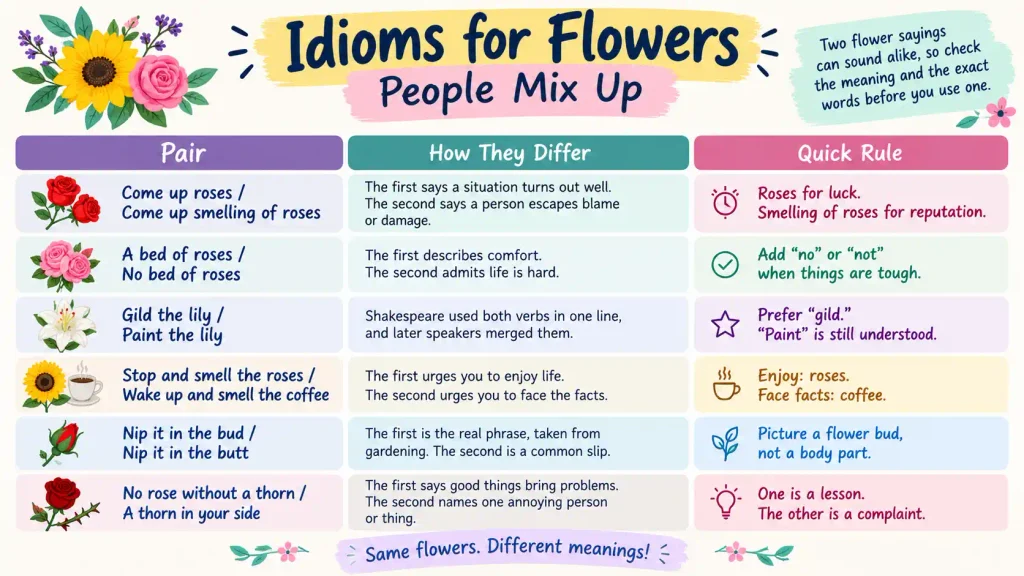
Two flower sayings can sound alike, so check the meaning and the exact words before you use one.
| Pair | How they differ | Quick rule |
| Come up roses / Come up smelling of roses | The first says a situation turns out well. The second says a person escapes blame or damage. | Roses for luck. Smelling of roses for reputation. |
| A bed of roses / No bed of roses | The first describes comfort. The second admits life is hard. | Add “no” or “not” when things are tough. |
| Gild the lily / Paint the lily | Shakespeare used both verbs in one line, and later speakers merged them. | Prefer “gild.” “Paint” is still understood. |
| Stop and smell the roses / Wake up and smell the coffee | The first urges you to enjoy life. The second urges you to face the facts. | Enjoy: roses. Face facts: coffee. |
| Nip it in the bud / Nip it in the butt | The first is the real phrase, taken from gardening. The second is a common slip. | Picture a flower bud, not a body part. |
| No rose without a thorn / A thorn in your side | The first says good things bring problems. The second names one annoying person or thing. | One is a lesson. The other is a complaint. |
Grammar guides flag these wording mistakes:
- Wrong: “We need to nip it in the bud.” Right: “We need to nip it in the bud.”
- Wrong: “Everything is smelling like roses.” Right: “Everything’s coming up roses.”
- Wrong: “He’s literally pushing up daisies.” Right: “He’s pushing up daisies.” The phrase is a figure of speech, so “literally” clashes with it.
- Wrong: “Exam week was a bed of roses” (said when it was hard). Right: “Exam week was no bed of roses.”
Which Idioms for Flowers Fit the Moment?
Some flower sayings sound warm, some sound sharp, and a few are too casual for formal writing.
A few depend on how you use them. “Come up smelling of roses” is cheerful but hints that the person got lucky. “Shrinking violet” is teasing, and speakers mostly use the negative form to praise someone bold.
Match the phrase to the situation:
- Sympathy card or funeral speech: use plain, direct words. Skip pushing up daisies and lily livered.
- Work email: nip it in the bud, gild the lily, or come up roses work well. Never call a coworker a wallflower.
- Exam essay or formal writing: primrose path and a bed of roses, used sparingly. Skip oops a daisy.
- Pep talk for a nervous friend: late bloomer or stop and smell the roses. Skip shrinking violet and wallflower.
These are style tips, not dictionary rules. Dictionaries label several of them as informal.
When Did These Idioms for Flowers First Appear?
The dated phrases first appear in the written record between the 1590s and the 1960s. The table shows the earliest evidence found for each.
| Idiom | Earliest evidence found | Label |
| A bed of roses | Late 1500s (dictionary record) | Traced |
| Gild the lily | Mid-1590s (“paint the lily,” Shakespeare); 1895 (“gild the lily,” US newspaper) | Documented |
| Nip it in the bud | 1607 (close variant, Beaumont and Fletcher) | Traced |
| Primrose path | Around 1600 (Hamlet) | Documented |
| Shrinking violet | Early 1800s (poetry) | Traced |
| Pushing up daisies | 1842 (similar phrases); 1918 (today’s form) | Traced |
| Everything’s coming up roses | 1959 (musical Gypsy) | Contested |
| Come out smelling like a rose | 1968 (dictionary record) | Traced |
| Come up roses | 1969 (dictionary record) | Traced |
| Stop and smell the roses; fresh as a daisy | No firm date found | Unknown |
These dates come from dictionary and reference entries. Earlier uses may exist.
More Idioms for Flowers Worth Knowing
Ten more flower sayings are worth knowing, and the table above defines each one. “Late bloomer” is kind and hopeful. “Wallflower” is mildly sad or teasing. “Under the rose” means in secret and sounds a little old. “Cut down tall poppies” criticizes people who attack the successful. “Oops a daisy” comforts a child who has tumbled. “Lily livered” is an old fashioned insult.
Idioms for Flowers FAQ
Did Shakespeare say “gild the lily”?
Not in those exact words. In King John, a nobleman speaks of gilding gold and painting a lily, and “gild the lily” came later as a blend of those two images. The earliest printed use found so far appears in an American newspaper in 1895. Both versions mean adding needless decoration.
What is the difference between “come up smelling of roses” and “coming up roses”?
To come up smelling of roses is to escape a bad situation with your reputation safe. “Coming up roses” describes a situation that simply turns out well. Compare “She came up smelling of roses after the mix up” with “Everything’s coming up roses this spring.”
Is it “nip it in the bud” or “nip it in the butt”?
The correct phrase is “nip it in the bud.” The expression comes from gardening, where pinching off a bud stops a flower from opening. Picture the flower, and the spelling will stay right.
Conclusion: Using Idioms for Flowers Well
Flower sayings are easy to learn once you know what each one means, where it came from, and what tone it carries. Keep the wording exact, watch the look alike pairs, and match the phrase to the moment. Pick two or three from this list and use them this week.
To read more: Idioms for Lying: 19 Best Phrases (Ultimate Guide)

Digital Communication Writer
Focus: everyday texting slang, emoji meanings, casual chat abbreviations (NGL, LY, DND, etc.)
Bio angle: Grew up navigating group chats and social apps, explains slang the way it’s actually used, with real examples showing serious vs. joking vs. sarcastic tone.