
Idioms for shoes turn everyday footwear into pictures of feeling, work, fear, and money. Shoes fit, pinch, wear out, and get handed on, so English uses them for life’s small changes. This guide gives you 35 phrases with plain meanings, natural examples, and notes on tone. Each one is checked, so you won’t learn a phrase no native speaker uses.
You will meet phrases with shoes, boots, and feet, because English mixes them freely. Where an origin story is only a popular guess, the guide says so. Use them at work and in chat.
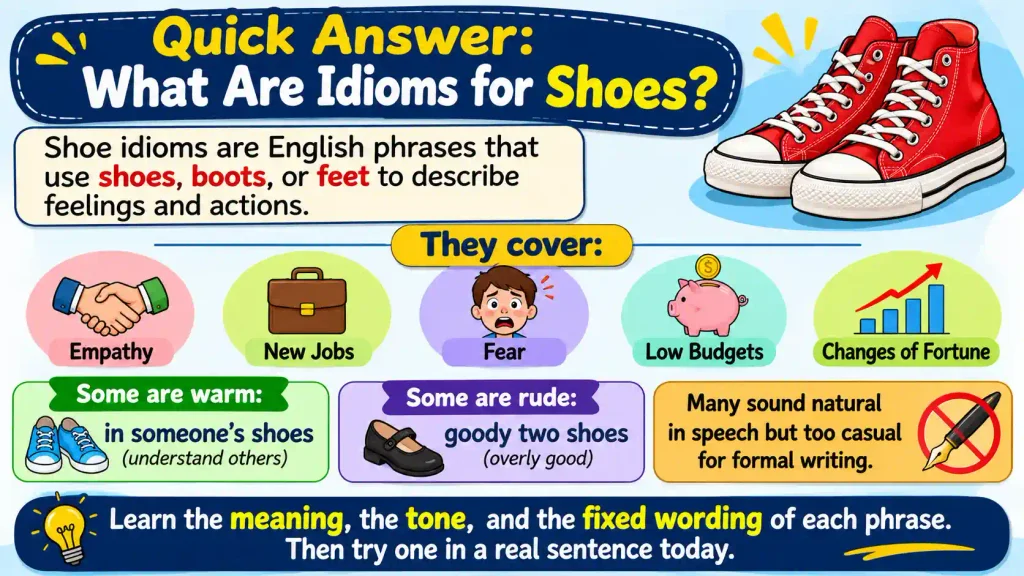
Quick Answer: What Are Idioms for Shoes?
Shoe idioms are English phrases that use shoes, boots, or feet to describe feelings and actions. They cover empathy, new jobs, fear, low budgets, and changes of fortune. Some are warm, such as in someone’s shoes, and some are rude, such as goody two shoes. Many sound natural in speech but too casual for formal writing. A few phrases on other list pages are invented, and this guide names them below. Learn the meaning, the tone, and the fixed wording of each phrase. Then try one in a real sentence today.
Idioms for Shoes About Understanding Others
These seven phrases describe seeing life from another person’s side.
1. In someone’s shoes
This means being in another person’s place. Tone: warm and neutral. Example: I would not like to be in his shoes when the boss reads that report.
2. Walk a mile in someone’s shoes
This suggests living another person’s life for a while before you judge them. Tone: warm and moral. Example: Walk a mile in her shoes before you say she is lazy.
3. Put yourself in someone’s shoes
This means imagining what another person feels, on purpose. Tone: kind and direct. Example: Put yourself in his shoes. He lost his job last week.
4. If I were in your shoes
This advises as if you were the other person. Tone: friendly and helpful. Example: If I were in your shoes, I would call her today.
5. Be in someone’s boots
This describes a hard or serious situation. Tone: serious, and mostly British. Example: I would not want to be in your boots right now.
6. That’s where the shoe pinches
This names the exact point where a plan hurts or fails. Tone: plain and sharp. The saying is often traced to Plutarch, though that link is repeated more than proven. Example: I like the job, but the early start is where the shoe pinches.
7. Walk in someone’s shoes
This means living through another person’s life over time. Tone: warm and steady. Example: You cannot judge him until you walk in his shoes.
Idioms for Shoes About Starting and Taking Over Work
These seven phrases describe a new job, a first step, or a hard task.
8. Fill someone’s shoes
This means taking over a job and doing it as well as the last person. It is about skill, not empathy. Tone: strong and hopeful. Example: After Coach left, it was hard to fill his shoes.
9. Big shoes to fill
This points to a job that is hard because the last person was very good. Tone: warm and honest. Example: The new teacher has big shoes to fill after Mrs Lee.
10. Step into someone’s shoes
This means taking over a role, often fast and for a short time. Tone: strong and direct. Example: When Dad was ill, I stepped into his shoes at the shop.
11. Follow in someone’s footsteps
This means doing the same job or living the same way as a person before you. Tone: warm and proud. Example: I want to follow in my gran’s footsteps and become a nurse.
12. Get your foot in the door
This means getting a first small chance that may lead to more. It is often said to come from salesmen who blocked a door with a foot, though that origin is not proven. Tone: hopeful and practical. Example: That first job helped me get my foot in the door.
13. Put your best foot forward
This means trying your hardest and making a good first impression. Tone: bright and strong. Example: Put your best foot forward at the interview.
14. Get off on the right foot
This means starting well. The opposite is getting off on the wrong foot. Tone: plain and hopeful. Example: We got off on the right foot, and the new team worked well.
Idioms for Shoes About Fear, Worry, and Luck
These seven phrases describe fear, nerves, bad luck, or luck that turns out well.
15. Shake in your shoes
This means being very scared or nervous. Use shook for a past event. Tone: plain and vivid. Example: I shook in my shoes before my first big test.
16. Shaking in your boots
This is the American form of shake in your shoes. Tone: casual and vivid. Example: He was shaking in his boots at the job interview.
17. Waiting for the other shoe to drop
This means waiting for more bad news after one bad thing has happened. It is said to come from the sound of a shoe dropping in the flat above, but that link is repeated more than proven. Tone: worried and casual. Example: The power went out, and we waited for the other shoe to drop.
18. Cold feet
This means sudden fear before a big step, most often a wedding. Tone: light and casual. Example: He got cold feet the night before the wedding.
19. Down at the heels
This describes a person or place that looks poor, worn, or tired. The British form is down at heel. Tone: sad and a little formal. Example: The old shop looked down at the heels, but the food was good.
20. Land on your feet
This means coming out of trouble in good shape. It comes from the way a cat lands after a fall. Tone: hopeful and casual. Example: He lost his job, but he landed on his feet with a better one.
21. Heart in your boots
This means feeling very afraid or very low. It is more common in British English. Tone: vivid and a little old. Example: My heart was in my boots when I saw the exam paper.
Idioms for Shoes About Money and Hard Work
These seven phrases describe low money, hard work, or leaving a job.
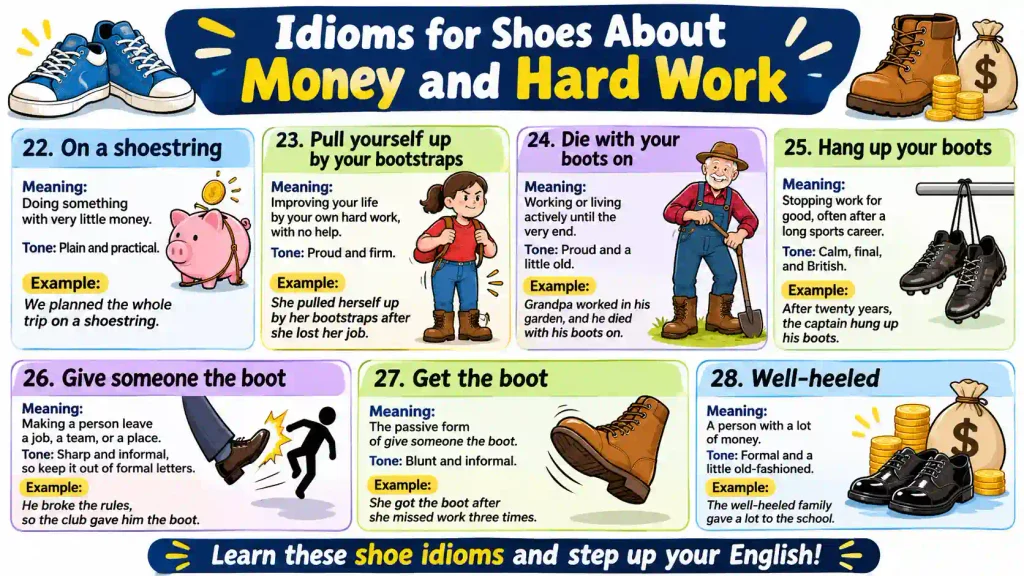
22. On a shoestring
This means doing something with very little money. Tone: plain and practical. Example: We planned the whole trip on a shoestring.
23. Pull yourself up by your bootstraps
This means improving your life by your own hard work, with no help. Some people find it harsh, because it leaves out luck. Tone: proud and firm. Example: She pulled herself up by her bootstraps after she lost her job.
24. Die with your boots on
This means working or living actively until the very end. Tone: proud and a little old. Example: Grandpa worked in his garden, and he died with his boots on.
25. Hang up your boots
This means stopping work for good, often after a long sports career. Tone: calm, final, and British. Example: After twenty years, the captain hung up his boots.
26. Give someone the boot
This means making a person leave a job, a team, or a place. Tone: sharp and informal, so keep it out of formal letters. Example: He broke the rules, so the club gave him the boot.
27. Get the boot
This is the passive form of give someone the boot. Tone: blunt and informal. Example: She got the boot after she missed work three times.
28. Well heeled
This describes a person with a lot of money. Tone: formal and a little old-fashioned. Example: The well heeled family gave a lot to the school.
Idioms for Shoes About Judging, Change, and Rest
These seven phrases describe truth, a change of sides, or a quiet rest.
29. If the shoe fits, wear it
This proverb says that if a remark about you is true, you should accept it. It began as “if the cap fits” in the early 1700s, and the shoe form came later in America, though the exact timeline is not proven. Tone: sharp and a little rude. Example: You say I talk too much. Well, if the shoe fits, wear it.
30. The shoe is on the other foot
This describes a full change of sides, where the person who had power now has none. Tone: plain and a little cold. Example: I used to wait for him. Now the shoe is on the other foot.
31. Goody two shoes
This describes a person who acts too good, too often, to please others. It comes from a 1765 children’s story, often linked to Oliver Goldsmith. Tone: negative and teasing. Example: Do not be a goody two shoes. Just be yourself.
32. Kick off your shoes
This means relaxing after a long day. Tone: warm and casual. Example: After school, I kicked off my shoes and read a book.
33. As comfortable as old shoes
This describes something easy and familiar. Tone: warm and soft. Example: Talking with my best friend feels as comfortable as old shoes.
34. Too big for your boots
This means thinking you are more important than you are. Tone: British, sharp, and teasing. Example: He got too big for his boots after one small win.
35. Bet your boots
This means being quite sure about something. Tone: sure and a little old. Example: You can bet your boots that it will rain today.
Phrases That Look Like Idioms for Shoes but Are Not
Some entries on other pages are invented. “My shoes are full” does not mean busy. “Change your shoes” does not mean changing your mind. “Jump out of your shoes” is not the standard phrase for a shock; people say “jump out of your skin”.
Other phrases sit on the edge. Dead man’s shoes, also written dead men’s shoes, is a real idiom recorded since at least the 1500s. It describes waiting for a person’s job after they leave or die, so use it with care. Fill your boots is British and means taking full advantage of a chance. Lick someone’s boots means flattering a powerful person, and it is rude.
Choosing Between Similar Idioms for Shoes: Tone and Mistakes
Tone matters, so check it before you use a phrase at work or in an exam. In someone’s shoes, fill someone’s shoes, and pull yourself up by your bootstraps suit formal writing. Dead man’s shoes, goody two-shoes, give someone the boot, kick off your shoes, and if the shoe fits, wear it are too casual or rude.
Common mistakes
- Use shoes in the “someone’s shoes” family. Say “in someone’s shoes”, not “in someone’s shoe”, because the phrase pictures a pair. Other phrases, such as if the shoe fits, keep the singular.
- Do not mix in with fill. In someone’s shoes is about empathy. Fill someone’s shoes is about taking over a job.
- Use on a shoestring, not on a shoelace.
- Use shook, not shaked. Say “I shook in my shoes”.
- Use the boot, not a boot. “Give someone a boot” sounds like a real boot.
- Do not say goody two-shoes as praise. Say “kind” or “helpful” instead.
Practice and FAQs on Idioms for Shoes
Practice
- Fill in the gap: “Before you judge her, walk a mile in her ___.” Answer: shoes.
- Pick the right word: “After Coach left, it was hard to ___ his shoes.” Answer: fill.
FAQs
What is the difference between in someone’s shoes and fill someone’s shoes?
In someone’s shoes is about feeling another person’s place. Fill someone’s shoes is about taking over a job and doing it well.
Is goody two shoes a compliment?
No. It describes a person who acts too good, too often, to please others, and it sounds teasing or fake.
Conclusion: Idioms for Shoes in Everyday English
Idioms for shoes give you warm, vivid words for empathy, work, fear, and money. Some phrases are comforting, such as in someone’s shoes. Others sting, such as goody two shoes and give someone the boot.
Check the tone before you use any phrase at work or in an exam. Keep the fixed wording, including shook, shoestring, and the boot. Learn a few phrases at a time and use each one in real talk. Start with one phrase today and use it in a real conversation.
To read more: Idioms for Dancing: 35 Powerful Phrases for Joy & Skill