
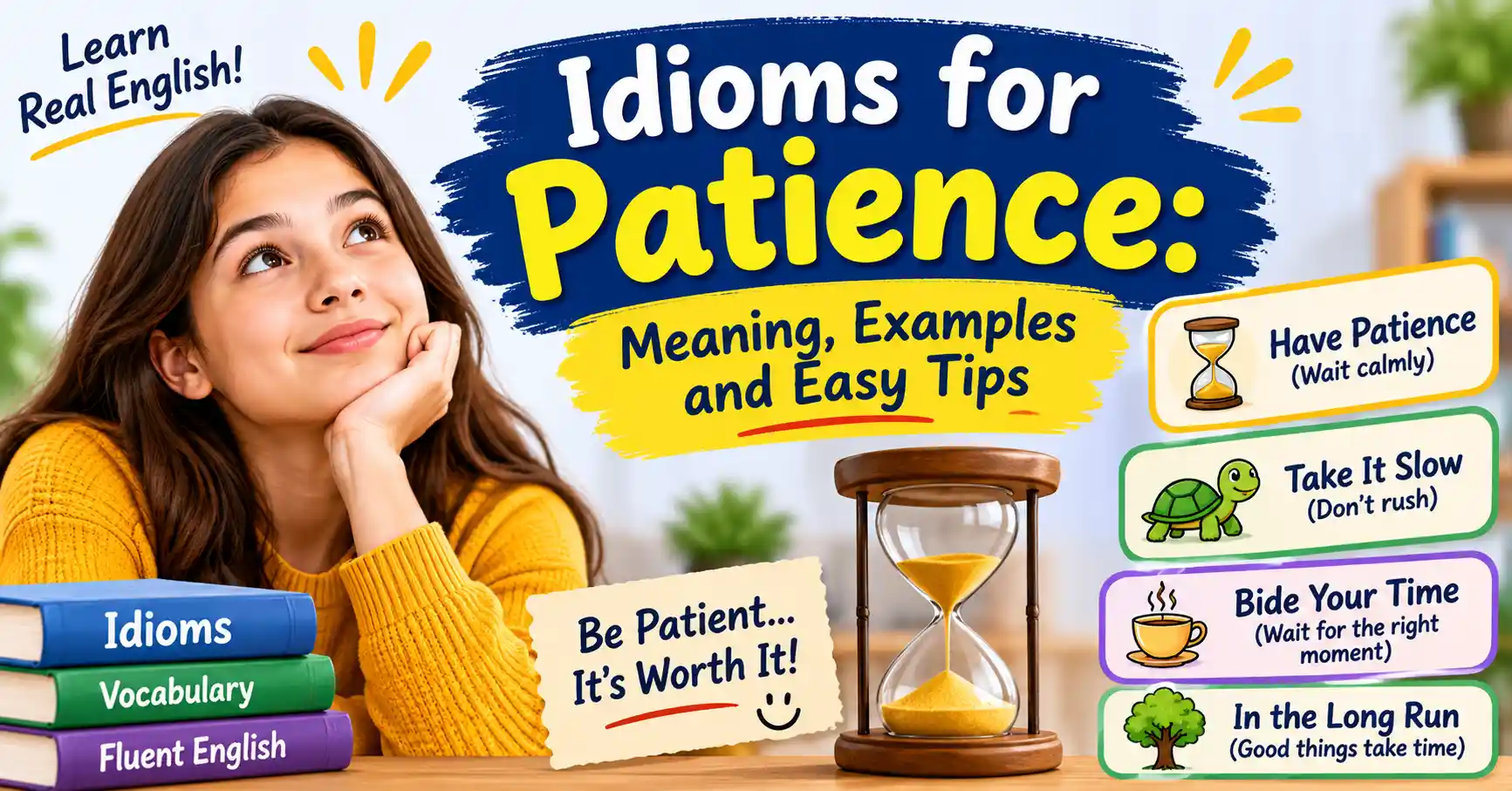
Idioms for patience are English phrases that describe waiting calmly, staying cool under stress, and trusting that good things take time. They help you say you are patient without repeating the same word. You can use them at work, at school, and in casual chat. Each one has its own tone, so the right choice depends on the moment.
This guide shares 40 phrases with plain meanings, tone notes, and natural examples. It also covers phrases for when patience runs out, plain phrases that only look like idioms, and common mistakes. Read it once, then pick a few to use today.
Quick Answer: What Are Idioms for Patience?
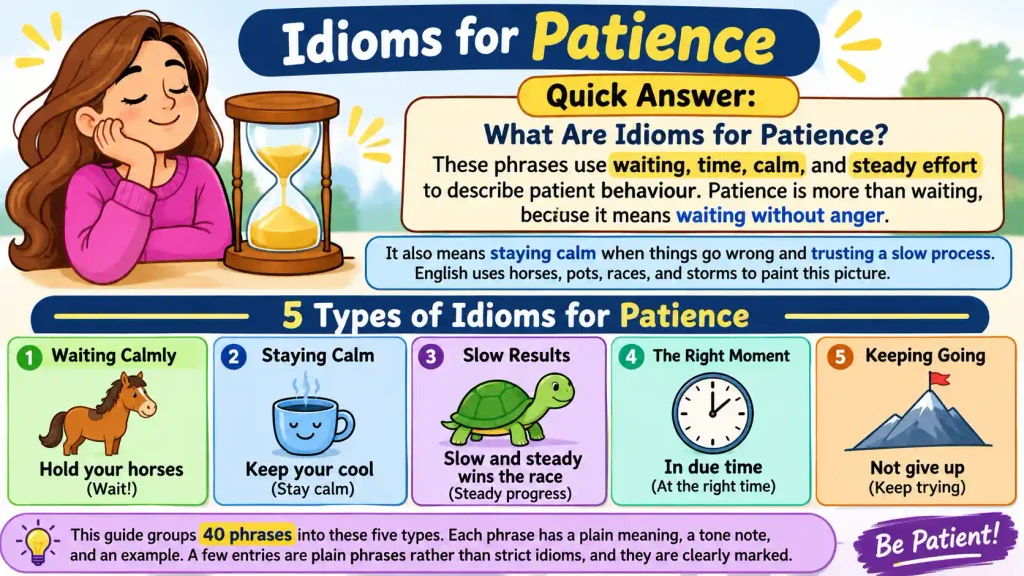
These phrases use waiting, time, calm, and steady effort to describe patient behaviour. Patience is more than waiting, because it means waiting without anger. It also means staying calm when things go wrong and trusting a slow process. English uses horses, pots, races, and storms to paint this picture. This guide groups 40 phrases into five types: waiting calmly, staying calm, slow results, the right moment, and keeping going. Each phrase has a plain meaning, a tone note, and an example. A few entries are plain phrases rather than strict idioms, and they are clearly marked.
Idioms for Patience That Mean Waiting Calmly
These eight phrases describe waiting without anger.
1. Hold your horses: Wait a moment and don’t rush. It comes from reining in horses. Tone: plain and direct. Example: Hold your horses; we are not leaving yet.
2. Sit tight: Stay where you are and wait calmly. Tone: plain and warm. Example: Sit tight, I will be back soon.
3. Hang tight: Wait calmly and don’t act until told. It is more casual than sit tight. Tone: casual and warm. Example: Hang tight in the classroom while I speak with the teacher.
4. Wait it out: Stay calm until a hard time ends. Tone: plain and strong. Example: The storm will pass, so we just need to wait it out.
5. Wait and see (plain phrase): Be patient until you know what happens. Tone: plain and calm. Example: We will just have to wait and see how things turn out.
6. Bide your time: Wait calmly for the right moment to act. Bide comes from Old English bīdan, “to stay.” Tone: calm and smart. Example: He is biding his time before he asks the question.
7. Play the waiting game: Wait for something to happen rather than forcing it. Tone: plain and a little tired. Example: After I sent my job application, I had to play the waiting game for weeks.
8. Wait your turn (plain phrase): Be patient until it is your time. Tone: plain and fair. Example: Please wait your turn for the game.
Idioms for Patience for Staying Calm
These eight phrases describe staying calm under stress.
9. Keep your cool: Stay calm and patient in a hard moment. Tone: plain and strong. Example: Keep your cool during the test.
10. Take a deep breath (plain phrase): Pause and calm down before you react. Tone: plain and kind. Example: When I got stuck in traffic, I just took a deep breath.
11. Bite your tongue: Stop yourself from saying something that might upset a person. Tone: plain and honest. Example: I had to bite my tongue when my brother spilled juice on my laptop.
12. Take a breather: Take a short break to calm down. Tone: plain and warm. Example: Let us take a breather and come back later.
13. Take it easy: Relax and move calmly instead of rushing. Tone: warm and casual. Example: After a long day at school, it is good to take it easy.
14. Keep it together: Stay calm and composed in a hard or emotional time. Tone: plain and strong. Example: Even though everything went wrong in the school play, I had to keep it together.
15. Go with the flow: Accept things as they come, without a fight. Tone: warm and casual. Example: Our bus was late, but I decided to go with the flow.
16. Take things in stride: Handle delays or hard times calmly, without complaint. Tone: plain and strong. Example: Even after she lost her place in the queue, she took it in stride.
Idioms for Patience About Slow Results
These eight phrases describe slow results and big goals.
17. Patience is a virtue: Patience is a good and rare quality. Tone: wise and moral, more a lesson than a casual line. Example: Even though it was hard to wait, I told myself that patience is a virtue.
18. Rome wasn’t built in a day: Big things take time. Tone: wise and plain. Example: You cannot learn the piano in a night. Rome wasn’t built in a day.
19. Good things come to those who wait: Patience leads to a better result. Tone: warm and hopeful. Example: I did not get the job at once, but I kept trying because good things come to those who wait.
20. Slow and steady wins the race: Steady work leads to success, even if it is slow. The idea comes from Aesop’s fable “The Tortoise and the Hare.” Tone: wise and warm. Example: Slow and steady wins the race, so I checked each sum with care.
21. All in good time: Things will happen when the time is right, so there is no need to rush. Tone: warm and calm. Example: You will get your turn, all in good time.
22. In due time: Something will happen when the right moment comes. Tone: plain and a little formal. Example: You will learn to ride a bike in due time.
23. Time heals all wounds: Pain or sadness gets better with time. Tone: warm and wise. Example: It hurts now, but time heals all wounds.
24. Give it time (plain phrase): Wait for things to improve. Tone: plain and kind. Example: Just give it time, and you will feel better.
Idioms for Patience for the Right Moment
These eight phrases describe waiting before you act or speak.
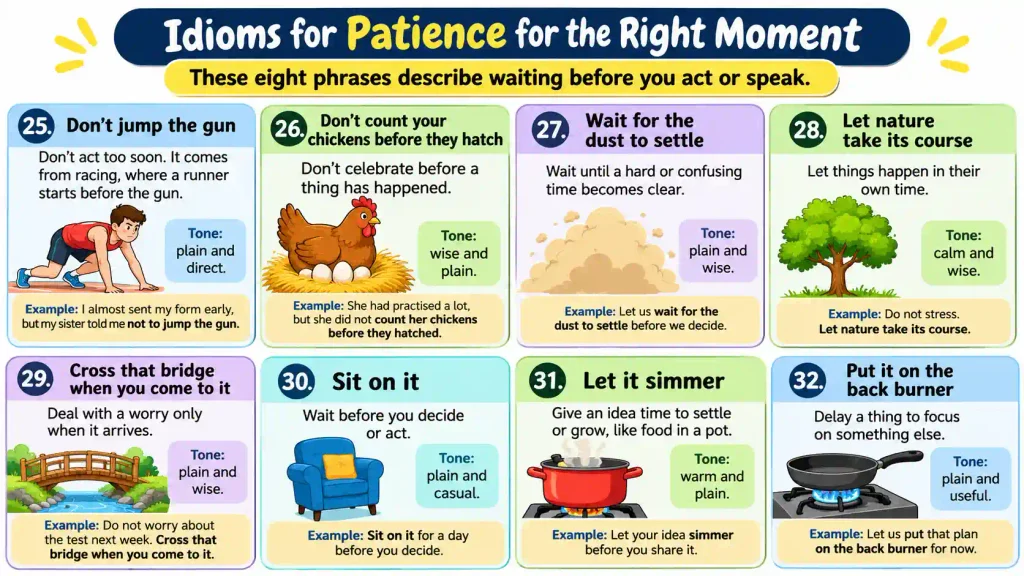
25. Don’t jump the gun: Don’t act too soon. It comes from racing, where a runner starts before the gun. Tone: plain and direct. Example: I almost sent my form early, but my sister told me not to jump the gun.
26. Don’t count your chickens before they hatch: Don’t celebrate before a thing has happened. Tone: wise and plain. Example: She had practised a lot, but she did not count her chickens before they hatched.
27. Wait for the dust to settle: Wait until a hard or confusing time becomes clear. Tone: plain and wise. Example: Let us wait for the dust to settle before we decide.
28. Let nature take its course: Let things happen in their own time. Tone: calm and wise. Example: Do not stress. Let nature take its course.
29. Cross that bridge when you come to it: Deal with a worry only when it arrives. Tone: plain and wise. Example: Do not worry about the test next week. Cross that bridge when you come to it.
30. Sit on it: Wait before you decide or act. Tone: plain and casual. Example: Sit on it for a day before you decide.
31. Let it simmer: Give an idea time to settle or grow, like food in a pot. Tone: warm and plain. Example: Let your idea simmer before you share it.
32. Put it on the back burner: Delay a thing to focus on something else. Tone: plain and useful. Example: Let us put that plan on the back burner for now.
Idioms for Patience for Keeping Going
These eight phrases describe long goals and steady work.
33. Hang in there: Don’t give up in a hard time. It does not mean waiting. It means keep going. Tone: warm and strong. Example: Hang in there, things will get better.
34. One step at a time: Take things slowly, one part after another. Tone: plain and calm. Example: I was lost in the big project, but my teacher told me to take it one step at a time.
35. Take it slow (plain phrase): Move at a calm pace, not rushing. Tone: plain and warm. Example: Take it slow with that puzzle.
36. Stay the course: Keep to your plan, even when it gets hard or slow. Tone: plain and strong. Example: I wanted to quit the piano, but my teacher told me to stay the course.
37. Be in it for the long haul: Stay committed and patient over a long time. Tone: plain and strong. Example: Training for the run was hard, but I was in it for the long haul.
38. Weather the storm: Get through a hard time by being patient and strong. Tone: plain and strong. Example: Our group faced a lot of harsh words, but we decided to weather the storm.
39. Take it one day at a time: Focus on today, not on all that is to come. Tone: calm and kind. Example: I am taking it one day at a time with this project.
40. Trust the process: Have faith in your steps, even when you cannot see the result yet. Tone: warm and hopeful. Example: I did not see change at once, but I chose to trust the process.
Idioms for Patience When Your Patience Runs Out
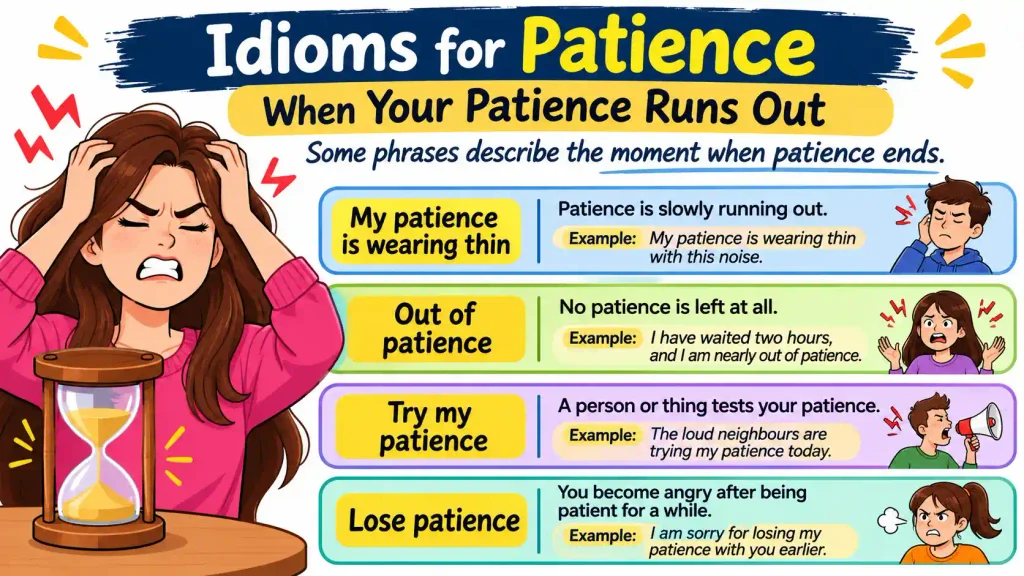
Some phrases describe the moment when patience ends.
- My patience is wearing thin: Patience is slowly running out. Example: My patience is wearing thin with this noise.
- Out of patience: No patience is left at all. Example: I have waited two hours, and I am nearly out of patience.
- Try my patience: A person or thing tests your patience. Example: The loud neighbours are trying my patience today.
- Lose patience: You become angry after being patient for a while. Example: I am sorry for losing my patience with you earlier.
Phrases That Look Like Idioms for Patience but Are Not
Use the Patience Test. If a phrase names waiting calmly, staying calm, trusting time, waiting for the right moment, or keeping going, it may be an idiom. If it only states a plain fact about waiting, it is plain language.
“Don’t rush it,” “not in a hurry,” “take forever,” “don’t be hasty,” “on hold,” and “let it go” are plain phrases. “Hold off” is a phrasal verb meaning delay. Entries such as wait and see and give it time are close to plain language, so they are marked in the list.
True idioms outside the main list include bear with me, a watched pot never boils, haste makes waste, keep your powder dry, and time will tell. Phrases like sit on the fence, walk on eggshells, and count sheep are about other things, not patience.
Idioms for Patience: Comparison, Tone, and Common Mistakes
Similar phrases are easy to mix up, so pick the one that fits the moment.
| Phrases | Difference |
| Sit tight / Hang tight | Sit tight means stay where you are. Hang tight is more casual and stresses not acting until told. |
| Bide your time / Wait and see | Bide your time means wait to act. Wait and see means wait to find out what happens. |
| Take it slow / One step at a time | Take it slow means move at a calm pace. One step at a time means do one part after another. |
Idioms range from warm to rude, so check the tone before you use one at work or in an exam.
| Phrase | Tone | Formal writing? |
| Patience is a virtue | Wise, moral | Yes |
| Rome wasn’t built in a day | Wise, plain | Yes |
| Slow and steady wins the race | Wise, warm | Yes |
| Hold your horses | Plain, direct | Only in a light line |
| Take a chill pill | Rude, casual | No, rude to a boss |
Common mistakes:
- Use hold your horses, not “hold your horse.”
- Use bite your tongue, not “bite your teeth.”
- Use patience is a virtue, not “patience are a virtue.”
- Use Rome wasn’t built in a day, not “Rome wasn’t build in a day.”
- Use sit tight, not “sit tightly.”
- Hang in there means keep going, not wait.
Practice and FAQs About Idioms for Patience
Try these three short tasks.
- Fill in the gap: “Hold your ___, we are not leaving yet.” Answer: horses.
- Fill in the gap: “The teacher asked us to ___ until she came back.” Answer: sit tight (or hang tight).
- Fix the sentence: “He bit his teeth and said nothing.” Answer: He bit his tongue and said nothing.
What is the difference between sit tight, hang tight, and wait it out? Sit tight means stay where you are and wait calmly. Hang tight means wait and don’t act until told. Wait it out means stay calm until a hard time ends.
Is “take a chill pill” rude? It can be. Said to a boss, teacher, or stranger, it sounds sharp. Use it only with close friends.
Conclusion: Use Idioms for Patience Every Day
Idioms for patience give you warm, clear words for waiting, staying calm, and keeping going. They let you describe patience without repeating the same word. Some phrases, like hold your horses, are direct commands, while others, like patience is a virtue, are wise lessons. Always check the tone before you use a phrase at work or in an exam. Phrases such as take a chill pill are best kept for close friends. Learn a few at a time and use them in real conversation so they stick. Start with one phrase today, and trust the process.
To read more: Idioms for Sleepy:Best Phrases for Tired Eyes(2026)