
English speakers borrow the weather all the time. When a friendship hits trouble, we say a storm is brewing. When a new restaurant becomes an overnight hit, we say it took the town by storm. These phrases sound simple, but each one carries a specific meaning, tone, and history. This guide covers 24 idioms about storms, with plain English meanings, example sentences, real origin stories, and the differences between American and British usage. By the end, you’ll know exactly what each phrase means and how to use it without making a common learner mistake.
Quick Answer: What Are Idioms About Storms?
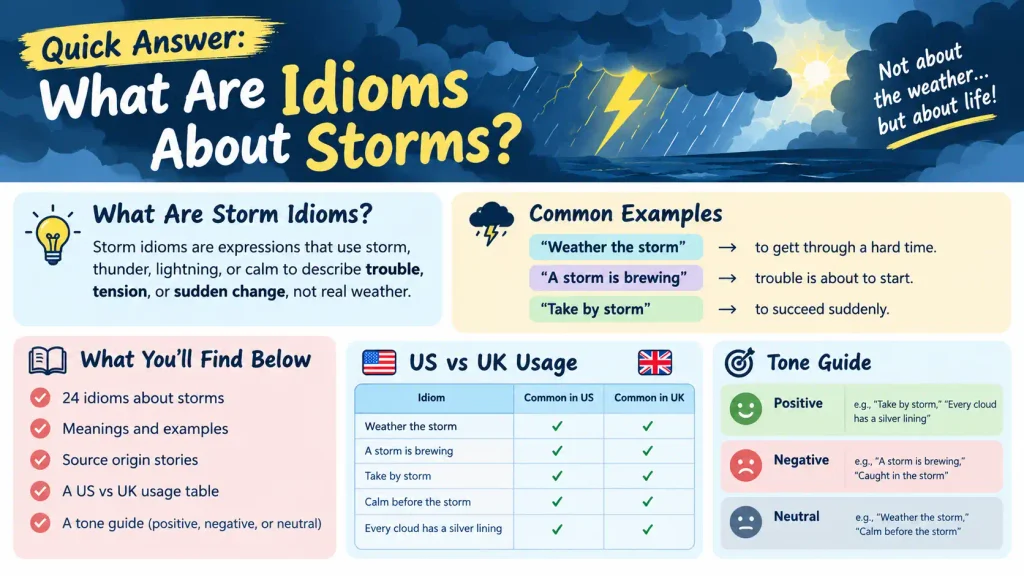
Storm idioms are expressions that use storm, thunder, lightning, or calm to describe trouble, tension, or sudden change, not real weather. “Weather the storm” means to get through a hard time. “A storm is brewing” means trouble is about to start. “Take by storm” means to succeed suddenly. Below, you’ll find 24 idioms about storms with meanings and examples, sourced origin stories, a US vs UK usage table, and a tone guide showing which idioms are positive, negative, or neutral.
What Makes an Idiom a “Storm” Idiom
Idioms about storms work because storms are sudden, dramatic, and hard to control, the same feelings people have during conflict, stress, or big change.
A real storm builds, hits, and then clears. That pattern fits human trouble almost perfectly. Tension builds, so we say “a storm is brewing.” Things get intense, so we say “the storm hit.” Trouble passes, so we say “the storm blew over.” Speakers of English reach for this pattern because everyone understands what a storm feels like.
Not every storm idiom means something bad. Some describe crisis. Some describe endurance. A few describe sudden success. That mix is part of why this group of phrases is worth learning together, instead of one at a time.
24 Idioms About Storms and Their Meanings
Below are storm idioms that appear in standard English dictionaries, each with a short meaning and one example sentence.
- Weather the storm: to get through a hard time without lasting damage. The small bakery weathered the storm of rising rent by cutting hours instead of closing.
- Ride out the storm: to wait patiently until a hard time passes. She decided to ride out the storm at work rather than quit during the layoffs.
- A storm is brewing: trouble is about to start. You could tell a storm was brewing the moment both sisters walked into the kitchen.
- The calm before the storm: a quiet period right before something difficult begins. The office felt oddly peaceful on Sunday night, the calm before the storm of Monday’s audit.
- The lull before the storm: the same idea, in slightly more formal writing. The market saw a lull before the storm, with prices holding steady just days before the crash.
- In the eye of the storm: right at the center of a crisis. As team captain, she was in the eye of the storm during the championship loss.
- Take (something) by storm: to succeed suddenly and completely. The new café took the neighborhood by storm within its first month.
- A storm in a teacup: a small problem blown far out of proportion. Their disagreement over the seating chart turned into a storm in a teacup.
- Any port in a storm: any solution will do when things get desperate, even a flawed one. He knew the loan had a high interest rate, but any port in a storm.
- A perfect storm: a rare mix of bad events happening together. Bad weather, a flu outbreak, and a broken heater created a perfect storm for the school’s attendance numbers.
- Storm out: to leave a place quickly, in anger. He stormed out of the meeting after his idea got rejected twice.
- A face like thunder: a very angry expression. Dad had a face like thunder when he saw the dent in the car.
- Steal someone’s thunder: to take credit or attention that belongs to someone else. Her brother stole her thunder by announcing his engagement at her graduation party.
- Blow over: a problem fades without lasting harm. The argument between the coworkers blew over by the next morning.
- A gathering storm: a problem slowly building toward crisis. Rising costs and falling sales formed a gathering storm for the small shop.
- Storm warning: an early sign that trouble is coming. Her silence at dinner was a storm warning nobody wanted to ignore.
- Cook up a storm: to cook with great energy and skill, usually for a group. Grandma always cooks up a storm for the holidays.
- Batten down the hatches: to prepare carefully for a difficult situation. With the merger announced, the whole team battened down the hatches for a rough quarter.
- Bring the thunder: to show up with strong energy or impact. The visiting team brought the thunder in the second half and won by ten points.
- Thunderstruck: completely shocked or amazed. She was thunderstruck when she found out she’d won the scholarship.
- A bolt from the blue: a shock that arrives with no warning. His resignation letter was a bolt from the blue for the whole department.
- Make waves: to cause a stir or attract strong attention. Her comments at the town meeting made waves across the whole community.
- Under a dark cloud: feeling unlucky or troubled. He’s been under a dark cloud since the accident, even though he wasn’t hurt.
- Blow off steam: to release built-up stress or anger. After the exam, the students blew off steam by playing basketball for an hour.
Where Idioms About Storms Actually Come From
Most storm idioms trace back to real ships, real books, or real weather reports, not vague folk wisdom.
The Perfect Storm
This phrase went from a niche weather term to everyday English almost overnight, though it didn’t start with the person most people credit. Journalist Sebastian Junger popularized it in his 1997 nonfiction book The Perfect Storm, about the fishing vessel Andrea Gail and the deadly 1991 Halloween nor’easter that struck the Atlantic. Junger said he coined the book’s title after a conversation with Bob Case, a National Weather Service meteorologist in Boston, who described an unusual, dangerous combination of three colliding weather systems as a “perfect situation” for a storm. Word researchers have since found the phrase “perfect storm” already in use in American weather reporting decades earlier, including a 1936 Texas newspaper describing a flood causing storm, so Junger and Case popularized the phrase rather than inventing it outright. The book’s 2000 film adaptation pushed it further into daily use, and today it describes any rare pileup of bad events, not just weather.
Any Port in a Storm
This one is old, and its earliest confirmed appearance in print is in John Cleland’s 1749 novel Fanny Hill. The idea is simple: a ship caught in bad weather will pull into any harbor, even a poor one, rather than stay at sea. The phrase carried that logic into daily speech: when you’re desperate, a flawed solution beats no solution at all.
A Storm in a Teacup
The British version of this phrase describes a tiny problem treated like a disaster. Some language historians point to a line in Cicero’s De Legibus, written in Latin, that used the image of a “tempest in a ladle,” a possible ancient ancestor of the idea, though the exact link to the modern English phrase isn’t fully confirmed. What is confirmed is the regional split: British English says “a storm in a teacup,” while American English usually says “a tempest in a teapot.” Same meaning, different kitchenware.
Calm Before the Storm
This phrase is often traced to an early 17th century play called The Dumb Knight, where an older version appeared as “calm before the tempest.” Over time, “tempest” gave way to “storm,” and the phrase settled into the form people use today, a quiet stretch right before real trouble starts.
Weather the Storm
Dictionaries including Merriam Webster and the American Heritage Idioms Dictionary trace this phrase to the mid-1600s and a literal nautical image: a sailing ship riding out bad weather before continuing its voyage. Someone who “weathers the storm” gets through a hard stretch the way a ship comes safely into harbor after rough seas.
Take by Storm
Long before this phrase meant sudden popularity, it described something more literal: seizing a fort or castle through a fast, forceful attack. Military writing used “take by storm” for centuries before the phrase softened into its modern meaning, winning people over quickly, whether it’s a new product, a new song, or a new restaurant.
Storm in a Teacup vs. Tempest in a Teapot: What’s the Difference?
Both phrases mean the same thing: a small problem treated like a major crisis, and the only real difference is geography.
| Storm in a Teacup | Tempest in a Teapot | |
| Region | British English | American English |
| Meaning | Overreacting to a minor issue | Overreacting to a minor issue |
| Word choice | “Storm” and “teacup” | “Tempest” and “teapot” |
| Common in | UK news, British writing | US news, American writing |
If you’re writing for a British audience, “storm in a teacup” will sound natural. If you’re writing for an American audience, “tempest in a teapot” fits better. Either works in casual conversation almost anywhere.
Are Idioms About Storms Positive, Negative, or Neutral? A Quick Tone Map
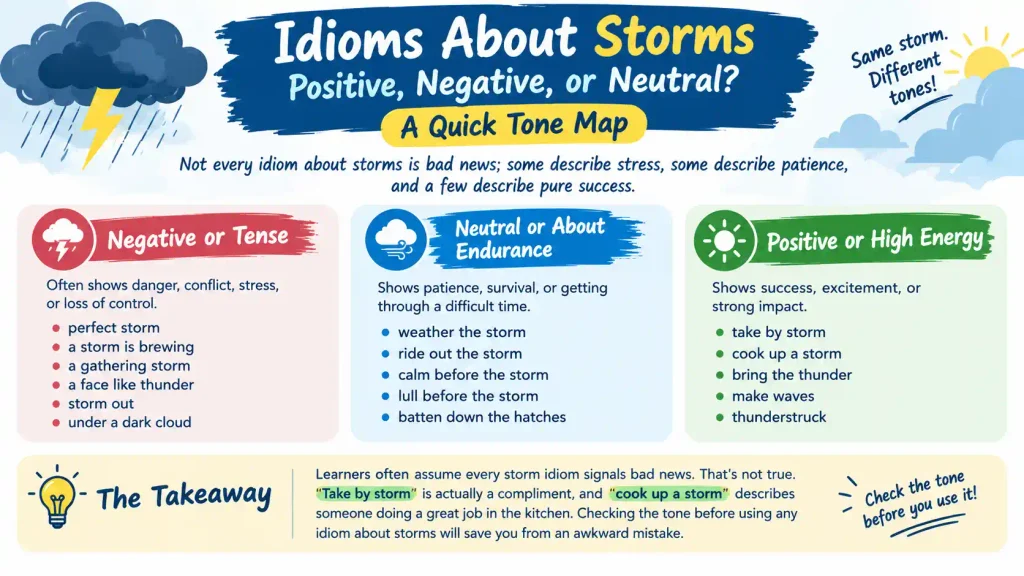
Not every idiom about storms is bad news; some describe stress, some describe patience, and a few describe pure success.
- Negative or tense: perfect storm, a storm is brewing, a gathering storm, a face like thunder, storm out, under a dark cloud
- Neutral or about endurance: weather the storm, ride out the storm, calm before the storm, lull before the storm, batten down the hatches
- Positive or high energy: take by storm, cook up a storm, bring the thunder, make waves, thunderstruck
Learners often assume every storm idiom signals bad news. That’s not true. “Take by storm” is actually a compliment, and “cook up a storm” describes someone doing a great job in the kitchen. Checking the tone before using any idiom about storms will save you from an awkward mistake.
Idioms about storms People Mix Up (Side by Side)
Several idioms about storms sound alike but carry different shades of meaning, and mixing them up is one of the most common learner errors.
| Idiom A | Idiom B | Key difference |
| Weather the storm | Ride out the storm | “Weather” suggests active strength and skill; “ride out” suggests patient waiting |
| Calm before the storm | Lull before the storm | Same meaning, but “lull” sounds more formal and literary |
| Storm in a teacup | Make a mountain out of a molehill | Same idea, different image: one uses weather, the other uses landscape |
| Take by storm | Storm out | “Take by storm” is a positive success; “storm out” is an angry exit |
If you’re unsure which one to pick, ask yourself one question: is the person overcoming something, or leaving something? That single question sorts most of these pairs correctly.
Is “Calm Before the Storm” Actually Real?
Yes, in a way. Real storms do have genuinely calm sections, which is likely why this phrase felt true enough to catch on.
The clearest example is the eye of a hurricane, a real area of low wind and clear skies sitting at the storm’s center, surrounded by its most violent winds. Smaller storms can also have a brief lull between an approaching front and the worst of the rain or wind. The idiom borrows from this real pattern, even though it’s usually applied to arguments, deadlines, and stressful weeks that have nothing to do with actual weather.
Common Mistakes Learners Make with Idioms About Storms
These phrases are easy to misuse in a few specific, repeatable ways.
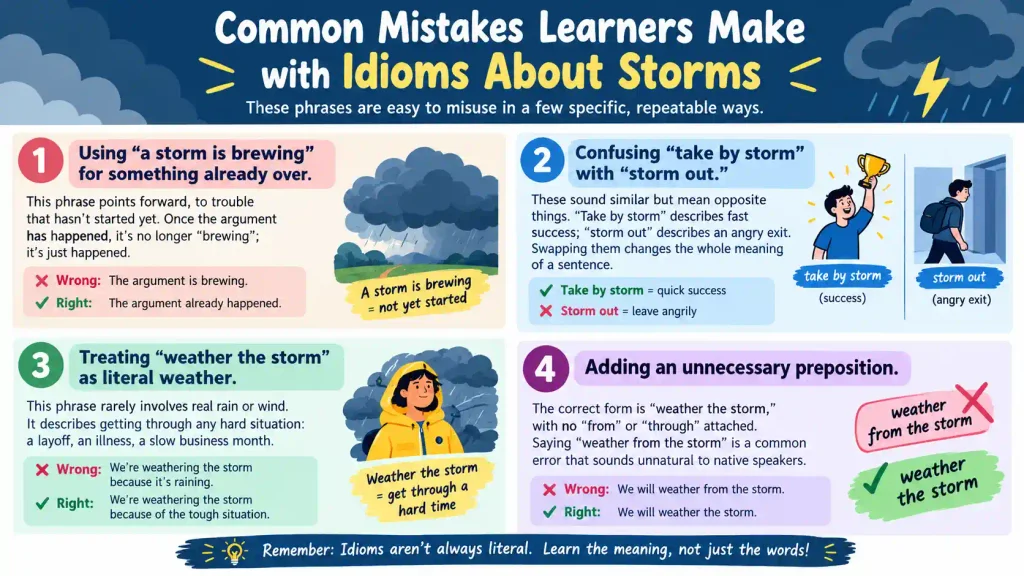
Using “a storm is brewing” for something already over. This phrase points forward, to trouble that hasn’t started yet. Once the argument has happened, it’s no longer “brewing”; it’s just happened.
Confusing “take by storm” with “storm out.” These sound similar but mean opposite things. “Take by storm” describes fast success; “storm out” describes an angry exit. Swapping them changes the whole meaning of a sentence.
Treating “weather the storm” as literal weather. This phrase rarely involves real rain or wind. It describes getting through any hard situation: a layoff, an illness, a slow business month.
Adding an unnecessary preposition. The correct form is “weather the storm,” with no “from” or “through” attached. Saying “weather from the storm” is a common error that sounds unnatural to native speakers.
FAQs
What does “a storm is brewing” mean?
“A storm is brewing” means trouble is starting to build, even though nothing has happened yet. It’s used for tense situations, arguments, or problems that feel like they’re about to break out.
Where does the phrase “perfect storm” come from?
“Perfect storm” was popularized by Sebastian Junger’s 1997 book about the 1991 nor’easter that sank the fishing boat Andrea Gail, after meteorologist Bob Case described the storm’s rare mix of weather systems as “perfect.” The phrase itself had already appeared in weather reporting decades before the book, so Junger and Case made it famous rather than inventing it.
What’s the difference between “storm in a teacup” and “tempest in a teapot”?
They mean the same thing: a small issue treated like a big crisis. The only difference is region: British English uses “storm in a teacup,” while American English uses “tempest in a teapot.”
Is “calm before the storm” scientifically true?
Yes, to a real extent. The eye of a hurricane is a genuinely calm, low wind area at the center of the storm, and many storms have a brief quiet stretch before their worst weather hits.
Related Idioms Worth Knowing
A few nearby idioms share the same weather based logic, even without the word “storm”: steal someone’s thunder, every cloud has a silver lining, under the weather, and throw caution to the wind. Learning these alongside storm idioms rounds out a fuller picture of how English speakers borrow weather to talk about everyday life.
Conclusion(Idioms About Storms)
Idioms about storms give English speakers a quick, vivid way to talk about trouble, tension, and sudden change without stating things directly. Most trace back to real ships, real books, or real weather reports, and each carries its own shade of meaning, from “weather the storm’s” quiet endurance to “take by storm’s” fast success. Once you know the tone and origin behind each of these idioms about storms, using them correctly becomes second nature, and you’ll start noticing them everywhere, from news headlines to casual conversation.
To read more: 22 Essential Idioms About Ears: Easy Meanings & Examples